

2025-2026 Small Grains Variety Performance Tests
Wheat Crop Overview
At the time of writing this report, 2026 Oklahoma wheat production is estimated at approximately 64 million bushels, roughly 40% lower than both the 2025 and 2024 crops and about 32% below the previous 10-year average (Table 1). The decline is a direct reflection of a season dominated by persistent, severe drought. Approximately 4.6 million acres were planted for the 2026 crop, about 6% more than the previous year and near the 10-year average, but harvested area is estimated at just 2.3 million acres, as drought forced many producers to graze out, bale, or abandon fields that were not worth taking to grain. The statewide average yield is projected at 28 bu/ac, 10 bushels below the 2025 average and 4 bushels below the previous 10-year average.
| Area | 2024 | 2025 | 2026 | 10-year |
|---|---|---|---|---|
| Planted area (million acres) | 4.4 | 4.3 | 4.6 | 4.7 |
| Harvested area (million acres) | 2.9 | 2.8 | 2.3 | 2.9 |
| Yield (bushels/acre) | 38 | 38 | 28 | 32 |
| Total Production (million bushels) | 108 | 106 | 64 | 94 |
Oklahoma's 2026 wheat crop was shaped by severe and persistent drought. Early September brought favorable moisture, and dual-purpose and graze-out producers took advantage of it, planting early to establish forage. Warm temperatures through September and into mid-October promoted rapid early growth, and the wheat that emerged generally looked good. Fall armyworms became severe in mid-September, and many producers were forced to treat emerging stands; a second flush moved through northwestern, western, and southwestern Oklahoma in October, prompting additional applications.
By mid-October, much of the state had turned dry and warm, and rainfall was scarce. With moisture lacking, many producers chose to dust in wheat intended for grazing, while holding grain-only acres back to wait for rain. Planting reached roughly 70% complete statewide by mid-October, the majority of it dusted in. A widespread rain at the end of October allowed most producers to finish planting and activated previously dusted-in seed. Southwestern Oklahoma, particularly around Altus, largely missed these rains and remained critically dry; planting there was delayed into late November.
Winter brought little relief. Rainfall remained limited and temperatures averaged above normal, and the combination accelerated development across the state. By midwinter the crop was running roughly two weeks ahead of a typical calendar, and First Hollow Stem arrived correspondingly early, compressing grazing-termination decisions for dual-purpose producers. By February, crop condition had diverged sharply: fields planted into moisture and drawing on stored subsoil water looked good, while those without that reserve were already showing severe drought stress. Importantly, much of the apparently healthy wheat was sustained not by in-season rainfall but by stored soil moisture, leaving even the better fields increasingly dependent on a timely spring rain.
A freeze on March 16–17 coincided with much of the crop at or near jointing. Because development was generally lagging and the crop had not advanced to the more freeze-sensitive flowering stage, injury was limited and did not appear to reduce yield potential. Insect pressure shifted as temperatures warmed, with greenbugs and brown wheat mites reported, particularly in the southwest. Brown wheat mites, which thrive under hot, dry conditions, added stress to an already weakened crop, though many producers declined to treat to limit input costs on drought-stressed acres. By late March, conditions in southwestern Oklahoma had deteriorated to the point that numerous fields were adjusted by crop insurance, and some producers questioned whether the remaining stand was even worth baling. The fields that still looked somewhat good, needed rain to hold.
The critical turn came in the first week of April, when most of the state, excluding the northwest and Panhandle, received at least a quarter inch of rain. Modest as it was in some areas, the timing was decisive, and for many fields this proved the saving rain that carried the crop forward. Warm temperatures persisted afterward, followed by a beneficial cooldown in May that eased heat stress during grain filling. Even so, roughly 80% of Oklahoma remained in drought into early June, underscoring that these rains rescued the crop without reversing the season's moisture deficit.
Harvest began early, consistent with a crop that spent the entire season ahead of schedule, and dry conditions allowed it to advance quickly, with a few showers holding us back for a few days. Yields varied dramatically from field to field, reflecting differences in planting date, stored soil moisture, and the spotty distribution of the April rains, but the statewide picture was clearly below average. Where fields caught timely moisture, results were reasonable; elsewhere, many acres were grazed out, bailed, or abandoned rather than taken to grain. Ultimately, the 2026 crop stands as a reflection of a severe drought year—one in which wheat was carried largely on stored soil moisture and a few well-timed rains, under persistently warm temperatures and with little margin throughout.
Disease Overview
During the 2026 wheat growing season, viral diseases were the most widespread and economically damaging issues across Oklahoma. The wheat streak mosaic complex, caused by wheat streak mosaic virus (WSMV), Triticum mosaic virus (TriMV), and High Plains wheat mosaic virus (HPWMoV), was prevalent across all major wheat-producing regions, not just the panhandle. This marks the second consecutive year of elevated pressure from this disease statewide.
Symptoms associated with wheat streak mosaic complex were first observed in early March and persisted throughout the spring. Although symptoms were obvious in spring, infections most likely took place in the fall, resulting in higher crop damage in comparison to spring infection. Warm temperatures during fall 2025 likely contributed to increased populations of the wheat curl mite, the vector responsible for transmitting these viruses. Among the three viruses, WSMV and TriMV were the most common, and co-infections of these two viruses were frequently observed. These mixed infections lead to intensified disease severity and yield losses. While HPWMoV was confirmed in multiple samples, its incidence remained lower relative to WSMV and TriMV.
Barley yellow dwarf (BYD) was also identified across the state, with first observations occurring in March at moderate to high levels in some fields. BYD virus is transmitted by cereal aphids, and similar to the wheat curl mite situation, warm fall temperatures likely allowed aphid populations to persist and spread the virus more effectively.
Fungal foliar diseases were present but generally less impactful in 2026 compared to viral diseases. Stripe rust and leaf rust were both detected starting in late March, but the incidence and severity of stripe rust remained low. Dry conditions limited stripe rust development, which is typically favored by cool and wet weather. Leaf rust, however, continued to progress despite drought conditions. Even so, the overall impact of leaf rust on yield should not be high in most fields, as leaf rust pressure peaked when much of the wheat had already progressed well beyond the early stages of kernel development, reducing the potential for significant yield loss.
As the crop approached heading, dryland root rots became more noticeable, particularly in fields severely affected by drought. Common root rot and Fusarium crown and root rots have been a recurring issue across Oklahoma for the past five seasons, largely driven by persistent drought conditions, which favor their development.
As wheat harvest progressed across Oklahoma, reports emerged of loose smut-contaminated grain being received at elevators in central Oklahoma. Grain from infected plants does not pose a problem when used for milling; however, grain harvested from fields infested with loose smut is not recommended for use as seed in subsequent seasons.
Overall, the 2025–2026 wheat season was marked by severe drought, warm temperatures, and one of the most widespread outbreaks of viral diseases in recent Oklahoma history. Despite above-average planted acreage, moisture deficits throughout the growing season substantially reduced harvested acres and yield potential.
Testing Methods
Seed was packaged and planted in the same condition as delivered from the respective seed companies. Most seed was treated with an insecticide plus a fungicide, but the formulation and rate of seed treatment used was not confirmed or reported in this document.
Plots were seven rows wide with 7.5-inch row spacing and were sown with a Great Plains no-till drill modified for cone-seeded, small-plot research. Plots were planted 25 feet long and trimmed to 19 feet at harvest with the plot combine. Wheel tracks were included in the plot area for yield calculation for a total plot width of 60 inches. The experimental design for all sites was a randomized complete block with four replicates. The intensive management trials at Apache, Chickasha, and Lahoma received two fungicide applications, additional topdress nitrogen application in the spring, and were planted on a seeds per acre basis at 1.2 million seeds per acre. Fungicide was applied at Feekes 6 (jointing) and Feekes 9 (flag leaf completely emerged). Additional information on product name, rate and date of application is included in the tables for the respective sites.
Plots received 5 gal/ac of 10-34-0 at planting. All variety trial locations were sown at 60 pounds per acre, except for the dual-purpose trials at El Reno and Walters, which were sown at 120 pounds per acre and the Panhandle trials at Balko and Hooker, which were sown at 45 pounds per acre. Grazing intensity, nitrogen fertilization, and insect and weed control decisions were made on a location-by-location basis and reflect standard management practices for the area. In general, the spring-applied N rate was calculated for a 70 bu/ac yield goal for the standard management trials and 100 bu/ac yield goal for the intensive management trials.
Plots were harvested with a Winterstieger Delta small plot combine. Grain weight, test weight, protein concentration, and moisture content were collected from each plot, and grain yields and protein concentration were corrected to 12% moisture content. Grain moisture at all sites was generally below 12%, and maximum and minimum grain moisture for all plots at a location typically ranged no more than 2%.
Data Interpretation
Yield, test weight, and protein data for each location and regional summary were analyzed using the appropriate statistical methods. At the bottom of each table, the mean and least significant difference (LSD) values are reported. The LSD is a test statistic that aids in determining whether there is a true difference in yield, test weight, and protein. In this report, one can be 95% confident that the difference between two varieties is real if the difference is greater than the LSD value. Data that is not significantly different is indicated by “NS”. For example, if the LSD value is 4 bu/ac in a trial where Variety A yielded 30 bu/ac and Variety B yielded 25, then Variety A would be considered to have a statistically higher yield. However, if Variety C yielded 27 bu/ac, then Variety A and Variety C would be considered to have a similar yield. In that same example trial, there is a 5% chance that the 4 bu/ac difference between Variety A and Variety B does not truly exist, but random chance caused the 5 bushel difference. These chance factors may include differences in fertility, moisture availability, and diseases. To aid in visualizing the varieties with the highest yields, test weights, and proteins, values highlighted in gray do not differ statistically from the highest value within a column. The performance of a variety may vary from year to year, even at the same location. Tests over two or more years and over multiple locations more accurately predict the performance of a variety.
Note
The dryland variety trials at Balko and Hooker in the Oklahoma Panhandle were harvested this season; however, yield results from these locations will not be published. Severe drought resulted in extremely low yields and substantial field variability, leading to coefficients of variation (CV) greater than 50% in both trials. At this level of variability, the experiments did not provide the precision necessary for reliable comparisons among varieties, and observed yield differences are more likely attributable to field variability than to genetic performance. Because the Oklahoma Wheat Variety Trials are intended to provide producers with accurate, research-based information for variety selection, we do not publish results that fail to meet our quality standards. We appreciate your understanding and remain committed to providing data that producers can use with confidence.
Additional Information on the Web
A copy of this publication as well as additional information about wheat management can be found at:
Website: www.wheat.okstate.edu
Blog: www.osuwheat.com
X: @OSU_smallgrains
Facebook: @OSU Small Grains
Stay connected with OSU Wheat!
Text WHEAT to (855) 452-0489 to receive updates from the OSU Wheat Text Group!
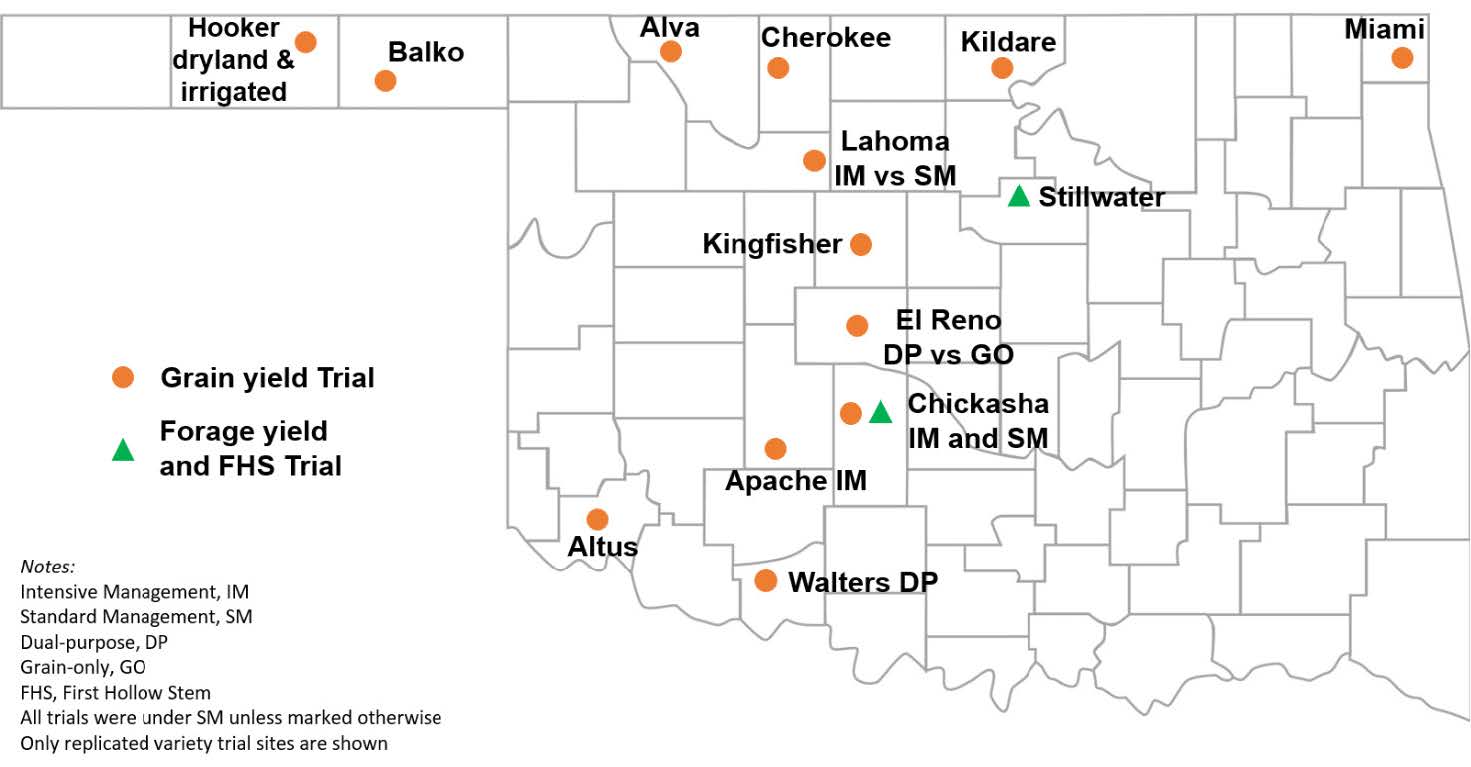
Figure 1. Performance test locations.
- Table 2. Summary of All Individual Locations part 1
- Table 3. Summary of All Individual Locations part 2
- Table 4. Altus Wheat Variety Trial
- Table 5. Alva Wheat Variety Trial
- Table 6. Apache Intensive Wheat Management Variety Trial
- Table 7. Cherokee Wheat Variety Trial
- Table 8. Chickasha Intensive Wheat Management Variety Trial
- Table 9. Chickasha Standard Wheat Management Variety Trial
- Table 10. Chickasha Wheat Management Variety Trial Standard vs. Intensive Management Comparison
- Table 11. El Reno Wheat Variety Trial Grain Only
- Table 12. El Reno Wheat Variety Trial Dual-Purpose
- Table 13. El Reno Wheat Variety Trial Grain Only vs. Dual-Purpose Management Comparison
- Table 14. Hooker Irrigated Wheat Variety Trial
- Table 15. Kildare Wheat Variety Trial
- Table 16. Kingfisher Wheat Variety Trial
- Table 17. Lahoma Standard Wheat Management Variety Trial
- Table 18. Lahoma Intensive Wheat Management Variety Trial
- Table 19. Lahoma Wheat Variety Trial Standard vs. Intensive Management Comparison
- Table 20. Miami Soft Red Winter Wheat Variety Trial
- Table 21. Walters Dual-Purpose Wheat Variety Trial
Contributors
Authors
- Amanda de Oliveira Silva | Small Grains Extension Specialist
- Tyler Lynch | Senior Agriculturalist
- Israel Molina Cyrineu | Graduate Research Assistant
- Francisco H. Aispuro Arana | Graduate Research Assistant
- Dr. Brett Carver | Wheat Breeder
- Dr. Meriem Aoun | Small Grains Pathologist
Funding Provided By
- Oklahoma Wheat Commission
- Oklahoma Wheat Research Foundation
- OSU Cooperative Extension Service
- OSU Agricultural Research
- Entry fees from participating seed companies
Area Extension Staff
- Josh Bushong | OSU Area Agronomist – Northwest District
- Raedan Sharry | OSU Area Agronomist - Southwest District
- Roy Grant | OSU Area Agronomist – Northeast District
- Alberto Amador Leal Gonzalez | OSU Area Ag Economist – West District
County Extension Staff
- Erin Metcalf | Alfalfa County Extension Educator
- Loren Sizelove | Beaver County Extension Educator
- Dakota Gardner | Caddo County Extension Educator
- Kyle Worthington | Canadian County Extension Educator
- Kimbreley Davis | Cotton County Extension Educator
- Rick Nelson | Garfield County Extension Educator
- Kelly Burrows | Grady County Extension Educator
- Halee Salmon | Jackson County Extension Educator
- MacKinzie Overman | Kay County Extension Educator
- Bryan Kennedy | Kingfisher County Extension Educator
- Lisa McBride | Texas County Extension Educator
- Katherine Hittle | Woods County Extension Educator
- Reba Palmer | Ottawa County Extension Educator
Station Superintendents/Staff
- Erich Wehrenberg | Agronomy Research Station, Stillwater, Lahoma
- David Victor | North Central Research Station, Lahoma
- Michael Pettijohn | South Central Research Station, Chickasha
- Mike Schulz, Blake Sisson, Greg Chavez | Southwest Research and Extension Center, Altus
Student Workers and Visiting Scholars
- Ana Sarah Silveira Barbosa
- Juan Bruno Bautista
- Enzo Belan
Partial financial support provided by the Oklahoma Wheat Commission and the Oklahoma Wheat Research Foundation.
Participating Seed Companies
AgriPro
Dave Abel
704 W 9th Street,
Newkirk, OK 74647
Phone: (620) 218-0848
Email: david.abel@syngenta.com
www.agriprowheat.com
Varieties: AP Prolific, AP Stocky, AP Sunbird, AP Tango, AP 24AX
AGSECO, Inc.
Jim Sipes
P.O. Box 7
12900 South Rd X, Manter, KS, 67862
Phone: (620) 493-4693
Email: jimsipes@pld.com
www.agseco.com
Varieties: AG Golden, AG Radical
CROPLAN by Winfield United
Todd Coulter/Ryan Moeller
500 North 1st street
Vincent, IA 50594
Phone: (765) 242-3161
Email: tgcoulter@landolakes.com
www.croplan.com
Varieties: CP7017 AX, CP7462, CP7869
Kansas Wheat Alliance (KWA)
Bryson Haverkamp
1990 Kimball Ave. Suite 200
Manhattan, KS 66502
Phone: (785) 320-4080
Email: kwa@kansas.net
www.kswheatalliance.org
Varieties: KS Bill Snyder, KS20HD134, KS Providence, KS Tradition, KS Territory, KS Homesteader CL+, KS170013D-19
Limagrain Cereal Seeds (LCS)
Daniel Dall
1250 N Main St.
Benton, KS 67017
Phone: (316) 452-3505
Email: daniel.dall@limagrain.com
www.limargraincerealseeds.com
Varieties: LCS Aries, LCS Caballero AX, LCS Cowie AX, LCS Gaucho CL+, LCS Highnoon, LCS Mojo, LCS Radar, LCS Troubadour AX, LCS Turnpike CL+ LCS Warbird AX
Nutrien Ag Solutions
James Gillum
3005 Rocky Mountain Ave. Loveland, CO 80538
Phone: (217) 993-1557
Email: james.gillum@nutrien.com
www.nutrienagsolutions.com
Varieties: Cavalry, Milestone, Ramsay
Oklahoma Genetics, Inc. (OGI)
Mark Hodges
201 South Range Road
Stillwater, OK 74074
Phone: (405) 744-4347
Email: hodgesm1@cox.net
www.okgenetics.com
Varieties: Bentley, Breakthrough, Butler's Gold, Doublestop CL+, Gallagher, Green Hammer, High Cotton, OK Corral, Orange Blossom CL+, Paradox, Scab Stryker, Showdown, Smith's Gold, Strad CL+, Wyatt
PlainsGold (Colorado Wheat Research Foundation)
Brad Erker/Tyler Benninghoven
4026 S. Timberline Road Suite 100
Fort Collins, CO 80525
Phone: (970) 449-6994
Email: tbenninghoven@coloradowheat.org
www.plainsgold.com
Varieties: Canvas, CO19410R, CO20022RC, Crescent AX, Kivari AX, Outlaw, Sheridan
Watley Seeds
Andy Watley
PO Box 51
Spearman, TX 79081
Email: watleyseed@valornet.com
www.watleyseed.com
Varieties : TAM 115, TAM 204
WestBred-Bayer
Lance Embree/Mark Lubbers
5014 W. 1st Ave
Stillwater, OK 74074
Phone: (316) 218-2661
Email: lance.embree@bayer.com
Email: mark.lubbers@bayer.com
www.westbred.com
Varieties: WB4347, WB4422, WB4445CLP, WB4459AX, WB4650, WB4792
Partial financial support provided by the Oklahoma Wheat Commission and the Oklahoma Wheat Research Foundation.
Figure 2. Oklahoma Wheat Commission logo.