

2024-2025 Small Grains Variety Performance Tests
Wheat Crop Overview
At the time of writing this report, 2025 Oklahoma wheat production is estimated to be approximately 107 million bushels, which is about 1% lower than 2024 production and 99% higher than 2023 production (Table 1). Approximately 4.3 million acres were planted for the 2025 crop, lower than the 2024 and 2023 crop years and the previous 10-year average. Number of harvested acres is estimated at 2.75 million, which is 4% lower than in 2024. The statewide average yield is projected at 39 bushels per acre. This is 1 bu/ac greater than the 2024 state average and 7 bu/ac greater than the previous 10-year average.
| 2023 | 2024 | 2025 | 10-year | |
|---|---|---|---|---|
| Planted area (million acres) | 4.5 | 4.4 | 4.3 | 4.7 |
| Harvested area (million acres) | 2.45 | 2.85 | 2.75 | 2.9 |
| Yield (bushels/acre) | 25 | 38 | 39 | 32 |
| Total Production (million bushels) | 54 | 108 | 107 | 93 |
Table 1. Oklahoma what production for 2023, 2024 and 2025 as estimated by USDA-National Agricultural Statistics Service, June 1, 2025.
Oklahoma’s wheat planting season was heavily impacted by severe drought. The fall season was essentially divided into two major rain events that shaped crop establishment and growth. Dual-purpose producers who planted before Sept. 22 achieved good stand establishment in early fall. Warm temperatures promoted rapid growth initially, but as drought conditions intensified — with multiple locations receiving no rainfall during October — crop health began to decline.
The next significant rain event occurred during the first week of November, almost beyond the optimal planting window in some areas. Anticipating late fall rain, many farmers chose to “dust in” their wheat ahead of the rain, while others — particularly those with hard, no-till ground—opted to wait. In early November, wheat growing regions across Oklahoma received between 1 and nearly 8 inches of rain, while the Panhandle experienced up to 20 inches of snow Nov. 5–9. These events quickly shifted conditions from extreme drought to localized flooding. Although November temperatures averaged above normal (~53°F), seeds remained in cool, wet soils for weeks, resulting in slow or failed germination. Standing water and soil crusting in some areas further contributed to plant losses. Consequently, wheat stands across the state were highly variable, some fields established well, while others remained uneven, leading to overall low fall forage production.
Wheat stands remained variable through spring. In many fields, late planting delayed growth, while some areas experienced poor germination. Very cold temperatures and snow Feb. 18–21 may have hindered tillering in late-planted wheat. Although moisture levels improved after the snow event, the crops had already suffered from a lack of moisture during a critical developmental transition period.
By April 1, moisture stress was evident. High winds and warm temperatures were taking a toll on the crop. Field conditions varied widely; some fields appeared healthy, while others were struggling. Crop stages reflected these differences with some wheat just past first hollow stem (FHS) and others yet to reach it, particularly late planted and grazed fields. Reports of brown wheat mites surfaced in southwestern Oklahoma, but most farmers opted not to spray in order to cut input costs on drought-stressed wheat. Producers were also applying fertilizer in anticipation of rain forecasted for the week.
Critically needed rainfall finally arrived in early April. The first round came with storms followed by a full day of steady, soaking precipitation. Rainfall totals varied across the state, from about 0.34 inches in parts of the Panhandle to 2–3 inches in northeastern and southwestern Oklahoma. April went on to become one of the wettest months on record. The first rain event was accompanied by freezing temperatures. Fortunately, most of the wheat was at or just past the jointing stage, which is generally more tolerant of freezing than the flowering stage. As a majority of the crop lagged in development and temperatures hovered near 29 degrees Fahrenheit across much of the state, widespread freeze injury was not observed.
April rainfall supported crop recovery and growth, and continued moisture in May was critical for carrying the crop through grain filling.
Rainfall during April and May created conditions that favored the late-season development. Leaf spotting diseases, including Septoria tritici blotch, Septoria nodorum blotch and tan spot, were observed in multiple fields statewide. Septoria tritici blotch and tan spot were primarily observed on the lower canopy, while Septoria nodorum blotch was more prominent on upper leaves and glumes. Wheat streak mosaic was also widespread and severe this season. Most symptomatic samples tested positive for wheat streak mosaic virus (WSMV) with a smaller number co-infected with both WSMV and Triticum mosaic virus.
In contrast to 2024, stripe rust incidence and severity remained low throughout the season. Leaf rust pressure remained minimal until mid-May but became significant in localized areas, particularly near Chickasha (Grady County) and Tipton (Tillman County).
During the second and third weeks of May, low levels of Fusarium head blight (FHB) were detected in variety trials at Stillwater (Payne County), Kildare (Kay County), Kingfisher (Kingfisher County) and Lahoma (Garfield County). Although the FHB Risk Tool (wheatscab.psu.edu) indicated high risk across most of Oklahoma (excluding the Panhandle) during the first week of May, no significant FHB outbreaks were reported in commercial wheat fields. Dryland root rots, Fusarium crown/root rot and common root rot were prevalent in numerous Oklahoma fields. Affected plants were stunted and white with discolored roots and lower stems. Severely infected plants died prematurely, producing white heads that were either sterile or contained shriveled grain. Dryland root rots favored by drought stress have been consistently widespread across Oklahoma for the past four growing seasons.
Frequent rains in June delayed harvest by at least two weeks in most areas with muddy field conditions causing additional delays. According to the Oklahoma Wheat Commission report, statewide grain yields ranged from the mid-40s to mid-50s bu/ac with intensively managed fields achieving 60–80 bu/ac. Test weights started strong but declined as rain delayed harvest, ranging from 58–63 pounds per bushel. The statewide average protein content was 11.2%.
Testing Methods and Data Interpretation
Testing Methods
Seed was packaged and planted in the same condition as delivered from the respective seed companies. Most seed was treated with an insecticide plus a fungicide, but the formulation and rate of seed treatment used was not confirmed or reported in this document.
Plots were seven rows wide with 7.5-inch row spacing and were sown with a Great Plains no-till drill modified for cone-seeded, small-plot research. Except for dryland locations in the Panhandle, plots were planted 25 feet long and trimmed to 19 feet at harvest with the plot combine. Panhandle dryland locations were 35 feet long at planting and trimmed to 29 feet at harvest. Wheel tracks were included in the plot area for yield calculation for a total plot width of 60 inches. The experimental design for all sites was a randomized complete block with four replicates. The intensive management trials at Apache and Lahoma received two fungicide applications and additional topdress nitrogen application in the spring and were planted on a seeds per acre basis at 1.2 million seeds per acre. Fungicide was applied at Feekes 6 (jointing) and Feekes 9 (flag leaf completely emerged). Additional information on product name, rate and date of application is included in the tables for the respective sites.
All variety trial locations were sown at 60 pounds per acre except for the dual-purpose trials at El Reno and Walters, which were sown at 120 lbs/ac. Grazing intensity, nitrogen fertilization and insect and weed control decisions were made on a location-by-location basis and reflect standard management practices for the area. In general, the spring-applied nitrogen (N) rate was calculated for a 70 bu/ac yield goal for the standard management trials and 100 bu/ac yield goal for the intensive management trials.
Plots were harvested with a Winterstieger Delta small plot combine. Grain weight, test weight, protein concentration and moisture content were collected from each plot, and grain yields and protein concentration were corrected to 12% moisture content. Grain moisture at all sites was generally below 12%, and maximum and minimum grain moisture for all plots at a location typically ranged no more than 2%.
Poor germination and uneven stands prevented harvest of the Chickasha intensive/standard management and El Reno grain-only trials, as it would compromise variety comparisons.
Data Interpretation
Yield, test weight and protein data for each location and regional summary were analyzed using the appropriate statistical methods. At the bottom of each table, the mean and least significant difference (LSD) values are reported. The LSD is a test statistic that aids in determining whether there is a true difference in yield, test weight and protein. In this report, one can be 95% confident that the difference between two varieties is real if the difference is greater than the LSD value. Data that is not significantly different is indicated by “NS”. For example, if the LSD value is 4 bu/ac in a trial where Variety A yielded 30 bu/ac and Variety B yielded 25, then Variety A would be considered to have a statistically higher yield. However, if Variety C yielded 27 bu/ac, then Variety A and Variety C would be considered to have a similar yield. In that same example trial, there is a 5% chance that the 4-bu/ ac difference between Variety A and Variety B does not truly exist, but random chance caused the 5-bushel difference. These chance factors may include differences in fertility, moisture availability and diseases. To aid in visualizing the varieties with the highest yields, test weights and proteins, values highlighted in gray do not differ statistically from the highest value within a column. The performance of a variety may vary from year-to-year, even at the same location. Tests over two or more years and over multiple locations more accurately predict the performance of a variety.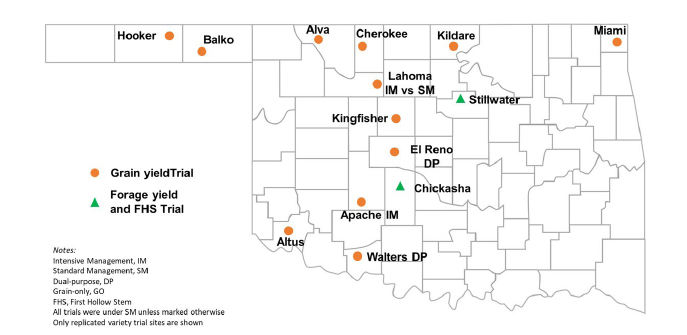
Figure 1. Performance test locations.
Additional Information on the Web
A copy of this publication as well as additional information about wheat management can be found at:
Website: www.wheat.okstate.edu
Blog: www.osuwheat.com
X: @OSU_smallgrains
Facebook: @OSU Small Grains
- Table 2. Summary of All Individual Locations part 1.
- Table 3. Summary of All Individual Locations part 2.
- Table 4. Altus Wheat Variety Trial.
- Table 5. Alva Wheat Variety Trial.
- Table 6. Apache Intensive Wheat Management Variety Trial.
- Table 7. Balko Wheat Variety Trial.
- Table 8. Cherokee Wheat Variety Trial.
- Table 9. El Reno Dual Purpose Wheat Variety Trial.
- Table 10. Hooker Wheat Variety Trial.
- Table 11. Kildare Wheat Variety Trial.
- Table 12. Kingfisher Wheat Variety Trial.
- Table 13. Lahoma Wheat Variety Trial.
- Table 14. Lahoma Intensive Wheat Management Variety Trial.
- Table 15. Lahoma Standard Vs. Intensive Management.
- Table 16. Miami Soft Wheat Variety Trial.
- Table 17. Walters Dual-Purpose Wheat Variety Trial.
- Table 18. Heading Date and Plant Height.
- Table 19. Seed Size and Seeding Rate.
Contributors
Authors
- Amanda de Oliveira Silva | Small Grains Extension Specialist
- Tyler Lynch | Senior Agriculturalist
- Israel Molina Cyrineu | Graduate Research Assistant
- Samson Abiola Olaniyi | Graduate Research Assistant
- Dr. Brett Carver | Wheat Breeder
- Dr. Meriem Aoun | Small Grains Pathologist
Funding Provided By
- Oklahoma Wheat Commission
- Oklahoma Wheat Research Foundation
- OSU Cooperative Extension Service
- OSU Agricultural Research
- Entry fees from participating seed companies
Area Extension Staff
- Brian Pugh | OSU Area Agronomist – Northeast District
- Josh Bushong | OSU Area Agronomist – Northwest District
County Extension Staff
- Erin Metcalf | Alfalfa County Extension Educator
- Loren Sizelove | Beaver County Extension Educator
- Riley Scott | Caddo County Extension Educator
- Kyle Worthington | Canadian County Extension Educator
- Kimbreley Davis | Cotton County Extension Educator
- Rick Nelson | Garfield County Extension Educator
- Kelly Burrows | Grady County Extension Educator
- MacKinze Overman | Kay County Extension Educator
- Bryan Kennedy | Kingfisher County Extension Educator
- Dr. Britt Hicks | Texas County Extension Educator & Area Extension
Livestock Specialist - Katherine Barger | Woods County Extension Educator
Station Superintendents/Staff
- Erich Wehrenberg | Agronomy Research Station, Stillwater, Lahoma
- David Victor | North Central Research Station, Lahoma
- Michael Pettijohn | South Central Research Station, Chickasha
- Mike Schulz, Blake Sisson, Greg Chavez | Southwest Research and Extension Center, Altus
Student Workers and Visiting Scholars
- Francisco H. Aispuro Arana
- Gilmar Machado
- Kenderson Gabriel G. dos Reis
- Laura Victoria Silva
- Rafael Abreu Moreira
Partial financial support provided by the Oklahoma Wheat Commission and the Oklahoma Wheat Research Foundation.
Participating Seed Companies
AgriPro
Dave Abel
704 W 9th Street,
Newkirk, OK 74647
Phone: (620) 218-0848
Email: david.abel@syngenta.com
www.agriprowheat.com
Varieties: AP Bigfoot, AP Prolific, AP Roadrunner, AP Sunbird, AP 24AX, Bob Dole, SY Wolverine
AGSECO, Inc.
Steve Ahring
P.O. Box 7
Girard, KS 66743
Phone: (620) 724-6223
Email: steve@delangeseed.com
www.agseco.com
Varieties: AG Golden, AG Radical
Armor by Winfield United
Todd Coulter/Ryan Moeller
500 North 1st street
Vincent, IA 50594
Phone: (765) 242-3161
Email: tgcoulter@landolakes.com
www.croplan.com
Varieties: AR Turret 25, AR Iron Eagle 22AX
Beck's Hybrid
Cailynn Fedorkowicz
6767 E 276th street, Atlanta, IN 46031
Phone: (302) 632-3870
Email: cailynn.fedorkowicz@beckshybrids.com
Varieties: 722, 728 (soft wheat)
CROPLAN by Winfield United
Todd Coulter/Ryan Moeller
500 North 1st street
Vincent, IA 50594
Phone: (765) 242-3161
Email: tgcoulter@landolakes.com
www.croplan.com
Varieties: CP7017 AX, CP7462, CP7869
Kansas Wheat Alliance (KWA)
Bryson Haverkamp
1990 Kimball Ave. Suite 200
Manhattan, KS 66502
Phone: (785) 320-4080
Email: kwa@kansas.net
www.kswheatalliance.org
Varieties: KS Bill Snyder, KS Mako, KS Providence, KS Territory
Limagrain Cereal Seeds (LCS)
Daniel Dall
1250 N Main St.
Benton, KS 67017
Phone: (316) 452-3505
Email: daniel.dall@limagrain.com
www.limargraincerealseeds.com
Varieties: LCS Aries, LCS Atomic AX, LCS Cowie AX LCS Helix AX, LCS Julep, LCS Radar, LCS Runner, LCS Steel AX, LCS Warbird AX
Oklahoma Genetics, Inc. (OGI)
Mark Hodges
201 South Range Road
Stillwater, OK 74074
Phone: (405) 744-4347
Email: hodgesm1@cox.net
www.okgenetics.com
Varieties: Bentley, Breakthrough, Butler's Gold, Doublestop CL+, Firebox, Gallagher, Green Hammer, High Cotton, Iba, OK Corral, Orange Blossom CL+, Paradox, Scab Stryker, Showdown, Smith's Gold, Strad CL+, Uncharted
Pioneer Seeds
Barrett Noirfalise
26528 Kafir rd, Carl Junction, MO 64834
Phone: (417) 208-7116
Email: barrett.noirfalise@pioneer.com
www.pioneer.com
Varieties: 25R65, 25R76 (soft wheat)
PlainsGold (Colorado Wheat Research Foundation)
Brad Erker/Tyler Benninghoven
4026 S. Timberline Road Suite 100
Fort Collins, CO 80525
Phone: (970) 449-6994
Email: tbenninghoven@coloradowheat.org
www.plainsgold.com
Varieties: Canvas, CO18042RA, CO19D087R, Crescent AX,
Kivari AX, Sheridan
Stockton Family Seed
Ryan Stockton
Sarcoxie, MO
Phone: (417) 439-7363
Email: RMStockton@stineisr.com
Varieties: AM513, AM514 (soft wheat from AgriMAXX)
Watley Seeds
Andy Watley
PO Box 51
Spearman, TX 79081
Email: watleyseed@valornet.com
www.watleyseed.com
Varieties : TAM 112, TAM 115, TAM 204
WestBred-Bayer
Lance Embree/Mark Lubbers
5014 W. 1st Ave
Stillwater, OK 74074
Phone: (316) 218-2661
Email: lance.embree@bayer.com
Email: mark.lubbers@bayer.com
www.westbred.com
Varieties: WB4347, WB4422, WB4445CLP, WB4792
Partial financial support provided by the Oklahoma Wheat Commission and the Oklahoma Wheat Research Foundation.
Figure 2. Oklahoma Wheat Commission logo.