

Planting Preparations, Scouting Guidance, and Integrated Pest Management Considerations for the Corn Leafhopper
Corn planting season is just around the corner for some Oklahoma growers. Here we provide an update on current corn leafhopper sightings in Texas and Oklahoma, monitoring efforts for the corn leafhopper and corn stunt symptoms, as well as integrated pest management (IPM) guidance should we see the insect in Oklahoma this year. For detailed information on the biology and behavior of the insect and details regarding the pathogens and disease please see the OSU Pest E-Alert from August 12, 2024.
Current Status of Corn Leafhopper Sightings and Monitoring
Our neighbors in Texas started planting corn earlier this month in the southern region of the state. On February 7, 2025, Texas A&M AgriLife Research and Extension reported that although a killing freeze took care of most volunteer corn, corn leafhoppers were collected from newly emerged volunteer corn in the Texas Lower Rio Grande Valley. However, corn leafhoppers have not been detected outside of this region in Texas.
Oklahoma State University (OSU) Extension has been monitoring field crop vegetation and native grasses since the 2024 harvest. Corn leafhoppers have not been detected for nearly two months by OSU Extension in Oklahoma. The freezing temperatures we have had in Oklahoma these past couple months have aided in removal of volunteer corn and likely the corn leafhoppers.
The questions many Oklahoma corn growers are asking for the 2025 season is if the corn leafhopper will move northward into the state and if so, how much ground does the insect need to cover to make it here? OSU Extension is continuing to monitor for corn leafhoppers with the help of county educators, cooperators, consultants, and industry partners.
Proper Identification of Corn Leafhoppers
There are several leafhopper species that occur in corn and other cropping systems. Some appear very similar to the corn leafhopper and many leafhopper species can only be differentiated by male genitalia. Growers and consultants are encouraged to verify corn leafhopper identifications with a trained entomologist. In general, corn leafhoppers are very small (~1/8”), yellow to light tan, and have two dark spots between their eyes. These spots can be challenging to see without a hand lens or scope and these spots are not unique to corn leafhoppers. If you see and collect a leafhopper that looks similar in appearance to the one below (Picture 1), contact Dr. Ashleigh Faris, OSU Extension Field Crop Entomologist, so that the species identity can be confirmed.
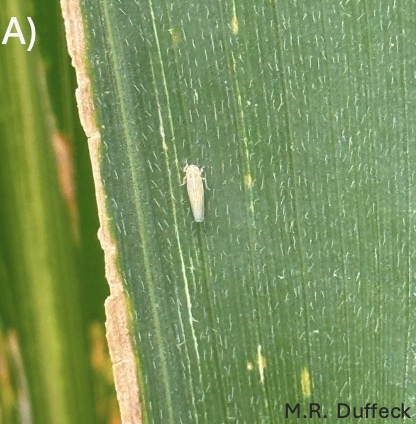
Figure 1A.
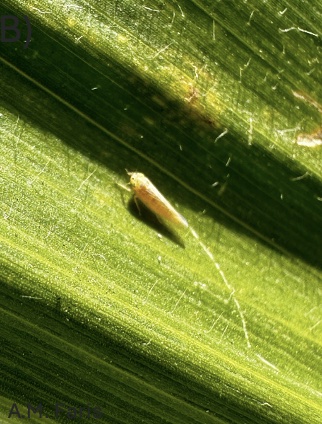
Figure 1B.
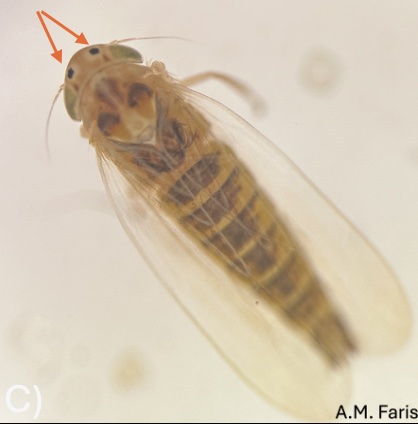
Figure 1C.
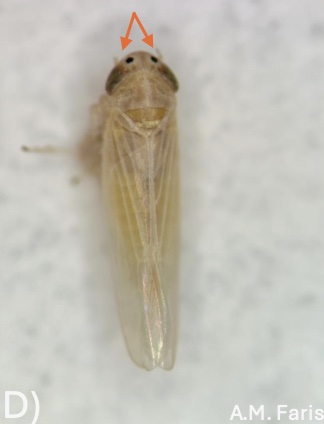
Figure 1D.
Picture 1. A & B) Corn leafhoppers on corn leaves in the field. C & D) Corn leafhoppers photographed under a microscope. Arrows point at the two dark spots located between the eyes, these spots are not unique to corn leafhoppers.
Scouting for the Corn Leafhopper & Reporting Sightings
Growers should scout corn fields for the corn leafhopper at VE if not using a high insecticide seed treatment. If using a high insecticide seed treatment, scouting should begin at the V1-V2 growth stage. Scouting should continue through V8, as infection by corn stunt pathogens after this stage is less likely to impact yield. Active scouting is encouraged as corn leafhoppers will reside in the whorls of corn plants; using a handheld vacuum with a clear canister is effective for scouting whorls (Picture 2A). Place the vacuum nozzle over the whorl and turn on the vacuum for several seconds. Repeat this at random locations on the field border and into the field, approximately 2-3 minutes per field. To retain sampled insects and use one vacuum to scout multiple fields, the vacuum can be modified with panty hose/stockings. Cut a section of the stockings to create a tube, then tie one end of the hose closed and place the open end between the nozzle and the canister so that insects are collected in the stocking tube. When finished scouting, carefully remove the nozzle, tie up the open end of the tube and place in the freezer to kill the insects. Once the insects are dead, the tube can be untied and insects can be viewed to determine if corn leafhoppers were collected.
Another monitoring option is yellow stickycards (no bait or attractant) which can be attached to wooden stakes and placed at field borders (Picture 2B). Yellow is an attractive color for many leafhopper species and these traps are inexpensive, they can be purchased from Home Depot and Amazon. If leafhoppers are collected, carefully remove the trap from the stake, place it in a gallon ziploc bag, and contact Dr. Faris for corn leafhopper identification confirmation.
If you collect leafhoppers that you suspect are corn leafhoppers, contact Dr. Ashleigh Faris, OSU Extension Field Crop Entomologist, so that their identity can be confirmed.
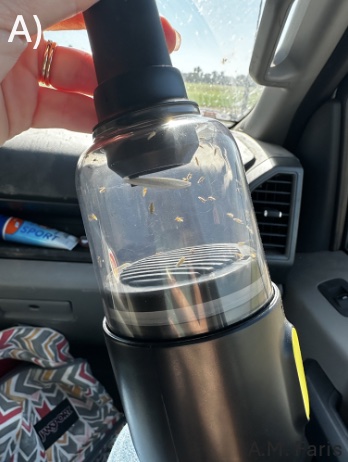
Figure 2A.
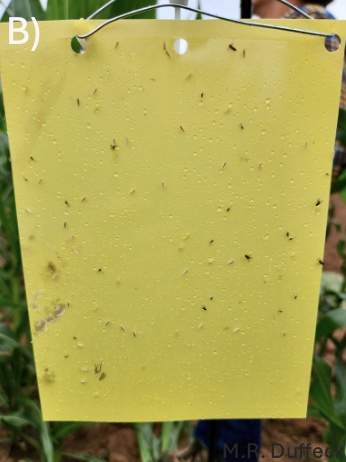
Figure 2B.
Picture 2. A) Handheld vacuum with clear canister for scouting corn leafhoppers in corn plant whorls. The vacuum can be modified with stocking hose so multiple fields can be scouted with a single vacuum. B) Yellow stickycard placed at field border to aid in corn leahopper monitoring. For emerging and vegetative corn growth stages, adjust height of the stickycard to the corn.
IPM Guidance for Corn Planting & Chemical Control Options for the Corn Leafhopper
Pre-planting and planting: There are currently no known corn hybrids that are resistant to corn stunt disease available on the U.S. market. In areas where volunteer corn is present, growers should remove it as this vegetation serves as a reproductive resource for the insect and a potential reservoir for corn stunt pathogens. When possible, growers are encouraged to plant corn early, as this will help reduce the likelihood of corn being planted when corn leafhoppers are present. At planting, growers should use a high insecticide seed treatment containing Cruiser® Corn 1250 or Poncho®1250 to allow for protection until V3.
Scout for corn leafhopper from emergence through V8: Follow the guidance outlined above to scout for the corn leafhopper. Due to the efficiency of the corn leafhopper to transmit pathogens associated with corn stunt disease, there is no economic threshold. Growers are encouraged to apply an insecticide when corn leafhoppers are detected in the field.
Chemical control options: There are insecticides labelled for leafhoppers in corn. However, the efficacy and residual control of these products on corn leafhoppers in the U.S. is unknown. A laboratory-based leaf dip assay conducted by OSU Extension Specialists Ashleigh Faris and Kelly Seuhs assessed the knockdown toxicity of several of these products on corn leafhoppers. Corn leafhoppers placed on leaves treated with products with the active ingredients dimethoate, flupyradifurone, bifenthrin, zeta-cypermethrin, sulfloxaflor, lambda-cyhalothrin, and bifenthrin all exhibited mortality. In the 2024 growing season, TAMU AgriLife conducted efficacy trials where pyrethroids bifenthrin and lambda-cyhalothrin provided excellent control for at least 7 days, and dimethoate was reported to provide good control. They also reported that an anecdotal evaluation of a Sivanto® Prime application suggests that it has very good activity as well.
Growers should be cautious when applying a pyrethroid such as bifenthrin, due to the potential for flaring spider mites. Similar caution should be paid for dimethoate and chlorpyrifos applications, although to a lesser extent. When selecting an insecticide, choose one that is not broad-spectrum and that is soft on beneficials to preserve natural control of arthropod pests. Always read and follow the guidelines provided on the insecticide label, the label is the law. Only apply insecticides when the corn leafhopper is confirmed to be present in the field you are treating. There is evidence of some insecticide resistance for corn leafhopper populations in Brazil and Argentina. Being a good steward of the chemistries we have available and applying insecticides only when needed and based on the label guidelines is key to preventing contributions to insecticide tolerance and resistance.