

Pull Factors: A Measure of Retail Sales Success Estimates for 77 Oklahoma Cities (2024 Edition)
Introduction
Whether people live in a small town or a major metropolitan area, they have the power to spend their money where they choose. This notion is very important to most cities, since many local government services (police, fire, parks and recreation) depend heavily on tax revenue from local retail sales (Semuels, 2017). It is helpful for cities to know the relative health of their retail sector – and in particular, if they are losing retail dollars when local residents shop elsewhere. To assess this, a calculation known as a pull factor is typically used. A pull factor is a measure of how well local retail stores are able to capture the sales of local and non-local people (see box). Because it compares actual retail spending in a city to that city’s population, it can be used to assess whether people are coming into the community to shop – or if people are leaving the community to shop elsewhere. Shopping online can also have repercussions for sales tax collections. Businesses currently only collect sales tax for online trans- actions in states where they have a presence (Whitacre, Ferrell and Hobbs, 2009); however, a 2018 Supreme Court decision has cleared the way for more taxation of online purchases (Liptak et al., 2018). This can impact the amount of revenue that local governments receive.
What is a Pull Factor?
Pull factors measure the relative strength of a city’s ability to attract retail shoppers. They are a quantitative measure of how the retail trade sector of a community is performing, put into an easily interpretable number.
Interpreting a Pull Factor
- PF < 1: The city is losing local retail shoppers to other areas
- PF = 1: The city is capturing retail shopping activity exactly equal to its population
- PF > 1: The city is attracting non-resident retail shoppers (in addition to its own population)
A pull factor of 1.25 would indicate that the retail sector is attracting non-resident consumers equal to 25% of the city’s population.
Pull factor analysis is important because it puts the health of the retail sector into a number that is easy to interpret. For example, if a city has a pull factor of less than 1, it is not capturing the retail sale expenditures of the local residents. In this case, retail spending is leaking out of the city and being spent in other locations. In contrast, a city with a pull factor of greater than 1 is capturing the entire expected retail sale spending of local residents - plus some extra. Pull factors can be used as indicators of the relative health of a community’s retail sector.
Typically, big cities such as Tulsa have pull factors greater than 1 because they have an abundant number of retail stores with a variety of goods to offer. Because of this, these cities typically capture the leakage from nearby smaller cities, which have fewer stores and often see residents leave to shop in the bigger city markets. These smaller cities - such as Sperry (population 1,206) - usually have pull factors of less than 1, because the city’s retail sector is smaller and generally struggles to keep all the spending within the city limits. Not only do these cities have a smaller retail sector, but they generally do not have the diversity and abundance of products that people want in their town. The retail sector is driven by population and disposable income, and a smaller population may not be able to support the volume of sales necessary for some types of goods and services. However, it is possible for some smaller cities to have strong pull factors – in particular if they serve as hubs for surrounding rural areas, and are relatively distant from larger towns with more developed retail sectors. This report discusses how pull factors are calculated (and details the websites where the required data is available) and constructs them for the largest city in each of Oklahoma’s 77 counties using data from 2024.
It is possible to calculate pull factors for counties (as opposed to cities); however this publication concentrates on cities because the decision to go shopping is typically focused on a particular location with specific stores or amenities in mind. The city-level measures detailed here help provide a basic overview of how the largest town in each county is performing in terms of retail activity. Furthermore, the largest county in the state, Oklahoma County, does not collect a sales tax.
Data and Methodology
The data that goes into the city pull factor calculation includes city and state-level per capita income (PCI), population, tax rate and total retail sales collected (see box below). There are two main websites used to gather this data. The population and PCI data (for both the city and the state) can be found on the United States Census website. The link in the box can be used for all cities with populations greater than 5,000. For smaller cities, the information can be found with the Census’ American Factfinder tool. The PCI data is taken from the American Community Survey table B19301. The PCI is on a moving average over the past 5 years (for example, 2019-2023). Since this is the case, it is not as accurate as an annual estimate – but is typically the best source available. The population measures for this report are also taken from the same American Community Survey, table B01003. Yearly updates are available for cities using the Census’ annual population estimates. Meanwhile, the tax rate and sales tax collections can be found on the Oklahoma Tax Commission website (again, for both the individual city and the state total). Using the OK Tax Commission link in the box, users should select View Public Reports and then Tax by NAICS Report before selecting the information (tax type, city, date) they are interested in. Note that the Tax Commission’s reports are broken out by North American Industrial Classification System (NAICS) codes, and that codes 44-45 represent the retail sector. Sales tax is collected on other sectors within a city as well, such as entertainment, recreation and food services. These are an import- ant part of the health of a city. However, this fact sheet only focuses on the predefined retail sector (NAICS codes 44-45) and the sales that storefront businesses collect. The numbers available from this system, for these specific NAICS codes, represent the retail sales taxes collected by a city. To get the total amount of retail sales in a city, the total amount of retail sales sector tax collections should be divided by the city sales tax rate (which is also available from the Tax Commission’s site). For this analysis, the June 2024 numbers were used, since they contain a full year of data on retail sales tax collections. A step-by-step guide for constructing a city-level Pull Factor is available in Shideler and Malone (2017).
As the formula in the box shows, all of this information is combined to calculate a Trade Area Capture (TAC) which is an estimate of the number of shoppers the retail area attracts for a given year. A PCI ratio is used in the denominator to adjust for income levels in the city versus the state. If the city PCI is above average, it requires the numerator to be larger in order to keep a positive pull factor. This feeds into the idea that retail sales are a factor of population and the disposable income of the residents. Finally, the pull factor is calculated by dividing the TAC by the overall population of the city. The pull factor indicates whether the retail market attracts non-local customers (i.e. has a value > 1.0) or loses local customers (i.e. has a value < 1.0).
The Pull Factor Formula (and Online Data Sources)
Pull factors are based on a measure of “Trade Area Capture” (TAC) which estimates the total number of shoppers an area attracts. The TAC is then divided by the city’s population to get the Pull Factor.
![Caculated TAC = RS / ( [RS_state / P_State] x [PCI / PCI_state ] ) ; Pull factor = ( Trade Area Capture ) / (Population )](https://extension.okstate.edu/fact-sheets/images/pull-factors-a-measure-of-retail-sales-success-estimates-for-77-oklahoma-cities/agec-1079.png "agec-1079.png")
Variable Included
RS: Retail sales tax collections (city level)
RSState: Retail sales tax collections (state level)
Available from: OK Tax Commission Public Reports
P: Population (city level)
PState: Population (state level)
PCI: Per capita income (city level)
PCIState: Per capita income (state level)
Available from: Census Quickfacts Website
2024 City-level Pull Factor
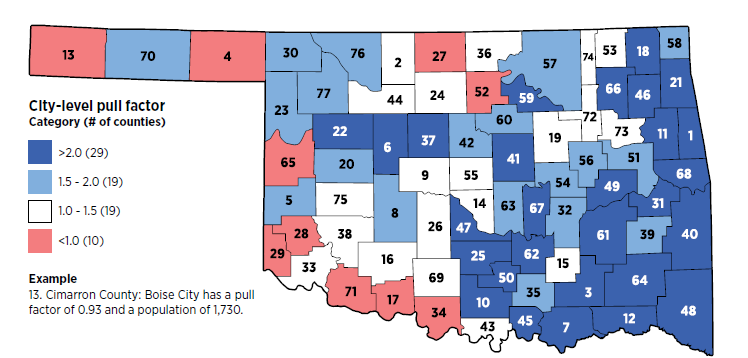
Figure 1. City-level pull factors for the largest town in each Oklahoma county (2024).
County: City, city-level pull factor (2024) | populations in thousands (2023)
- Adair: Stillwell, 3.72 | 3.74
- Alfalfa: Cherokee, 1.07 | 1.32
- Atoka: Atoka, 4.03 | 2.92
- Beaver: Beaver, 0.89 | 1.63
- Beckham: Elk City, 1.78 | 14.10
- Blaine: Watonga, 2.30 | 2.63
- Bryan: Durant, 2.28 | 19.21
- Caddo: Anadarko, 1.83 | 5.63
- Canadian: El Reno, 1.25 | 17.92
- Carter: Ardmore, 2.23 | 24.67
- Cherokee: Tahlequah, 2.19 | 16.51
- Choctaw: Hugo, 3.30 | 5.18
- Cimarron: Boise City, 0.93 | 1.73
- Cleveland: Norman, 1.05 | 128.71
- Coal: Coalgate, 1.12 | 1.92
- Comanche: Lawton, 1.26 | 90.66
- Cotton: Walters, 0.96 | 2.17
- Craig: Vinita, 2.93 | 5.23
- Creek: Sapulpa, 1.14 | 22.27
- Custer: Weatherford, 1.81 | 12.01
- Delaware: Grove, 2.53 | 7.10
- Dewey: Seiling, 2.53 | 0.86
- Ellis: Shattuck, 1.62 | 1.19
- Garfield: Enid, 1.34 | 50.82
- Garvin: Pauls Valley, 2.78 | 6.03
- Grady: Chickasha, 1.44 | 16.35
- Grant: Medford, 0.68 | 1.01
- Greer: Mangum, 0.69 | 2.76
- Harmon: Hollis, 0.68 | 1.67
- Harper: Laverne, 1.56 | 1.05
- Haskell: Stigler, 3.60 | 2.70
- Hughes: Holdenville, 1.58 | 5.92
- Jackson: Altus, 1.22 | 18.67
- Jefferson: Waurika, 0.89 | 1.63
- Johnston: Tishomingo, 1.64 | 3.10
- Kay: Ponca City, 1.27 | 27.81
- Kingfisher: Kingfisher, 2.00 | 4.96
- Kiowa: Hobart, 1.42 | 3.38
- Latimer: Wilburton, 1.83 | 2.86
- Le Flore: Poteau, 3.00 | 8.90
- Lincoln: Chandler, 3.74 | 2.89
- Logan: Guthrie, 1.81 | 11.02
- Love: Marietta, 1.30 | 2.84
- Major: Fairview, 1.26 | 2.70
- Marshall: Madill, 4.35 | 3.97
- Mayes: Pryor Creek, 2.67 | 9.52
- McClain: Purcell, 2.01 | 6.72
- McCurtain: Idabel, 2.84 | 6.96
- McIntosh: Eufaula, 2.80 | 2.80
- Murray: Suphur, 2.43 | 4.90
- Muskogee: Muskogee, 1.20 | 36.87
- Noble: Perry, 0.92 | 4.47
- Nowata: Nowata, 1.10 | 3.52
- Okfuskee: Okemah, 1.85 | 3.06
- Oklahoma: Oklahoma City, 1.04 | 702.76
- Okmulgee: Okmulgee, 1.59 | 11.37
- Osage: Pawhuska, 1.61 | 2.98
- Ottawa: Miami, 1.97 | 12.96
- Pawnee: Cleveland, 2.55 | 3.21
- Payne: Stillwater, 1.76 | 48.82
- Pittsburg: McAlester, 2.35 | 18.10
- Pontotoc: Ada, 2.35 | 16.54
- Pottawatomie: Shawnee, 1.89 | 31.51
- Pushmataha: Antlers, 2.49 | 2.34
- Roger Mills: Cheyenne, 0.85 | 0.84
- Rogers: Claremore, 2.05 | 19.92
- Seminole: Seminole, 3.07 | 7.16
- Sequoyah: Sallisaw, 2.52 | 8.55
- Stephens: Duncan, 1.44 | 22.87
- Texas: Guymon, 1.70 | 12.60
- Tillman: Frederick, 0.68 | 3.46
- Tulsa: Tulsa, 1.28 | 12.32
- Wagoner: Coweta, 1.45 | 10.16
- Washington: Bartlesville, 1.20 | 37.56
- Washita: Cordell, 1.01 | 2.74
- Woods: Alva, 1.75 | 5.00
- Woodward: Woodward, 1.94 | 11.98
2016 City-level Pull Factor
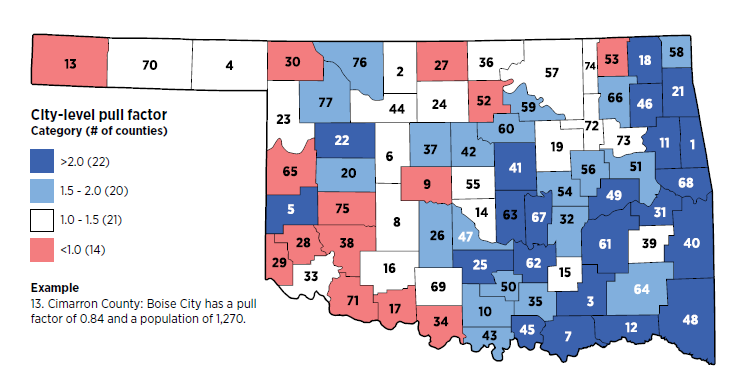
Figure 2. City-level pull factors for the largest town in each Oklahoma county (2016).
County: City, city-level pull factor (2016) | populations in thousands (2016)
- Adair: Stillwell, 3.20 | 4.02
- Alfalfa: Cherokee, 1.18 | 1.52
- Atoka: Atoka, 4.01 | 3.08
- Beaver: Beaver, 1.20 | 1.45
- Beckham: Elk City, 2.00 | 11.99
- Blaine: Watonga, 1.24 | 3.92
- Bryan: Durant, 2.28 | 17.59
- Caddo: Anadarko, 1.25 | 6.77
- Canadian: El Reno, 0.92 | 18.79
- Carter: Ardmore, 1.88 | 25.11
- Cherokee: Tahlequah, 2.35 | 16.74
- Choctaw: Hugo, 2.74 | 5.26
- Cimarron: Boise City, 0.84 | 1.27
- Cleveland: Norman, 1.10 | 122.18
- Coal: Coalgate, 1.18 | 2.12
- Comanche: Lawton, 1.23 | 94.63
- Cotton: Walters, 0.64 | 2.85
- Craig: Vinita, 2.45 | 5.56
- Creek: Sapulpa, 1.37 | 20.92
- Custer: Weatherford, 1.88 | 11.98
- Delaware: Grove, 2.56 | 6.83
- Dewey: Seiling, 2.41 | 0.66
- Ellis: Shattuck, 1.05 | 1.25
- Garfield: Enid, 1.48 | 51.00
- Garvin: Pauls Valley, 2.41 | 6.21
- Grady: Chickasha, 1.55 | 16.42
- Grant: Medford, 0.78 | 1.02
- Greer: Mangum, 0.69 | 2.92
- Harmon: Hollis, 0.80 | 1.96
- Harper: Laverne, 0.76 | 1.34
- Haskell: Stigler, 3.44 | 2.74
- Hughes: Holdenville, 1.56 | 5.68
- Jackson: Altus, 1.38 | 19.42
- Jefferson: Waurika, 0.81 | 2.10
- Johnston: Tishomingo, 1.79 | 3.08
- Kay: Ponca City, 1.49 | 24.53
- Kingfisher: Kingfisher, 1.75 | 4.78
- Kiowa: Hobart, 0.89 | 3.67
- Latimer: Wilburton, 1.47 | 2.72
- Le Flore: Poteau, 2.48 | 8.59
- Lincoln: Chandler, 2.80 | 3.13
- Logan: Guthrie, 1.51 | 11.49
- Love: Marietta, 1.76 | 2.71
- Major: Fairview, 1.24 | 2.63
- Marshall: Madill, 2.93 | 3.86
- Mayes: Pryor Creek, 2.30 | 9.52
- McClain: Purcell, 1.91 | 6.44
- McCurtain: Idabel, 2.25 | 7.01
- McIntosh: Eufaula, 2.18 | 2.93
- Murray: Suphur, 1.78 | 5.04
- Muskogee: Muskogee, 1.79 | 38.35
- Noble: Perry, 0.81 | 5.06
- Nowata: Nowata, 0.78 | 3.72
- Okfuskee: Okemah, 1.61 | 3.26
- Oklahoma: Oklahoma City, 1.15 | 638.37
- Okmulgee: Okmulgee, 1.72 | 12.24
- Osage: Pawhuska, 1.00 | 3.52
- Ottawa: Miami, 1.61 | 13.48
- Pawnee: Cleveland, 1.99 | 3.22
- Payne: Stillwater, 1.72 | 49.50
- Pittsburg: McAlester, 2.29 | 18.21
- Pontotoc: Ada, 2.30 | 17.37
- Pottawatomie: Shawnee, 2.07 | 31.47
- Pushmataha: Antlers, 1.98 | 2.55
- Roger Mills: Cheyenne, 0.91 | 0.83
- Rogers: Claremore, 1.99 | 19.07
- Seminole: Seminole, 2.16 | 7.42
- Sequoyah: Sallisaw, 2.19 | 8.60
- Stephens: Duncan, 1.44 | 22.98
- Texas: Guymon, 1.48 | 21.83
- Tillman: Frederick, 0.65 | 3.74
- Tulsa: Tulsa, 1.37 | 403.09
- Wagoner: Coweta, 1.41 | 9.67
- Washington: Bartlesville, 1.21 | 36.65
- Washita: Cordell, 0.69 | 2.90
- Woods: Alva, 1.56 | 5.12
- Woodward: Woodward, 1.99 | 12.54
Pull Factors for 77 Oklahoma Cities (2024 Data)
This report calculates city-level pull factors for the largest city in each Oklahoma county, using the most recent data available (2024) (Figure 1). The city population is also listed. The county containing each city displays a color corresponding to four levels of city pull factors, ranging from the highest (over 2.0) to the lowest (less than 1.0). Table 1 displays the relevant information for each of the 77 cities, by population category.
Discussion
Since each city displayed in Figure 1 was selected because it was the largest in its county, it probably has a stronger retail sector than many surrounding, smaller towns – and likely captures shoppers from those areas. Thus, only a small portion of the cities listed have a pull factor of less than 1. Most of the cities with pull factors less than 1 are found in the western half of the state, with quite a few in the southwestern quadrant. Many of these towns have less than 3,000 people and are within driving distance of larger cities (Cheyenne (Elk City), Mangum (Altus), Walters (Lawton) and Waurika (Weatherford). Alternatively, in the southeast quadrant, the largest cities in most counties have relatively strong pull factors (> 2). This may be because they are further away from larger cities (or with less direct routes to alternative shopping locations), and have developed retail sectors that cater to the needs of local residents and those living in the nearby towns. These southeastern towns are also generally larger in population (none are smaller than 1,000) compared to the southwestern cities noted above.
The three largest cities in the state have pull factors only slightly larger than 1 (Oklahoma City – 1.04; Tulsa – 1.28, Norman- 1.05). This still reflects the fact that they are able to attract non-locals to shop there – and in some ways masks how popular their retail sectors actually are. In Tulsa, for instance, the pull factor of 1.28 indicates that the local retail sector is not only capturing the expected shopping of the 412,000 residents, but also 115,360 non-residents (412,000 * 0.28). That is a sizeable portion of the surrounding counties! Thus, they are likely capturing many shoppers from neighboring cities like Bixby and Owasso, as well as counties like Creek, Rogers and Wagoner. Similarly, Oklahoma City's pull factor of 1.04 suggests that it is capturing an additional 28,110 shoppers on top of its 702,760 population 702,760 * 0.04 = 28,110). This is a significant segment of neighboring counties like Logan, Kingfisher and Lincoln.
Table 1 demonstrates that pull factors can vary widely across cities that have similar populations. For instance, Seiling and Cheyenne both have around 850 people, but Seiling's pull factor is over twice that of Cheyenne. This may be due to Seiling capturing sales to small nearby communities like Taloga (pop. 303) and several unincorporated areas (Chester, Orion, Bado). Alternatively, Cheyenne does not have as many surrounding rural towns that might support their retail sector. In the same manner, Perry and Sulphur are both around 5,000 in population, but the pull factor for Perry (which is within driving distance of Stillwater) is less than half that of Sulphur's. This is true in larger towns as well: Claremore (population 19,069) has a pull factor of 2.05, while El Reno (population 18,786) has a pull factor of only 1.25 – likely due to El Reno's proximity to the OKC metropolitan area. These differences are largely dependent upon the types of amenities available in or near the communities. For example, Sulphur is located just outside of the Chickasaw National Forest, is 3 miles from the Chickasaw Cultural Center, and is home to the Chickasaw Nation's Artesian Hotel, Casino and ARTesian Gallery and Studios. Similarly, Claremore is home to Rogers State College and the Claremore Expo Center, both of which bring numerous visitors to town for special events.
An earlier version of this fact sheet was published using data from 2016 (Figure 2). Comparing a city's pull factor over time demonstrates that these values can rise or fall – but that large shifts are rare. In fact, for cities over 20,000 population, the average change in pull factor between 2016 and 2024 was only -0.03. However, bigger shifts can happen: the pull factor in Madill (pop. 3,966) rose from 2.93 to 4.35 during this time, perhaps partially due to the legalization of medical marijuana in 2018 and the city's proximity to the Texas border (Cruikshank and Whitacre, 2024). Similarly, Watonga (pop. 2,633) saw their pull factor rise from 1.24 to 2.30, perhaps due to the increasing popularity of nearby Roman Nose State Park.
Conclusion
While the pull factor is an easy way for communities to measure the retail trade in their communities, it does have some limitations. First, it can leave communities wanting in terms of policy prescriptions; that is to say, how does one increase the pull factor in his/her community? While the answer is to increase retail sales, how one goes about doing that without an influx of population, income or new attraction in town is difficult to determine. Shopping patterns and trends are also determined by other factors, such as commuting patterns to employment centers and life stages, which many communities also feel to be beyond their control. Second, retail leakage does not automatically equate to a business opportunity; there may be insufficient demand in a community (either due to lack of population or preferences), such that it makes sense for residents to purchase goods and services elsewhere. It is recommended, then, that the community using pull factors also conduct additional analysis, such as population thresholds or gap analysis (which uses pull factor analysis for each individual sector rather than all retail (Shideler and Malone, 2017)). Such analysis provides a better sense of which sectors might actually present opportunities for a viable business.
| FIPS Code | County | City | PCI (2023) | Population (2023) | Tax rate (2024) | Retail sales ($) (2024) | Trade area captured | Pull factor |
|---|---|---|---|---|---|---|---|---|
| 40129 | Roger Mills | Cheyenne | 31,021 | 837 | 0.03 | 5,698,372.00 | 712.33 | 0.85 |
| 40043 | Dewey | Seiling | 28,110 | 863 | 0.04 | 15,828,235,25 | 2,183.51 | 2.53 |
| 40053 | Grant | Medford | 29,440 | 1,014 | 0.04 | 5,220,607.00 | 687.65 | 0.68 |
| 40059 | Harper | Laverne | 22,756 | 1,050 | 0.0325 | 9,615,316.92 | 1,638.52 | 1.56 |
| 40045 | Ellis | Shattuck | 27,421 | 1,185 | 0.04 | 13,559,942.75 | 1,917.60 | 1.62 |
| 40003 | Alfalfa | Cherokee | 32,248 | 1,319 | 0.0325 | 11,719,957.54 | 1,409.31 | 1.07 |
| 40007 | Beaver | Beaver | 26,003 | 1,625 | 0.03 | 9,646,030.67 | 1,438.50 | 0.89 |
| 40057 | Harmon | Hollis | 24,901 | 1,674 | 0.03 | 7,345,705.67 | 1,143.93 | 0.68 |
| 40025 | Cimarron | Boise City | 25,963 | 1,729 | 0.03 | 9,302,324.00 | 1,617.31 | 0.88 |
| 40067 | Jefferson | Waurika | 22,304 | 1,847 | 0.03 | 9,302,324.00 | 1,617.31 | 0.88 |
| 40029 | Coal | Coalgate | 24,509 | 1,919 | 0.03 | 13,622,862.00 | 2,155.40 | 1.12 |
| FIPS Code | County | City | PCI (2023) | Population (2023) | Tax rate (2024) | Retail sales ($) (2024) | Trade area captured | Pull factor |
|---|---|---|---|---|---|---|---|---|
| 40033 | Cotton | Walters | 25,282 | 2,173 | 0.03 | 13,622,000.33 | 2,089.36 | 0.96 |
| 40127 | Pushmataha | Antlers | 20,117 | 2,341 | 0.035 | 30,256,797.14 | 5,832.36 | 2.49 |
| 40011 | Blaine | Watonga | 16,741 | 2,633 | 0.06 | 26,144,257.50 | 6,055.91 | 2.30 |
| 40093 | Major | Fairview | 28,520 | 2,699 | 0.04 | 25,092,712.50 | 3,411.79 | 1.26 |
| 40061 | Haskell | Stigler | 23,057 | 2,702 | 0.035 | 57,774,197.71 | 9,716.63 | 3.60 |
| 40149 | Washita | Cordell | 26,684 | 2,743 | 0.04 | 19,014,373.25 | 2,763.22 | 1.01 |
| 40055 | Greer | Mangum | 23,538 | 2,759 | 0.03 | 11,514,873.67 | 1,897.03 | 0.69 |
| 40091 | McIntosh | Eufaula | 23,050 | 2,783 | 0.035 | 46,258,700.86 | 7,782.28 | 2.80 |
| 40085 | Love | Marietta | 21,904 | 2,837 | 0.03 | 20,787,525.67 | 3,680.13 | 1.30 |
| 40077 | Latimer | Wilburton | 19,473 | 2,861 | 0.035 | 26,247,685.14 | 5,226.88 | 1.83 |
| 40081 | Lincoln | Chandler | 27,703 | 2,893 | 0.04 | 77,233,436.50 | 10,810.93 | 3.74 |
| 40005 | Atoka | Atoka | 25,392 | 2,918 | 0.04 | 77,012,128.25 | 11,761.06 | 4.03 |
| 40113 | Osage | Pawhuska | 25,503 | 2,984 | 0.04 | 31,606,441.75 | 4,805.83 | 1.61 |
| FIPS Code | County | City | PCI (2023) | Population (2023) | Tax rate (2024) | Retail sales ($) (2024) | Trade area captured | Pull factor |
|---|---|---|---|---|---|---|---|---|
| 40107 | Okfuskee | Okemah | 18,300 | 3,058 | 0.035 | 26,654,414.57 | 5,648.10 | 1.85 |
| 40069 | Johnston | Tishomingo | 19,302 | 3,097 | 0.03 | 25,287,833.00 | 5,080.35 | 1.64 |
| 40117 | Pawnee | Cleveland | 26,336 | 3,208 | 0.035 | 55,630,237.14 | 8,191.16 | 2.55 |
| 40075 | Kiowa | Hobart | 20,000 | 3,378 | 0.04 | 24,758,548.50 | 4,800.42 | 1.42 |
| 40141 | Tillman | Frederick | 23,025 | 3,460 | 0.035 | 14,014,490.57 | 2,360.27 | 0.68 |
| 40105 | Nowata | Nowata | 24,448 | 3,522 | 0.03 | 24,432,645.33 | 3,875.36 | 1.10 |
| 40001 | Adair | Stilwell | 17,016 | 3,740 | 0.04 | 61,108,784.25 | 13,926.13 | 3.72 |
| 40095 | Marshall | Madill | 20,501 | 3,966 | 0.03 | 91,157,195.67 | 17,242.50 | 4.35 |
| 40103 | Noble | Perry | 32,537 | 4,471 | 0.0425 | 34,655,037.65 | 4,130.22 | 0.92 |
| 40099 | Murray | Sulphur | 27,375 | 4,900 | 0.03 | 83,963,374.33 | 11,893.79 | 2.43 |
| 40073 | Kingfisher | Kingfisher | 32,085 | 4,964 | 0.035 | 82,205,509.43 | 9,935.35 | 2.00 |
| FIPS Code | County | City | PCI (2023) | Population (2023) | Tax rate (2024) | Retail sales ($) (2024) | Trade area captured | Pull factor |
|---|---|---|---|---|---|---|---|---|
| 40151 | Woods | Alva | 27,603 | 5,009 | 0.0425 | 62,535,351.76 | 8,785.24 | 1.75 |
| 40023 | Choctaw | Hugo | 19,767 | 5,184 | 0.035 | 87,102,696.57 | 17,087.37 | 3.30 |
| 40035 | Craig | Vinita | 22,195 | 5,229 | 0.03 | 87,734,646.33 | 15,328.52 | 2.93 |
| 40015 | Caddo | Anadarko | 21,630 | 5,627 | 0.035 | 57,507,025.14 | 10,309.76 | 1.83 |
| 40063 | Hughes | Holdenville | 15,425 | 5,916 | 0.05 | 37,283,218.80 | 9,372.87 | 1.58 |
| 40049 | Garvin | Pauls Valley | 26,135 | 6,031 | 0.045 | 113,092,748.00 | 16,780.18 | 2.78 |
| 40087 | McClain | Purcell | 26,609 | 6,716 | 0.05 | 103,199,892.80 | 13,515.74 | 2.01 |
| 40089 | McCurtain | Idabel | 20,861 | 6,959 | 0.04 | 106,171,139.50 | 19,735.84 | 2.84 |
| FIPS Code | County | City | PCI (2023) | Population (2023) | Tax rate (2024) | Retail sales ($) (2024) | Trade area captured | Pull factor |
|---|---|---|---|---|---|---|---|---|
| 40041 | Delaware | Grove | 38,751 | 7,101 | 0.04 | 179,189,135.00 | 17,931.36 | 2.53 |
| 40133 | Seminole | Seminole | 20,048 | 7,161 | 0.04 | 113,837,535.25 | 22,019.06 | 3.07 |
| 40135 | Sequoyah | Sallisaw | 23,443 | 8,553 | 0.04 | 130,304,522.75 | 21,554.14 | 2.52 |
| 40079 | Le Flore | Poteau | 23,433 | 8,903 | 0.03 | 161,607,950.00 | 26,743.56 | 3.00 |
| 40097 | Mayes | Pryor Creek | 26,008 | 9,520 | 0.04 | 170,443,853.50 | 25,413.16 | 2.67 |
| FIPS Code | County | City | PCI (2023) | Population (2023) | Tax rate (2024) | Retail sales ($) (2024) | Trade area captured | Pull factor |
|---|---|---|---|---|---|---|---|---|
| 40145 | Wagoner | Coweta | 33,373 | 10,157 | 0.04 | 126,378,593.75 | 14,684.62 | 1.45 |
| 40083 | Logan | Guthrie | 27,981 | 11,021 | 0.0375 | 143,619,643.47 | 19,903.75 | 1.81 |
| 40111 | Okmulgee | Okmulgee | 28,980 | 11,370 | 0.04 | 135,146,159.00 | 18,083.80 | 1.59 |
| 40153 | Woodward | Woodward | 35,404 | 11,976 | 0.04 | 211,646,272.00 | 23,181.56 | 1.94 |
| 40039 | Custer | Weatherford | 31,869 | 12,014 | 0.045 | 178,734,153.33 | 21,748.21 | 1.81 |
| 40139 | Texas | Guymon | 23,962 | 12,596 | 0.04 | 132,084,114.75 | 21,372.28 | 1.70 |
| 40115 | Ottawa | Miami | 22,658 | 12,960 | 0.0365 | 148,897,357.26 | 25,482.95 | 1.97 |
| 40009 | Beckham | Elk City | 29,700 | 14,097 | 0.045 | 192,315,111.56 | 25,109.69 | 1.78 |
| 40051 | Grady | Chickasha | 32,439 | 16,349 | 0.0425 | 196,741,398.82 | 23,518.66 | 1.44 |
| 40021 | Cherokee | Tahlequah | 29,597 | 16,513 | 0.0325 | 264,264,258.46 | 34,623.83 | 2.10 |
| 40123 | Pontotoc | Ada | 29,798 | 16,536 | 0.04 | 299,104,377.00 | 38,924.23 | 2.35 |
| FIPS Code | County | City | PCI (2023) | Population (2023) | Tax rate (2024) | Retail sales ($) (2024) | Trade area captured | Pull factor |
|---|---|---|---|---|---|---|---|---|
| 40017 | Canadian | El Reno | 25,074 | 17,919 | 0.04 | 144,792,634.75 | 22,392.74 | 1.25 |
| 40121 | Pittsburg | McAlester | 27,243 | 18,098 | 0.04 | 298,752,822.00 | 42,524.72 | 2.35 |
| 40065 | Jackson | Altus | 33,571 | 18,670 | 0.04125 | 197,755,423.27 | 22,842.76 | 1.22 |
| 40013 | Bryan | Durant | 27,364 | 19,209 | 0.04375 | 308,592,218.06 | 43,731.03 | 2.28 |
| 40131 | Rogers | Claremore | 30,872 | 19,921 | 0.03 | 325,358,981.00 | 40,867.91 | 2.05 |
| 40037 | Creek | Sapulpa | 31,131 | 22,268 | 0.04 | 252,492,386.75 | 31,451.37 | 1.41 |
| 40137 | Stephens | Duncan | 33,531 | 22,872 | 0.035 | 284,204,734.57 | 32,867.69 | 1.44 |
| 40019 | Carter | Ardmore | 31,358 | 24,757 | 0.0375 | 446,413,922.40 | 55,204.41 | 2.23 |
| 40071 | Kay | Ponca City | 31,567 | 27,812 | 0.03833 | 287,253,082.70 | 35,287.08 | 1.27 |
| FIPS Code | County | City | PCI (2023) | Population (2023) | Tax rate (2024) | Retail sales ($) (2024) | Trade area captured | Pull factor |
|---|---|---|---|---|---|---|---|---|
| 40125 | Pottawatomie | Shawnee | 31,065 | 31,511 | 0.04 | 477,781,984.25 | 59,640.71 | 1.89 |
| 40101 | Muskogee | Muskogee | 25,602 | 36,873 | 0.04 | 412,082,918.75 | 63,779.06 | 1.73 |
| 40147 | Washington | Bartlesville | 34,695 | 37,559 | 0.034 | 404,359,990.29 | 45,194.51 | 1.20 |
| 40119 | Payne | Stillwater | 26,806 | 48,818 | 0.04 | 593,615,613.75 | 85,873.20 | 1.76 |
| 40047 | Garfield | Enid | 31,661 | 50,821 | 0.0425 | 554,637,213.88 | 67,931.11 | 1.34 |
| 40131 | Comanche | Lawton | 30,746 | 90,662 | 0.04125 | 902,394,201.21 | 113,813.04 | 1.26 |
| FIPS Code | County | City | PCI (2023) | Population (2023) | Tax rate (2024) | Retail sales ($) (2024) | Trade area captured | Pull factor |
|---|---|---|---|---|---|---|---|---|
| 40027 | Cleveland | Norman | 37,897 | 128,714 | 0.04125 | 1,324,877,823.27 | 135,567.43 | 1.05 |
| 40143 | Tulsa | Tulsa | 37,533 | 412,322 | 0.0365 | 5,092,548,988.77 | 526,146.03 | 1.28 |
| 40109 | Oklahoma | Oklahoma City | 37,109 | 702,767 | 0.04125 | 7,025,975,723.39 | 734,195.56 | 1.04 |
| PCI (2023) | Population (2023) | Tax rate (2024) | Retail sales ($) (2024) |
|---|---|---|---|
| 34,859 | 3,995,260 | 0.045 | 35,916,978,333.56 |
References
Cruikshank, J. and Whitacre, B. (2024). “Does My Town Sell a Lot of (Legal) Weed? Medical Marijuana Dispensary Gap Analysis Across 77 Oklahoma Cities.” Oklahoma Cooperative Extension Service Fact Sheet AGEC-921. Available online: https://ex- tension.okstate.edu/fact-sheets/does-my-small-town-sell-a-lot-of-legal-weed-medical-marijuana-dispensary-gap-analy- sis-across-77-oklahoma-cities-agec-921.html
Liptak, B., Casselman, B., and Creswell, J. (2018). “Supreme Court Widens Reach of Sales Tax for Online Retailers.” New York Times. Available online: https://www.nytimes.com/2018/06/21/us/politics/supreme-court-sales-taxes-internet-merchants. html
Semuels, A. (2017). “All the Ways Retail’s Decline Could Hurt American Towns.” The Atlantic. Available online: https://www.theatlantic.com/business/archive/2017/05/retail-sales-tax-revenue/527697/
Shideler, D. and Malone, T. (2017). Measuring Community Retail Activity. Oklahoma Cooperative Extension Service Fact Sheet AGEC-1049. Available online: http://factsheets.okstate.edu/documents/agec-1049-measuring-community-retail-activity/
Whitacre, B. Ferrell, S. and Hobbs, J. (2009). E-commerce and Sales Taxes: What You Collect Depends on Where You Ship. Oklahoma Cooperative Extension Service Fact Sheet AGEC-1022. Available online: http://pods.dasnr.okstate.edu/docushare/ dsweb/Get/Document-6930/AGEC-1022web.pdf