

An Introduction to Fireflies
Introduction
Fireflies are charismatic beetles with important cultural, biological, biomedical and economic importance. Often associated with summer nights, firefly recreational viewing occurs globally. While interest in fireflies is growing, fireflies themselves are declining due to pesticide use, light pollution and habitat loss and degradation.
Fireflies, Lightning Bugs or Glowworms
Fireflies belong to the beetle family Lampyridae. There are an estimated 2,000 species worldwide with at least 170 species in North America. All known species produce light through bioluminescence at some point in their lifecycle, but not all species have flashing patterns as adults. Beyond bioluminescence, a distinct characteristic of adult fireflies is a pronotum (hard shield) that completely covers the head.
Fireflies have many common names, including lightningbugs or glowworms, depending on the region in North America. There might be a connection between the common name for these flashing insects and the weather with the term firefly more prominent in areas with higher chances of wildfire and lightningbug more prominent in areas with higher chances of lightning storms. However, it is unknown how accurate this etymology might be. Occasionally, fireflies are also called glowworms. However, glowworms can also refer to other insects, including fungus gnats (Arachnocampa luminosa) or bioluminescent fly larvae (Orfelia fultoni). Two other beetle families, Phengodidae and Elateridae, have species that glow, adding further confusion.
Fireflies' Diet
Fireflies are predaceous as larvae and eat earthworms, slugs, snails and soft-bodied insects. In order to eat other invertebrates, larvae will inject venom into prey. The venom paralyzes and dissolves the prey. Adult fireflies typically do not need to eat and spend the majority of their time focusing on reproduction. However, there is one genus of firefly (Photuris spp.) where females mimic flashing patterns of other female firefly species (typically from Photinus species) to lure males in to eat to acquire defensive compounds.
Firefly Flashing
The nervous system controls the flashing process. A chemical reaction known as bioluminescence occurs in fireflies that causes the bottom of their abdomen to glow. For fireflies, this chemical reaction involves the use of oxygen, calcium, nucleic acids, proteins and enzymes. To control the pattern of light emitted, fireflies use nitric oxide gas in combination with oxygen regulation. Unlike a light bulb, which emits heat and light, fireflies only emit light, creating a type of energy called cool light. The glowing portion of a firefly's abdomen is called the lantern. After injury or death, a firefly's lantern will continue to glow for up to an hour.
Fireflies emit light in shades of white, yellow, red, orange and green with color hue and intensity changing depending on temperature and other environmental variables. Often fireflies flash as part of a courtship ritual, however, they may also flash for other reasons, including a warning coloration to show predators that they are unpalatable.
Courtship flashes are unique to each species with males flashing so that females of the same species can recognize them. There are additional fash types, including female answer flashes to male mate flashes, female warning flashes, male competition flashes, male rejection flashes and alarm flashes by both sexes to indicate a threat, such as a predator. Females typically have a flash pattern that is shorter, paler and simpler than that of the males.
For certain species of fireflies, if a swarm reaches a high enough density, instead of flashing at random, males will begin to fash synchronously. This allows female fireflies to see male flashing patterns more clearly and respond to the flashing patterns.
There are also female fireflies that flash but cannot fly, relying on flashing to bring male fireflies to them for reproduction. Photuris spp. adult females will mimic the flashes of other female firefly species. Photuris spp. adult females will mimic the flashes of other female firefly species to lure in male Photinus spp. to kill and eat.
While firefly adults are associated with glowing, flashing or flickering, not all species glow as adults. Fireflies that do not flash as adults are called dark or lantern-less fireflies. Often these firefly species are diurnal (active in the daytime) and will emit pheromones to communicate with one another rather than relying on bioluminescence.
| Image | Caption |
|---|---|
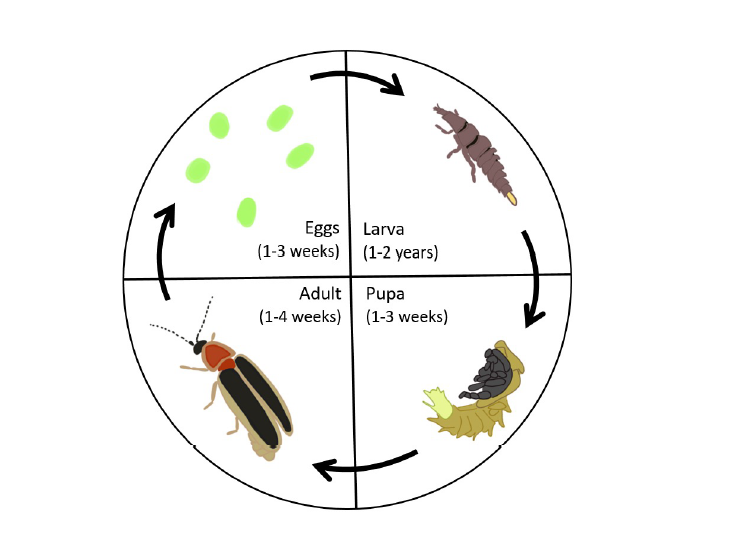
| Figure 1. The life cycle of a firefly. Illustration by Emily Geest, Oklahoma City Zoo and Botanical Garden. |
Life History
Beetles are holometabolous, which means they undergo four stages of development: egg, larva, pupa and adult. The length of each life stage differs by species, location, temperature and humidity. Eggs are laid in moist places, such as leaf litter and soil. Some species have eggs that glow continuously. The majority of a firefly's life cycle is spent as a larva (grub), where an individual will undergo four to seven instars (growth stages) and live for one to two years. All known firefly larvae have one to nine glowing spots. Larvae can glow intermittently or continuously while they are underground or in leaf litter. Larvae then pupate in mud chambers or attached to materials like tree bark. To survive winter, species enter a period of dormancy and will overwinter in logs, deep soil, bark or under leaf litter. Depending on the species, fireflies can overwinter as eggs, larvae or pupae. As an adult, a firefly will live one to four weeks when it will focus on reproduction.
Adult Defense
Fireflies can exhibit reflex bleeding as a form of protection. If you catch fireflies, you may notice an orange-colored liquid on your hands. The substance will have a distinct odor and does not taste good if you attempt to eat a firefly.
Identification
Since flashing patterns are unique to each species, observations of the different flashing, glowing and flickering patterns can be used to identify the species. It is important when identifying fireflies that time of day, temperature, humidity, color of flash and length of flash are all recorded to help identify a species. After recording a flashing pattern, if possible, capture the firefly and take photos to help confirm the species. Release all fireflies after catching. The three most common flashing genera are Photuris spp., Photinus spp. and Pyractomena spp. For non-glowing species the most common genera are Ellychnia spp., Lucidota spp. and Pyropyga spp. Firefly-focused books (see below) are great resources to learn more about firefly identification and biology.
Conservation
There are many ways to help fireflies, including:
- Reduce the use of pesticides, especially insecticides
- Leave leaf piles in your yard to provide habitat for fireflies
- Plant native plants in gardens to increase habitat for fireflies and firefly prey
- Reduce outdoor lighting that can affect communication between fireflies
- Reduce mowing and other ground vibrations that can damage underground larvae
- Fireflies can draw in tourists to watch their nighttime displays; however, large crowds can trample sensitive soil and kill firefly larvae below ground. When traveling to watch fireflies, take care to stay on trails and follow all posted signage
- Become engaged in firefly conservation
Best Time of Year to See Fireflies in Oklahoma
Oklahoma has 26 species of fireflies with the most commonly encountered species being the common eastern firefly (Photinus pyralis). Fireflies are most common during warm and humid conditions from May to November with the peak season typically in May and June.
| Species Name | Common Name |
|---|---|
| Lucidota atra | Woodland Lucy |
| Phausis inaccensa | Shadow ghost |
| Photinus brimleyi | Sidewinder |
| Photinus consanguineus | Double Cousin |
| Photinus consimilis | Cattail flash-train firefly |
| Photinus curtatus | Clipped single-flash firefly |
| Photinus dimissus | Two-step flasher firefly |
| Photinus granlatus | Lawn single-flash firefly |
| Photinus macdermotti | Mr.Mac |
| Photinus punctulatus | Punctuate firefly |
| Photinus pyralis | Common eastern firefly |
| Photinus tenuicinctus | Thinly girdled firefly |
| Photuris divisa | Flint Hills firefly |
| Photuris hebes | Heebie-jeebies |
| Photuris quadrifulgens | Spring 4-flasher |
| Pleotomus pallens | Pale glow-worm |
| Pyractomena angulata | Candle firefly |
| Pyractomena borealis | Spring treetop flasher |
| Pyractomena dispersa | Marsh flicker |
| Pyractomena lucifera | Marsh imp |
| Pyractomena marginalis | Marginal firefly |
| Pyropyga minuta | Flower elf |
| Pyropyga modesta | Modest elf |
| Pyropyga nigricasns | Black-bordered elf |
Learning Activities
We recommend the following activities to learn more about fireflies.
Firefly Watching
The best way to learn about fireflies is to go outside in the evening (fireflies are most active at dusk, and activity is reduced by 10 p.m. for most species) and watch them. Count how many times a firefly's lantern flashes, how long each flash or glow lasts and how long before the pattern repeats. Fireflies can be caught by hand or net and placed in a jar to examine more closely. Make sure to release all fireflies where they were caught afterwards.
Be a Scientist
Engage in community science by uploading your firefly photos and records to iNaturalist, Firefly Conservation & Research or Firefly Atlas. Scientists use these records to understand species ranges, distribution, life cycle patterns and population levels. All observations are welcome from casual firefly watchers to professionals.
Communicate Like a Firefly
With a group at night (or indoors with the lights of), pass out flashlights. Have the groups split into teams and have every team make their own flashing pattern (ex: three short bursts and one long burst of light or four short bursts, etc.). Mix the group up and send them away from one another. Have everyone use their flashlights to try and locate their partners. For an added challenge, you can write down patterns on flashcards and pass them out with flashlights, so partners have to find one another on their own.
Firefly Photography
Using a camera (tripods work well), lower your camera's shutter speed and lengthen the exposure to capture the light trails left by fireflies. These light trails can make observing patterns easier.
Get Creative
Firefly themed arts and crafts are numerous online, from creating firefly finger puppets to firefly dioramas. Incorporating fireflies into art is a valuable way to examine details of firefly anatomy and biology while being creative.
Helpful Resources
Firefly Books
- “Fireflies, Glow-worms, and Lightning Bugs” by Lynn Frierson Faust
- “Silent Sparks: The Wondrous World of Fireflies” by Sara Lewis
Online Resources
References
Abadi. 2018. Some Americans say ‘firefly’ while others say ‘lightning bug’, and a series of maps highlights an interesting theory why. Insider. https://www.businessinsider.com/firefly-lightning-bug-english-language-map-2018-7#:~:text=In%20the%20 United%20States%2C%20glowing%20insects%20are%20known,of%20the%20Midwest%20tend%20to%20say%20 %22lightning%20bug.%22. Retrieved 15 May 2023.
Faust L. 2017. Fireflies, glow-worms, and lightning bugs: Identification and natural history of the fireflies of the eastern and central United States and Canada. University of Georgia Press, Athens, GA.
Lewis SM. 2016. Silent sparks: The wondrous world of fireflies. Princeton University Press, Princeton, NJ
Scientific America. 2005. How and why do fireflies light up?. https://www.scientificamerican.com/article/how-and-why-do-fireflies/ Retrieved: 23 March 2023.
The Xerces Society. 2023. Firefly Atlas. https://www.fireflyatlas.org/. Retrieved: 26 June 2023.