

Mite Control in Oklahoma Peanut Production
- The twospotted spider mite (TSSM) can cause economic damage in peanuts by sucking plant nutrients from leaves, leading to yellowing, browning and defoliation, which robs the plant’s ability to photosynthesize and fill out peanut pods.
- TSSM infestations in Oklahoma typically occur in mid- to late August when hot and dry conditions accelerate mite development.
- Early detection of TSSM and timely application of miticides that are soft on natural enemies can effectively manage TSSM outbreaks in peanuts.
Identification and Biology
The TSSM, Tetranychus urticaeis Koch, (Trombidiformes: Tetranychidae) is small in size, ~ 1/50th of an inch. As noted in their common name, adult TSSM have a well-defined spot on each side of the front half of the abdomen (Figure 1). Adult female TSSM can overwinter in soil of non-crop and weedy areas. They will lay their eggs singly on the underside of leaves. Eggs are 0.14 mm long and become white as they age. Just before hatch, the red eyespots of the larvae are visible. Larvae are translucent and have six legs. They go through two nymphal stages where they have eight legs. Due to the small size of the adults, a hand lens is required to distinguish adult TSSM from specks of dirt and sandy soil.
Twospotted spider mites are more of an economic concern during hot, dry weather, as their populations will increase when temperatures are greater than 85 degrees Fahrenheit, humidity is less than 90% and moisture levels are low. These environmental conditions will also allow spider mites to com-plete a generation in nine to 12 days, but in cooler temperatures, it can take up to 20 days for a single generation to complete its lifecycle. In general, drought conditions promote TSSM population spikes. Females produce approximately 100 eggs in their lifetime, and populations can increase 70-fold in as little as six days during the summer. Their small size, the dense peanut canopy and the TSSM’s ability to retreat to the soil when disturbed make these mites difficult to detect at low population levels when they are easiest to manage.
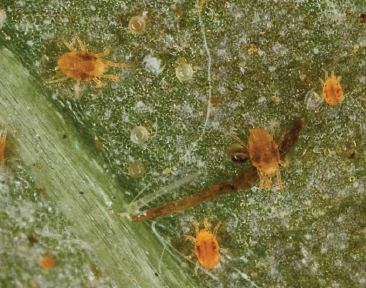
Figure 1. Twospotted spider mites on a leaf. Photo credit: David Cappeart, Bugwood
Crop Injury
Twospotted spider mite infestations typically begin in small areas which may be only a few feet in diameter within felds or along feld borders. Adults colonize the plant by infesting the lower leaves and moving into the terminal leaves. Leaves of lightly infested plants become yellow to silver-gray in appearance (Figure 2). When peanuts are heavily infested, foliage turns brown or reddish-brown and leaves often drop from plants (Figure 3). Severely damaged plants often die. High numbers of TSSM can result in webbing on stems and leaves (Figure 3) which helps the mites protect their colonies. In some years, amount of mites can become extremely large by late August in Oklahoma. Infestations during the later pod-filling stages can cause significant damage and substantial yield reduction, especially in late-season, drought-stressed peanuts.
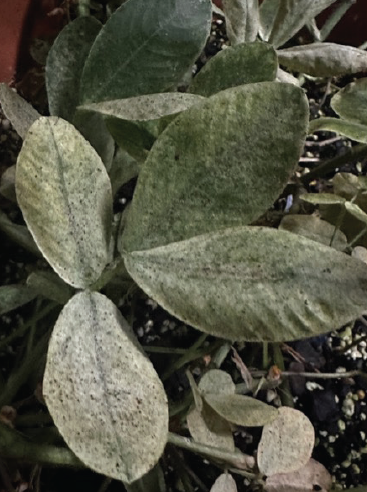
Figure 2. Light yellow and silvery leaves are signs of a light spider mite infestation in peanuts. Photo credit: Ashleigh M. Faris, Oklahoma State University Extension.
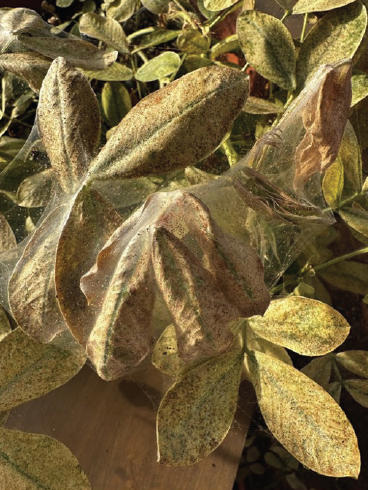
Figure 3. Yellow-brown leaf discoloration and webbing are signs of a heavy spider mite infestation. Photo credit: Ashleigh M. Faris, Oklahoma State University Extension.
Scouting Tips & Action Threshold
To scout for TSSM in peanuts, walk felds in a “Z-” or “W-shaped” pattern, checking non-irrigated areas and dry corners first as well as feld edges and weedy or grassy borders. Infestations often begin as “hotspots” of yellowing and stippling on lower leaves, which turn bronze and eventually brown. Look across the feld for these silvering leaves and yellowing spots as you walk the crop (Figure 4). Use a white piece of paper and a hand lens to confirm mite presence by shaking plant leaves over the paper and looking for moving specks. Mites move from dying plants to healthy ones downwind. Scouting downwind from damaged areas can help you catch the migration before it becomes widespread.
There is no economic threshold for mites in peanuts. Because infestations can increase rapidly due to their rapid reproduction rate, growers are encouraged to treat for mites at the early signs of infestation. As infestations build, they can be challenging to treat due to the dense peanut canopy, webbing preventing effective delivery of the chemical and the fact that TSSM populations have shown to have some level of tolerance, and in some cases, resistance to some chemical control options. Mites are often not detected until feeding damage is obvious, webbing from the mites is present and populations build to where two treatments will be needed to manage the infestation.
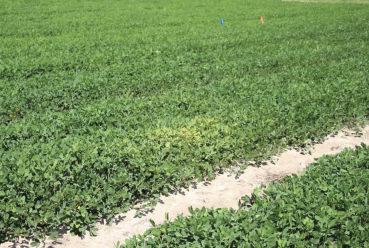
Figure 4. Characteristic yellow ring, also referred to as bronzing, indicating a spider mite hotspot in peanuts. Photo credit: Mark Abney, University of Georgia Extension.
Management
Cultural control – preventing mite population development:
- Irrigation – avoid drought stress. Overhead irrigation can wash of mites. The most important time to prevent water stress is during pod-filling. Irrigation does not preclude peanuts from mite infestations, as dry corners or areas where irrigation is inconsistent can serve as TSSM hotspots. Mites will then move into other areas of the feld.
- Weed removal – reduces host plants to delay mite movement into peanut fields.
Biological control - natural control by other predatory mites and insects feeding on TSSM:
- Beetle predators occur naturally in peanut felds. They include lady beetle larvae and adults and the collops beetle.
- Predatory bugs include big eyed bugs and the minute pirate bugs.
Chemical control – The aforementioned predators are natural residents in peanut. It is important to limit the use of broad-spectrum insecticides, since these products can reduce predator populations that provide natural pest control and may foster TSSM outbreaks. The use of broad-spectrum insecticides like acephate or a pyrethroid may also fare mite populations. The ovicidal activity of miticides labeled for use in peanut is limited, so more than one application may be needed to clean up infestations.
- When to apply miticides – Chemical applications for spider mites in pea-nut should occur before mite infestations are severe. During pod-filling is when mites can cause the most economic damage. But infestations at any hot and dry part of the growing season can lead to nutrient loss and defoliation, resulting in stressed plants thus impacting yield potential. The economic benefit of treatment diminishes approximately one-two weeks before digging.
- Negative side efects of miticides – Spider mites can quickly develop resistance to pesticides. There are populations of spider mites in the United States that have developed resistance to bifenthrin and lambda-cyhalothrin (pyrethroids) and to dimethoate (or-ganophosphate). To prevent build up of resistance, rotate miticides by selecting different modes of action (MoA) and active ingredients (ai). Only use a miticide at the product's labeled rate and do not exceed the number of allowable uses in a season.
- Effective miticide application – Miticides primarily act by contact, making good coverage on both leaf surfaces important. Ensure adequate spray volume (e.g., 15-20 gallons per acre) for miticide applications to improve efficacy. Miticides work best when populations are low and before TSSM webbing is present. There are limited miticides available for use in peanuts and none are consistent killers of mites (Table 1).
| Trade Name | Active Ingredient | Targeted Life Stage | Mode of Action |
|---|---|---|---|
| Comite II | Spiromesifen | Juveniles & adults | Inhibition of ATP synthesis |
| Portal* | Fenpyroximate | All life stages | Mitochondrial electron transport inhibitor |
| Zeal | Etoxazole | Eggs & juveniles | Growth regulator |
| Brigade* | Bifenthrin | Juveniles & adults | Alteration of sodium channels |
| Hero* | Bifenthrin + zeta-cypermethrin | Juveniles & adults | Alteration of sodium channels |
| Elevest* | Bifenthrin + chlorantraniliprole | Juveniles & adults | Alteration of sodium channels |
*Cases of population resistance development have been observed with pyrethroids and organophosphates. Insecticide labels change frequently and generic products may differ from the original products in their formulation, target crop, target pests, labeled rates, and restrictions for use. Therefore, always read and follow the label directions to ensure the target crop and pest are listed, the correct rates are being selected and all restrictions are being met before use.