

Plant Health Update April 2025
Each month, the Plant Disease and Insect Diagnostic Laboratory (PDIDL) provides a summary of plant health problems from Oklahoma specialty crop growers (horticultural crops). The volume of samples submitted to the lab has increased with the warmer weather. A summary of sample submissions is shown in Table 1.
| Submit Date | Host | County | Diagnosis/Identification |
|---|---|---|---|
| 3/27/2025 | Ornamental Allium* | Payne | Undetermined plant virus |
| 4/1/2025 | Ryegrass | Jefferson | Cultural/Environmental Problem |
| 4/1/2025 | Euonymus | Oklahoma | Rhizoctonia and Pythium root rot |
| 4/1/2025 | Pine | Oklahoma | Drought stress, Dothistroma needle blight |
| 4/1/2025 | Elm | Love | Dutch elm disease-not detected; Environmental stress |
| 4/2/2025 | Turfgrass | Kiowa | Carabid beetle (Amara sp./spp.) |
| 4/2/2025 | Tulips | Ottawa | Fungal root rot suspected |
| 4/2/2025 | Tulips | Ottawa | Fungal root rot suspected |
| 4/2/2025 | Tulips | Ottawa | Tulip fire (Botrytis tulipae) |
| 4/2/2025 | Pecan | Creek | Ganoderma root rot, Animal damage |
| 4/2/2025 | Cranesbill | Cleveland | False rust (Synchytrium geranii) |
| 4/2/2025 | Wax myrtle | Payne | Cold damage |
| 4/3/2025 | Tomato | Pontotoc | Sunscald; Sunburn |
| 4/3/2025 | Pecan | Rogers | March flies (Family Bibionidae) |
| 4/3/2025 | Ostrich Fern | Carter | Normal plant growth |
| 4/3/2025 | Peony | Carter | Peony leaf blotch suspected |
| 4/7/2025 | Pine | Canadian | Environmental stress, insect damage |
| 4/7/2025 | Eastern red cedar | Cherokee | Rust (Gymnosporangium sp.) |
| 4/4/2025 | Evergreens | Payne | Drought stress damage |
| 4/7/2025 | Eastern red cedar | Payne | Rust (Gymnosporangium sp.) |
| 4/4/2025 | Musk thistle | Custer | Fasciation (likely abiotic) |
| 4/4/2025 | Chinese pistache | Jefferson | Root problem suspected |
| 4/4/2025 | Golden juniper | Cleveland | Dieback (unidentified fungus) |
| 4/8/2025 | Seven Son's Flower tree | Payne | Canker (Botryosphaeria dothidea), Decline (Fusarium solani) |
| 4/8/2025 | Hydrangea | Cherokee | Rhizoctonia stem and root rot |
| 4/8/2025 | Japanese maple | Cherokee | No pathogen found; Abiotic problem |
| 4/8/2025 | Potato | Payne | Cold temperature injury |
| 4/9/2025 | Eastern red cedar | Oklahoma | Cedar-quince rust |
| 4/9/2025 | Cedar | Jackson | Environmental stress; Problem (Abiotic disorder) |
| 4/9/2025 | Home and garden | Texas | No arthropod found; normal plant growth |
| 4/11/2025 | Eastern Red cedar | Pontotoc | Rust (Gymnosporangium sp./spp.) |
| 4/8/2025 | Mulberry | Alfalfa | Branch dieback, Animal damage |
| 4/14/2025 | Insect ID | Ellis | Elm calligrapha (Calligrapha scalaris) |
| 4/15/2025 | Boxwood | Payne | Winter injury, spider mite damage |
| 4/15/2025 | Boxwood | Payne | Spider mite damage |
| 4/9/2025 | Home and garden | Texas | No arthropod found; normal plant growth |
| 4/11/2025 | Eastern Red cedar | Pontotoc | Rust (Gymnosporangium sp./spp.) |
| 4/8/2025 | Mulberry | Alfalfa | Branch dieback, Animal damage |
| 4/14/2025 | Insect ID | Ellis | Elm calligrapha (Calligrapha scalaris) |
| 4/15/2025 | Boxwood | Payne | Winter injury, spider mite damage |
| 4/15/2025 | Boxwood | Payne | Spider mite damage |
| 4/9/2025 | Tomato | Jefferson | Leaf distortion, possibly edema |
| 4/15/2025 | Mulberry | Payne | Animal damage, wood borers |
| 4/10/2025 | Tomato | McClain | Cold temperature injury |
| 4/10/2025 | Blue atlas cedar | Oklahoma | Wound canker suspected |
| 4/15/2025 | Potting media | Oklahoma | No arthropod found |
| 4/15/2025 | Peach | Oklahoma | Sapsucker, insect damage |
| 4/17/2025 | Hydrangea | Cherokee | Rhizoctonia root and stem rot |
| 4/21/2025 | Loblolly pine | Loblolly pine | Environmental stress, pH induced pathology |
| 4/21/2025 | Cypress | Grant | Botryosphaeria or Seiridium canker |
| 4/21/2025 | Callery pear | Cleveland | Herbicide & Mechanical injury; planting too deep |
| 4/22/2025 | Bermudagrass | Delaware | Spring dead spot |
| 4/22/2025 | Abelia | N/A | Foliar nematode |
| 4/23/2025 | Landscape and garden | Stephens | Ground nesting, solitary bee |
| 4/24/2025 | Landscape and garden | Canadian | Plant ID-Poison Hemlock |
| 4/24/2025 | Japanese maple | Cherokee | Flower pot parasol (Leucocoprinus birnbaumii) |
| 4/23/2025 | Cherry | Payne | Fireblight not detected; Cold temperature injury |
| 4/23/2025 | Apricot | Payne | Fireblight not detected; Cold temperature injury |
| 4/23/2025 | Apricot | Payne | Fireblight not detected; Cold temperature injury |
| 4/25/2025 | Holly | Ottawa | Branch canker, cultural problem |
| 4/25/2025 | Apple | Woods | Wood rot (Shizophyllum commune); Sapsucker |
| 4/25/2025 | Apple | Ottawa | Insect damage, likely May/June beetles |
| 4/25/2025 | Pecan | Garfield | Environmental stress |
| 4/25/2025 | Magnolia | Murray | Environmental stress |
| 4/25/2025 | Nectarine | Stephens | Insect damage (Oriental fruit moth suspected) |
| 4/25/2025 | Conifer | Oklahoma | Branch dieback, undetermined cause |
| 4/25/2025 | Oak | Oklahoma | Chemical injury suspected |
| 4/25/2025 | Japanese maple | Oklahoma | Cold temperature injury suspected |
| 4/25/2025 | Pin oak | Garfield | Herbicide injury suspected |
| 4/24/2025 | Tomato | Okmulgee | Fungi-Pezizomycetes suspected |
| 4/29/2025 | Crabapple | Muskogee | Fireblight |
| 4/29/2025 | Crabapple | Muskogee | Not fireblight; cultural problem suspected |
| 4/25/2025 | Apple | Oklahoma | Suspected picture-winged fly |
| 4/14/2025 | Rose | Custer | Suspect crown gall |
| 4/28/2025 | Oak | Okfuskee | Environmental stress (storm damage) |
| 4/29/2025 | Oak | Major | Alkaline pH suspected, nutrient deficiency |
| 4/29/2025 | Tomato, pepper, potato | Okfuskee | Herbicide injury suspected |
| 4/29/2025 | Flower garden | Unknown | Cultural problem |
| 4/28/2025 | Asian Pear | Payne | Fire blight |
| 4/28/2025 | Pear | Payne | Branch canker suspected |
| 4/15/2025 | Japanese Maple | Cherokee | In progress |
| 4/15/2025 | Fruit | Payne | In progress |
| 4/16/2025 | Pecan | Tulsa | In progress |
| 4/16/2025 | Pecan | Tulsa | In progress |
| 4/16/2025 | Pecan | Tulsa | In progress |
| 4/16/2025 | Pecan | Tulsa | In progress |
| 4/16/2025 | Pecan | Tulsa | In progress |
| 4/21/2025 | Geranium | Payne | In progress |
| 4/24/2025 | Boxwood | Cherokee | In progress |
| 4/30/2025 | Japanese Yew | Oklahoma | In progress |
| 4/30/2025 | Falsecypress | Cherokee | In progress |
| 4/30/2025 | Fragrant Viburnum | Cherokee | In progress |
| 4/30/2025 | Oak (ornamental) | Oklahoma | In progress |
*Testing of this sample was not completed until April
This month, images of musk thistle were submitted by Erin Hubbard (Pontotoc county extension) on behalf of Tim McCoy in Custer County. These images show thistle plants with abnormally wide stems and blooms.
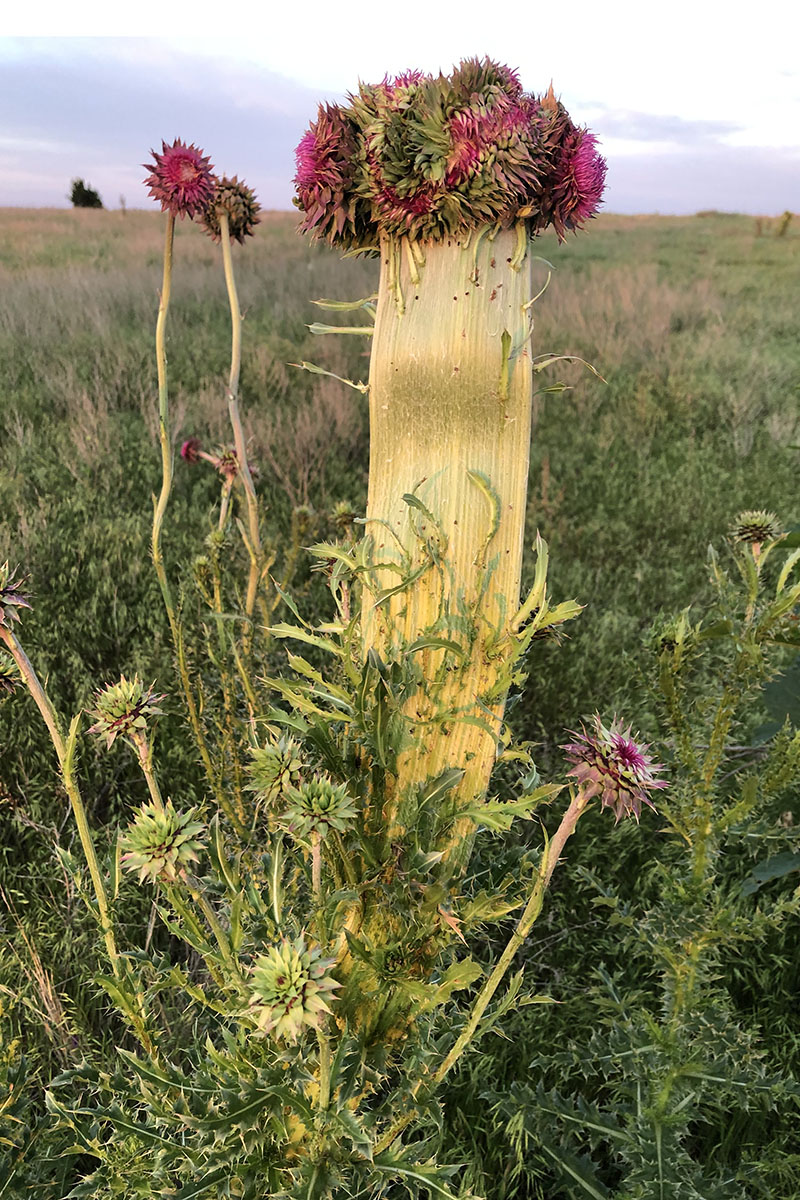
Figure 1. An abnormally wide stem was observed on this musk thistle plant. Photo by Tim McCoy.
The stem widening symptom is called fasciation, and it is most often observed in asparagus, roses and plants in the Asteraceae family (ie. daisy, zinnia, sunflower). Thistles are in this family, so it is not unexpected that they would develop these symptoms.
In normal plants, when cells divide at the meristem (tip), the elongation occurs mostly in one direction (upward). In a plant with fasciation, the meristem also divides in a perpendicular direction, creating a flattened appearance.
There are several causes of fasciation. Most often, it is due to a random genetic mutation, and it is sometimes seed-borne. In some instances, viruses or the bacterial plant pathogen Rhodococcus fascians are responsible for the unusual growth. It can also develop when certain pests or pathogens (mites, insects or fungi) damage the growing tip and cause odd growth patterns. Finally, chemical injury has been associated with fasciation in some plants.
My guess is that the fasciation affecting this plant, a biennial called musk thistle, is due to a random genetic mutation. The grower observed the symptoms last year as well as this season. If this plant was in the same location last year and this year, it is probably the same plant. If it is in a new area, it may suggest that the mutation is seed-borne. No treatment is needed. Just enjoy the oddity that nature has provided.
Recently, the PDIDL worked with Dr. Mustafa Jibrin to confirm pecan bunch disease, which is caused by a phytoplasma (wall-less bacteria). This disease has been visually diagnosed in Oklahoma, but this is the first laboratory confirmation. It is described in fact sheet EPP-7642 Pecan Diseases: Prevention and Control. We are currently running molecular tests to fully validate our results so a first report article can be published.
Several educators have contacted the PDIDL about leaf spot diseases and premature defoliation affecting shade trees. Many plants developed a heavy load of leaves this spring in response to rainy spring weather. A dense tree canopy does not allow much air circulation, creating an environment favorable to fungal disease. On some trees, leaf spot or anthracnose diseases have developed, and this is the cause of the defoliation. London plane trees and sycamores have been significantly affected by a disease called sycamore anthracnose (Figure 2).
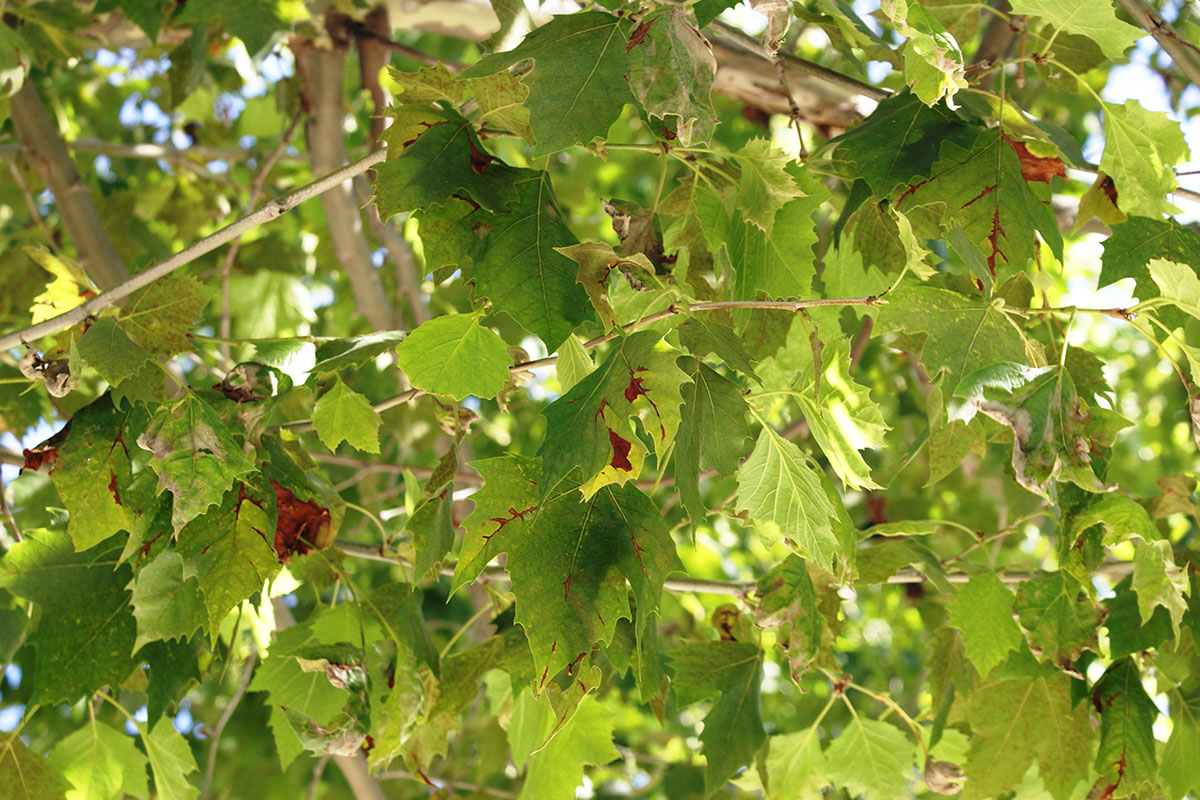
Figure 2. These sycamore leaves show abnormal brown spots and discolored veins due to sycamore anthracnose.
Anthracnose is a general term meaning that the leaf spot is severe and the fungus could move into the twigs, causing a shoot tip blight. Many types of trees can develop anthracnose (ie. oak, maple), but different fungal organisms are responsible. Often, clients believe that the disease is spreading between unrelated plants. Most plant pathogens, however, specialize in one or a few types of plants and are not able to infect unrelated plants. Instead, the explanation for why disease symptoms develop on different plant types in the same area is the surrounding environment. Fungal diseases favor moderate temperatures (55-80˚F) and moist conditions. Most areas of Oklahoma had several days of rain this spring, and heavy dews are common at this time of the year.
Sycamore anthracnose can be problematic for trees, but susceptibility varies. In fact, it is not uncommon to have many sycamores or London plane trees planted in one area show different responses to the disease. Some trees may have heavy spotting and defoliation, while other trees are lightly affected. This is usually caused by genetic differences as these trees are often propagated by seeds. Sycamore leaves with anthracnose generally have vein discoloration (Figure 3). It may be more visible on the backside of the leaves. The pathogen moves through the veins and into the twigs or branches. If sycamore trees have symptoms this year, the fungus may survive in the twigs until next spring, making it likely that some level of sycamore anthracnose would affect the trees next year. Another long spring with rainy weather and moderate temperatures, and sycamore anthracnose could negatively affect tree health. Management options include injecting a fungicide into the tree this year (protects for about 2 years) or spraying the tree at budbreak with a fungicide next spring if the weather seems favorable for anthracnose.
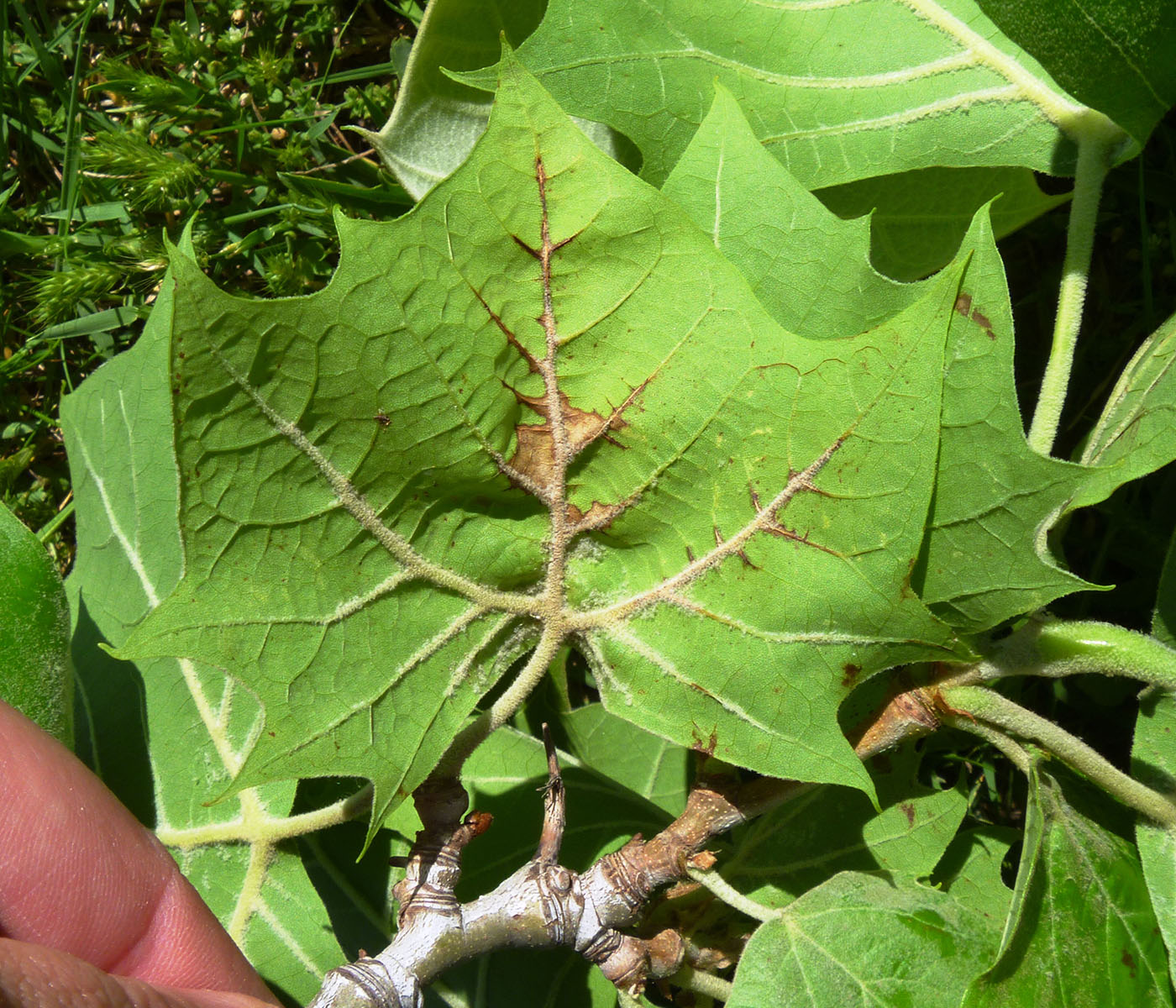
Figure 3. A key symptom of sycamore anthracnose is that the veins show brown discoloration on the underside of affected leaves.
We do occasionally observe oak anthracnose in Oklahoma. It seems to have similar characteristics to sycamore anthracnose. Therefore, if a tree has leaf spots and defoliation this season, fungicide applications may be justified as injections this summer or next spring, applied at bud break.
Educators have asked if fungicide applications are beneficial right now for leaf spot and anthracnose diseases. In most areas of Oklahoma, additional rain is in the forecast and temperatures are still below 75˚F (at least in the morning). These conditions are favorable for both leaf spot and anthracnose diseases of trees, so the application of fungicides is suggested. The products should be applied in advance of rainfall as most fungicides provide protection against infection and are not curative. If fungicides are applied, good coverage is needed for contact fungicides (chlorothalonil, copper, sulfur); systemic fungicides (myclobutanil, propiconazole) can move within the plant and may be suitable for larger plants where obtaining good coverage is difficult. It may take a week or more after application for a systemic fungicide to move throughout the tree. Always read and follow the label when preparing to apply fungicides. Organic formulations of some fungicides (copper, sulfur) are available at most garden centers.
Some trees appear to be dropping leaves without an obvious fungal disease (Figure 4). Sometimes trees will selectively abscise (drop) leaves if they sense a fungal attack. When a spore (infectious particle) of a fungus tries to invade the leaf, the tree does not waste energy on “fighting” the infection. Instead, they eliminate the disease by dropping the affected leaves.
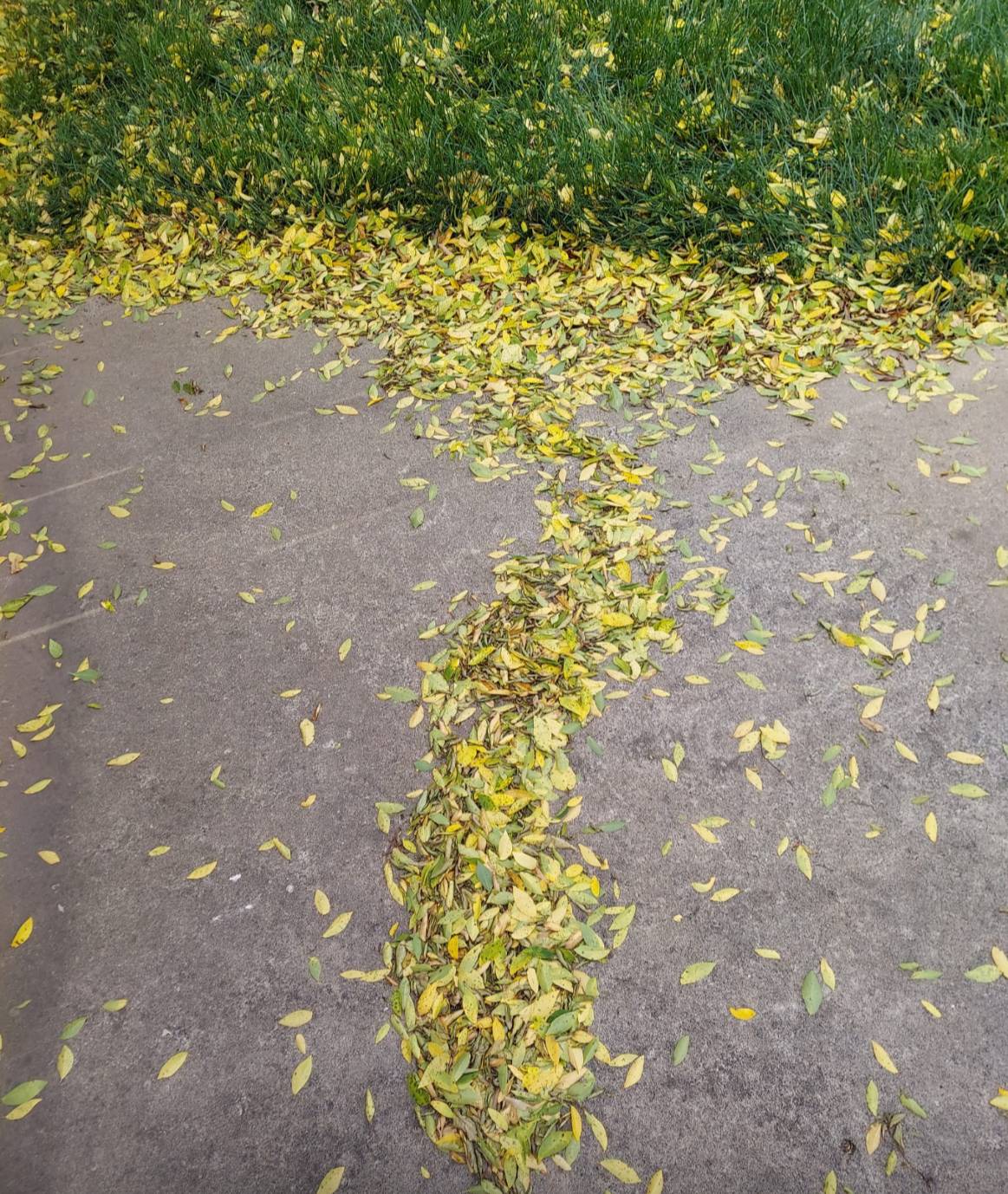
Figure 4. These leaves have recently fallen from a Chinese (Lacebark) elm in central Oklahoma.
Leaf yellowing and premature leaf drop may also be due to cladoptosis (self-pruning). The trees recognize that the weather is transitioning from cooler and wetter to hotter and drier. Under normal summer conditions (hot, hot, hot!), the tree is not able to support a large canopy. Shedding leaves helps prevent excessive wilting during the hot and dry periods of summer. Premature defoliation reduces stress and is actually beneficial. Some trees practice summer shedding every year (ie. River birch, cottonwood), but the practice may be more common this year following rainy spring weather and moderate temperatures.
Look for additional plant health updates from the PDIDL throughout 2025. If you have suggestions for future topics, please contact jen.olson@okstate.edu or call the PDIDL at (405) 744-9961.