

Bulk Density Estimates with Different Soil Sampling Probes, Soil Textures and Soil Moisture Conditions
Estimating soil bulk density (BD) is intensive and time-consuming. Accurate BD estimations are essential for determining elemental stocks, such as soil nutrients. Spatial and temporal variation in soil properties make it challenging to accurately estimate soil BD, which can change over time. Changes in BD can occur from soil erosion, soil deposition, clay swelling or compaction of soil, and these changes can be caused or exacerbated by anthropogenic activities. Errors and biases can also arise from sampling equipment and measurement methods that may skew BD estimations. Refer to fact sheet PSS-2287 for the basics of the BD sampling process and dynamic nature of soil BD. This fact sheet discusses the impact of different soil sampling probes, moisture conditions and soil textures on soil BD estimations.
Sampling Probes
Soil sampling probes come in different cutting edge diameters, core lengths and operational mechanisms. The most popular sampling probes include hydraulic probes, push probes, augers and slide hammer probes. Hydraulic probes are mechanically driven sampling probes often mounted on tractors or trucks. The push probe and slide hammer probes are operated manually. These probes often require hammering to push in soil to a desired depth. Augers are useful for collecting samples in dry hard soils but not ideal for BD sampling due to the destruction of the sample structure.
A study conducted in Oklahoma used three sampling probes of different diameters to take five samples with each probe within a 32-foot radius. Soil samples were collected from 19 farm fields located in Garfield, Major, Washita and Caddo counties in Oklahoma. The probes included a 1.57-inches in diameter hydraulic probe, a push probe of 0.89-inches in diameter and a slide hammer probe of 1.9-inches in diameter. The samples were taken down to the 12-inch soil depth and segmented into 0-4, 4-8 and 8- to 12 inch segments. Samples were taken across a range of coarse- to fine-textured soils at moisture levels lower than 18% by weight. Therefore, the samples were collected in relatively dry soil conditions.
Results from this study showed that sampling probes can have a significant impact on soil BD measurements, especially in the surface layer. However, differences between sampling probes were observed for at least one depth in 17 of the 19 fields sampled. The average BD of the 0- to 4-inch layer samples taken with the small diameter push probe was higher than the BD of the samples taken with the slide hammer for five of the 19 fields and higher than the BD of the samples taken with the hydraulic probe in seven of the 19 fields. The surface layer of soil consists of a greater proportion of granular soil structure and relatively higher amounts of voids or pore space. Due to its force per unit area of cutting edge, a small diameter push probe tends to compress the surface soil during insertion, resulting in greater compaction of the surface layer. Both the slide hammer and the push probe required hammering to reach the desired depth of sampling. Compaction from both the slide hammer probe and push probe was evident in the 8- to 12-inch layer, from the hammering of the probes due to the hard and dry soil conditions at sampling. The hydraulic probe resulted in significantly lower BD estimates at that depth than the push probe (five fields) and the slide hammer (six fields). When averaged across the fields (shown at bottom of Table 1), the push probe exhibited 10% higher BD at the surface layer, and both push probe and slide hammer had significantly higher BD than the hydraulic probe in the 8- to 12-inch layer.
| Field | Bulk density (g cm3) PP 0-4 in | Bulk density (g cm3) SH 0-4 in | Bulk density (g cm3) HP 0-4 in | Bulk density (g cm3) PP 4-8 in | Bulk density (g cm3) SH 4-8 in | Bulk density (g cm3) HP 4-8 in | Bulk density (g cm3) PP 8-12 in | Bulk density (g cm3) SH 8-12 in | Bulk density (g cm3) HP 8-12 in |
|---|---|---|---|---|---|---|---|---|---|
| 1 | 1.23 | 1.22 | 1.30 | 1.43ab | 1.42a | 1.52b | 1.41 | 1.41 | 1.44 |
| 2 | 1.49 | 1.36 | 1.49 | 1.64ab | 1.70b | 1.51a | 1.61 | 1.56 | 1.61 |
| 3 | 1.92b* | 1.17a | 1.25a | 1.41a | 1.54ab | 1.55b | 1.56 | 1.52 | 1.35 |
| 4 | 1.82b | 1.34a | 1.36a | 1.49 | 1.51 | 1.46 | 1.35 | 1.38 | 1.42 |
| 5 | 1.56b | 1.37a | 1.3a | 1.35a | 1.47ab | 1.51b | 1.60b | 1.44a | 1.44ab |
| 6 | 1.52 | 1.53 | 1.54 | 1.56a | 1.59a | 1.70b | 1.54 | 1.55 | 1.59 |
| 7 | 1.63b | 1.26a | 1.31a | 1.50 | 1.51 | 1.53 | 1.50 | 1.58 | 1.53 |
| 8 | 1.29b | 1.12a | 1.29b | 1.52 | 1.58 | 1.59 | 1.56 | 1.58 | 1.53 |
| 9 | 1.27ab | 1.09a | 1.36b | 1.59b | 1.48a | 1.63b | 1.58 | 1.61 | 1.62 |
| 10 | 1.50 | 1.32 | 1.48 | 1.35a | 1.56b | 1.52b | 1.41 | 1.60 | 1.55 |
| 11 | 1.58b | 1.53b | 1.31a | 1.54b | 1.63c | 1.46a | 1.68b | 1.69b | 1.51a |
| 12 | 1.48b | 1.42ab | 1.34a | 1.47b | 1.55c | 1.36a | 1.50b | 1.48b | 1.33a |
| 13 | 1.40ab | 1.52b | 1.34a | 1.68b | 1.66b | 1.55a | 1.69b | 1.72b | 1.57a |
| 14 | 1.22 | 1.28 | 1.18 | 1.45b | 1.49b | 1.32a | 1.47b | 1.47b | 1.39a |
| 15 | 1.40b | 1.46b | 1.21a | 1.52b | 1.49b | 1.43a | 1.47ab | 1.56b | 1.40a |
| 16 | 1.19 | 1.10 | 1.23 | 1.44 | 1.55 | 1.52 | 1.57 | 1.60 | 1.51 |
| 17 | 1.34 | 1.25 | 1.34 | 1.63 | 1.71 | 1.69 | 1.83b | 1.82b | 1.68a |
| 18 | 1.41 | 1.33 | 1.36 | 1.62b | 1.53a | 1.61ab | 1.73 | 1.66 | 1.69 |
| 19 | 1.43 | 1.43 | 1.35 | 1.46 | 1.44 | 1.56 | 1.55 | 1.53 | 1.55 |
| Answer | 1.46b | 1.32a | 1.33a | 1.51a | 1.55a | 1.53a | 1.56b | 1.56b | 1.53a |
*letters indicate significant differences at p<0.05
Texture
Generally found in literature, sandy soils tend to have higher BD and lower overall porosity in comparison to clay soils (USDA, 2008). However, the presence of organic matter as well as anthropogenic activities can influence BD in different textured soils. The BD ranged from 1.23 g cm3 to 1.67 gm cm3 across 47 agricultural sites in Oklahoma with an average of 1.45 g cm3. These estimates include samples from coarse and fine textured soils. Table 2 shows the distribution of BD in different soil textures in Oklahoma. The variation in BD was highest in soils with high silt and clay content and lowest in sandy soils. It should be noted that these BD estimates are for 0-30 centimeters of length and were taken with the hydraulic probe.
| Sand % | Silt % | Clay % | Number of Sites | Avg, BD g cm3 | CV% |
|---|---|---|---|---|---|
| <15 | >60 | <25 | 26 | 1.44a | 3.60b |
| <10 | >60 | >30 | 2 | 1.42a | 5.70c |
| <30 | <40 | >30 | 5 | 1.41a | 3.50ab |
| <35 | <45 | <20 | 2 | 1.39a | 3.0ab |
| >60 | <25 | <15 | 12 | 1.48a | 2.80a |
Moisture
Soil moisture can play a critical role during soil sampling. While the samples in the above mentioned study were collected under dry soil conditions, data collected by Wilson and Warren (2011) showed that as soil moisture levels increase the tendency of soil probes to compress soil layers also increases. The authors took BD samples with the hydraulic probe from the exact location at three times within 18 days down to 4-foot depth. The samples were divided into 4-inch segments. The soil was at its driest during the first sampling (T1), was wettest during the second (T2), there was intermediate moisture during the third sampling (T3). The BD was lowest during the driest conditions compared to the wetter soil conditions, although it was not statistically different at the 0- to 12-inch depth. The T1 (dry) sampling registered significantly lower BD in the 12- to 16-inch and 24- to 28-inch segments compared to the other soil moisture levels (Figure 1). The dry sampling registered significantly lower BD at the 28- to 32-inch layer when compared to sampling during wetter periods.
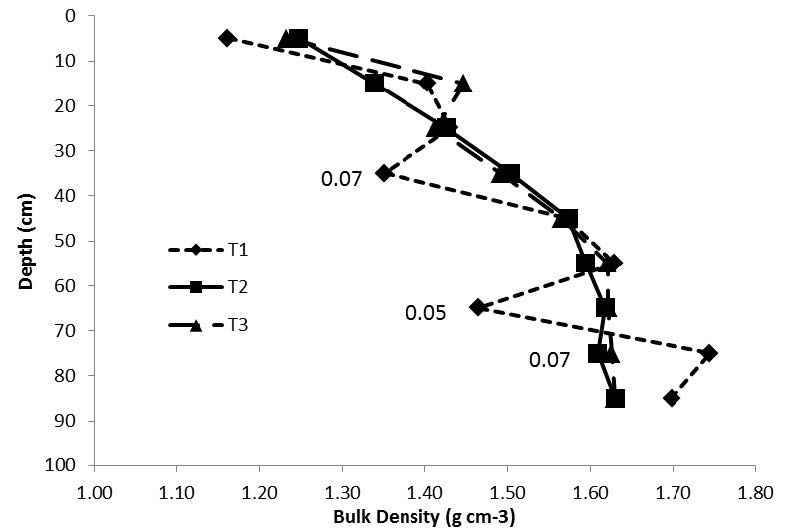
Figure 1. Bulk density as measured at sampling event T1 (driest), T2 (wettest) and T3 (intermediate conditions).
These results were in contrast to the expectations that the shrinkage of dry soils would result in increased BD as observed in clod methods of measuring BD. The authors investigated the compression of cores by measuring core lengths and hole depths to explain these results. The core lengths were slightly (0.35 inch/1 cm) larger than the hole depth during sampling at the T1 (driest) and T2 (wettest) periods, indicating the possibility of core expansion, while the core length was similar during the T3 (intermediate) period. The authors took samples down to 4 feet; however, during the first two samplings, the bottom of the core fell back into the hole while extracting the core. Therefore, a detached piece of the core could have blocked the bottom of the hole, preventing accurate measurement of the hole depth. However, when BD values were used to calculate mass of soil up to 90 centimeters, the wet period samples registered higher soil mass for similar depth, indicating compression of the soil cores.
Conclusion
BD samples taken with different probes or different moisture conditions could result in different values even within a small sampling area. Some of these discrepancies could arise from sampling equipment, conditions and human errors during sample collection. In general, these results show that smaller diameter push probes can result in compression of surface layers, while the sampling during wet or intermediate wet conditions could compress soil in deeper layers. However, these results also illustrate the difficulty in estimating the small amounts of compression by measuring length of core and hole. Therefore, soil sampling probes of the same diameter should be used if sampling is done at different time periods, and efforts should be made for sampling during similar moisture conditions.
References
USDA-NRCS. 2008. Soil Quality Indicators. (Available at: chrome-extension://efaidnbmnnnibpcajpcglclefndmkaj/https://www. nrcs.usda.gov/sites/default/files/2022-10/nrcs142p2_051591.pdf) Accessed: 02/14/2025
Sharma, S.; Wilson, T.; Ochsner, T.; Warren, J.G. 2020. Sampling probes affect bulk density and soil organic carbon measurements. Agricultural & Environmental Letters. DOI: 10.1002/ael2.20005
Sharma, S.; Warren, J. 2024. Basics of Soil Bulk Density. PSS-2287. Oklahoma Cooperative Extension Service. Available at: https://extension.okstate.edu/fact-sheets/basics-of-soil-bulk-density.html
Oklahoma Carbon Program. 2013. Soil Sampling to Measure the Carbon Sequestration Rate of Aggregate Acres.