

Timely Scouting and Management Considerations for Corn Earworms
The rain has been good for our full season field corn. In many parts of Oklahoma, the crop is entering the reproductive growth stages. We’ve received reports of corn earworms in the field, particularly in southwest Oklahoma. Below is guidance on how to identify corn earworms and their damage, as well as suggestions on how to manage them. For information on other corn pests, see OSU Fact Sheet CR-7192.
Corn Earworm Life Cycle and Description
The corn earworm, Helicoverpa zea, can be found throughout most of North America and will feed on several vegetable crops including field crops, some ornamentals and a wide variety of wild plants. The name of the caterpillar is based on their host plant, e.g. corn earworm, tomato fruitworm, cotton bollworm, soybean podworm, or sorghum headworm. This insect will overwinter as a pupa in the top two inches of soil in areas where winter temperatures are mild. Oklahoma falls within their overwintering range, and we can see 4-5 generations per year. Adults emerge in late March and early April; Oklahoma also receives the moths that migrate northward from Texas. The corn earworm can complete its life cycle in 30 days. Corn earworm adults are moths; females will lay their eggs singly on leaf hairs and corn silks. One female can lay between 500-3,000 eggs. Eggs are dome-shaped and greenish when first laid but darken to a grayish color over time. In 3-4 days, the eggs will hatch, and larvae (the damaging stage) will move to the developing corn ears where they begin to feed.
Corn earworms are variable in color, they can be shades of pink, yellow, green, brown, and black (Figure 1). They typically have dark or light stripes that run lengthwise along their body and can be positively identified by the short, sharp microspines between the hairs on their body (Figure 2). However, a magnification of 7-10x is needed to see these microspines. Larvae are cannibalistic, they will attack and feed on other corn earworm larvae which typically results in one larva per ear of corn. Larvae progress through 5-6 instars, increasing in size as the feed and develop. Corn earworms will feed for 21-25 days before they enter the soil to pupate. Adults will emerge in 10-25 days. For details on how to distinguish corn earworms from other larvae in corn see OSU Fact Sheet EPP-7160.
| Image | Caption |
|---|---|
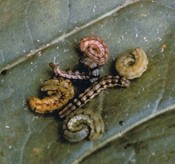 |
Figure 1. Color variations of budworm larvae. Photo Credit: OSUExtension |
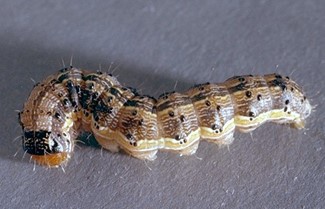 |
Figure 2. Corn earworm. Photo Credit: OSU Extension. |
Adult moths are usually light yellowish olive with a single dark spot near the center of each front wing (Figure 3). Some adults may have vague darker markings on their wings. Wingspan is around 2.5 inches.
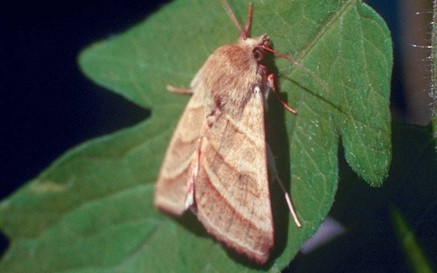
Figure 3. Budworm moth. Photo Credit: OSU Extension.
Corn Earworm Damage and Management
Larvae will typically first eat the corn silks but eventually move into the developing ear. Corn earworms will feed at the tips of the ears but can also cause damage by feeding on kernels along one half of the ear (Figure 4). Damage due to feeding also allows for pathogenic fungi to develop (aflatoxins). In some cases, corn earworms will feed on developing whorls of corn plants.
For yield to be impacted by corn earworms, they must eat between 40-60 kernels at the tip of the ear. The corn plant will compensate for this damage by filling out kernels at the base of the cob. Based on field observations by colleagues at North Carolina State University, when corn is drought stressed, the ability for corn to compensate is reduced. Drought stress is likely a bigger issue for corn than the corn earworm.
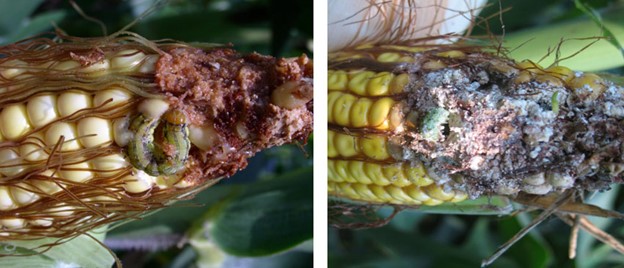
Figure 4. Corn earworm damage. Photo Credit: Pioneer Agronomy Sciences. Corn earworm damage. Photo Credit: Pioneer Agronomy Sciences.
It is not recommended that corn earworm be controlled with insecticides in field corn. Sweet corn producers that spray daily or every other day struggle to have effective control against this pest. This is due to the difficulty of delivering the insecticide into the husk where the larvae reside. However, if eggs are detected on silks a timely insecticide application may be made if the grower feels the investment is warranted. One insecticide option is Vantacor, formerly known as Prevathon. Foliar application or overhead chemigation can be used. For all insecticide applications be sure to follow the label instructions and rates.
Many Bt corn hybrids offer some suppression of corn earworm. However, resistance to hybrids with Cry toxins has been documented in the U.S. Corn hybrids that express Vip toxins should have minimal corn earworm infestations as these toxins remain effective.