

Stinkbugs in Oklahoma Cotton
Scouting efforts have revealed stinkbugs in cotton across the state. They are most prevalent in lush, irrigated cotton at the moment. As other summer crops, such as corn, are harvested it is likely that stinkbugs will move into available crops like cotton. Scouting for and managing these pests is important as they can lead to yield and quality losses if left unmanaged.
The most prevalent stinkbug in Oklahoma cotton at the moment is the green stinkbug (Fig. 1), but I have also heard reports of brown and Conchuelas (Fig. 3). Stinkbugs can be difficult to scout for. Adult stinkbugs tend to aggregate and can be highly concentrated within a field (Texas A&M AgriLife Extension).
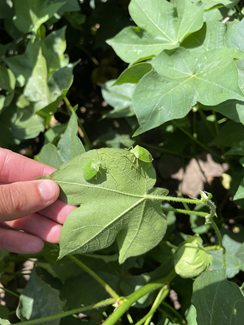
Figure 1. Stinkbugs on cotton leaf
Photo Credit: Jenny Dudak
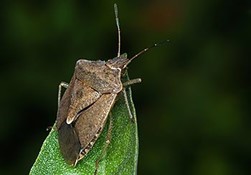
Figure 2. Brown stinkbug.
Photo credit: Cotton Incorporated
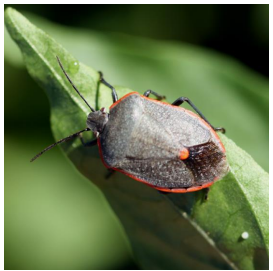
Figure 3. Conchuela
Photo credit: Colorado State University
Scouting stinkbugs can be difficult as they can be elusive. Even if you are not seeing stinkbugs in the crop they may be there. Scout for damage to small bolls. To effectively scout, collect bolls from several areas of the field and examine the inside of the boll for internal warts (Fig. 4) and/or stained lint. These signs of damage indicate that stinkbugs have been feeding on the bolls. Action thresholds are 10-15 percent boll injury during weeks 3-5 of bloom, 20 percent during weeks 2 and 6, and 30 percent or more 7 weeks after bloom (Vyavhare et al. 2019). Use an insecticide labelled for control of stinkbugs in cotton such as, acephate, Bidrin, bifenthrin and others. Following management applications for stinkbugs be sure to scout for returning stinkbugs as well as flare ups of secondary pests such as aphids and spidermites.
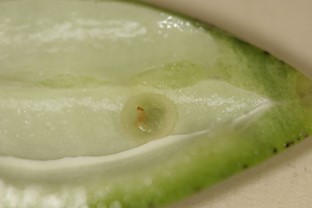
Figure 4. Stinkbug injury on cotton boll
Photo credit: NC State University
References
Texas A&M AgriLife Extension (n.d.) Cotton Insect Management Guide Stink Bugs. Texas A&M AgriLife Extension. https://cottonbugs.tamu.edu/fruit-feeding-pests/stinkbugs/ Accessed: July 31, 2023.
Vyavhare, S.S., Kerns, D., Allen, C., Bowling, R., Brewer, M. & Parajulee, M. (2019) Managing Cotton Insects in Texas. Texas A&M AgriLife Extension. https://extensionentomology.tamu.edu/files/2018/03/ENTO075.pdf Accessed: July 31, 2023.