

Peanut Disease Update: Time to Scout the Fields and Plan Management Decisions
With the frequent rains received in May and June in the state of Oklahoma it is not surprising that the risk for the development of foliar diseases in peanuts is high. Several peanut fields were scouted in Caddo County in the last week, and the foliar disease known as Early leaf spot was commonly found in all scouted fields (Figure 1 A-B). Early leaf spot, caused by the fungus Passalora arachidicola, is the most prevalent and yield-limiting foliar disease affecting peanuts in Oklahoma. Yield loss in the peanut crop is due to necrotic spots reducing the photosynthetic area of the leaves and defoliation of the plants in response to infection. Yield loss is more noticeable when defoliation levels exceed 50% when the disease is not controlled and nearly complete defoliation occurs. Therefore, adequate control of this disease is essential in the production of a high-yielding peanut crop.
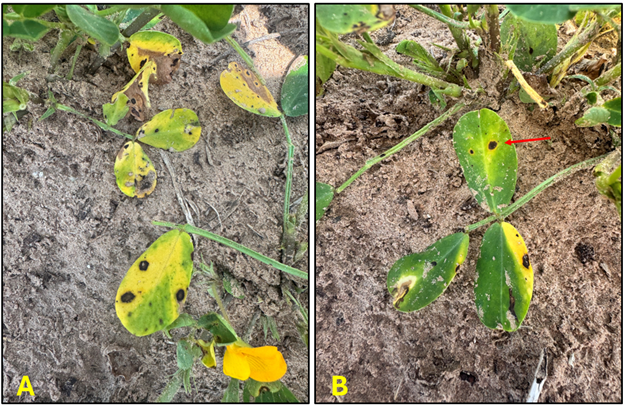
Figure 1. A) Symptoms of Early leaf spot (Passalora arachidicola) observed on the lower canopy of peanut plants, with the presence of dark spots visible on the upper leaf surface. Figure 1. B) Presence of dark spots on the lower leaves with a yellow halo around the spots (red arrow).
The pathogen that causes this disease can infect any above-ground portion of the peanut plant, but leaf spots in the leaflets of the peanut crop are the most common observed symptoms. Depending upon weather conditions and cropping history, leaf symptoms usually appear between 30 to 50 days after planting. Symptoms are first seen on leaves in the lower canopy. Later, the number of spots increase as the disease progresses to the upper canopy. Symptoms of the disease include brown or black lesions (spots) visible on the upper and lower leaf surface. A yellow halo usually is present around early leaf spots (Figure 2 A-B). However, the presence or intensity of a yellow halo on the upper leaf surface is not always a reliable characteristic for identifying Early leaf spot, since halos are also common in other peanut foliar diseases, such as Late leaf spot.
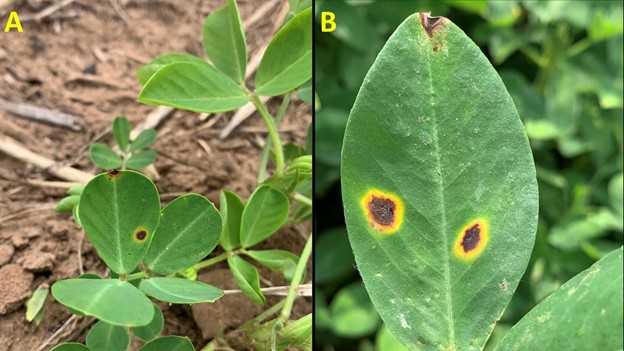
Figure 2. A) Peanut plants showing symptoms of Early leaf spot (Passalora arachidicola). Figure 2. B) Early leaf spot causes brown to black lesions in the peanut leaves, that start circular as pinpoint-size dots and present a distinct yellow border or halo.
The development of the disease is greatly influenced by weather, and conditions with relative humidity are 95% or greater and temperature is between 60.8 and 87.7 F favors infection by the fungus. Similar weather conditions that we have been experiencing in the state in the last weeks. The pathogen that causes Early leaf spot overwinter in peanut crop debris, and the spores produced in the crop residue are dispersed in air currents, wind, or by splashing water onto peanut leaves. While most inoculum is produced locally at the field where the crop was planted this year or adjacent fields planted last year, spores can blow in from neighboring fields and occasionally over long distances, particularly during tropical storms.
An integrated management program that uses cultural practices, genetic resistance and a fungicide program is suggested. Cultural practices will give partial control of Early leaf spot. Rotation of peanuts with other crops and management of peanut residue by tillage, help delay the onset of disease and slow leaf spot development. These practices reduce the level of primary inoculum in the field. Peanut varieties differ in reaction to leaf spot, but levels of resistance in peanut varieties alone are not sufficient to provide adequate disease control. Spanish varieties are most susceptible, Virginia types are intermediate, and runner varieties are partially resistant.
Oklahoma peanut growers: if you haven’t already, now is the time to scout your fields and determine whether a foliar fungicide application is needed. To help growers and stakeholders to take decisions regarding fungicide applications in the peanut fields, a decision support system (DSS) known as Leaf Spot Advisor is available to provide recommendations regarding the best moment for fungicide applications. The advisory calculates the number of hours that are conducive for the development of the disease. Spraying is recommended when 36 “leaf spot hours” have accumulated from either 30 days after planting or 10 days from the last fungicide application. The Leaf Spot Advisory system is currently running on the Mesonet webpage .
Information on how to use the website and evaluate the risk of leaf spots in your peanut fields is available on the Peanut Disease Update from July 7 page.
Fungicides with different modes of action can be applied in alternation, in a tank mix, or in a pre-mix to slow down and/or complete stop the development of the disease. Rotating fungicide applications with different modes of action is a key strategy for managing fungicide resistance. Contact your county Extension agent for current recommendations regarding recommended fungicides, applications schedules and resistance management strategies.
For more information or Early leaf spot disease or how to distinguish this disease from other leaf spots the occurs in the peanut production in Oklahoma consult the Foliar Diseases of Peanuts factsheet.