

Cow-Calf Corner | September 21, 2026
The Feedlot House of Cards is Collapsing
Derrell S. Peel, Oklahoma State University Extension Livestock Marketing Specialist
The latest USDA Cattle on Feed shows the September feedlot inventory at 11.163 million head, up 0.7 percent from one year ago. Monthly on-feed totals have been above year earlier levels the past five months. Placements in August were down 9.2 percent year over year and August marketings were down 3.3 percent. Average feedlot placements and marketings have declined sharply in recent months and are now at record low levels in available cattle on feed data (Figure 1).
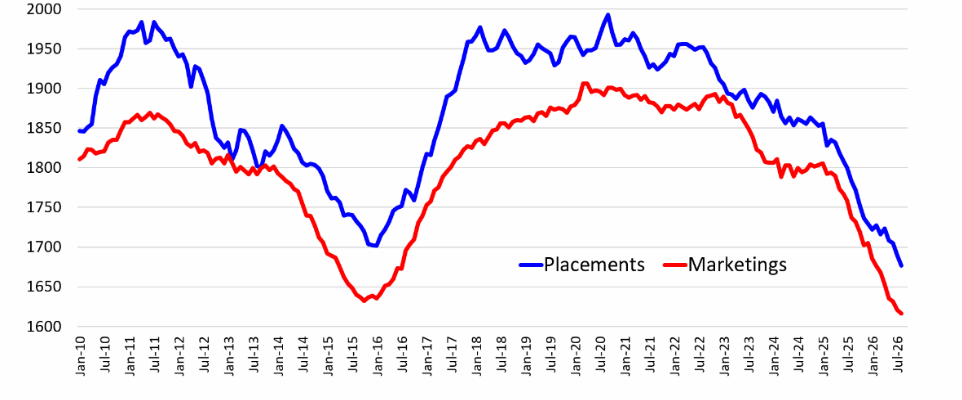 Figure 1. Feedlot Placements and Marketings - 1,000 Head, 12 Month MA
Through the current cattle cycle, the calf crop peaked in 2018 at 36.29 million head and has declined for eight consecutive years, with the 2026 calf crop estimated at 32.5 million head, down 3.79 million head from the cyclical peak. The decreases in average placements and marketings in Figure 1 are generally consistent with the declining calf crop.
However, cattle on feed inventories have remained relatively high in recent years (Figure 2). Average feedlot inventories peaked in September 2022 and declined to a recent low of 11.4 million head in April 2026, down just 4.0 percent or 480 thousand head. Feedlot inventories have remained elevated due to a slow marketings rate. The feedlot marketings rate – the percentage of inventory marketed each month – was at 16.0 percent in July 2023, having averaged 16.0 percent since 2018. The average marketings rate began declining and dropped below 15.0 percent in October 2025. Currently, the twelve-month average marketing rate in August 2026 is a record low 14.1 percent (Figure 2). The low marketing rate has even allowed on-feed totals to be higher year over year for the last five months. The sharp decrease in placements in July and August likely means that feedlot inventories will drop below year earlier levels soon and for the foreseeable future.
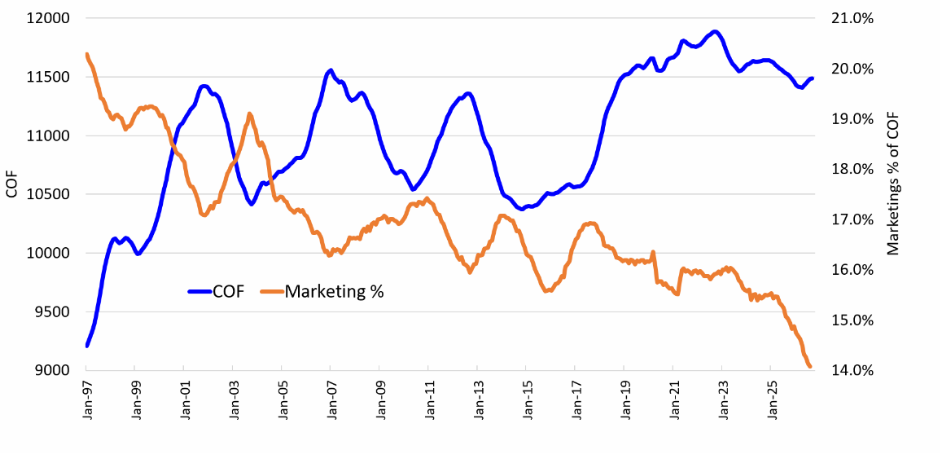 Figure 2. Cattle of Feed and Feedlot Marketing % - 1,000 Head, 12 Month MA
Several consequences have emerged resulting from the ever-lower feedlot marketing rate. The low marketing rate is accomplished mostly by extending days on feed. This has led to a dramatic increase in carcass weight since 2023. For example, steer carcass weights increased 23 pounds in 2024, 24 pounds in 2025 and are up 32 pounds thus far in 2026. From 1960-2022 the average annual increase in steer carcass weights was 4.0 pounds/year. Though there have been individual years of significant increase in carcass weight, there have never been multiple years of much heavier carcasses. The roughly 75-pound increase in steer carcass weights in the last three years is equivalent to the increase over the previous 18 years. The dramatic increase in carcass weights has also resulted in sharply decreased average yield grades. Recent data shows that the average Y4/5 percentage for the past twelve months is 29.2 percent, more than double the rate just six years ago. The increased incidence of bovine congestive heart failure has emerged as a major feedlot health issue and is very likely related to extremely heavy fed cattle weights.
Going forward, it will be increasingly difficult to maintain feedlot inventories. Feeder supplies are expected to tighten into 2027 with a smaller calf crop. Resumption of Mexican cattle imports may relieve some of the pressure, at least regionally. Delayed beef cow culling the past three years means that more replacement heifers will be needed just to stabilize the cow herd with additional heifers needed for any potential herd rebuilding. The feedlot marketing rate may stay low but is unlikely to keep dropping as it has in the past 18 months. In that case, lower placements will push feedlot inventories lower in the coming months.
Derrell Peel, OSU Extension livestock marketing specialist, talks about how beef demand is holding steady going into fall on SunUpTV from September 12, 2026. Beef Demand is Holding Steady-What's Ahead this Fall | Livestock Marketing
Retaining Ownership to Get Paid for Genetic Selection
Paul Beck, Oklahoma State University Department of Animal and Food Sciences
In previous articles over the last few weeks, we discussed marketing calves to capture their true value. The price at an auction market is the market's estimate of what a calf is worth that day, based on the information buyers can see and trust. There are no real visual indications of the calf's genetic potential for growth, feed efficiency, or carcass value. Calves sired by proven sires may have the potential for high rates of gain, improved feed efficiency, and exceptional marbling and carcass quality. However, if the calf is sold at weaning there is no way for the cow-calf producer to capture that potential value unless they take steps to market their genetics.
A two-year comparison makes this point exceptionally well. In this example calves were sired by Angus bull either by artificial insemination from top bulls in the breed or natural service clean-up bulls purchased from reputation Angus seedstock producers. Calves produced through timed artificial insemination were 69 pounds heavier at weaning than natural-service calves, but much of that difference came from being born earlier. The adjusted 205-day weaning weights for AI sired calves were only 9 pounds heavier than calves from natural service sires. As ownership continued, however, differences in performance associated with genetics became greater. AI-sired steers were 109 pounds heavier as long yearlings after grazing wheat pasture. During finishing, the AI sired steers gained faster (3.74 versus 3.56 pounds per day) and produced 50-pound heavier carcasses. The analysis estimated $150/head greater net return from the AI-sired steers, including $82 less feed, using prices and costs from that time.
Our recent OSU research underscores why "true value" must be defined carefully. Steers that were sired by bull selected for high growth based on yearling-weight EPD had the same weaning weight as moderate-growth contemporaries. By harvest, high-growth steers were 73 pounds heavier, produced 26 pounds more hot carcass weight, and reached harvest seven days sooner. However, they also ate more feed and had lower feed efficiency. Moderate-growth steers tended to produce more USDA Prime quality grade carcasses. Selection for growth added productivity, but it did not produce universal superiority in feed efficiency or carcass quality.
To get our calves full value we first must create value by early castration and dehorning, a sound health program, and nutrition that allows genetics to be expressed. Second, capture value by marketing uniform groups, documenting genetics and management. Finally, choosing an marketing outlet whose buyers value superior genetics or retaining ownership when feed resources, health, finances, risk tolerance, and the market outlook justify it. Retained ownership reveals calves’ real value, to benefit from it you need to know where the value of your calves is, prove it, and sell where buyers recognize it.
Resources:
Capture More of Your Calves' True Value. Cow-Calf Corner, September 7, 2026.
Matching Cattle to the Market That Rewards Their Strengths. Cow-Calf Corner, September 14, 2026.
Rancher’s Thursday Lunchtime Webinar Series – September 24, 2026 | 12 p.m.
Pasture Mealybug: What Producers Need to Know— Ashleigh Faris
Register for the Rancher’s Thursday Lunchtime Webinar Series
Join the beef cattle Extension team, experienced ranchers and scientists to learn and share beef cattle production, management and marketing tips. This free webinar series will focus on animal health challenges facing the livestock industry, New World screwworm, bovine theileriosis and pasture mealybug.
August 27, 2026 | 12 p.m.
New World Screwworm: Animal Health Official Update — Dr. Sara Ahola and Dr. Rod Hall
September 3, 2026 | 12 p.m
New World Screwworm Threats and Economic Impacts — Jonathan Carmack and Amy Hagerman
September 10, 2026 | 12 p.m.
Bovine Theileriosis in Oklahoma: Current Status, Practical Prevention — Dr. Ruth Simecka
September 17, 2026 | 12 p.m.
Theileria Orientalis Genotype Ikeda: Approaches from the Field — Dr. John Currin
September 24, 2026 | 12 p.m.
Pasture Mealybug: What Producers Need to Know — Ashleigh Faris
Contact
David Lalman
Extension Specialist for Beef Cattle
david.lalman@okstate.edu
(405) 744-6060
Paul Beck
Extension Specialist for Beef Nutrition
paul.beck@okstate.edu
(405) 744-9288
Rosslyn Biggs
Extension Specialist for Beef Cattle
rosslyn.biggs@okstate.edu
(405) 744-8587