

Cow-Calf Corner | September 7, 2026
Beef Imports and the Brazil Roller Coaster
Derrell S. Peel, Oklahoma State University Extension Livestock Marketing Specialist
Beef imports continue to be the subject of political attention that has resulted in a myriad of variable and inconsistent policies and actions. Cattle and beef markets have been buffeted by a barrage of political interference that has clouded markets and contributed to producer uncertainty and delay in responding to market signals to rebuild cattle inventories.
The latest trade data shows that beef imports continue to increase, up 18.7 percent year over year in July and up 12.9 percent for the first seven months of the year compared to one year ago. Australia remains the largest source of beef imports, up 16.1 percent thus far in 2026 and representing a 21.8 percent share of total imports. Close behind is Brazil, the number two beef import market. More on Brail below. Canada is the third largest source of beef imports, almost unchanged year over year, (up a scant 0.7 percent this year) and representing a 14.6 percent share of beef imports. Monthly beef imports were up 18.6 percent in July from number four Mexico and are up 27.8 percent for the year to date compared to last year. Mexico accounts for 12.2 percent of total beef imports. New Zealand is the fifth largest beef imports source, up 9.3 percent from last year and representing an 11.3 percent share of beef imports. Beef imports from number six Uruguay are down 2.4 percent year over year but still account for 6.3 percent of beef imports.
everal smaller import markets are in the spotlight as well. Beef imports from Argentina, resulting from an expanded tariff rate quota announced in fall of 2025, have increased 155.1 percent in the first seven months this year to a share of 4.8 percent of total beef imports. From Nicaragua, beef imports are up 36.4 percent year over year, totaling 3.7 percent of imports. Similarly, newcomer Paraguay is up 49.1 percent compared to last year and accounts for 3.6 percent of beef imports.
Brazil has emerged as a major source of beef imports. For 20 years from 2001- 2020, Brazil averaged 5.5 percent of total beef imports, ranging from 2.1 to 9.2 percent. Since 2021, Brazil’s share of beef imports has averaged 13.7 percent and Brazil moved into the number two position with 20.8 percent of 2026 year to date beef imports.
Brazil has experienced a roller coaster of impacts amid variable and wildly inconsistent U.S. trade policy. Figure 1 shows the dramatic range of monthly beef imports from Brazil since 2021. In general, Brazil competes for the small “Other Country” quota, which has been filled in the first few days of January in the last five years, mostly by Brazil. This accounts for the January spikes in beef imports since 2022 (Figure 1). As soon as the quota is filled each year, Brazil has been subject to a 26.4 percent over-quota tariff. However, in 2025, Brazil was subject to a flurry of arbitrary federal tariff changes that included at least five tariff levels that ranged from zero up to a maximum of 74.6 before dropping back to over-quota level of 26.4 percent. Such a quagmire of policy changes disrupts business relationships and supply chains and increases uncertainty for international and domestic producers.
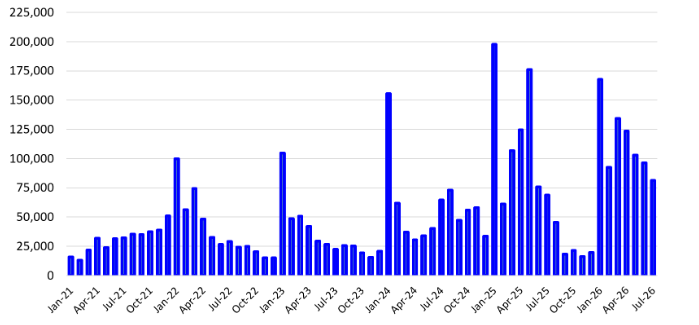 Figure 1. Beef Imports from Brazil. 1,000 Pounds, Monthly.
Recently, a federal announcement of an additional 300,000 metric tons of quota-free beef imports appears intended to largely benefit Brazil. It’s not clear how much additional beef might be imported as a result because a significant portion of imports would have happened anyway. Most beef imports from Brazil are used in food service, primarily for ground beef, and are unlikely to have any measurable impact on ground beef prices at retail grocery.
The roller coaster continues. Despite recent federal support for increased beef imports, a new executive order last week signals the intent to revisit the perpetual and controversial issue of mandatory country of origin labeling (mCOOL). Voluntary labeling is currently available if desired. Ironically, consumers would be unlikely to benefit much because most Brazilian beef is used in food service (e.g. restaurants) and the proposed mCOOL law does not apply to beef in food service.
Best Management Practices for Controlling Eastern Redcedar Trees
Mark Z. Johnson, Oklahoma State University Extension Beef Cattle Breeding Specialist and John R. Weir, Oklahoma State University Senior Extension Specialist, Natural Resource Ecology and Management
Controlling the encroachment of eastern redcedar trees is critically important. Soil water content is lower where redcedar trees exist. These trees have a huge negative impact on grazing ecosystems. As covered last week, the eastern redcedar tree uses water every day, year-round, sapping soil water content at a rate between 0.5 - 21 gallons/day. When redcedar trees are not controlled, they thrive in a wide variety of soils, have a high tolerance to drought, are highly resilient, and increase in biomass quickly. These trees are invading prairies, shrublands, riparian zones, forests and introduced pastures. These trees increase the risk and intensity of wildfires!
Best Management Practices for Controlling Eastern Redcedar
- Prescribed Fire. Burning of pastures and rangeland is the most effective and economical tool for controlling redcedar and maintaining healthy ecosystems. The suppression of fire has led to more redcedar encroachment. Fire kills cedar trees and helps suppress other woody plants. Fire improves soil, water and wildlife habitat. Prescribed burns are recommended every three years.
- Mechanical Control. If fire isn’t possible or infestations are too numerous and large, mechanical control can be effective. For smaller trees and lighter infestations, use hand tools, chain saws and brush cutters. For heavy infestations of large trees, a ball and chain pulled by bulldozers or hydraulic saws. Follow mechanical control with prescribed fire to prevent reinvasion by seedlings and seeds. Beware, mechanical methods of control are more expensive (in both time and money) and don’t provide the ecosystem benefits of fire.
- Grazing Management. Proper grazing allows enough dormant grass to serve as fuel for an effective prescribed fire. If redcedar is not controlled, forage production declines, reducing grazing capacity and ultimately reducing cattle inventory.
Cattle producers and landowners should assess land and pastures to take inventory of the number and size of redcedar trees present. Being proactive in redcedar control practices pays dividends and offers an excellent return on investment. Ignoring a redcedar tree problem can permit invasions and growth to get out of control rapidly. More information on prescribed fires and redcedar control is available in the material referenced below.
Reference
Best Management Practices for Controlling Eastern Redcedar (E-988)
Capture More of Your Calves’ True Value
Paul Beck Oklahoma State University Extension Beef Cattle Nutrition Specialist
The price at an auction market is the market's estimate of what a calf is worth that day, based on the information buyers can see and trust. There is very little indication of the calf's future potential for growth, feed efficiency, or carcass value. Calves sired by proven sires may have the potential for high rates of gain, improved feed efficiency, and exceptional marbling and carcass quality, but if that calf is sold at weaning there is no way for the cow-calf producer to capture that future potential.
To get our calves full value we first must create value by early castration and dehorning, a sound health program, and nutrition that allows genetics to be expressed. Second, capture value by marketing uniform groups, documenting genetics and management, choosing a market whose buyers value those traits, or retaining ownership when feed resources, health, finances, risk tolerance, and the market outlook justify it. Retained ownership does not create value; it reveals it. Know where the value is, prove it, and sell where buyers recognize it.
How Do You Capture the Value for These Calves?
- Marketing – market calves in uniform lots where buyers recognize the potential value of calves.
- Value Added Programs – preconditioning, all natural, and other programs have costs but can be profitable. An analysis of the Superior Auction markets by Kansas State University shows that calves in the VAC45 program received an $8.64/cwt premium over calves in the VAC24 program, where calves are vaccinated at 2 to 4 months of age but are unweaned at the time of the sale. Calves enrolled in the Oklahoma VAC-45 OQBN program received premium of $23/cwt relative to unweaned non-preconditioned calves with no indication of vaccination status.
- Add weight postweaning – many price discounts decrease as cattle get heavier and approach feedlot entry weights. While discounts associated with calf sex or mismanagement such as leaving bull intact or excessive flesh from overfeeding increase as calves get heavier, other discounts become less important for larger calves. Adding weight on pasture or in a well-designed dry lot growing program helps dilute some of the discounts that are more pronounced in lighter weight calves.
- Retain ownership through finishing – retaining ownership adds much more risk and may be most practical for producers with enough cattle to assemble large groups of uniform single sex groups of calves. However, the only way to fully capture the value of genetic selection for growth, feed efficiency, and carcass quality is to feed cattle through harvest and market cattle based on their actual performance and carcass value. We will examine this more closely in next week’s article.