

Cow-Calf Corner | March 31, 2025
Feeder Cattle Markets Across Four Marches
Derrell S. Peel, Oklahoma State University Extension Livestock Marketing Specialist
As March wraps up, it is interesting to look back at feeder cattle markets over the past four years. Figure 1 shows Oklahoma combined auction prices by weight for M/L, No 1 steers in March since 2022. Not only have feeder cattle prices risen dramatically, but the relationship between light and heavy weight feeder cattle has changed significantly. The change in relative prices across weight groups reflects market signals about how resources should be used for cattle production.
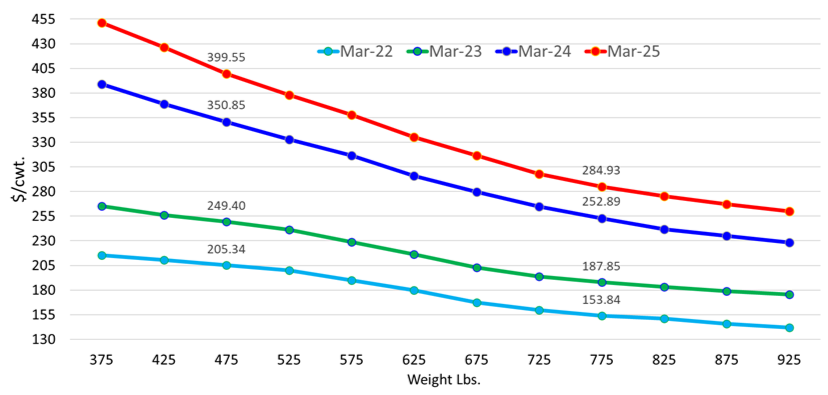
Figure 1. Price-Weight Relationship
Medium/Large No. 1 Steers, Oklahoma
As an example, Table 1 summarizes the prices and relationships between calf prices and feeder cattle for 475- and 775-pound steers. These prices are highlighted in Figure 1. In total, prices for calves increased by 94.6 percent from 2022 to 2025 while prices for 775-pound steers increased by 85.2 percent. Prices for the feeder steers increased faster initially in 2023 before the calf prices increased sharply in 2024 and 2025. In 2023, the March feeder prices were 75.3 percent of the calf price level but by 2025, the feeder price was 71.3 percent of calf price.
The price relationships between calves and feeder cattle determine the value of adding additional to calves as stockers. Table 1 includes the value of 300 pounds of gain between the 475-pound calves and 775-pound feeders. In 2022, the value of gain was $0.72/pound and increased to $1.03/pound by 2025. Over the four years, the value of gain increased by 43.1 percent.
| Weight | % | Year 2022 |
Year 2023 |
Year 2024 |
Year 2025 |
% Chg. 2022-2025 |
|---|---|---|---|---|---|---|
| Lbs. | $/Cwt. | $/Cwt. | $/Cwt. | $/Cwt. | ||
| 475 | $205.34 | $249.40 | $350.85 | $399.55 | +94.6 | |
| % Chg. YOY | +21.5 | +40.7 | +13.9 | |||
| 775 | $153.84 | $187.85 | $252.89 | $284.93 | +85.2 | |
| % Chg. YOY | +22.1 | +34.6 | +12.7 | |||
| 775 as % of 475 | 74.9 | 75.3 | 72.1 | 71.3 | ||
| VOG | ($/lb.) | $0.72 | $0.90 | $0.98 | $1.03 | +43.1 |
| % Chg. YOY | +25.0 | +8.2 | +5.8 |
YOY = Year over Year; VOG = Value of Gain
The increase in calf prices means that cow-calf revenue has increased dramatically in the past four years. Based on the March prices in Table 1, calf revenue has increased from $975.37/head in 2022 to $1,897.86/head, an increase of $922.49/head. In contrast, gross revenue for 300 pounds of stocker gain have increased from $216/head in 2022 to $309/head in 2025. If we assume that it would be possible to stock two head of stockers per cow, the total stocker revenue increase would be $186 on a per cow equivalent. In other words, cow-calf revenue has increased 424 percent more than stocker revenue from 2022 to 2025.
Current market conditions clearly favor calf production over stocker production. That is to say, grass has more value marketed as weaned calves compared to stocker-based gain. Cow-calf producers have increased incentives to maximize calf production compared to retaining calves for increased stocker gain. Stocker producers face challenging margins and limited opportunities in the current market. The combination of increased calf production incentives and relatively cheap feedlot cost of gain means that stockers are squeezed into a limited role generally favoring lighter beginning weights and faster turnover of stockers.
Spring Pasture Management
Mark Z. Johnson, Oklahoma State University Extension Beef Cattle Breeding Specialist
Much of Oklahoma finished the summer and fall of 2024 with drought stressed pastures. As we approach the season when soil temperature and photoperiod are priming warm season grasses to grow, it is important to assess damage to drought stressed pastures and manage accordingly. Following drought, stand damage is readily apparent even on well-managed pastures.
Keep the following in mind this spring to aid in recovery of drought stressed, warm season grass pastures:
- Damaged stands of grass CAN recover with weed control, proper fertility and deferred grazing.
- The best post-drought management approach is to reduce competition and focus on moisture conservation and use. Aggressive weed control measures reduce competition for moisture and soil nutrients allowing desirable plants the best opportunity for successful growth and re-establishment. Herbicides are best applied early!
- Fertilization will be most important for improved grasses (such as bermudagrass or Old World bluestem) in tandem with weed control.
- Permit the desirable grasses to stay ahead of grazing pressure. Manage as if it is a new stand of grass to give time for root systems to grow and re-establish.
- It may be necessary to sacrifice specific grazing paddocks or pastures in order to let the majority of pastures recover by delaying grazing pressure.
- Make a plan now for warm season grass pastures and hay meadows with the health of desirable plant species in mind.
- Considering the potential for a continued lack of moisture make sure fertility, weed control and grazing pressure permit your desired plant species to capitalize on the moisture when it comes.
Reference
Pasture Recovery Following Drought. Oklahoma Cooperative Extension Fact Sheet PSS-2592.
Enhancing Meat Quality Through Management Decisions Pre-Calving
Paul Beck, Oklahoma State University Cooperative Extension Service Beef Cattle Nutrition Specialist
Meat quality is influenced by various factors that affect the consumer's eating experience, including tenderness, marbling, and fat composition. While many factors contribute to the final product, beef producers play a key role in shaping meat quality through their management and nutritional decisions, even before an animal is born.
Production systems vary widely based on climate and economics, but management choices made before birth can significantly impact meat quality. Key decisions include breed selection and maternal nutrition.
Breed type affects meat quality. Bos taurus breeds, such as Angus and Hereford, tend to have higher marbling scores than Bos indicus breeds. Crossbreeding beef and dairy genetics can optimize efficiency and carcass quality, with research ongoing to determine the best breed combinations for superior meat characteristics.
A dam's uterine capacity and diet during pregnancy directly impact the offspring’s muscle development, fat composition, and overall meat quality. Intrauterine growth restriction can limit muscle fiber development and reduce marbling. Proper maternal nutrition helps mitigate these effects. Studies show that protein supplementation during gestation improves marbling and meat tenderness, while both undernutrition and overnutrition of the beef cow during gestation can negatively impact carcass traits of their calves.
Feeding antioxidant-rich diets to pregnant cattle can enhance the offspring’s meat quality by improving shelf life and flavor stability. Research suggests that plant-based antioxidants, such as rosemary and thyme, can reduce fat oxidation, preserving meat tenderness and taste.
Beef producers have a significant influence on meat quality through breeding choices and nutrition management. Understanding these factors and implementing best practices from conception through finishing can lead to higher-quality beef, improving both consumer satisfaction and market value.
Reference
Beck, P.A., Beck, M.R., Apple, J.K., 2024. Production systems and nutrition. In: Encyclopedia of Meat Sciences III, vol. 1. https://dx.doi.org/10.1016/B978-0-323-85125-1.00029-6. ISBN: 9780323851251