

Cow-Calf Corner | July 28, 2025
Still Looking for Replacement Heifers
Derrell S. Peel, Oklahoma State University Extension Livestock Marketing Specialist
The July Cattle on Feed (COF) report showed the continued decrease in feedlot inventories. Feedlot placements in June were down 7.9 percent year over year, more than expected. June feedlot marketings were down 4.4 percent year over year, in line with pre-report expectations.
Over the past six months, total placements were 5.0 percent less than one year earlier while total marketings were down 4.0 percent year over year. Placements decreased by 539 thousand head and marketings decreased by 437 thousand head in the past six months. The difference means that placements decreased by 102 thousand head more than marketings thereby reducing feedlot inventories. Average placements and marketings have generally been falling for roughly five years, at a faster rate recently (Figure 1). Decreased flow of cattle through feedlots corresponds to the decline in total calf crop since the cyclical peak in 2018.
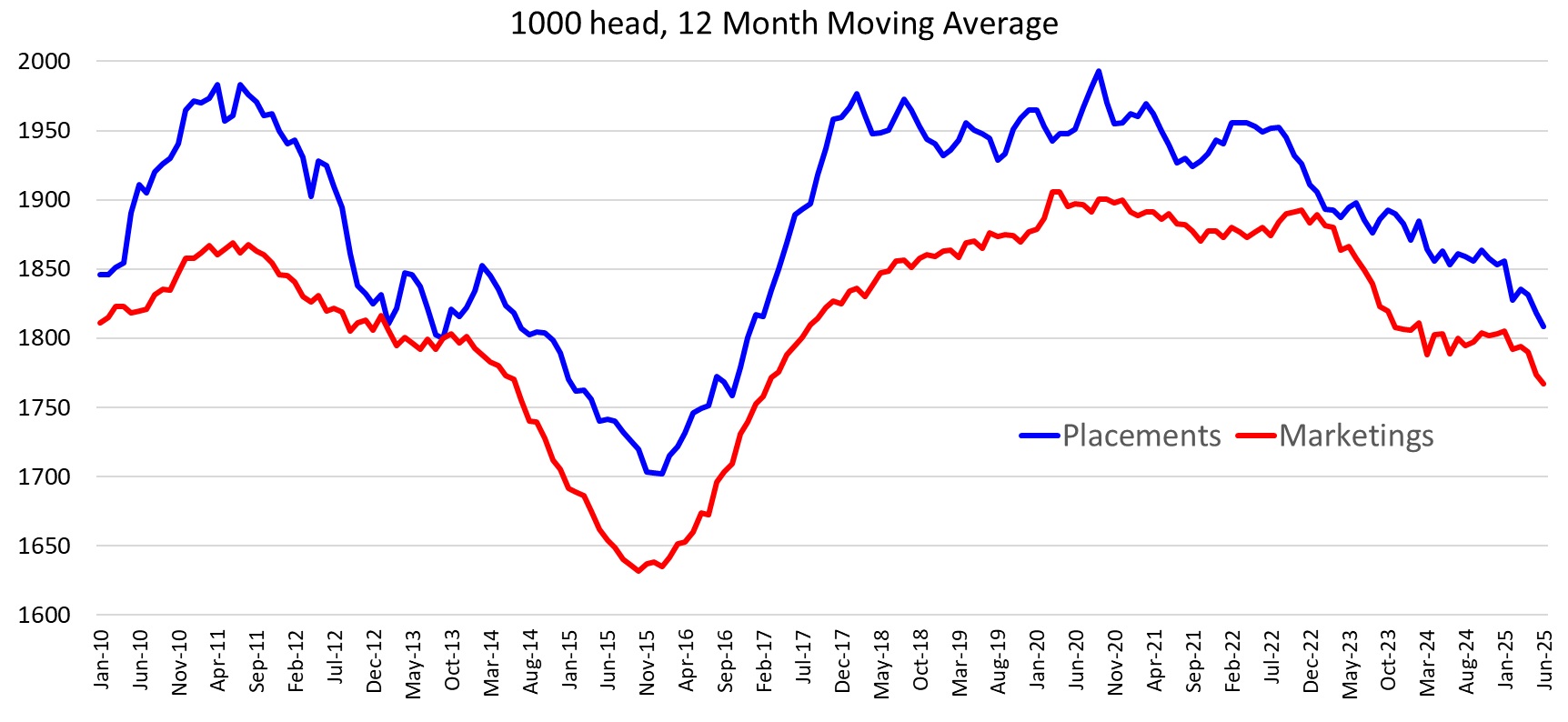
Figure 1. Feedlot Placements and Marketings
The July 1 feedlot inventory was 11.124 million head, down 1.6 percent year over year. This is the eighth consecutive month of year-over-year decreases in feedlot numbers. The 12-month moving average of feedlot inventories has now dropped to the lowest level since May 2019. However, the current level is just 2.9 percent below the peak level in September 2022, indicating that feedlot inventories have declined slowly compared to the calf crop.. The estimated 2025 calf crop is 33.1 million head, 8.8 percent lower than the cyclical peak in 2018. The estimated supply of feeder cattle outside of feedlots in the July Cattle report is the smallest in 29 years of available data.
The July COF report also included the quarterly breakdown of steers and heifers in feedlots.
Heifers in feedlots decreased by 5.4 percent from last year. However, heifers, as a percentage of total feedlot inventories, was 38.1 percent, up from the April 1 level of 37.6 percent. The number of heifers in feedlots would indicate that heifer retention is not underway to a significant level.
The July Cattle report provided a mid-year look at cattle inventories. The report is tricky to interpret since there was no report last year for comparison. The report showed total cattle inventories at 94.2 million head, down 1.3 percent from the 2023 level. Most report categories were down in the two-year comparison as the industry was clearly liquidating through 2024.
The beef cow inventory was reported at 28.65 million head, down 1.5 percent from 2023 but up 2.8 percent compared to the January 1 level. Historically, this would indicate some herd growth in the first half of the year but there is little other data to corroborate this estimate. Beef replacement heifers for July 1 were 3.7 million head, down 5.1 percent from two years ago. The comparison of July to January beef replacement heifers was about the same as two years ago and does not indicate heifer retention. From the other inventory categories, the estimated supply of feeder cattle outside feedlots is 34.0 million head, the lowest in 29 years of available data.
Taken together, the July Cattle on Feed and the Cattle reports do not indicate significant heifer retention. My feeling is that some movement towards herd rebuilding may be starting but is very slow and cautious. It is possible, perhaps even likely, that the January 2025 beef cow herd will be the cyclical low, but the January 2026 inventory will likely be close to unchanged showing very little, if any, growth this year.
Derrell Peel, OSU Extension livestock marketing specialist, discusses heifer retention and how the lack of herd rebuilding is impacting the market on SunUpTV from July 21, 2025 at SunUpTV: Livestock Marketing - July 19, 2025 ( YouTube )
For Extension fact sheets & more visit, the OSU Extension website.
Expected Beef Yield from a Butcher Calf
Mark Z. Johnson, Oklahoma State University Extension Beef Cattle Breeding Specialist
Producers who finish their own calves or consumers who purchase a finished butcher calf often face the question of how much beef they will take home after the harvest and cutting process. The answer to the question dictates how much freezer space will be needed. The amount of product yielded from a finished beef calf is often misunderstood. Accordingly, this topic addresses what to expect in terms of the relationship between live weight, carcass weight and actual take home product from the carcass.
Dressing Percentage (DP) is the portion of the live weight that will result in hot carcass weight (HCW) after removal of the head, hide and internal organs. For most fed cattle, the HCW will range from 60 – 64%. HCW will vary and is influenced by gut fill, degree of muscularity and fatness, mud or manure on the hide, and pregnancy status. For example, a 1500 live finished beef calf with a dressing percentage of 63% DP would yield a 945 pound carcass. The 945 pound HCW is not the amount of beef the consumer will take home to put in the freezer. It is noteworthy that a chilled carcass weight will be 2 - 5 percent lower than HCW. A beef carcass is 70 – 75 percent water, as it chills water evaporation will cause the carcass weight to decrease.
Chilled Carcass Weight, Primals, Sub-Primals and Retail Cuts
After the carcass is cooled, it will be further processed into cuts of meat. This process is referred to as “breaking down the carcass.” Beef primal cuts are the rib, chuck, shank, brisket, plate, flank, round, short loin and the sirloin. Primal cuts will be further processed into sub-primal or retail cuts. The basic concept is to remove the majority of the bones, separate tender muscles from less tender muscles, to separate thicker muscles from thin muscles and to separate fatter from leaner portions. There are several factors that will influence the amount of beef that will be wrapped for the freezer. The most common factors influencing variation include:
External Carcass Fat has the greatest impact on the percentage of retail product from a carcass. As more fat is trimmed away, less weight will be in the packaged meat.
Superior Carcass Muscularity will increase the percentage of retail product. For example, Dairy-type cattle typically yield lower than beef-type cattle.
Cutting Style or the cutting specs given to the processor can effect the take home yield. This can be a major influence based on the amount of bone-in versus boneless cuts, how much external fat is trimmed off and the amount of fat in the ground beef.
Carcass Aging (typically for 7 – 10 days) offers the advantages of improving tenderness and intensifying the flavor of beef. With respect to carcass yield, long-term aging can have a negative effect.
Bottomline
As a general guideline, expect to take home about 42 percent of the live weight for consumption. If basing the prediction off the HCW, expect to take home roughly two-thirds. If using the 1500 pound live butcher calf with a 63% DP referenced in the above example, you will need freezer storage space for about 630 pounds of cut and wrapped beef. More detailed information is available in the material referenced below.
Reference
Rancher’s Thursday Lunchtime Series: Grazing Management Practices at Work in LeFlore County Oklahoma
David Lalman and Paul Beck OSU Extension Beef Cattle Specialists
The next Ranchers’ Thursday Lunchtime Series began last Thursday, July 24 and will continue through August 28.
In this week the series will visit with David Pickle a well-managed cow/calf operation in LeFlore county.
These free webinar sessions are scheduled for Thursdays at noon. Join our Beef Cattle Extension team, experienced ranchers and scientists, to learn and share beef cattle production, grazing management, and parasite control!
Upcoming
Thursday, July 31 - Zoom Webinar - noon to 1 pm
- Grazing and Management at Pickle Farms, LeFlore County – David Pickle, Pickle Farms; Liana Jones, LeFlore County Cooperative Extension; and Brian Freking, Cooperative Extension SE District Livestock Specialist
- Approaches to Change Grazing Distribution & Forage Quality in Native Grass – Dr Laura Goodman, Cooperative Extension State Rangeland Ecology Specialist and Dana Zook, Cooperative Extension NW District Livestock Specialist
Thursday, August 14 – Zoom Webinar - noon to 1 pm
Emerson Cattle Grazing Management Practices in McIntosh County – Josh Emerson, Emerson Cattle; Pam Ward, McIntosh County Cooperative Extension; and Earl Ward, Cooperative Extension NE District Livestock Specialist
Thursday, August 21 – Zoom Webinar - noon to 1 pm
Adaptive vs Continuous Grazing Management: Advantages and Antagonisms – Brian Pugh, Cooperative Extension State Forage Agronomist
Thursday, August 28 – Zoom Webinar - noon to 1 pm
Results of the Statewide Parasite Resistance Study – Dr. Rosslyn Biggs, DVM, Cooperative Extension State Beef Cattle Specialist
To register and review the detailed schedule, visit the Beef Extension website.
Register Online
Ranchers' Thursday Lunchtime Series
Missed an article or want to re-read a past article? Previous editions of the Cow-Calf Corner Newsletter are available at Timely Tips for Oklahoma Producers.