

Cow-Calf Corner | July 21, 2025
Drought Mostly in the West
Derrell S. Peel, Oklahoma State University Extension Livestock Marketing Specialist
Drought conditions have diminished significantly in much of the eastern two-thirds of the country while drought continues to expand and deepen in the west, Pacific Northwest and across the northern plains areas of Montana and North Dakota (Figure 1). Drought conditions have improved in the past two months in several major beef cow states including Texas, Oklahoma, Kansas, Nebraska and South Dakota.
Range and pasture conditions in the eight western states (AZ, CA, ID, NV, NM, OR, UT, WA) include 39.9 percent poor and very poor conditions, worse than last year and the five-year average for this date. In the Great Plains region (CO, KS, MT, NE, ND, SD, WY), 25.7 percent of pastures and ranges are in poor to very poor condition, higher than last year and the five-year average. In contrast, Texas and Oklahoma have just 15 percent of ranges and pastures in poor and very poor condition, compared to year-ago and five-year averages both over 26 percent for this date.
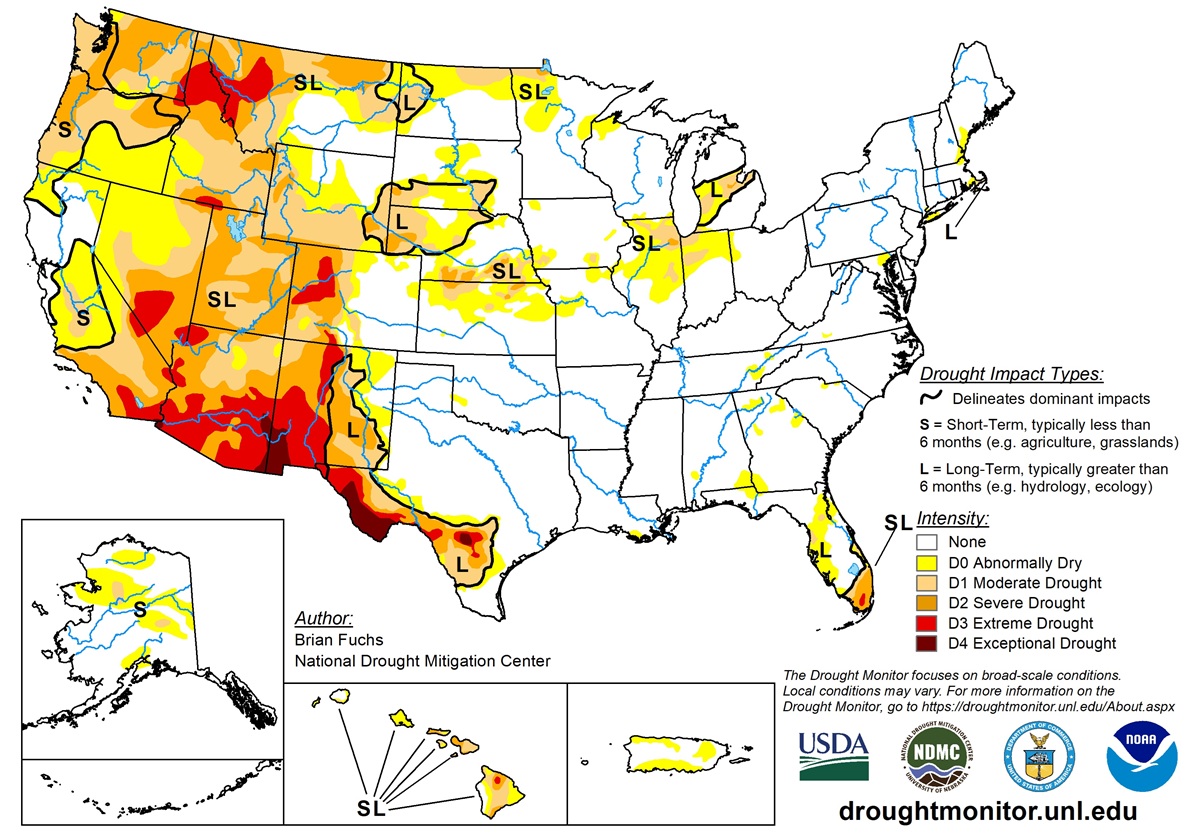
Figure 1. U.S. Drought Monitor Map; July 15, 2025 (released Thursday, July 17, 2025) Valid 8 a.m. EDT
To what extent is drought limiting efforts or potential to initiate beef cow herd rebuilding this summer? Probably not a great deal and certainly less in total than any time in recent years. Although some producers are still being impacted by drought, most of the current drought regions have relatively low beef cow numbers and would not offset increases in other regions.
By contrast, ample moisture in some regions is resulting in forage production that is outpacing animal grazing. In some cases, excessively wet conditions are hindering hay production, at least in terms of quality, if not quantity. Anecdotal reports from producers and lenders suggest considerable producer interest in retaining heifers but the indications are that the pace is slow. Upcoming USDA reports will hopefully provide more insight into whether and how much herd building is underway.
Heifer slaughter has been declining in recent weeks and is down 3.5 percent year over year thus far in 2025 (down 5.6 percent in recent weeks). Beef cow slaughter is down 16.5 percent year over year. If the current beef cow slaughter rate persists for the remainder of the year, herd culling in 2025 may drop below 9.0 percent, a level that is certainly consistent with herd rebuilding. Taken together, heifer and beef cow slaughter suggest that the beef cow herd may stabilize and possibly increase fractionally by the end of the year.
Feeder and fed cattle markets have shrugged off the summer doldrums and moved higher in the past week. Choice boxed beef prices, which pulled back about five percent from the late June highs, stabilized last week and will likely move mostly sideways through the heat of the summer. Cattle prices are expected to remain very strong with muted seasonal tendencies in the fall.
Foxtail – The Unwanted Grass
Mark Z. Johnson, Oklahoma State University Extension Beef Cattle Breeding Specialist
It is apparent that the ample moisture and cooler than normal temperatures in Oklahoma over the spring and early summer has resulted in a great deal of Foxtail infestation in many pastures and hay meadows. This is a very competitive plant and conditions have been favorable for it this year. This is unfortunate and a problem that needs to be addressed.
What is Foxtail?
Foxtail is an annual, warm-season, weedy grass that is problematic. It consist of three varieties, Green Foxtail, Yellow Foxtail and Giant Foxtail. Small infestations can be spot treated, larger infestations can require renovation of an entire pasture. It reproduces annually by seed with germination from April to June and seedheads develop from July to September. Foxtails are characterized by bushy seedheads, which resemble a fox’s tail. Foxtails are adaptable and can thrive in various environments, including lawns, pastures, cultivated fields and disturbed areas. Cattle will graze Foxtail when the plants are young and before seedheads develop. Cattle do not like to graze Foxtail after seedheads have developed. The risks associated with grazing mature plants include the seedheads becoming lodged in the mouth, gums, tongue nose or eyes. This can lead to injuries, infections, decreased appetite and weight loss.
Controlling Foxtail
Controlling Foxtail can be a cumbersome process, since it is a grass, most broadleaf herbicides do not control it. Depending on the degree of infestation a combination of herbicides, tillage and mowing may be necessary. Beware that mowing existing Foxtail at this time of year has been ineffective, as the plant will send up another seedhead on a shorter stalk. Seedheads are dense and well populated so a long-term management approach including tillage and herbicide will be most successful as a means to exhaust the seed bank in the soil. Read the reference material below for more information on identifying Foxtail and effective control measures.
Best Management Practices Regarding Foxtail
- Regularly inspect your pastures and hay for the presence of Foxtail.
- Never feed hay that is heavily contaminated with mature Foxtail to cattle. In addition to the health issue mentioned above, hay feeding will spread the seed.
- Cattle that have been grazing infested areas can bring the seed into good pastures, either in their haircoat, feet or gastrointestinal tract. It will take two to three days for seed to pass through the digestive system and the seeds are still viable.
References
- Foxtail control in pastures and hayground, Oregon State University
- Foxtails, Oklahoma Agricultural Experiment Station
- Controlling Weeds in Home Lawns, OSU Extension
Rancher’s Thursday Lunchtime Series: Grazing Management Practices at Work around Oklahoma
David Lalman and Paul Beck, Oklahoma State University Extension Beef Cattle Specialists
The next Ranchers’ Thursday Lunchtime Series begins this Thursday, July 24 and will continue through August 28.
In this series we will visit well-managed cow/calf operations in Jackson, LeFlore, and McIntosh counties.
These free webinar sessions are scheduled for Thursdays at noon. Join our Beef Cattle Extension team, experienced ranchers and scientists, to learn and share beef cattle production, grazing management, and parasite control!
View the Rancher's Thursday Lunchtime Series flyer for more information.
Thursday, July 24 - Zoom Webinar - noon to 1 pm
Grazing Strategies at Abernathy Angus in Jackson County – Reed Abernathy, Abernathy Angus; Halee Salmon, Jackson County Cooperative Extension; and Marty New, Cooperative Extension SW District Livestock Specialist
Thursday, July 31 - Zoom Webinar - noon to 1 pm
- Grazing and Management at Pickle Farms, LeFlore County – David Pickle, Pickle Farms; Liana Jones, LeFlore County Cooperative Extension; and Brian Freking, Cooperative Extension SE District Livestock Specialist
- Approaches to Change Grazing Distribution & Forage Quality in Native Grass – Dr Laura Goodman, Cooperative Extension State Rangeland Ecology Specialist and Dana Zook, Cooperative Extension NW District Livestock Specialist
Thursday, August 14 – Zoom Webinar - noon to 1 pm
Emerson Cattle Grazing Management Practices in McIntosh County – Josh Emerson, Emerson Cattle; Pam Ward, McIntosh County Cooperative Extension; and Earl Ward, Cooperative Extension NE District Livestock Specialist
Thursday, August 21 – Zoom Webinar - noon to 1 pm
Adaptive vs Continuous Grazing Management: Advantages and Antagonisms – Brian Pugh, Cooperative Extension State Forage Agronomist
Thursday, August 28 – Zoom Webinar - noon to 1 pm
Results of the Statewide Parasite Resistance Study – Dr. Rosslyn Biggs, DVM, Cooperative Extension State Beef Cattle Specialist
To register and review the detailed schedule, visit the Beef Extension website.
Register Online
Ranchers' Thursday Lunchtime Series
Missed an article or want to re-read a past article? Previous editions of the Cow-Calf Corner Newsletter are available at Timely Tips for Oklahoma Producers