

Cow-Calf Corner | August 4, 2025
Winter Stocker Grazing Prospects
Derrell S. Peel, Oklahoma State University Extension Livestock Marketing Specialist
Why worry about winter grazing in early August? In just a few weeks, producers interested in grazing winter wheat (or other cool season cereals) for dual-purpose or forage-only grazing will be thinking about planting for fall/winter grazing. It’s not too early to begin evaluating the economic and agronomic conditions and considerations for possible winter stocker production.
Agronomic conditions will determine the feasibility and potential for early wheat planting. Factors such as soil moisture and soil temperature will determine just how early wheat can be planted. Additionally, producers must evaluate the early-planting trade-off between earlier grazing potential and the additional risk of limited forage production due to the likelihood of increased pest and weed challenges and uncertainty about fall moisture for continued growth of early-planted wheat.
Economic considerations include preparing a budget, estimating the breakeven cost of production and evaluating returns potential and risk. General market conditions determine the overall potential for stocker production, expressed as the gross margin, i.e. value of gain for added weight of feeder cattle. Table 1 shows prices and value per head for steers in early August as well as current value of gain for a range of beginning weights and added weight gain. For example, the table shows that the value of 250 pounds of gain for a 500-pound steer at the current time is $2.03/lb. The value of gain varies depending on the beginning weight and the total amount of weight added. Of course, changes in feeder cattle price levels and relative prices between stocker purchase prices and feeder sales prices also change the value of gain.
| Weight (lbs) | Average Price ($/cwt.) | Total Value ($/hd) | VOG 400 lb. Beg. Weight ($/lb.) | VOG 450 lb. Beg. Weight ($/lb | VOG 500 lb. Beg. Weight ($/lb.) | VOG 550 lb. Beg. Weight ($/lb.) | VOG 600 lb. Beg. Weight ($/lb.) | VOG 650 lb. Beg. Weight ($/lb.) |
|---|---|---|---|---|---|---|---|---|
| 400 | $487.05 | $1,948 | - | - | - | - | - | - |
| 450 | $460.69 | $2,073 | $2.50 | - | - | - | - | - |
| 500 | $432.84 | $2,164 $2.16 | $1.82 | - | - | - | - | - |
| 550 | $414.33 | $2,279 | $2.20 | $2.06 | $2.29 | - | - | - |
| 600 | $396.65 | $2,380 | $2.16 | $2.05 | $2.16 | $2.02 | - | - |
| 650 | $379.50 | $2,467 | $2.07 | $1.97 | $2.02 | $1.88 | $1.74 | - |
| 700 | $369.83 | $2,589 | $2.14 | $2.06 | $2.12 | $2.07 | $2.09 | $2.44 |
| 750 | $356.27 | $2,672 | $2.07 | $2.00 | $2.03 | $1.97 | $1.95 | $2.05 |
| 800 | $342.99 | $2,744 | $1.99 | $1.92 | $1.93 | $1.86 | $1.82 | $1.85 |
| 850 | $332.22 | $2,824 | $1.95 | $1.88 | $1.88 | $1.82 | $1.78 | $1.79 |
| 900 | $324.71 | $2,922 | $1.95 | $1.89 | $1.90 | $1.84 | $1.81 | $1.82 |
The next step is to determine the cost of production and determine if the value of gain covers production costs and offers acceptable returns for the stocker enterprise. Beyond the first cost of the stocker animal (which is covered in the calculation of the value of gain), the value of gain must cover all other production costs plus economic returns to the enterprise. In the example above, $2.03/lb. times 250 pounds of gain is a per head margin of $508, which must cover costs for feed (grazing and supplements), vet/medicine, death loss, interest, and daily care costs plus returns for management and unpaid labor. Total cattle and production cost divided by ending weight provides a breakeven value which is compared to expected selling price to determine potential returns. Cattle breakevens will vary significantly across different operations and depend heavily on the grazing cost. The values of gain in Table 1 suggest the likelihood of positive returns at current market prices.
The market risk of stocker production is due to the fact that the animal is not bought and sold at the same time. The stocker purchase price is known from current market values, but the selling price depends on market changes during 4-5 months of stocker grazing. Feeder futures prices can provide an indication of feeder prices in the coming months. The current Feeder futures price for March 2026 is roughly $315-$320/cwt. (subject to lots of daily volatility). The March futures price is significantly lower than current cash and futures prices. Deferred futures are sharply discounted and have been rising to meet cash in recent months. For example, the August feeder contract was priced at about $296/cwt. on May 1 but is currently over $336/cwt. moving toward expiration of the contract this month.
It is likely that feeder prices will be higher than the March Feeder futures currently suggest, but the discounted futures prices means that some risk management alternatives are limited. Current feeder market prices suggest decent potential for stocker returns, subject to high levels of risk. Discounted futures prices means that it is likely not possible to lock in favorable margins for next spring and much of the return potential is “betting on the come”. Minimum pricing alternatives such as Puts or LRP contracts can provide some level of price coverage against market volatility and sharp price decreases.
Expected Beef Yield From a Butcher Calf – Part 2, Response to Questions
Mark Z. Johnson, Oklahoma State University Extension Beef Cattle Breeding Specialist
In response to questions received after the article last week on the expected beef yield from a butcher calf, this week additional information is provided. First, a quick recap of last week’s article. When having a butcher calf processed we face the question of how much freezer space will be needed for the take home product. As a general guideline, expect to take home about 42 percent of the live weight. If basing the prediction off of the HCW, expect to take home roughly two-thirds. For example, if we had a butcher calf with a 1,500 pound live finished weight, a dressing percentage of 63% would result in a 945 pound hot carcass weight. After breaking down the carcass and packaging the cuts, we should expect about 630 pounds of beef. The actual amount of product taken home for consumption will vary based on degree of fatness and muscularity, cutting specs and carcass aging.
Questions primarily focused on three topics.
What is the Expected Yield of Specific Cuts?
Below, figure 1 shows the expected yield of specific cuts from a 750 pound hot carcass weight.
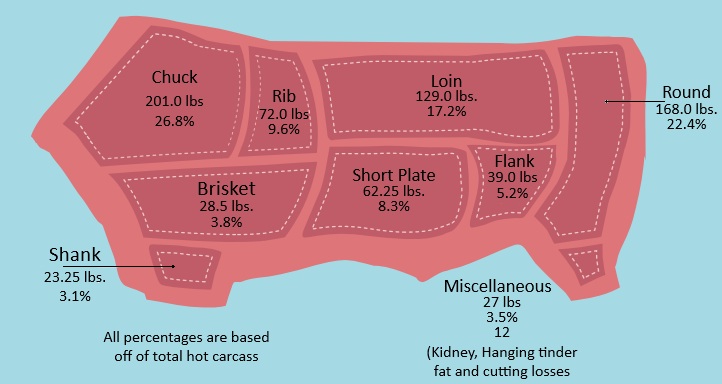
Figure 1. Typical Weights and Percent of a Chilled Carcass for the Various Primal Cuts of Beef from a 1,200-pound Live Steer (750-pound hot carcass).
What is the Number of Steaks Expected?
In addition to the percentages and pounds expected shown in figure 1, the following serves as a general guideline:
- 20 – 26 Ribeye Steaks
- 22 – 28 T-Bone/Porterhouse Steaks
- 6 – 8 Filets
- 10 – 14 Sirloin Steaks
The number of steaks yielded can vary a great deal based on the desired cut and thickness - most consumers prefer a steak between .75 – 1.5 inches of thickness. Steaks result from the rib and loin, which collectively account for just under 27% of the beef carcass. The remainder of the carcass is usually divided into roasts, tenderized steaks (often used for Chicken Fried Steaks), stew meat and ground beef.
How Much External Fat to Leave On?
Strive for an optimum amount. Fat enhances flavor, palatability and the perception of tenderness. A calf’s ability to put on fat is dependent on time on feed, the quality of the ration fed and genetic potential. Excessive amounts of external fat should be trimmed off. Although trimming off fat is not beneficial to the amount of take home product, a fatter carcass will lose less weight during the aging process. Most processors strive to provide the best quality product possible. Custom processing instructions allow the processor to provide the specific cuts the customer requests. Dialogue between the customer and processor often leads to a better eating experience.
References:
Supplementation Strategies for Stocker Calves Grazing Summer Pasture
Paul Beck, Oklahoma State University Cooperative Extension Beef Cattle Nutrition Specialist
Late summer is a critical period for stocker operations grazing both native rangeland and introduced pastures. While native grasses and introduced Old World bluestem pastures provide adequate forage during the growing season, their nutrient content—especially protein and energy—becomes limiting during late summer or under drought conditions. Introduced forage species such as bermudagrass are highly productive and usually provide adequate protein, but digestibility—and therefore energy content—declines in late summer, limiting stocker gains.
Strategic supplementation can help maintain optimal growth rates and maximize returns, but the key to success is matching the supplement to the pasture.
Why Supplement?
Correct Major Nutrient Deficiencies
As forages mature, their digestibility and protein levels decline. Stocker calves, especially those with high growth potential, may not meet their nutrient requirements from forage alone. Supplementation provides additional energy and protein to help calves maintain target average daily gains, improve feed efficiency, and reach market goals on time.
Deliver Feed Additives and Minerals
Medicated feed additives and minerals can be provided with the supplement to ensure proper dosage. Medicated feed additives improve performance and the efficiency of supplementation, and are often highly economical when included with supplements. Minerals are vital to all bodily processes, and deficiencies can negatively affect growth and immune function.
Support Livestock Management
Often overlooked economically, supplementation also provides management benefits. It allows for easier observation of cattle, improves disposition and handling of animals not accustomed to human interaction, and enhances grazing distribution when supplement is placed in underutilized areas.
Increase Pasture Carrying Capacity
Feeding higher supplementation rates can replace a portion of forage intake, effectively increasing pasture carrying capacity. This approach is useful for maintaining stocking rates during droughts or boosting them under normal conditions.
Looking Ahead
In upcoming newsletters, we will look at how supplementation rates affect stocker cattle gains and supplemental efficiency and discuss guidelines for choosing the right supplement program based on pasture conditions and production goals.
Upcoming
Thursday, July 31 - Zoom Webinar - noon to 1 pm
- Grazing and Management at Pickle Farms, LeFlore County – David Pickle, Pickle Farms; Liana Jones, LeFlore County Cooperative Extension; and Brian Freking, Cooperative Extension SE District Livestock Specialist
- Approaches to Change Grazing Distribution & Forage Quality in Native Grass – Dr Laura Goodman, Cooperative Extension State Rangeland Ecology Specialist and Dana Zook, Cooperative Extension NW District Livestock Specialist
Thursday, August 14 – Zoom Webinar - noon to 1 pm
Emerson Cattle Grazing Management Practices in McIntosh County – Josh Emerson, Emerson Cattle; Pam Ward, McIntosh County Cooperative Extension; and Earl Ward, Cooperative Extension NE District Livestock Specialist
Thursday, August 21 – Zoom Webinar - noon to 1 pm
Adaptive vs Continuous Grazing Management: Advantages and Antagonisms – Brian Pugh, Cooperative Extension State Forage Agronomist
Thursday, August 28 – Zoom Webinar - noon to 1 pm
Results of the Statewide Parasite Resistance Study – Dr. Rosslyn Biggs, DVM, Cooperative Extension State Beef Cattle Specialist
To register and review the detailed schedule, visit the Beef Extension website.
Register Online
Ranchers' Thursday Lunchtime Series
Missed an article or want to re-read a past article? Previous editions of the Cow-Calf Corner Newsletter are available at Timely Tips for Oklahoma Producers.