

Cow-Calf Corner | August 11, 2025
Cattle Market Factors We’re Not Talking Much About
Derrell S. Peel, Oklahoma State University Extension Livestock Marketing Specialist
Cattle and beef markets are very complex and impacted by many factors. At any point in time some factors will be more important and receive lots of attention while others are temporarily ignored. With cattle markets dominated by cattle inventory and cyclical dynamics, the following items are not being discussed much for now.
Pork and Poultry Prices
Beef prices are record high and there is lots of discussion about whether that can be sustained. However, it seems that changes in pork and poultry prices are having relatively little impact on beef demand. Figure 1 shows that pork loin prices have been relatively weak in 2025. Ham prices have been close to year-earlier levels so far this year with bellies (bacon) strong as always.
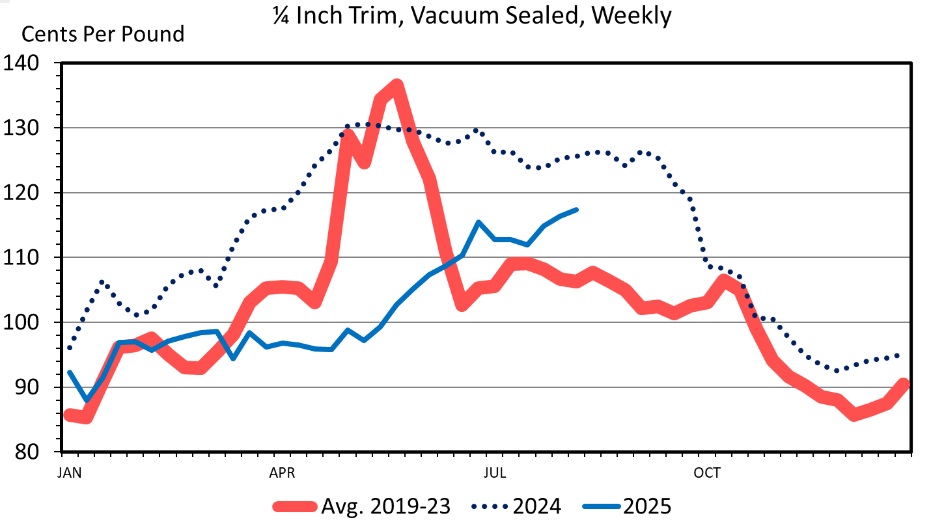
Figure 1. Wholesale Pork Loin Prices
Chicken breast meat prices have been higher year over year (Figure 2) along with chicken leg prices – perhaps getting some support from high beef prices. However, chicken wing prices dropped sharply lower year over year as soon as the Super Bowl was over.
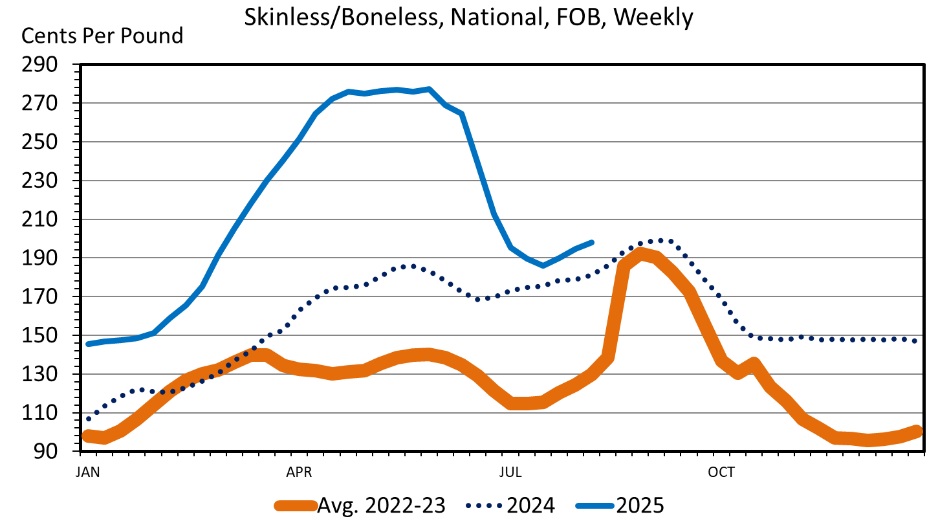
Figure 2. Wholesale Chicken Breast Prices
Cold Storage
Beef in cold storage is rarely a major cattle and beef market factor but is indicative of some market trends. Numerous factors impact beef cold storage supplies but the most important is the winter build-up of lean trimmings supplies resulting from seasonally large cow slaughter in the fall. Figure 3 shows that the sharp drop in cow slaughter in the past two years has resulted in significantly lower average cold storage supplies. This contributes to the current record high ground beef prices.
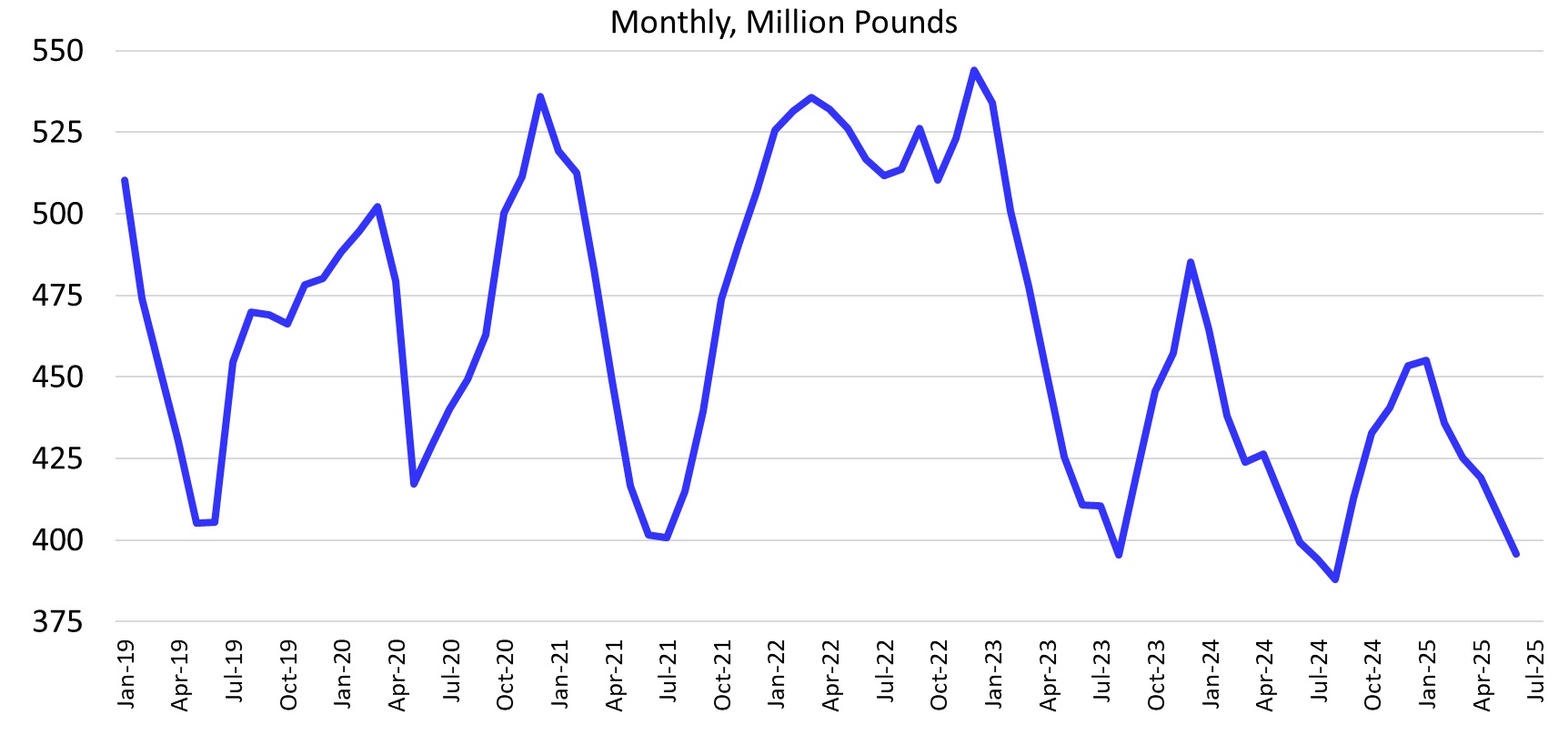
Figure 3. Beef Cold Storage
Beef By-Products
Beef by-products (or drop credit) have remained relatively steady in 2024 and 2025, down from previous years. The steer by-product value has averaged $11.59/live cwt. of fed cattle in 2025. This is down from nearly $14/live cwt. in 2022. Historically, hides made up the biggest component of the many items included in by-product values. However, hide values are very low worldwide. Tallow has been a larger component of by-product values recently, driven by biodiesel demand. It is noteworthy that by-product values have not kept pace with higher fed cattle prices. Historically by-product values were nearly 10 percent of live fed cattle prices but have averaged just 5.3 percent of fed prices in 2025 and most recently are less than five percent.
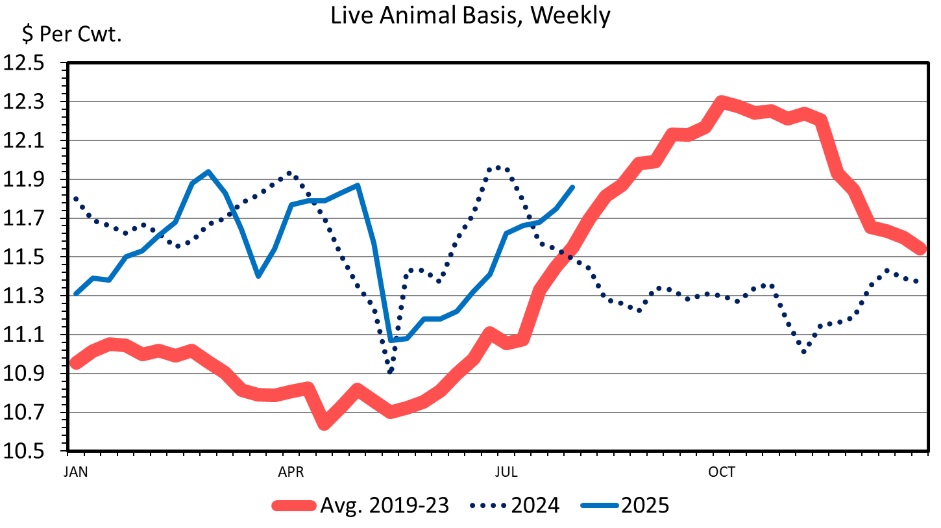
Figure 4. Steer Hide And Offal Value
What is Hay Worth This Year?
Mark Z. Johnson, Oklahoma State University Extension Beef Cattle Breeding Specialist
Over the past few weeks, once weather permitted baling of hay in Oklahoma and good yields were reported, buyers and sellers have been asking “What is hay worth this year?”
From January to May, the average price of all types of hay across the U.S. had been seasonally increasing, from $153/ton in January to $176/ton in May. With the majority of the country receiving ample spring and early summer moisture, May prices appear to have been the annual peak. In June, the same hay price was down $11 from a month earlier to $165/ton. Alfalfa posted a decrease as well, quoted at $177/ton, down $14 from May. As drought continues to hold a grip in the western U.S., it was mostly western states that quoted recent higher prices of hay.
As a result of increased hay stocks coming into 2025, more acres and Mother Nature’s help, hay prices have continued to trend lower. The price forecast had been for the U.S. hay price to average $165/ton in 2025. That expectation is likely on the high side, with potential back towards $157-$160 for an annual average. Prices are expected to have a typical seasonal decrease into the end of the year. Given that trend, fourth quarter prices should average around $150/ton.
Bottom Line: Increased acres and good weather will limit any significant increase in the hay market this year. While there may be some regional differences, prices are expected to trend near year ago levels, yet average $10-$15 lower in 2025. Accordingly, end users can be a little more patient this year in procurement as prices are expected to continue to trend lower for the next several months.
References:
- USDA: Oklahoma Direct Hay Report AMS Livestock, Poultry and Grain Market News OK Dept. of Ag Market News; Fri Aug 8, 2025
- CattleFax: Have Hay Prices Peaked? Troy Bockelmann;
Supplementation Rates for Stocker Calves Grazing Summer Pasture
Paul Beck, Oklahoma State University Cooperative Extension Beef Cattle Nutrition Specialist
In our last article, we discussed why summer supplementation is essential for stocker calves grazing native or introduced pastures. This article will focus on the effects of supplementation rate on stocker calf performance and supplementation efficiency.
Recent research at Oklahoma State University has evaluated varying rates of supplementation using extruded dried distillers grains (DDGS) cubes on summer native range pasture. The performance of steers grazing native range over a two-year trial at two locations in western Oklahoma—the Marvin Klemme Range Research Station near Bessie, OK, and the USDA-ARS Southern Plains Experimental Range near Ft. Supply, OK—under increasing rates of supplemental extruded DDGS cubes is shown in the table below.
Results show a clear linear improvement in weight gain with increasing supplementation rate up to a certain point. However, as supplementation rate increases, the marginal response decreases.
| 0 | 2 lbs/day | 4 lbs/day | 6 lbs/day | |
|---|---|---|---|---|
| % of Bodyweight | - | 0.25% | 0.5% | 0.75% |
| Average Daily Gain, lbs/day | 1.55 | 2.11 | 2.37 | 2.59 |
| Supplement Efficiency | - | 3.6 | 4.9 | 5.8 |
Table 1. Performance of Grazing Stocker Steers Grazing Native Range Pastures in Western Oklahoma with Increasing Supplementation Rates of Extruded Dried Distiller’s Grain Cubes
Feeding 2 pounds of supplement per day increased average daily gain by more than 0.5 lbs/day, requiring only 3.6 pounds of supplement per pound of added gain. At higher supplementation rates, the marginal increase in performance was smaller. Feeding 4 pounds per day increased gains by only 0.26 lbs/day over calves not receiving supplements, requiring 4.9 pounds of supplement per pound of added gain. Feeding 6 pounds per day increased gain by 1.03 lbs/day but required almost 6 pounds of supplement for each pound of additional gain.
Key Takeaways: Higher supplementation rates increased average daily gain, but efficiency decreased at higher rates. The cost of supplementation must be weighed against the value of added gain to ensure the program is economically viable. Next week, we will look at some general guidelines I use for designing supplementation programs.
Survey of Oklahoma Cattle Producers Regarding Ticks and Tick-Borne Diseases
Jonathon Cammock, OSU Cooperative Extension Livestock Entomologist
The Oklahoma State University Extension Livestock Entomology Program is seeking participants for a study on the impact of ticks on beef and dairy cattle production in Oklahoma. We are looking for producers who are willing to complete a brief survey, to help us assess tick and tick-borne disease knowledge and prevalence, and identify preventative measures taken to protect producers, employees, and livestock from tick bites and tick-borne diseases. Information collected will be used to develop Extension programming targeted at your needs as cattle producers. We would appreciate if you could take the time to participate!
To access the survey if you are interested in participating Questionnaire: Assessment of Oklahoma Cattle Producer’s Knowledge and Awareness of Ticks and Tick-Borne Diseases
Rancher’s Thursday Lunchtime Series Restart Set for August 14: Grazing Management Practices at Emerson Ranch in McIntosh County
David Lalman and Paul Beck OSU Extension Beef Cattle Specialists
After a one-week hiatus we will resume the Rancher’s Thursday Lunchtime Webinar Series on August 14 and will continue through August 28.
In this week the series will visit with John Emerson a well-managed cow/calf operation in McIntosh County.
These free webinar sessions are scheduled for Thursdays at noon. Join our Beef Cattle Extension team, experienced ranchers and scientists, to learn and share beef cattle production, grazing management, and parasite control!
Looking Ahead
In upcoming newsletters, we will look at how supplementation rates affect stocker cattle gains and supplemental efficiency and discuss guidelines for choosing the right supplement program based on pasture conditions and production goals.
Upcoming
- Thursday, August 14 – Zoom Webinar - noon to 1 pm
Emerson Cattle Grazing Management Practices in McIntosh County – Josh Emerson, Emerson Cattle; Pam Ward, McIntosh County Cooperative Extension; and Earl Ward, Cooperative Extension NE District Livestock Specialist - Thursday, August 21 – Zoom Webinar - noon to 1 pm
Adaptive vs Continuous Grazing Management: Advantages and Antagonisms – Brian Pugh, Cooperative Extension State Forage Agronomist - Thursday, August 28 – Zoom Webinar - noon to 1 pm
Results of the Statewide Parasite Resistance Study – Dr. Rosslyn Biggs, DVM, Cooperative Extension State Beef Cattle Specialist
To register and review the detailed schedule, visit the Beef Extension website.
Register Online
Ranchers' Thursday Lunchtime Series
Missed an article or want to re-read a past article? Previous editions of the Cow-Calf Corner Newsletter are available at Timely Tips for Oklahoma Producers.