

Social Media Marketing for Small Businesses: A Practical Guide
A significant number of small businesses use social media to connect with customers. With the average person spending nearly 2.5 hours a day on these platforms, social media offers a powerful opportunity to enhance marketing strategies (Kemp, 2024). Unlike traditional marketing, it offers benefits like real-time interactions with customers and a more human touch, amplifying the customer experience. Additionally, most social media platforms offer built-in analytics tools that help business owners deepen the understanding of their customer base and the impact of their social media efforts. In this fact sheet, we will discuss key strategies for using social media effectively for small businesses.
Topics include:
- Choosing the right platform(s)
- Creating engaging content
- Building a strong presence
- Growing your audience
- Measuring performance
Choosing the Right Platform(s)
When choosing a social media platform for your business, consider your marketing objectives as well as the type of content you plan to share most frequently. If your goal is to build a community around your brand, Facebook is an excellent choice. If you aim to visually showcase products through images and videos, Instagram may be the ideal platform. For businesses focused on sharing long-form videos, educational content or tutorials, YouTube offers the best format. Do not be afraid to experiment with different platforms to find the best fit for your business. You can also use multiple platforms with each serving a distinct purpose.
The graphs below show the percentage of United States adults' use of the three most popular social media platforms for small businesses, including YouTube, Facebook and Instagram (Digital Marketing Institute, 2024), broken down by age and gender (Pew Research Center, 2024). Percentage totals may exceed 100% due to participants being able to select multiple social media platforms. Understanding your target audience's demographics can be valuable when determining the right platforms for your business.
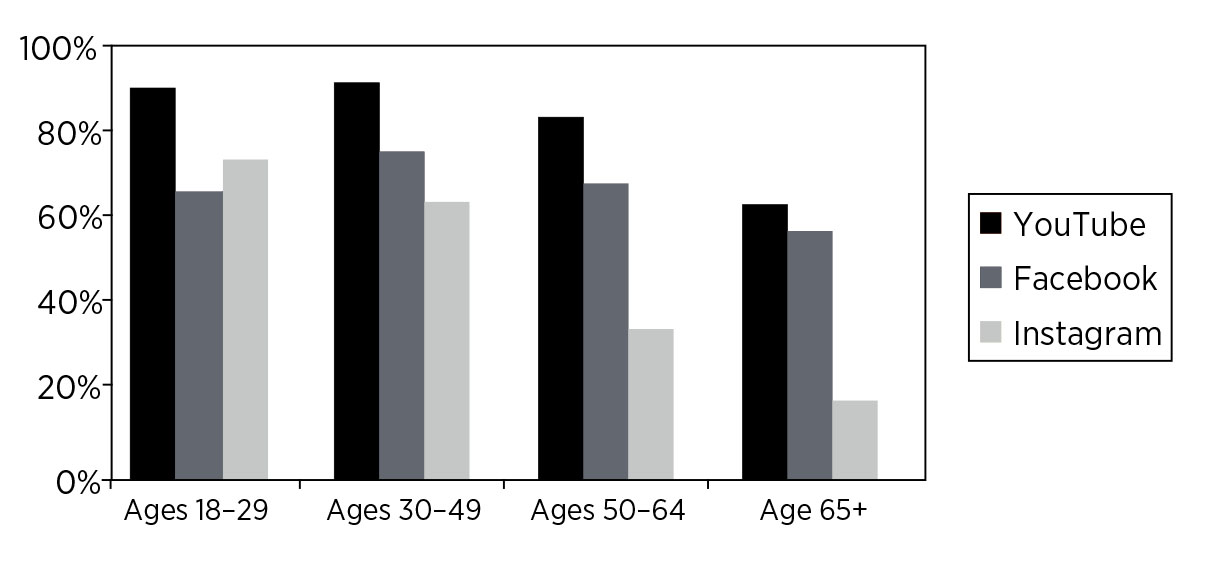
Figure 1. Percentage of U.S. adults' use of YouTube, Facebook and Instagram by age.
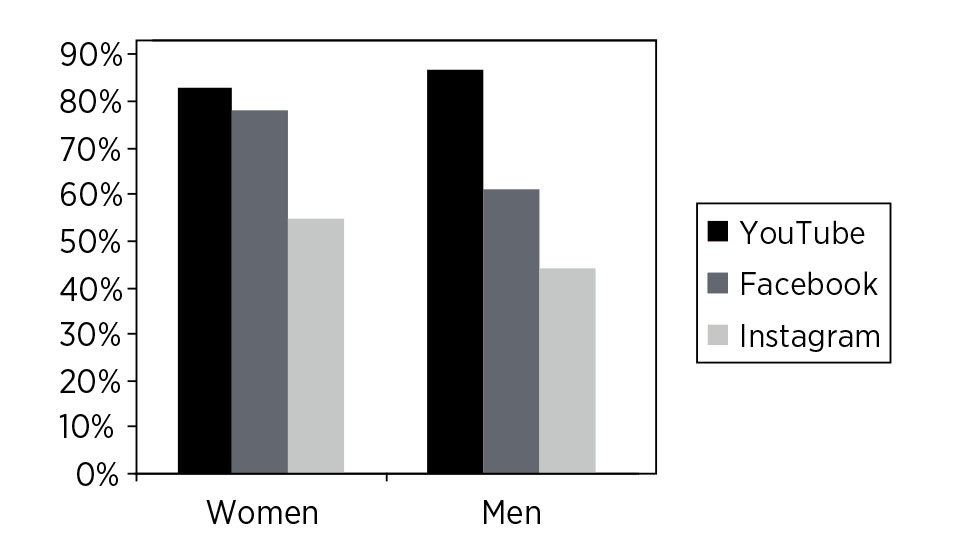
Figure 2. Percentage of U.S. adults' use of YouTube, Facebook and Instagram by gender.
Creating Engaging Content
Creating content that captures attention and drives interaction is essential in social media marketing. One effective approach is storytelling — sharing content that makes your brand more relatable and engaging. This could include behind-the-scenes footage, customer testimonials, product tutorials, team profiles or other narratives that showcase your brand's personality. While some content, like new product announcements or sales promotions, can be presented in a more straightforward manner, storytelling adds depth and keeps audiences interested.
Another way to create engaging content is by hosting events that generate buzz and can be shared as news stories. For example, local brick and mortar businesses might invite food trucks to use their parking lots during special events or on weekends. This not only encourages cross-promotion and attracts new customers but also creates shareable moments that can gain traction on social media.
Building a Strong Presence
Consistency is key to establishing a strong presence on social media. While there's no universal rule for how often to post, maintaining a regular and predictable posting schedule helps reinforce your brand's visibility. Studies have shown that posting specific days and at optimal times can improve audience reach, though these times can vary by platforms (Macready, 2024). To streamline your content strategy, take advantage of scheduling tools available on most social media platforms. These tools allow you to plan and schedule posts in advance, ensuring consistent activity without the need for real-time posting. However, keep in mind that once scheduled content goes live, timely engagement with your audience remains essential to maintaining an active and responsive online presence.
Hashtags are another way to increase your reach and engagement on social media. They are keywords or phrases preceded by a # (e.g., #SmallBusiness) that categorize content and make it searchable. When users search for a hashtag, they see all posts using it, giving your business the chance to reach new audiences. Since hashtags are free to use, they offer a cost-effective way to increase visibility and grow your following.
Growing your Audience
Expanding your social media audience requires more than just posting content; it's about building relationships and increasing visibility. Engaging with your followers is key. Responding to customers' questions or comments and addressing customer feedback show that your business is active and values its customers. Encouraging conversations through interactive posts, such as user-generated content and polls, can further boost engagement and attract new followers. While organic posts feel more authentic to customers, allow for more interaction and are more cost effective, growing your following this way can require time and patience (Morin-van Dam, 2024).
In addition to organic growth, you can benefit from paid promotions to reach a wider audience. Most social media platforms offer paid advertising options that allow you to target specific audiences based on specific criteria like demographics, location, interests or behavior. Even a small budget can increase your content's visibility and bring in potential customers who might not have found your business otherwise.
While paid posts can help broaden your reach more quickly, they often result in limited interaction. Although users can interact with the content on platforms like Instagram and Facebook, these interactions tend to be less organic than those on unpaid content. Relying solely on paid posts can lead to lower engagement, reduced authenticity and may hinder the sense of community or connection you're trying to build through social media.
Often, businesses will use a combination of organic and paid posts to maximize their reach. It may take some time and experimentation to find the balance that is right for your business.
Measuring Performance
By accessing analytics built into each platform, you can track the impact that using social media has on your business. But before diving into analytics, it's important to understand your goals for using social media in the first place.
- Are you wanting to grow your audience or client base?
- Are you looking to spread awareness about your business or brand?
- Do you want more people to visit your website and purchase products or services?
First, consider the results you are working to obtain. Then, see if the data show a positive impact toward that goal.
Analytics to consider:
- Engagement: Engagement is important. Likes, shares and comments will go a long way. If you are trying to expand your audience or spread awareness about your business, these interactions will be invaluable.
- Traffic & Conversion Rate: Conversion Rate analytics show the number or percentage of users who take a desired action, such as visiting your website or purchasing a product or service (Shopify, 2024). In order to view conversion rates for either Facebook or Instagram, you will need to access the Facebook Ads Manager. First, log into your business Facebook page. Then, click the menu button in the top-right corner. Next, find the Ads Manager under the Professional section. Lastly, click on the Ads Manger to open (Ghimire, 2023). Conversion Rate analytics are available for both paid and organic posts.
- Click-Through Rate (CTR): This metric shows how many people clicked a link or post and followed it to your website or landing page (Haans, et al., 2019). To determine your Click-Through Rate, you will also need to know the number of Impressions a post had. An Impression is the number of times users saw your content on a platform (Kenan, 2024).
- To calculate the Click-Through Rate (CTR):
- CTR = number of clicks ÷ number of impressions (x 100)
- For example, if you had 15 clicks and 100 impressions, your CTR would be 15%.
- To calculate the Click-Through Rate (CTR):
| Marketing goals | Key metric | What it measures |
|---|---|---|
| Are you looking to spread awareness about your business or brand? (Brand awareness) | Reach | The number of unique users who saw your content |
| Same market goals as the row above. | Impressions | Total views (total times your content was displayed) |
| Are you wanting to boost engagement on your social media posts? (Engagement) | Likes, Comments, Shares | How well/often your audience interacts with your posts |
| Do you want more people to visit your website and purchase products or services? (Traffic & Conversion) | Click-through rate (CTR) | Percentage of users who clicked on a link in your post or ad |
| Same market goals as the row above. | Conversions | The number of users who completed a desired action (e.g., purchase, sign-up) |
In Conclusion
Learning to use social media for your business can take time. Understanding your target audience and demographics will help to create a more meaningful experience for your customers and make a greater impact on your business. Engaging and effective content plays a key role, as a strong following naturally grows over time. You can then use the platform's built-in analytics to see what kind of content is giving you the best return on investment. Most importantly, be patient. Do not be afraid to engage with your customers, experiment and let the uniqueness of your business shine through.
References
Dam, Dorien Morin-van. “Organic Social Media Growth: Strategies to Win on Social.” Socialinsider Blog: Social Media Marketing Insights and Industry Tips , 8 Nov. 2024, www.socialinsider.io/blog/organic-social-media-growth/.
Digital Marketing Institute. “Which Social Media Platforms Should You Use for Your Business? | Online Digital Marketing Courses.” Digitalmarketinginstitute.com, 19 July 2024, digitalmarketinginstitute.com/blog/which-social-media-platforms-should-you-use-for-your-business.
Ghimire, Michael. “Where Is the Ads Manager on Facebook?” Privyr Blog, Dec. 2023, www.privyr.com/blog/where-is-the-ads-manager-on-facebook/. Accessed 6 Jan. 2025.
Haans, Hans, et al. “Search Engine Advertisements: The Impact of Advertising Statements on Click-through and Conversion Rates.” Marketing Letters, vol. 24, no. 2, 20 Feb. 2019, pp. 151–163, https://doi.org/10.1007/s11002-013-9226-5.
Kenan, Jamia . “Reach vs Impressions: What's the Difference in Terms?” Sprout Social, 20 Feb. 2024, sproutsocial.com/insights/reach-vs-impressions/.
Macready, Hannah. “Best Time to Post on Social Media in 2023 [ALL NETWORKS].” Social Media Marketing & Management Dashboard, 27 Mar. 2023, blog.hootsuite.com/best-time-to-post-on-social-media/.
Pew Research Center. “Social Media Fact Sheet.” Pew Research Center, 31 Jan. 2024, www.pewresearch.org/internet/fact-sheet/social-media/?tabItem=0ec23460-3241-4a1f-89bc-0c27fb641936.
Shopify. “How to Improve Your Social Media Conversion Rate (2024) - Shopify.” Shopify, 7 Aug. 2024, www.shopify.com/blog/social-media-conversion-rate#.
Simon Kemp. “Digital 2024: 5 Billion Social Media Users.” We Are Social USA, 31 Jan. 2024, wearesocial.com/us/blog/2024/01/digital-2024-5-billion-social-media-users/.