

From Health Data to Action: Using Community Health Data to Improve Community Health
Abstract
Community health data can help people understand local health needs and make informed choices. This fact sheet describes three sources of health data: county health rankings and roadmaps, Oklahoma State Department of Health OK2SHARE and community health needs assessments. It also gives five steps for using data to take action. Health data are important to identify health concerns, see who is most affected and choose ways to improve health.
Introduction
Where people live, work, learn and play can affect their health. Healthy food, health care, safe places to be active, transportation, housing and jobs all matter. Education can help people build healthy habits. Communities can also improve health by changing local policies, systems and places.
Changes to policies, systems and local places can make healthy choices easier. Health data can help local leaders, groups and residents find needs and set goals. Data can also help them work with partners, seek funds and plan programs.
Understanding Health Disparities
Health disparities are gaps in health between groups of people. Income, jobs, housing and where people live can play a role. For example, one county may have more chronic disease than a nearby county. Rural residents may have less access to health care than people in cities. Some neighborhoods may have fewer safe places to be active or buy healthy food. Local conditions can help explain these gaps. Personal choices are only part of the picture. Health data can help leaders direct support to people and places with the greatest needs.
The Role of Data in Community Change
Health data can help people look beyond personal choices. The data can show local factors that shape health. Leaders and partners can ask:
- What makes healthy choices hard?
- Who faces the greatest barriers?
- What local factors add to the problem?
- What changes could improve health?
Data can help leaders and partners use facts instead of guesses. Data can also help groups work toward shared goals.
| Data source | What it provides | How it can be used | Website |
|---|---|---|---|
| County health rankings and roadmaps | County data on health outcomes and factors that affect health, such as health behaviors, health care, income, education and the physical environment. | Identify health concerns, compare counties, and recognize patterns that may indicate opportunities for community action. | County Health Rankings |
| Oklahoma State Department of Health (OK2SHARE) | Oklahoma health data by county, age, race and ethnicity, disease, births and deaths. | Support grant applications, coalition planning, policy discussions and community assessments with state-specific data. | OK2SHARE |
| Community health needs assessments (CHNAs) | Local health needs and priorities identified by hospitals and health systems using data and community input. | Align Extension efforts with existing priorities, identify partners and support collaborative planning. | Available through local hospitals and healthcare systems. |
Other sources can also help explain local health:
- Oklahoma State Department of Health reports, the Behavioral Risk Factor Surveillance System (BRFSS)
- Vital statistics (birth and death records)
- Women, Infants and Children (WIC) programs
- SNAP-Ed and EFNEP program data
- School health surveys and report cards
- Local hospitals and clinics
- Community organizations and coalitions
No single source provides a complete picture of community health. Combining information from multiple sources often pro-duces a more accurate understanding of local needs.
Moving from Data to Action
Finding data is only the first step. Data are most useful when they lead to action. Leaders and partners can use health data to find concerns, learn what may cause them and choose ways to help.
The steps below show one way to use data for local action.
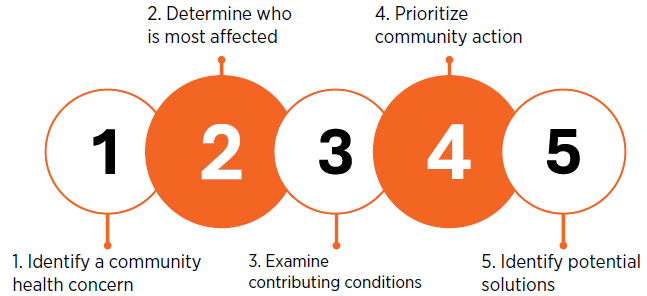
Figure 1. From health data to action: a framework for using community health data.
| Step | Key question | What to consider | Example |
|---|---|---|---|
| 1. Identify a community health concern. | What health issue is affecting our community? | Review local data to find important health problems and patterns. | High rates of obesity or diabetes, food insecurity, limited health care or low physical activity. |
| 2. Determine who is most affected. | Who experiences the greatest burden? | Examine differences by age, income, race/ethnicity, geographic location or other population characteristics. | Rural residents have higher rates of diabetes than urban residents. |
| 3. Examine contributing conditions. | What community conditions may be contributing to the issue? | Look beyond individual behaviors and consider environmental, social and systemic factors. | Few stores with healthy food, lack of transportation or few safe places to be active. |
| 4. Identify potential solutions. | What changes could improve community health? | Consider changes to policies, systems and local places that address the causes of the problem. | Build walking trails, support healthy food policies, improve referral systems or expand access to local resources. |
| 5. Prioritize community action. | Where should the community focus its efforts? | Consider how many people are affected, what resources are available and what the community can do. | Choose one or more priority issues. Then set goals and make an action plan. |
You do not need to be a data expert. Start by using data to understand local needs. Then use the findings to set priorities and choose actions. Changes to policies, systems and local places can make healthy choices easier.
References
Centers for Disease Control and Prevention. (n.d.). Social determinants of health. https://www.cdc.gov/social-determinants-of-health
County Health Rankings and Roadmaps. (n.d.). County Health Rankings & Roadmaps. https://www.countyhealthrankings.org
Oklahoma State Department of Health. (n.d.). OK2SHARE. https://health.ok.gov/data-and-statistics/ok2share
U.S. Department of Agriculture. (n.d.). Policy, systems, and environmental change. SNAP-Ed Connection. https://snaped.fns. usda.gov/snap-ed-works/policy-systems-and-environmental-change
U.S. Department of Health and Human Services. (n.d.). Social determinants of health. Healthy People 2030. https://health.gov/healthypeople