

Preparing for Grasshoppers in Summer Crops & Rangeland
Grasshoppers are out earlier each year it seems and 2025 is no different. Over this past week many growers have noticed several small grasshopper nymphs in wheat fields, pastures, and roadsides around the state. Below is information on grasshopper biology, how rains and other environmental factors impact their populations and development, and guidance on how you can manage grasshoppers early in the season. You can receive in the field, live updates on insect pests by following osu_crop_insects on Instagram.
Grasshopper Biology & Damage
Many have asked why we were seeing such an increase grasshopper numbers and so early. We know that drought and heat favor grasshopper invasions while rain and cold weather slow them down. With this past fall and winter being on the mild side until the freeze in January, female grasshoppers had plenty of opportunity to lay all their eggs over an extended period in soil where temperatures are warmer than ambient, above ground temperatures. As temperatures continue to warm, we will see a rise in populations. Grasshoppers lay their eggs from summer to fall about ½ to 2” into the ground and each egg pod can contain between 20-120 eggs. Dry falls favor high populations of grasshoppers in the spring.
Grasshoppers undergo simple metamorphosis, where the nymphs look like miniature adults but are wingless and unable to reproduce. Nymphs will have 5 or 6 instars where the grasshopper grows, and their wing pads develop. Grasshoppers take 40-60 days to complete a single generation. Eggs will hatch in late April and early May with peak hatching in June. Most grasshopper species will have 3 generations a year.
While high amounts of rain can help to decrease populations by drowning small nymphs, it’s unlikely that the recent rains will eliminate grasshoppers from the environment. However, cool wet springs can foster insect diseases that can also help with managing grasshopper populations. One of these naturally occurring fungi is Entomophthora grylli which will kill the grasshoppers when it is warm and humid. As we enter May and June, it will be important to monitor field margins for grasshoppers so you can manage them while they are still small nymphs if necessary.
Grasshoppers can compete with cattle for forage, reducing the quality and quantity available. Grasshoppers consume up to 50% of their body weight every day in forage. Cattle consume about 1.5-2.5% of their body weight in forage, so pound for pound, a grasshopper will eat 12-20 times as much plant material as a steer. In short, 30 pounds of grasshoppers will eat as much as a 600-pound steer. Some grasshoppers feed on the most desirable forage plants in the rangeland, leaving the less desirable plants. When coupled with drought conditions, grasshopper feeding can cause long-term deterioration of the forage plant community.
Grasshoppers can deplete crop stands, decimating seedlings. They can also cause defoliation in young plants, reducing and delaying growth and production which can negatively impact yield. In field crops, damage will typically occur within the first 50-100 feet on the field border.
Grasshoppers in Oklahoma
There are over 130 grasshopper species in Oklahoma, but two species in particular cause the most damage to crops, gardens, trees, and shrubs: the differential grasshopper, Melanoplus differentialis (Fig. 1), and the two-striped grasshopper, Melanoplus bivittatus (Fig. 2). The differential grasshopper has black chevron markings on the hind femur and a yellow body. Adults are quite large, ranging from 1 1/8 – 1 3/4" They will move into fields from weedy borders and will actively feed on crops. They can be especially devastating to young seedlings during stand establishment. The two-striped grasshoppers have a green to brown body (two color variations) with two light stripes that run from their eyes to their wing tips. Adults are around 1 3/4" long. This species will feed on weeds and then move into field crops. To learn more about grasshopper species in Oklahoma please see OK State Fact Sheet EPP-7341.
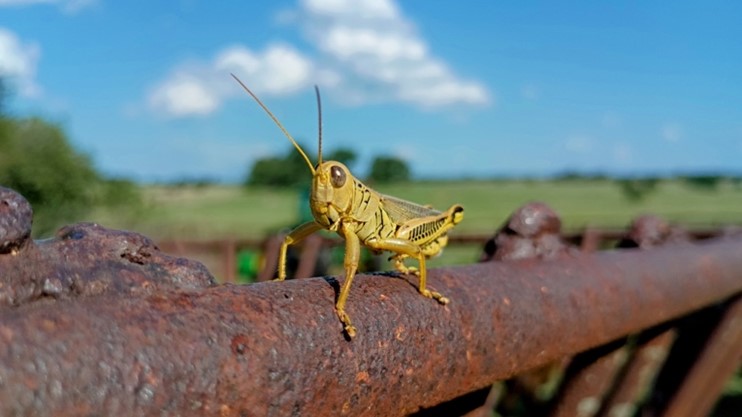
Figure 1. Differential grasshopper. Credit: Jonathan Cammack, OSU.
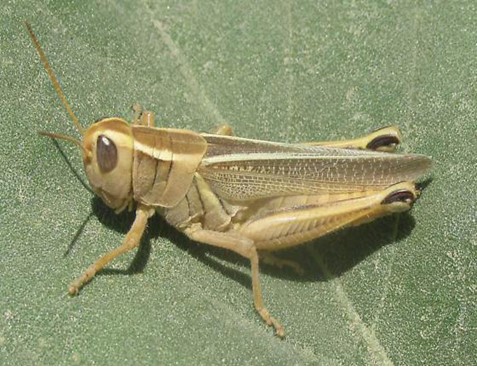
Figure 2a. The two color variations of the two-stripped grasshopper. Credit: Wyatt Hoback, Alex Harmon, & Tom Royer, OSU.
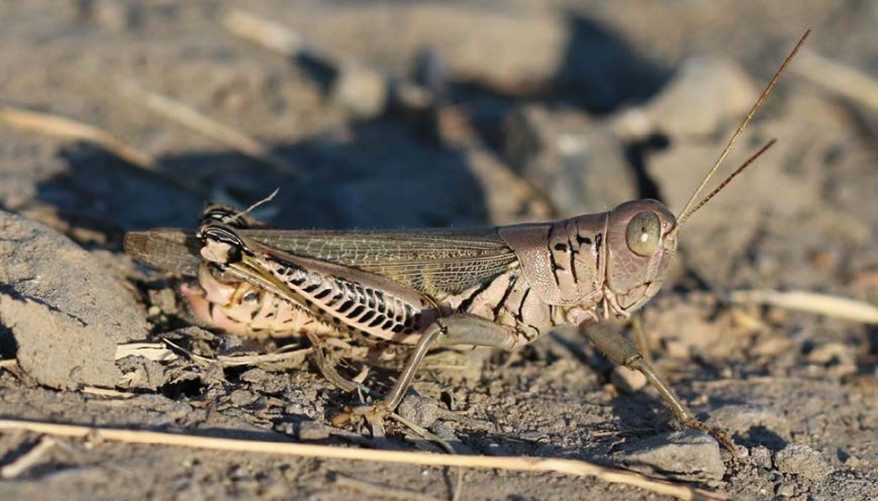
Figure 2b. The two color variations of the two-stripped grasshopper. Credit: Wyatt Hoback, Alex Harmon, & Tom Royer, OSU.
Grasshopper Management
Like with most insect pests, it is easiest to control grasshoppers when they are small (Fig. 3) and within their hatching sites of field borders, roadsides, and fencerows. By treating early, you can treat less area with less insecticide, kill grasshoppers before they cause extensive damage and before they can fly and migrate to reproduce and lay more eggs. Action thresholds for grasshoppers can be dependent upon the crop and based on the density of grasshoppers within a square yard (Table 1). A square yard can easily be estimated by taking a wire coat hanging and stretching it into a square. Other crops do not have action thresholds, so it is up to your discretion on the risk for your crop. Keep in mind the growth stage of the crop you are looking to protect as younger plants are more susceptible to grasshopper damage and may not recover from defoliation. This is also true for drought stressed crops.
Guidance from retired IPM Coordinator and Extension Cropping Systems Entomologist Dr. Tom Royer, insecticide applications in rangeland is probably never justified until numbers exceed 12 per square yard. A suggested threshold of 24 or more SMALL grasshoppers (less than ½ inches long) per square yard is a starting point for deciding whether to spray or not. The threshold for larger grasshoppers (greater than ½ inch long) is from 12-40 per square yard.
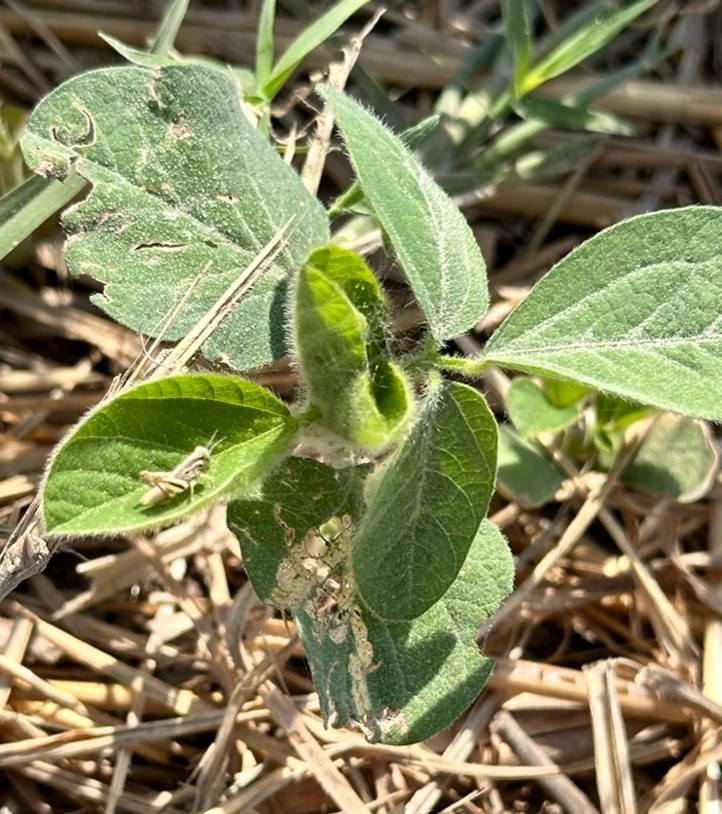
Figure 3. Early nymph grasshopper on a double crop soybean plant. Credit: Ashleigh M. Faris, OSU.
| Grasshopper Population | Field: # yd2 | Field Margin: # yd2 | Treatment Necessary? |
|---|---|---|---|
| Non-Economic | 0-2 | 5-10 | No |
| Light | 3-7 | 11-20 | Depends on crop |
| Moderate | 8-14 | 20-40 | Probably |
| Abundant | 15 or more | 41 or more | Yes |
Chemical Control for Grasshoppers in Field Crops
In terms of grasshopper management in field crops, it is best to apply insecticide to the entire field unless infestations are only at the field borders. Cotton producers in Altus and Sentinel area have been using Orthene for grasshopper control. Vantacor, which replaced Prevathon, is also an option and has a much more concentrated, lower use rate than Prevathon. If producers still have Prevathon on hand, they can still use it. Vantacor can be alternated with Dimilin for better control of grasshoppers. If applying a pre-emergent in the early part of the season, acephate can be applied at the same time to help with grasshopper control. For these insecticide options to be effective they must be applied to the nymph stages. Always read and follow label directions for any insecticide application.
Chemical Control for Grasshoppers in Rangeland
Grasshopper eggs are often deposited in concentrated egg-laying sites, such as pastures, ditches, and field margins that were not tilled. Grasshopper nymphs tend to remain concentrated in their hatching areas for some time after they emerge, so applying an approved insecticide as a spot treatment in those areas can effectively reduce grasshopper numbers in a local area. For grasshopper infestations in rangeland, applying insecticides in a swathing method can save on chemical and cost while still knocking back the population. This is referred to as the Reduced Agent and Area Treatments (RAATS). To learn more about the RAAT method, see OSU Fact Sheet EPP-7196.
Suggested pesticides must be registered and labeled for use by the Environmental Protection Agency and the Oklahoma Department of Agriculture & Forestry. The status of pesticide label clearances is subject to change and may have changed since this alert was produced.
The users are always responsible for the effects of pesticide residues on their livestock and crops, as well as for problems that could arise from drift or movement of the pesticide from their property to that of others. Always read and carefully follow the instructions on the container label.