

Plant Health Update, January 2025
The PDIDL was recently awarded funds from the Oklahoma Department of Agriculture, Food and Forestry Specialty Crops Block Grant. These funds allow diagnosticians to run advanced diagnostic methods including molecular analysis and DNA sequencing on samples submitted to the lab without passing the extra costs onto specialty crop growers.
There were 71 submissions to the PDIDL in January 2025, and 21 were classified as Oklahoma specialty crops. Table 1 summarizes the sample types and diagnostic findings.
| Submit Date | Host | County | Identification method | Diagnosis/Identification |
|---|---|---|---|---|
| 1/6/25 | Plant/weed Identification request | Okmulgee | Digital Diagnosis (Plant ID) | Rosaceous plant, exact ID not determined; New images requested |
| 1/6/25 | Lawn and landscape | Mcintosh | Digital Diagnosis (Insect ID) | Caterpillar, possibly fall armyworm |
| 1/6/25 | Lawn and landscape | Stephens | Digital Diagnosis (Insect ID) | Not an arthropod; Samara seeds |
| 1/8/25 | Magnolia | Cleveland | Digital Diagnosis (Disease ID) | Winter injury |
| 1/14/25 | Orchids | Payne | Specialist services (Insect ID) | Yellow meadow ants (Lasius sp.) |
| 1/17/25 | Woody Ornamentals | Tulsa | Visual, Culture, PCR, Sequencing | Wood rot fungus (Trichaptum sp.) |
| 1/17/25 | Woody Ornamentals | Tulsa | Visual, Culture, PCR, Sequencing | Wood rot fungus (Trichaptum sp.) |
| 1/17/25 | Woody Ornamentals | Tulsa | Visual, Culture, PCR, Sequencing | Wood rot fungus (Trichaptum sp.) |
| 1/17/25 | Woody Ornamentals | Tulsa | Visual, Culture, PCR, Sequencing | Wood rot fungus (Trichaptum sp.) |
| 1/17/25 | Woody Ornamentals | Tulsa | Visual, Culture, PCR, Sequencing | Wood rot fungus (Trichaptum sp.) |
| 1/21/25 | Bermudagrass | Tulsa | Digital Diagnosis (Insect ID) | Suspected groundpearls (Margarodes sp.) |
| 1/21/25 | Loblolly Pine | Cleveland | Digital Diagnosis (Disease ID) | Environmental stress factors |
| 1/21/25 | Rosary Vine; string-of-hearts | Payne | Digital Diagnosis (Disease ID) | Root problems suspected; cultural problem suspected |
| 1/22/25 | Coleus | Oklahoma | Lateral flow tests (Disease ID) | negative for 4 viruses; site related problem suspected |
| 1/23/25 | Plant/weed Identification request | Major | Digital Diagnosis (Plant ID) | Suspected to be Osage orange (Maclura pomifera) |
| 1/24/25 | Lawn and landscape | Comanche | Digital Diagnosis (Insect ID) | Psyllids |
| 1/24/25 | Holly | Cherokee | Visual, Culture, PCR, Sequencing | Aerial blight (Phytophthora citrophthora); Dieback (Colletotrichum sp.) |
| 1/27/25 | Common Apple | Muskogee | Microscopy | Stem swelling, suspected to be variety characteristic |
| 1/27/25 | Common Apple | Muskogee | Microscopy, Enrichment, Lateral flow test | Negative for fire blight (Erwinia amylovora); suspected to be variety characteristic |
| 1/29/25 | American Holly | Cherokee | In progress | In progress |
| 1/30/25 | Wintercreeper | Cherokee | In progress | In progress |
*All Oklahoma residents may submit up to 10 free samples per year. General fees are applied after 10 samples have been submitted.
Some of the samples submitted in January exhibit winter injury or environmental stress because of winter weather. An example of winter injury to a magnolia tree is shown in Figure 1. On warm winter days, it is suggested to provide supplemental irrigation to woody plants, especially evergreen plants. When evergreen plants have adequate irrigation through the winter months, they are less prone to developing brown leaves. When cold temperatures are in the forecast (below 15°F), it is helpful to install temporary barriers around evergreen plants. For additional information, see fact sheet HLA-6404 Winter Protection for Landscape plants.
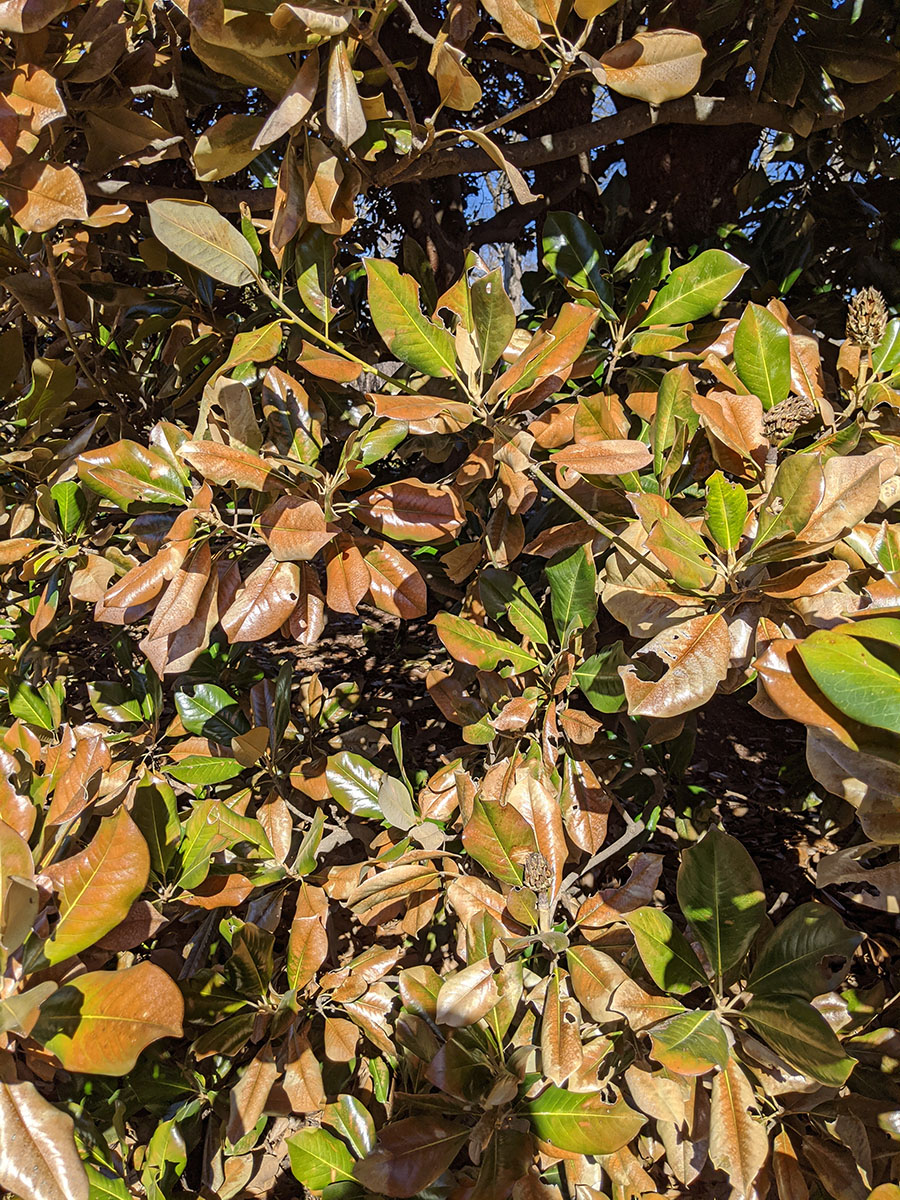
Figure 1. This magnolia has brown leaves due to winter injury.
One interesting case involving an arthropod problem in a greenhouse was submitted this month. The grower occasionally observed ants on orchid plants, but many ants were found when repotting the plants. The ants were associated with scales, another type of insect that was feeding on the plant. In this video, you can see one of the ants collecting a scale insect to take back to the nest. These ants are known to feed on small invertebrates. The PDIDL was able to identify the ants as Yellow meadow ants (Lasius sp.) and to provide the grower with management recommendations.
Look for additional plant health updates from the PDIDL throughout 2025. If you have suggestions for future topics, please contact jen.olson@okstate.edu or call the PDIDL at (405) 744-9961.