

Sheep and Wool
A recent trip to Montana for agricultural tours sparked my interest in sheep and wool production. Not that I am going to run out and purchase a flock of sheep and a new set of clippers because there is no way that my old back could handle bending over and shearing sheep. However, I am at the stage of life where I am infatuated with learning as much as I can, especially about agriculture.
The first stop was in Big Timber, MT at a wool warehouse that was built in 1908. The
brick walled wooden plank floored building sitting next to the railroad tracks is
still collecting, storing, and selling wool for local producers. At its peak production
the warehouse sold 4 million pounds of wool annually! The local Montana Extension
Educator said they get about eight pounds of wool per animal, which means this warehouse
could store the wool from roughly half a million head of sheep. Currently there are
only about three large producers in that area that each own 800-1000 head of sheep.
This is the same trend we see across the US. The USDA says that in 1945 there were
56 million head of sheep in the USA. That number dropped to nearly 5 million head
in 2016. This is largely due to the drop in wool prices and producers switching their
focus from wool production to lamb and mutton production.
The Sweetgrass County Wool Marketing Association collects and sorts the wool by quality
and stuffs it into 350–450-pound bales at the warehouse. A sample is then collected
and mailed to New Zealand to be measured and tested for quality so it can be marketed.
Most of the wool will be sold and shipped to either Charleston, SC or San Angelo,
TX, which if you own a map, you know is a long way from Big Timber, MT. Even though
wool prices are down and there is a major threat from large predators, producers still
rely on the sheep for range management. The wooly small ruminants are a biological
control of a noxious weed called leafy spurge. This multi-species grazing is extremely
important to their management practices.
Wool quality grades are based on the fineness and quality of wool fibers. The primary
determining factor is the fiber diameter which is measured in microns. One micron
is 1/25,400th of an inch. Typically, wool that is 20 microns is soft enough to be
considered a “next to skin” quality wool. The famous wool producing breed, Merino,
typically produces wool from 26 microns all the way down to and below 18 microns.
Of the ranches we visited in Montana, Targhee and Targhee/Rambouillet crosses were
the most common breeds.
My appreciation for high quality wool clothing grows more every time I put on my wool
shirts, sweaters, and socks. Today, my desire to learn more about American agriculture
is growing at an even faster pace. The Oklahoma Agriculture Statistics Pocket Facts
2023 says that Oklahoma had 60,000 sheep and lambs in 2023 and 70,000 as of January
2024 while producing 71,000 pounds of wool in 2023. Perhaps we might see a rebound
of sheep in Oklahoma. If you have the desire to learn more about agriculture, contact
your county’s OSU Extension office.
| Image | Caption |
|---|---|
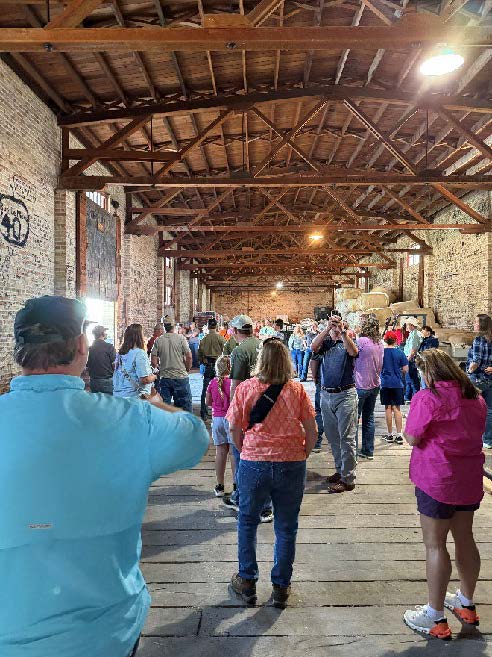 |
Figure 1. Sweetgrass County Wool Marketing Association Warehouse |
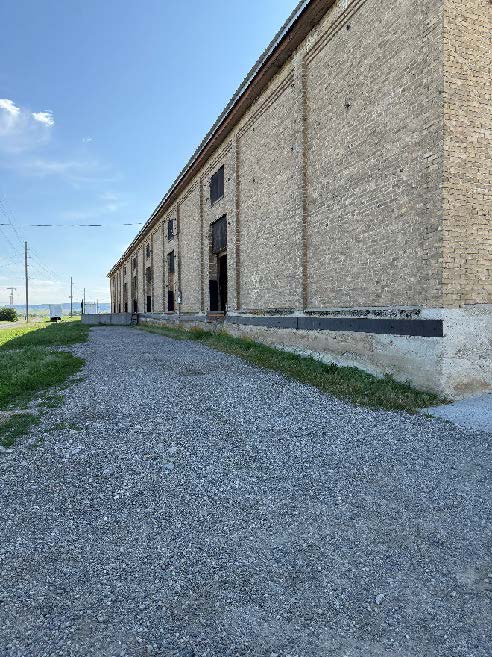 |
Figure 2. Sweetgrass County Wool Marketing Association Warehouse |