

Cow-Calf Corner | October 26, 2026
Feedlot Placements Record Low
Derrell S. Peel, Oklahoma State University Extension Livestock Marketing Specialist
The latest Cattle on Feed report pegged the feedlot inventory at 11.372 million head, fractionally below one year ago. September marketings were down 6.6 percent year over year. Feedlot placements in September were record low for the month and down 12.1 percent year over year. Marketing were about as expected but the placements were lower than pre-report estimates.
Feedlot placements have been generally decreasing since 2018 but have dropped dramatically since Jan 2025 from an annual average of 1.856 million head per month to the current average of 1.656 million head per month for the past 12 months (Figure 1). This decrease of 10.8 percent means that, on average, 200,000 head less cattle per month are being placed in feedlots. In other words, total placements were down 2.392 million head in the most recent twelve months, compared to the period from February 2024-January 2025.
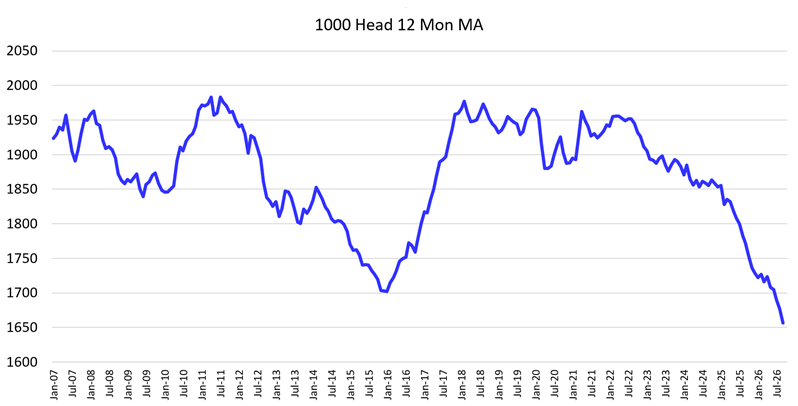
Figure 1. Feedlot Placements
Despite the sharp drop in feedlot placements, the average monthly on-feed inventory has declined just 1.26 percent between January 2025 and October 2026. This is possible because of a similar decrease in the feedlot marketings rate. From January 2025 to September 2026, the average marketings rate has decreased from 15.5 percent to a record low 14.0 percent (Figure 2). Feedlot placements are down; but once in the feedlot, cattle are staying more days and being marketed very slowly.
The slower marketings rate (monthly marketings as a percent of the monthly on-feed inventory) is the reason that carcass weights have increased so dramatically, beginning in 2024. Average steer carcass weights are up 76 pounds since 2023, with heifer carcasses up 66 pounds. Carcass weights appear to be topping out. The most recent weekly data shows an average steer carcass weight up 7 pounds compared to last year, the smallest year over year increase since February 2024.
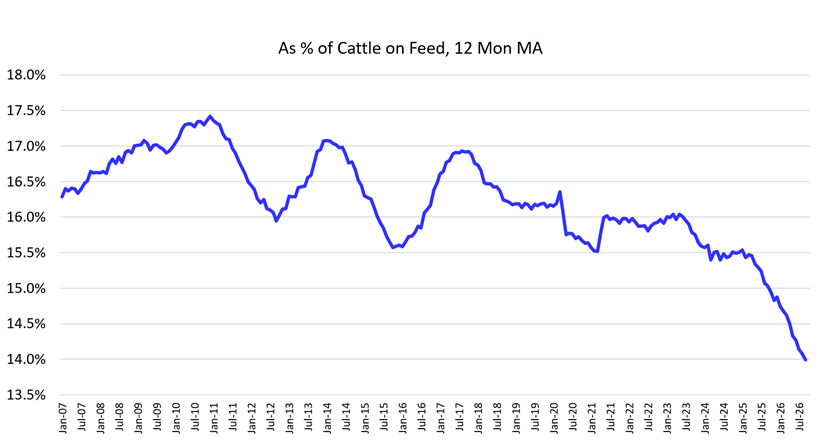
Figure 2. Feedlot Marketings
Recapturing Body Condition in the Cowherd
Mark Z. Johnson, Oklahoma State University Extension Beef Cattle Breeding Specialist
In 2026, drought-stressed pastures and intense heat could easily result in cows that are thinner than normal at weaning this fall. Beef cows follow a normal (and predictable) fluctuation of Body Condition Scores (BCS) across the annual production cycle. As a result of lactation, cows typically drop to their lowest BCS at weaning, then regain weight (and BCS) during the dry period from mid to late gestation, when nutritional requirements are lower. The target BCS at calving is 5 – 6. This prepares cows for the spike in energy requirements at the onset of lactation, and adequate fat stores ensure a timely return to heat and staying on track for a 365-day calving interval.
The Body Condition Scoring System
The BCS system used for beef cattle ranges from 1 to 9. A score of 1 indicates cows that are thin and emaciated, cows of BCS 9 are fat and obese. Pictures and definitions of the BCS system can be found in Chapter 20 of the 8th edition of the OSU Beef Cattle Manual. Typically, late summer/early fall (when cows are slicked off and in the 2nd trimester of pregnancy) is the most accurate and best time of the management cycle to evaluate BCS. Weaning time or at fall pregnancy checks is realistically the most convenient time of the annual management cycle to capture a weight on cows. If cows need to be fed and managed to have adequate BCS by the start of calving season, managing for a target weight gain can be effective.
When condition scoring cows, producers should look beyond age, frame size, depth, length pregnancy status and hair coat. The condition scoring system is intended to provide a consistent system to quantify relative fatness regardless of these other factors that create differences in cow appearance. There is a strong relationship between weight and BCS. For each unit of change in BCS, cows should gain or lose approximately 7% of their BCS 5 weight. For example, a cow that weighs 1,200 lbs. at a BCS 5 should reach a BCS of 6 at 1,284 lbs. or drop to a BCS 4 at 1,116 lbs.
If you find your cowherd in need of recapturing some flesh prior to the anticipated start of spring calving a few months down the road, take action now to reach optimum BCS by the start of your calving season. Short breeding seasons, short calving seasons and uniform calf crops in the future are the result of intentional nutritional management of the cowherd during this time-frame of production.
Reference
Beef Cattle Manual. Eight Edition. E-913. Oklahoma Cooperative Extension. Chapter 20.
Grazing Crop Residues to Extend Grazing and Stretch Hay Supplies
Paul Beck, Oklahoma State University Extension Beef Cattle Nutrition Specialist
Drought conditions across much of Oklahoma have reduced pasture production and hay supplies going into winter. Many producers have already started feeding hay, raising concerns about having enough forage to carry cowherds through the winter.
In a past Cow-Calf Corner articles we discussed using failed cotton as a grazing resource when droughts limit forage production and hay stocks are short. Grazing crop residues following grain harvest is an underutilized way to economically extend grazing and conserve hay supplies in Oklahoma.
Corn and grain sorghum residues are a valuable grazing resources for beef cows, particularly during mid-gestation when nutrient requirements are relatively low. Cattle selectively graze the most nutritious plant components first, consuming any remaining grain, followed by leaves and husks. Stalks and cobs are selected last and are considerably lower in digestibility and should not be considered the primary source of nutrients for the cow.
The University of Nebraska indicates that corn residue from each acre of a field yielding 100 bushels can support a 1,200-pound cow for 30 days. A field yielding 150 bushels could provide approximately 45 cow-grazing days per acre. These estimates assume cattle consume approximately 50% of the leaves and husks, representing only about 15% of the total residue.
Grain sorghum produces 8 to 12 pounds of grazable residue per bushel of grain harvested, so an 80-bushel/acre grain sorghum crop could provide 640 to 960 pounds of grazable forage per acre.
For all crop residues nutritional value declines as grazing progresses because cattle selectively consume the higher-quality portions first. Protein supplementation may be necessary as residue quality declines, particularly for lactating cows and growing replacement heifers.
Producers should exercise caution when grazing drought-stressed sorghum or corn residues because of potential nitrate accumulation. Grain sorghum regrowth, particularly following frost, can also present a prussic acid risk. Herbicide grazing restrictions should be checked before turning cattle into harvested fields.
Grazing crop residues can delay hay feeding, reduce winter feed costs, and provide additional value from harvested cropland. However, stocking rates should reflect the amount of palatable residue available, and cattle should be moved before the remaining forage becomes too low in quality to meet their nutritional requirements.
Mary Drewnoski, University of Nebraska, presented Feeding Corn Stalks, Milo Stalks, and Soybean Hay on November 17, 2022 as part of the Thursday Rancher's Series.