

Cow-Calf Corner | September 15, 2025
High Beef Prices Continue into Fall
Derrell S. Peel, Oklahoma State University Extension Livestock Marketing Specialist
The USDA Choice boxed beef cutout was $404.77/cwt. last week, down from the year-to-date peak of $413.60/cwt. in the first week of September. The current boxed beef value is 31.7 percent higher than one year ago, with all primal values higher year over year. Rib primals are up 31.5 percent; loin primals, up 31.4 percent; round primals are 31.5 percent higher; and chuck primals are up 34.6 percent from last year. Brisket, short plate and flank primals are also up 21 to 35 percent year over year. Across forty wholesale cuts reported by USDA, twenty products are up more than 20 percent year over year and the average increase across all forty is 32.8 percent over last year. The only product down from one year ago is short ribs, which are almost exclusively an export product and weak due to decreased beef exports.
Prices for 90 percent lean trimmings were $434.05/cwt. last week, down slightly from the previous weekly high of $435.31/cwt. and up 17.1 percent year over year. Fifty percent lean trimmings are priced at $159.89/cwt., up 30.9 percent from last year. A 7:1 ratio of 90s to 50s makes an 85 percent lean mix with a price of $399.78/cwt. for wholesale ground beef value, up 17.7 percent from one year ago.
USDA recently released the August retail meat prices showing that the all-fresh beef price was another record high at $9.18/lb., up from last month and up 12.6 percent year over year – over $1/lb. higher than one year ago (Figure 1). Retail pork prices dropped slightly from last month and are up 2.2 percent from last year, while retail broiler prices were fractionally higher this month and up 1.9 percent year over year.
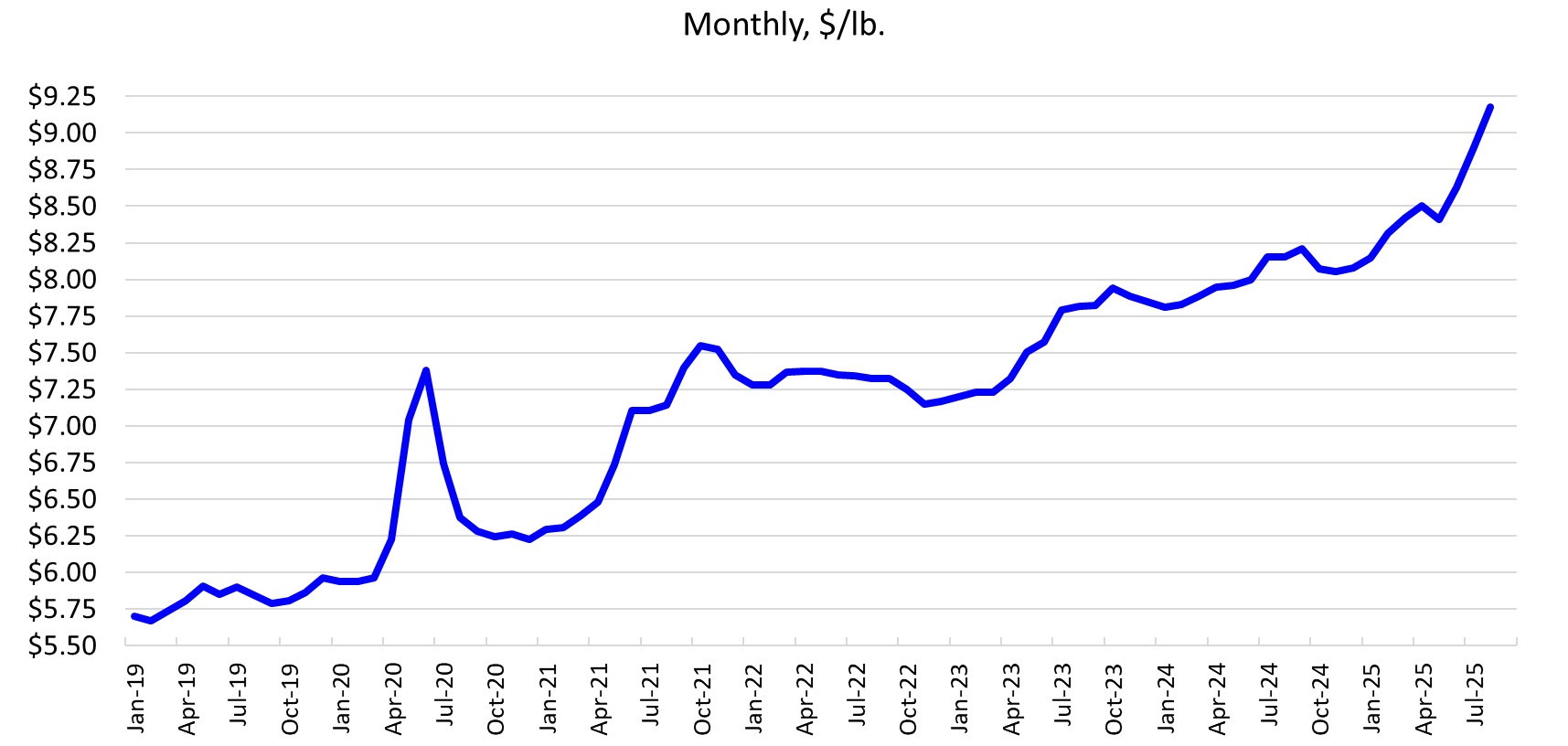
Figure 1. Retail All-Fresh Beef Price
Retail beef prices continue to increase relative to broiler and pork prices. Figure 2 shows the beef-to-broiler and beef-to-pork retail price ratios since January 2023. The ratios have continued to increase and are at record levels in August 2025, with a ratio of 3.69 for beef-to-broiler prices and 1.83 for beef-to-pork. The beef-to-broiler ratio has increased 10.5 percent in the past year and is up 24.3 percent since January 2023. The beef-to-pork ratio has increased 10.2 percent year over year and 22.0 percent since January 2023.
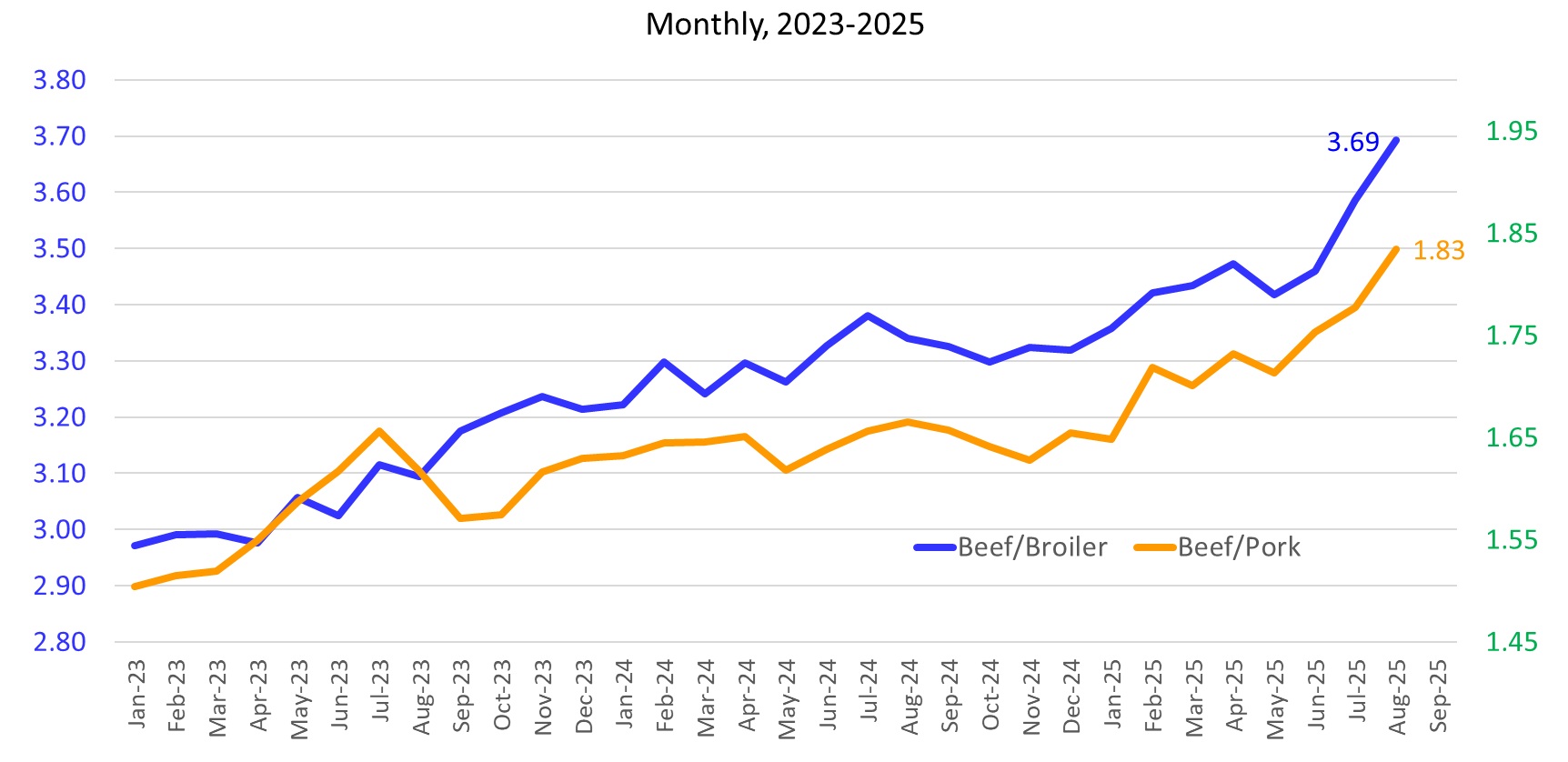
Figure 2. Retail Meat Price Ratio
Beef prices remain strong and beef demand is robust despite the availability of favorably priced alternative proteins. Moving into the fall, consumer demand shifts from a summer grilling focus to crock pot cooking and increased restaurant visits. This may slightly change relative values among beef products, but beef product demand continues strong at all levels.
Estimating Winter Hay Needs
Mark Z. Johnson, Oklahoma State University Extension Beef Cattle Breeding Specialist
Some basic rules of thumb to follow when determining the hay supplies you will need to sustain your cow herd over the winter and into next spring.
- Determine your average mature cow size. This can be done by weighing your 4 – 7 year old cows and calculating the average weight. From mature cow size, we can approximate the amount of forage dry matter cows will need to consume per year or per day. For example: a 1,000 pound cow will consume about 26 pounds of forage dry matter per day. A 1,400 pound cow will consume about 36.4 pounds of forage dry matter per day.
- Determine your cow inventory
- Estimate the amount of time you expect to be feeding cows.
From this information you can calculate the total amount of hay needed. For example: 100 cows weighing 1,400 pounds will consume about 3640 pounds of hay per day. We should take into account that a certain amount of the hay fed will be wasted and there will be a certain amount of spoilage of each bale fed that won’t be consumed. With this in mind we will add another 10% to the daily total to bump it up to about 4000 pounds (2 tons) per day.
Remember the amount of hay wasted or spoiled could be higher. If we are feeding hay carried over from last year, expect a higher percentage spoiled in each bale.
If we are expecting to feed hay from mid-October to mid-May, that is approximately 200 days of hay feeding. 4000 pounds of hay needed per day x 200 days equals a total of 800,000 pounds (400 ton) of forage dry matter that cows will consume over this time. If we are feeding or buying large rounds with an average weight of 1,250 pounds that equates to 640 (800,000 divided by 1,250) big bales needed to sustain the 100 cows.
If possible, purchase hay by the ton. It leads to less error in securing the amount of hay you will need to purchase or have on inventory. If buying hay by the bale is your only option, make sure to weigh enough of the bales to have an accurate representation of bale weight. Also, take into account the amount of spoilage of each bale. One of the upsides of hay baled this summer is less spoilage.
Other factors such as weather, stage of gestation or lactating versus dry cows will obviously impact nutritional requirements of cows from day to day. Many Oklahoma producers are fortunate to have more standing forage than normal as we evaluate pastures right now. This may reduce hay needs and move back the starting date of hay feeding this year.
Beef-on-Dairy Crosses are a Practical Alternative for Stocker Programs
Paul Beck, Oklahoma State University Cooperative Extension Beef Cattle Nutrition Specialist
Calf supplies are expected to be tight this fall. The U.S. beef cow herd is the smallest since the early 1960s, and calf crops continue to shrink. Stocker operators will need to look for alternative sources of grazing cattle.
One option is beef-on-dairy crosses. Each year, U.S. dairies produce more than 4 million calves for beef production, and a growing share are dairy cows bred to beef sires. These crossbreds typically outperform straight dairy calves in growth, feed efficiency, and carcass value.
OSU Research Findings
Oklahoma State University has studied how beef-on-dairy crosses perform in both stocker and finishing systems.
- In one trial, steers were finished either as lightweight calves (100 days old) or after 217 days of stocker grazing. Grazed calves gained 2.0 lbs./day while grazing and entered the feedlot at heavier weights and had improved carcass traits, but also consumed more feed than calves placed directly on feed (Grote et al., 2024).
- A commercial-scale study in western Oklahoma compared beef-on-dairy calves to native beef calves. Dairy-beef crosses gained less during grazing than native beef calves on native range and entered the feedlot lighter but compensated during finishing to reach heavier slaughter weights (Grote et al., 2024).
- In another wheat pasture study, 100-day old lightweight beef-on-dairy crosses struggled early, gaining only 0.75 pounds per day in the first month compared to 2.5 pounds for beef calves. Gains improved with time—gaining 3.3 lbs./day later in the grazing season (from day 84 to 140)—and over the 140-day grazing period they gained an average of 2 lbs./day compared to 2.75 for beef calves.
Management Keys
The slower start on pasture is often due to previous management and new environment. Unlike beef calves raised alongside their dams, dairy-beef calves don’t learn grazing behavior early in life. When they leave the dairy, many are unfamiliar with hay, group housing, open pastures, or even water sources.
A 2–3 week receiving period is critical. This time allows calves to adjust to new feeds, learn to graze, and develop herd behavior before turnout. Once adapted, their grazing performance improves and becomes more competitive with beef calves.
Take-Home Message
With tight beef calf supplies, beef-on-dairy crosses are becoming an important option for stocker operators. They require careful management at receiving and early grazing, but they finish well in the feedlot and produce high-quality carcasses. These calves are likely to play a growing role in the U.S. beef supply.
This research was supported by the USDA Critical Agricultural Research and Extension (CARE) Award No. 2022-68008-37102.
Survey of Oklahoma Cattle Producers Regarding Ticks and Tick-Borne Diseases
Jonathon Cammock, OSU Cooperative Extension Livestock Entomologist
The Oklahoma State University Extension Livestock Entomology Program is seeking participants for a study on the impact of ticks on beef and dairy cattle production in Oklahoma. We are looking for producers who are willing to complete a brief survey, to help us assess tick and tick-borne disease knowledge and prevalence, and identify preventative measures taken to protect producers, employees, and livestock from tick bites and tick-borne diseases. Information collected will be used to develop Extension programming targeted at your needs as cattle producers. We would appreciate if you could take the time to participate!
To access the survey if you are interested in participating Questionnaire: Assessment of Oklahoma Cattle Producer’s Knowledge and Awareness of Ticks and Tick-Borne Diseases
Missed an article or want to re-read a past article? Previous editions of the Cow-Calf Corner Newsletter are available at Cow-Calf Corner - The Newsletter
If you were forwarded this email and want to get it delivered straight to your email inbox, email Paul Beck (paul.beck@okstate.edu) or Derrell Peel (derrell.peel@okstate.edu) to be added to our email list.