

Cow-Calf Corner | September 1, 2025 Labor Day edition
Winter Wheat Grazing and Stocker Prospects
Derrell S. Peel, Oklahoma State University Extension Livestock Marketing Specialist
Unseasonably cool and wet weather in late August has resulted in the best prospects for early planted wheat in several years. Ample rain across much of Oklahoma, especially in major wheat production areas, is providing the moisture and cool soil temperatures necessary for wheat germination. Early wheat establishment and growth could lead to earlier and more grazing potential this fall. Producers will be looking ahead to the best ways to utilize additional wheat forage this fall and winter.
The current cattle market situation provides quite different opportunities and challenges for cow-calf and stocker producers. In late 2022, cattle prices began the sharp trend up leading to current levels. Table 1 shows how 2025 cattle market conditions compare to the last week of August in 2022.
| Steers (Okla Auctions) | Units | 2022 | 2025 | % Change |
|---|---|---|---|---|
| Beginning Weight | Lbs. | 475 | 475 | |
| Beginning Price | $/Cwt. | $204.98 | $481.50 | 134.9 |
| Beginning Value | Head | $974 | $2,287 | 134.9 |
| Ending Weight | Lbs. | 775 | 775 | |
| Ending Price | $/Cwt. | $176.77 | $372.12 | 110.5 |
| Ending Value | Head | $1370 | $2,884 | 110.5 |
| Total Gain | Lbs. | 300 | 300 | |
| Value Increase | Head | $396/head | $597/head | 50.8 |
| Value of Gain | $/Lb. | $1.32 | $1.99 | 50.8 |
The value of calves has increased by nearly 135 percent in the three-year period, increasing from less than $1,000/head to almost $2,300/head. The value of yearlings has increased over 110 percent in the same period. The stocker margin between the two levels has increased just over 50 percent since 2022, with a current value of gain of $1.99/lb. In other words, while a 475-pound steer currently sells for over $4.81/lb., the value of adding an additional 300 pounds of weight to the steer is just about $2.00/lb. All costs of production beyond the animal cost, plus any profit potential, must be covered by the value of gain.
The value of gain reported here is based on current beginning and ending animal values. The value of winter wheat stockers next March is unknown but Feeder futures provides an indication. Deferred Feeder futures are priced at a discount to current market values, limiting any potential to lock in stocker margins for the winter grazing period.
The 2025 stocker situation shown in Table 1 shows that stocker producers must carefully evaluate stocker enterprises this year. The combination of market focus on calves and calf prices, along with relatively cheap feedlot cost of gain. means that the potential for stocker production is squeezed at this time. Stocker cattle numbers are limited, and significant numbers of calves have been sold early this year. At the same time, feedlots have a strong economic claim on the limited feeder supplies and will likely purchase and place lighter weight feeders in feedlots. In general, stocker opportunities are limited to starting with very lightweight animals and selling rather quickly at lighter feeder weights.
The potential for substantial winter wheat forage begs the question of what the most valuable use of that forage will be. Traditional stockers have limited potential but may be feasible under carefully considered circumstances. Wheat forage may also be used for cow-calf production or perhaps to “stocker” replacement heifers in development for breeding.
Dr Derrell Peel discusses how beef prices are already high — but could they climb even further? Derrell Peel, OSU Extension livestock marketing specialist, shares market outlook and economic forces that may continue driving beef prices upward on SunUpTV from September 1, 2025.
How High Can Beef Prices Go? OSU Market Insights
Cost Effective Supplementation for Growing Calves
Mark Z. Johnson, Oklahoma State University Extension Beef Cattle Breeding Specialist
From a moisture standpoint, the summer of 2025 has been good for many Oklahoma cattle producers. As a result, many of us have ample standing forage. This week we address the Oklahoma Gold and Oklahoma SuperGold supplementation programs as a means of adding profit potential. Both programs were designed to cost effectively improve the growth of calves and stocker cattle grazing pastures in late summer and fall. Both are based on limit feeding high protein supplements.
Crude Protein (CP) content and digestibility of warm season grasses declines during mid-summer and fall. No doubt many Oklahoma producers watched green pastures turn brown during August when there was little rain coupled with several weeks of intense heat. This weather pattern corresponds with declining quality of standing forage. In late spring and early summer calves can gain 2 – 3 lbs./day on the same pastures that now may be limiting gains to less than half that amount, even with ample standing forage. Why? Because cattle's growth performance is based on the most limiting nutrient in their diet. The same grasses that would have contained over 10% CP in late spring and early summer are now likely well below that level. Regardless of our warm season forage type, (native grasses, Bermuda, sorghum Sudan or millet), the same maturity pattern holds true. A 500 lb. calf gaining 1.5 lbs./day requires a diet containing a minimum of 10% CP. Bottomline: at this point, CP has become the growth limiting factor in a calf's diet.
The Cost Effective Solution
If you have standing forage to be used before wheat pasture comes on, or just wanting to cost effectively add weight to growing calves, the key to improving growth rates is protein supplementation. As opposed to high energy creep feeds, Gold and SuperGold programs are designed to improve growth rate through high protein supplementation when ample standing forage is available. The Oklahoma Gold program includes a 38% CP supplement at a rate of 1 lb./day and includes an ionophore additive along with vitamins and minerals. The Oklahoma SuperGold program is similar as it includes supplementing a 25% CP at a rate of 2.5 lbs./day. The Oklahoma Gold program is one of the most cost effective and industry proven supplementation programs ever developed. From early June to October, several trials conducted at OSU, indicate feeding 1 lb./day of Gold can increase gains of stockers grazing summer pastures by up to 0.6 lb./day. Furthermore, the Gold program is based on a low volume of feed and offers the flexibility of feeding every-other-day. In some situations the SuperGold feeding program may offer advantages. Remember, both of these feeding strategies work based on ample standing forage. More details for both feeding strategies can be found at Oklahoma State University Fact Sheets in the fact sheets referenced below.
References:
- Oklahoma Cooperative Extension Fact Sheet AFS-3032. Oklahoma Gold Q&A.
- Oklahoma Cooperative Extension Fact Sheet AFS-3033. Oklahoma SuperGold Q&A.
Mark Johnson, OSU Extension beef cattle breeding specialist, sat down with Robert Hodgen, King Ranch CEO and OSU alumnus, to explore cattle industry insights and the role of information asymmetry in ranching. Discover how access to better data impacts beef cattle producers, market decisions, and the future of ranching economics. Whether you're a cow-calf operator, cattle breeder, or industry leader, this conversation offers valuable takeaways for smarter ranch management on SunUpTV form September 1, 2025. Cow-Calf Corner - "Are You Missing Out on Key Cattle Market Signals? (YouTube)
Will Buyers Pay Preconditioning Premiums for Already Expensive Calves?
Kellie Curry Raper, Professor and Livestock Marketing Specialist, Agricultural Economics
Heard at the coffee shop: “Calf prices are so high right now that I don’t see why I would bother vaccinating or weaning before I take them to town. It’s extra work and buyers aren’t going to pay premiums with prices this high anyway.”
Will preconditioning pay in the face of historic cattle prices that continue to rise? Econ 101 says that a profitable decision requires that the revenue added by preconditioning must outweigh the cost added by preconditioning. (That equation also holds true for any subset of management practices.) Looking at recent history provides insight into the revenue side of that equation.
Figure 1 overlays the average preconditioning premiums ($/cwt) for steers received by Oklahoma Quality Beef Network (OQBN) cattle from 2012 through 2024 with the average 4th Quarter price (Oct-Dec) for 500-600 pounds steers in those same years. Average price is represented by the bars with the price scale on the left. The corresponding premiums are represented by the orange line and the price scale on the right. The pattern is clear – premium levels tend to move with price levels.
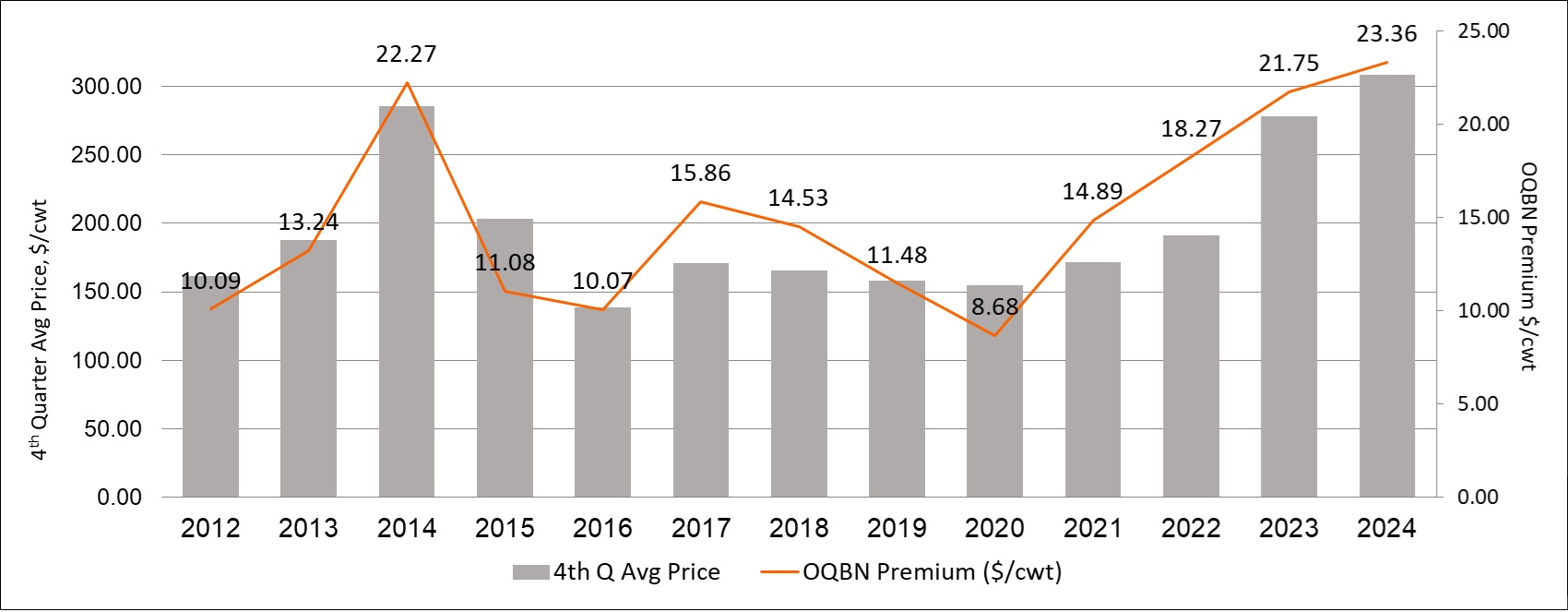
Figure 1. OQBN Preconditioning Premiums Relative to 4th Quarter Average Price for 500-600 lb. Steers, Southern Plains. Source: Livestock Marketing Information Center and Oklahoma Quality Beef Network Historical Data (Raper and Peel).
Why would cattle buyers not only pay premiums, but pay relatively HIGHER premiums for those already very expensive cattle? The answer is RISK. The whole point of preconditioning calf health programs is to prepare calves for better performance as they move through the system. That improved performance is measured in lower death loss, fewer health issues, and better gain – that is, lower risk. For example, a survey of Texas Cattle Feeders Association feedlot managers indicated death loss rates of 4.3% for nonpreconditioned cattle and death loss of only 1.5% for preconditioned cattle. As prices move upward, the cost of death loss as well as the opportunity cost of lost performance also increases. Buyers who pay premiums for preconditioned cattle are paying to lessen that risk. And as prices move higher, the premiums that they are willing to pay for that decrease in risk will generally rise in response to the rising economic risk.
So, what’s the answer to our question “Will preconditioning pay in the face of historic cattle prices that continue to rise?” History says “Yes”. While marketing calves off the cow may yield positive returns, particularly in the current environment of rapidly rising prices, the case for preconditioning prior to marketing is still strong.
About OQBN: Oklahoma Quality Beef Network
| LOCATION | SALE DATE | 45-DAY WEAN DATE | 60-DAY WEAN DATE |
|---|---|---|---|
| OKC West Livestock (El Reno) | November 11, 2025 | September 27, 2025 | September 12, 2025 |
| November 18, 2025 | October 4, 2025 | September 19, 2025 | |
| December 16, 2025 | November 1, 2025 | October 17, 2025 | |
| January 20, 2026 | December 6, 2025 | November 21, 2025 | |
| McAlester Stockyards | September 23, 2025 | August 9, 2025 | July 25, 2025 |
| November 11, 2025 | September 27, 2025 | September 12, 2025 | |
| April 7, 2026 | February 25, 2026 | February 10, 2026 | |
| Payne County Stockyards | November 15, 2025 | October 1, 2025 | September 16, 2025 |
| Southern Plains Livestock (Blackwell) | November 24, 2025 | October 10, 2025 | September 25, 2025 |
| LeFlore County Livestock (Wister) | December 13, 2025 | October 29, 2025 | October 14, 2025 |
For more information or to sign up
Paul Vining (405) 744-4268
Survey of Oklahoma Cattle Producers Regarding Ticks and Tick-Borne Diseases
Jonathon Cammock, OSU Cooperative Extension Livestock Entomologist
The Oklahoma State University Extension Livestock Entomology Program is seeking participants for a study on the impact of ticks on beef and dairy cattle production in Oklahoma. We are looking for producers who are willing to complete a brief survey, to help us assess tick and tick-borne disease knowledge and prevalence, and identify preventative measures taken to protect producers, employees, and livestock from tick bites and tick-borne diseases. Information collected will be used to develop Extension programming targeted at your needs as cattle producers. We would appreciate if you could take the time to participate!
To access the survey if you are interested in participating Questionnaire: Assessment of Oklahoma Cattle Producer's Knowledge and Awareness of Ticks and Tick-Borne Diseases
Missed an article or want to re-read a past article? Previous editions of the Cow-Calf Corner Newsletter are available at Cow-Calf Corner - The Newsletter
If you were forwarded this email and want to get it delivered straight to your email inbox, email Paul Beck (paul.beck@okstate.edu) or Derrell Peel (derrell.peel@okstate.edu) to be added to our email list.