

Cow-Calf Corner | October 20, 2025
Beef Imports to the Rescue?
Derrell S. Peel, Oklahoma State University Extension Livestock Marketing Specialist
Could Beef Imports from Argentina Reduce Beef Prices in the U.S.?
Argentina is the sixth largest beef producing country and the fifth largest beef exporting country, accounting for roughly 6 percent of global beef exports. Argentine beef production is about 27 percent of total U.S. production. In recent years, Argentine beef exports have been growing with the majority of beef exports going to China along with Israel, the E.U. and the U.S.
Argentina is the ninth largest source of beef imports in the U.S., accounting for about 2.1 percent of total U.S. beef imports thus far in 2025. U.S. imports of Argentine beef have been growing in recent years (recovery in Argentina) and were up 41.7 percent year over year through July (the latest data available since the shutdown).
How Much More Beef Can the U.S. Import from Argentina?
It's not clear how much capacity to increase beef exports exists currently in Argentina. Domestic beef consumption in Argentina uses 70-75 percent of total beef production in the country. If, for example, the U.S. doubled imports over 2024 levels, it would likely mostly be at the expense of domestic consumption in Argentina or other export markets for Argentine beef. Such an increase in imports from Argentina would have a negligible impact on the total supply of beef in the U.S. market. In fact, if the U.S. took all of the projected 2025 Argentine beef exports (not likely), it would represent less than 2.5 percent of the total U.S. beef supply.
The Impact in U.S. Beef Markets
The majority of Argentine beef imports are lean processing beef used for ground beef production. This beef is quite similar to beef imported from Brazil (and most other import sources). Imports from Argentina are less than 10 percent of the imports from Brazil. Increasing imports from Argentina would have a very slight impact in offsetting the reduction in imports from Brazil expected because of the sharp increase in tariffs on Brazil. The impacts on beef imports from Brazil are not evident in the January -July import data and we have not had any updates since then. The August data should have been released in early October.
Record high cattle and beef prices are occurring despite record beef imports. Increased beef imports (mostly lean processing beef) partially offsets decreased nonfed beef production in the U.S., helping to moderate sharply higher ground beef prices and increasing utilization of fatty trimmings from U.S. fed cattle. Argentina is a relatively minor source of beef imports and potential increases would not significantly change the overall supply of beef in the U.S. In short, it does not appear that increasing beef imports from Argentina would have any significant impacts on U.S. beef prices. At most, it might have a very slight (and probably undetectable) impact of moderating expected future increases in U.S. ground beef prices.
Mature Cow Size and Calf Revenue Generated - 2025
Mark Z. Johnson, Oklahoma State University Extension Beef Cattle Breeding Specialist
This week I will answer an additional question based on producer feedback to articles from the past couple of weeks. Specifically, the relationship of high growth, high mature weight cows to calf weaning weights and profit potential of commercial cow-calf operations. We take a look at this relationship relative to the 2025 calf market.
The U.S. cow herd has been steadily increasing in mature weight for several decades. This is largely the result of selection pressure applied to increasing weaning and yearling weights. Because of the positive genetic correlations between weights taken at all stages of life, mature weight has increased even though that has not been the objective. Mature cow size can be effectively addressed (reduced) through well-planned breeding programs. Excessive mature weight of beef cows has several downsides. The focus of this article is its impact on profitability in commercial cow-calf operations.
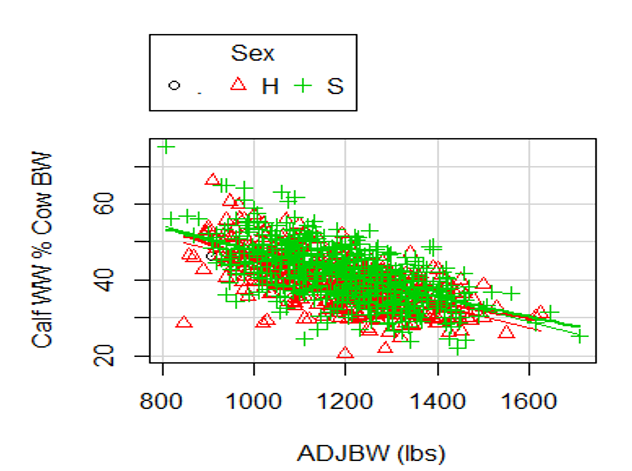
Forage budgeting based on mature cow size indicates that for each 100 head of 1,000 pound cows you could run in your cow-calf operation, the same forage base (and feed input cost) would sustain 71 head of 1,400 pound cows. As well, for each 100 pound increase in mature weight, cows average approximately 10 more pounds of calf weaning weight produced. As shown in the graph below, research at Michigan State University indicates heavier weight cows (at a constant Body Condition Score), wean a lower percentage of their body weight.
The Math
For the sake of this article, some assumptions are necessary, these are:
- the 1,000 pound cows will wean calves weighing 450 pounds
- the 1,400 pound cows will wean calves weighing 500 pounds
- Most recent USDA Market Report indicates a value of $4.60/pound for calf weaning weight for 450 pound calves and a value of $4.35/pound for 500 pound calves (assuming a 50:50 steer:heifer mix).
- a 90% calf crop weaned for both groups of cows
Therefore, the 100 head of 1,000 pound cows will wean 40,500 pounds of calf pay weight with a total value of $186,300. For example: (100 cows x 90% x 450 pounds x $4.60 per pound)
The 71 head of 1,400 pound cows will wean 64 calves weighing 500 pounds for a total of 32,000 pounds of calf pay weight with a total value of $139,200. (71 cows x 90% rounded up to 64 calves x 500 x $4.35 per pound)
Bottomline
The math tells us the same forage base and feed cost could result in $47,100 more revenue generated annually. Running a greater number of more moderate sized cows on the same forage base creates more revenue and profit potential.
Final Thoughts
Growth traits SHOULD be included in your selection program relative to Mature Weight. EPDs for all growth traits are available and can be used in bull selection as tools to accomplish this.
Since the 1980s, cattle breeders have done an excellent job of using EPDs to improve growth at weaning, yearling and finishing weights relative to keeping birth weights low and maintaining calving ease. Scientific literature indicates growth traits (Birth Weight, Weaning Weight, Yearling Weight, Finished Weight, Carcass Weight and Mature Size) are all moderate to high in heritability. If and when selection pressure is applied to mature weight and it is included in your selection goals, it will respond and can be changed for the better.
References
2024 Beef Improvement Federation Symposium. Cow Longevity: Economics & Genetic Solutions. Dr. Bob Weaber.
2024 Beef Improvement Federation Symposium. The Full Picture of Cow Efficiency. Dr. David Lalman.
2024 OSU Blueprint For The Future Cattle Conference. Metrics, Management and Monitoring in Grazing Systems. Dr. Jason Rowntree.
Beyond Cheap Gain: Managing Stocker Calves for the Long-Run
Paul Beck, OSU Extension Beef Cattle Nutrition Specialist
The stocker phase sits at the crossroads of beef production—linking the cow-calf sector to the feedlot—and management decisions made during this stage echo all the way to harvest. A recent review of research from 1995 to 2024 in Applied Animal Science highlights how genetics, grazing management, supplementation, growth technologies, and health programs used in stocker systems influence later performance in the feedlot (Snider et al., 2025).
Most U.S. calves spend time in a stocker or backgrounding program before entering the feedlot. While we often think of this phase as just a way to add “cheap gain,” it also provides value by sorting cattle into uniform load lots, increasing resilience by getting calves through weaning and commingling stresses, and spreading calf inventory through the year. Stocker systems vary widely across regions, forage bases, and management goals—but research shows some consistent themes.
Genetics
U.S. calf populations are highly diverse due to regional adaptation of the cowherd. Grazing smaller-frame and early maturing calves prior to feedlot entry, can help them reach acceptable harvest weights with larger carcasses without becoming overly fat.
Grazing Management
Pasture strategies that boost grazing gain can have mixed effects during finishing. Restricted gain on pasture may lead to compensatory gain in the feedlot, but often reduces lifetime performance and marbling potential.
Supplementation
Supplements are used to correct nutrient deficiencies, manage grazing behavior, or increase stocking rates. Research shows variable effects on feedlot performance—some programs have no impact, while others can reduce efficiency during finishing.
Growth-Promoting Technologies
Ionophores improve stocker gain by 10% without affecting feedlot performance. Implants improve gain 10–20% in the stocker phase with little impact on finishing performance and efficiency, though some studies suggest reduced marbling with aggressive implant programs.
Placement weight, condition, and age entering the feedlot are strong predictors of finishing success. Stocker management isn't just about adding cheap gain—it's essential for preparing cattle for production in the feedlot and capturing value across the entire beef production chain.
Reference
M. A. Snider et al. 2024. Invited Review: Effects of management on performance of stocker cattle and subsequent feedlot performance. Applied Animal Science 41:329-349. https://doi.org/10.15232/aas.2024-02663
Emerging Bovine Disease Update: Asian Longhorned Tick
Rosslyn Biggs, DVM, Oklahoma State University Extension Beef Cattle Specialist
The Asian longhorned tick (Haemaphysalis longicornis) is an invasive species established in more than 20 U.S. states. Believed to have entered the country around 2010, it was first identified on cattle in northeastern Oklahoma in summer 2024. For the first time in early October 2025, the Kansas Department of Agriculture announced that the tick had been identified in their state.
Researchers at Oklahoma State University College of Veterinary Medicine are continuing their project through the end of the year to evaluate the status of the Asian longhorned tick and its pathogens in Oklahoma and bordering states cattle herds. Preliminary results have detected Theileria orientalis genotype Chitose but not Ikeda, the pathogen of greatest concern. No Asian longhorned ticks have been identified. Additional participation from across the state is needed and encouraged. Cattle producers are urged to take part during fall processing.
Eleven herds have submitted samples thus far, and an additional 20 to 40 farms have the opportunity to participate by submitting blood, ticks, or both.
All sampling supplies, shipping labels, and testing are provided at no cost to producers. Samples may be collected by veterinarians or producers with a consulting herd veterinarian. Blood collections will process twice weekly with results emailed to the address on the submission form and the consulting herd veterinarian. Anaplasma marginale testing will also be provided at no cost, (up to 20 samples per herd) if anaplasmosis is suspected in the herd.
For more information or to participate in the study please fill out the interest form or contact a member of the research team:
- Dr. Ruth Scimeca at ruth.scimeca@okstate.edu
- Dr. Rosslyn Biggs at rosslyn.biggs@okstate.edu
- Dr. John Gilliam at john.gilliam@okstate.edu