

Cow-Calf Corner | May 26, 2025
Happy Memorial Day!
Feedlot Inventory Inches Lower
Derrell S. Peel, Oklahoma State University Extension Livestock Marketing Specialist
The latest USDA Cattle on Feed report pegs feedlot inventories on May 1 at 11.376 million head, down 1.5 percent year over year. This is the sixth consecutive monthly decrease year over year in feedlot numbers though the decrease has been minimal thus far. Figure 1 shows that annual average feedlot totals are slightly lower recently (far right side) but have decreased little in the past 18 months or so.
April feedlot placements were down 2.6 percent year over year, about as expected. Feedlot placements have been variable, down four of the last six months and down a total of 3.6 percent compared to the same period one year ago. April feedlot marketings were down 2.5 percent year over year, also close to expectations. Feedlot marketings were down three of the previous six months, compared to last year, and decreased just 1.6 percent in total during the same six-month period. The result is a slower turnover rate that allows feedlots to maintain higher inventory levels despite decreased placements.
Feedlots have maintained inventories primarily because of two factors: continued heifer feeding and increased days on feed. The April quarterly breakdown showed that the heifer percentage of feedlot inventories dropped to the lowest level in five years but remains above the average of the past 30 years. Data from Kansas feedlots shows that days on feed (DOF) increased in mid-2023 with average DOF increasing by about ten days since. Heifer feeding and increased days on feed have masked declining feeder cattle numbers since mid-2023.
Cattle on Feed and Calf Crop (1000 heads)
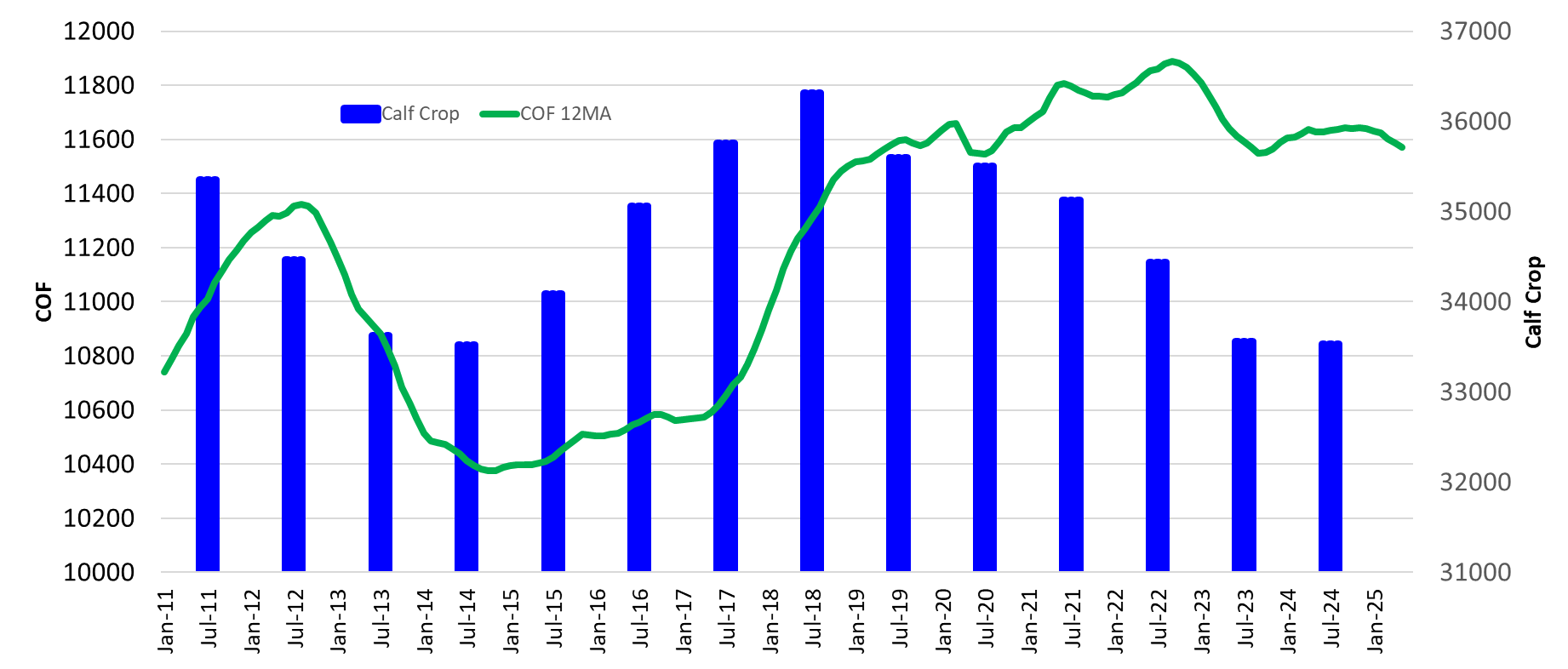
Figure 1. shows that the total calf crop has declined for the past six years, peaking cyclically in 2018. Feedlot inventories have remained relatively steady while the total calf crop declined. The current relationship between cattle on-feed and calf crop is a sharp contrast to a decade ago when feedlot inventories dropped as the calf crop decreased to cyclical lows. From 2012-2014, average feedlot inventories decreased by 984,000 head. Since the peak in 2022, average feedlot inventories have fallen by just 315,000 head and have varied by a scant 94,000 head in the past 24 months.
There are indications that heifer feeding will decline in the coming months as heifer retention increases. Additionally, days on feed have likely reached a maximum, meaning that no additional gains are likely from slowing the feedlot turnover rate. In other words, the gains from slowing the turnover rate do not continue once the slowing is complete. Both of these factors mean that it is likely that feedlots will see more rapid decreases in average inventories in the coming months.
Upside of a Short Calving Season
Mark Z. Johnson, Oklahoma State University Extension Beef Cattle Breeding Specialist
There are several benefits to a short calving season including simplifying cow management, gaining efficiency of labor management, increasing weaning weight and improving uniformity/marketability of the calf crop. Collectively all these advantages lead to one positive potential impact: improved profitability. CattleFax survey data of cow-calf operations sorts participants into three groups: high, average and low profitability. The high profitability group had a shorter calving season with a higher percentage of cows calving in the first 45 days. The shorter calving season creates opportunities to gain efficiency in several areas of management and these operations were able to sell more pounds of while keeping expenses down.
Obviously, more calves born earlier in the calving season equates to more pounds at weaning. What is the value of a single cow calving one heat cycle earlier? If calves gain about 2 pounds a day from birth to weaning, in the current market with a pound of weaning weight valued in excess of $3, the added 40 pounds of weaning weight is worth at least $120 per cow. The added benefit of uniformity also improves marketability of your calf crop. Calf buyers prefer to buy load lots of uniform calves so they can be managed similarly. Calf crops with substantial weight variation will be discounted in the market place.
Address the following questions to achieve a shorter breeding season in 2025 and a shorter calving window next spring:
- Do you have ample bull to female ratios in each breeding pasture?
- What is the age of your bulls and the number of females they should be expected to cover?
- Are you managing your 2-year old pairs separate from your mature cows to insure proper development, body condition and potential to breed back quickly?
- Have all your bulls passed a breeding soundness exam prior to turn out?
- Is your cow herd in adequate body condition? Is supplemental feed needed?
- Have you considered an estrous synchronization protocol to tighten your breeding season?
Reference: Calving Season Length Impacts. CattleFax Trends. Matthew McQuagge. Mid-May, 2025
Enhancing Pastures with Annual Clovers
Paul Beck, Oklahoma State University Cooperative Extension Beef Cattle Nutrition Specialist
Annual clovers offer significant benefits to forage systems across Oklahoma, including improved forage quality, extended grazing seasons, and reduced fertilizer costs. These legumes naturally fix atmospheric nitrogen, enhancing soil fertility and boosting livestock performance—all while lowering input expenses.
In Oklahoma’s diverse climate, annual clovers often outperform perennial varieties, particularly in the southern and eastern regions where hot, humid summers can limit the persistence of perennial clovers. Because annual clovers complete their life cycle in a single year, they require annual re-establishment through either reseeding or replanting.
Establishment Tips for Oklahoma Producers
- Select the Right Species: Match clover species to your soil’s texture, drainage, and pH.
- Soil Preparation: Maintain a soil pH above 6.0. If necessary, apply lime at least six months before planting.
- Fertilization: Avoid nitrogen applications to encourage clover growth and nitrogen fixation.
- Weed Management: Use herbicides with short residual activity.
- Planting: Drill seeds ¼ to ½ inch deep, or broadcast with a 20–25% higher seeding rate.
- Sod Seeding: Graze or mow forage to 3 inches before planting. Ideal planting dates are October 15 to November 15.
Recommended Clover Species for Oklahoma
- Arrowleaf: Late-maturing, high-yielding, ideal for hay and grazing; prefers well-drained soils.
- Ball: Low-growing, excellent reseeder; tolerates wet soils and close grazing.
- Berseem: High forage producer; thrives in wet soils but lacks cold hardiness—best for southern Oklahoma.
- Crimson: Early maturing and cold tolerant, excellent for late winter and early spring grazing.
- Persian: Tolerates wet soils and reseeds well, but has low cold tolerance and poses a bloat risk.
- Red: Upright and cold hardy, ideal for hay; does not tolerate wet or acidic soils.
- Rose: Drought tolerant, reseeds effectively, and adapts well to Oklahoma’s variable rainfall.
- Subterranean: Low-growing and an excellent reseeder; tolerates wet soils and close grazing.
With proper species selection and management, annual clovers can significantly enhance pasture productivity and profitability in Oklahoma.
For additional guidance, contact your local OSU Extension office, see the factsheet Forage Legumes for Oklahoma PSS-2585 (Forage Legumes for Oklahoma) or visit Forage and Pasture Management.