

Cow-Calf Corner | March 3, 2025
The Role of Stockers in Today’s Cattle Market
Derrell S. Peel, Oklahoma State University Extension Livestock Marketing Specialist
Shrinking cattle inventories in recent years leads to a wide range of impacts on the multi-sectored cattle industry. Figure 1 shows the rising feeder prices and changes in price relationships that impact economic incentives of the various cattle production activities. As feeder cattle prices have risen, the prices for lightweight animals have increased faster and more than heavy feeder cattle. This has particular implications for stocker producers.
The cattle industry includes several production sectors, all of which contribute to the singular objective of producing slaughter-ready cattle. Broadly speaking, the cow-calf sector is the primary sector producing the supply of calves for the entire industry. At the other end, the feedlot sector ensures that cattle are finished with carcasses producing high-quality beef. In between, the stocker (or backgrounding) sector consists of many varied and flexible activities and arbitrage that serve several different functions for the cattle industry.
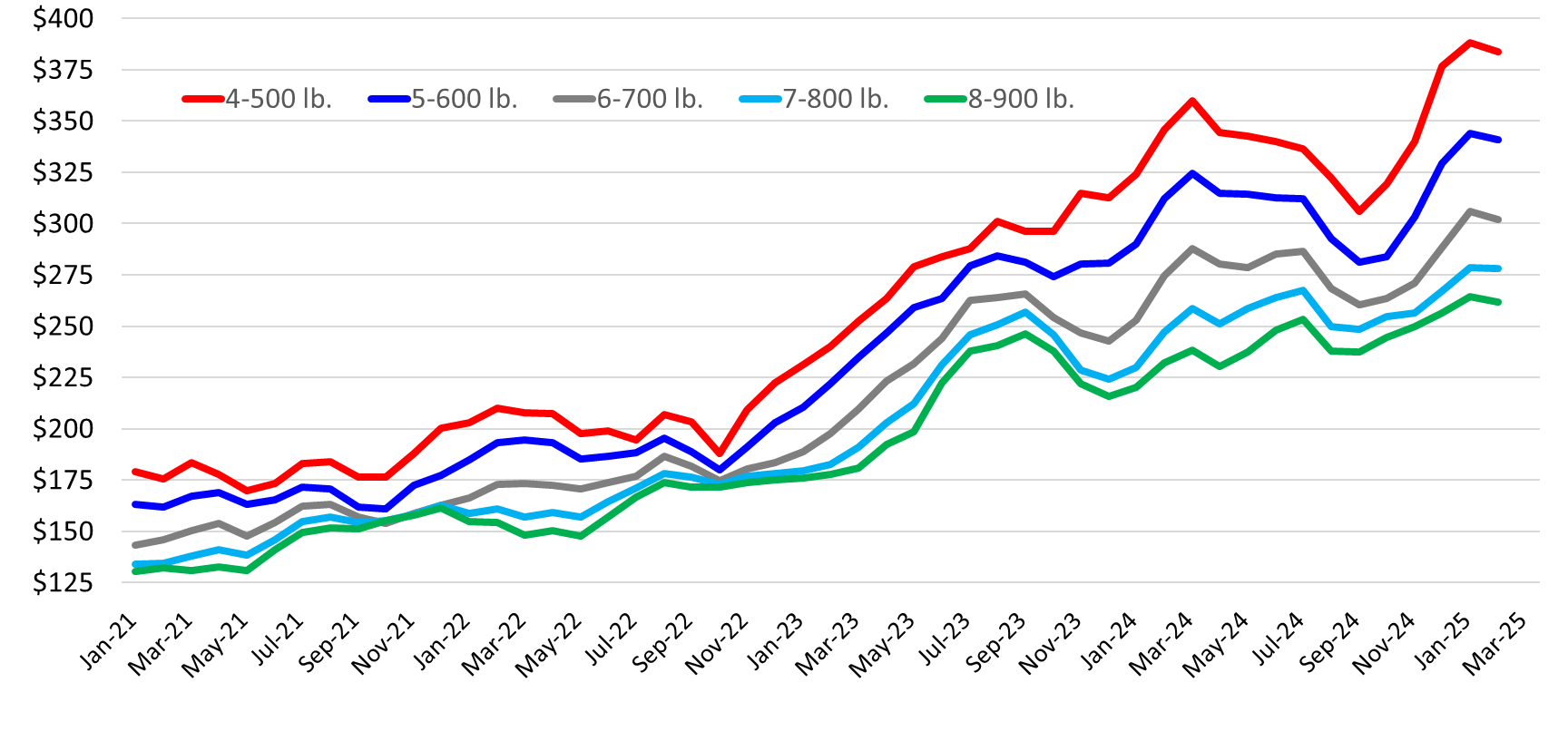
Figure 1. Steer Price Oklahoma Combined Auctions, $/cwt.
The stocker sector provides basic production value for the cattle industry. Calves and lightweight feeder cattle are grown to increase size and weight prior to feedlot placement. Stocker production also helps balance forage and feedgrain values. Cheaper forage-based stocker gains help keep the cattle industry competitive. When grains are expensive relative to forage, more weight can be put on feeder cattle prior to feedlot production. On the other hand, when cattle numbers are limited, feedlots can place lighter feeder cattle to help maintain feedlot inventory. This is especially true when feedlot cost of gain is relatively low due to cheaper grain prices. From the cow-calf perspective, forage is used for calf production but can be used for stocker production. Retained stocker production is an option for forage use when calf prices are relatively low and the value of added gain on stockers is relatively higher. Stocker production also plays an important role in spreading out cattle production seasonally and across years.
The current market is characterized by tight feeder cattle supplies and relatively low feedlot cost of gain. The role of the stocker industry gets squeezed in this environment. On the one hand, high calf prices are encouraging herd rebuilding and increased calf production. In other words, the market is indicating that the highest and best use of forage is for calf production rather than forage-based stocker production. On the other hand, low feedlot cost of gain and tight feeder supplies are encouraging feedlots to place animals sooner and at lighter weights, effectively bidding them away from stocker production. Both of these influences are reflected in the wide spread in feeder prices from light to heavy (Figure 1), which means a large rollback and relatively low value of gain for stocker production. Stocker production will still occur but the opportunities will be fewer and the margins will be trickier. However, when heifer retention begins, feeder supplies will be further squeezed from a feedlot perspective, but many of those heifers will need a growing phase as part of their development for breeding and thus provide a stocker role.
Value Proposition of Bulls
Mark Z. Johnson, Oklahoma State University Extension Beef Cattle Breeding Specialist
Definition of Value Proposition – a statement that defines how a product or service can meet a customers needs and help them achieve their goals.
Each bull you consider for purchase in a cow-calf operation needs to be evaluated relative to the benefits offered to your operation’s bottomline. For example:
You are an Oklahoma cow-calf producer who needs two more Angus bulls this spring and has narrowed the selection list down to the following five bulls which you have available to purchase private treaty:
| ID | CED | BW | WW | YW | CEM | HP | MW | Marb | $B | Price |
|---|---|---|---|---|---|---|---|---|---|---|
| 1 | 12 | 0.2 | 70 | 120 | 9 | 13 | 76 | 0.35 | 154 | $10,000 |
| 2 | 4 | 2.9 | 82 | 141 | 12 | 6 | 96 | 0.79 | 180 | $8,000 |
| 3 | 15 | 0.1 | 78 | 145 | 14 | 17 | 86 | 1.80 | 215 | $12,500 |
| 4 | 5 | 3.5 | 91 | 157 | 8 | 5 | 99 | 0.71 | 185 | $7,500 |
| 5 | 11 | 0.7 | 63 | 108 | 8 | 10 | 65 | 1.90 | 189 | $5,500 |
The bulls are all spring yearlings and will be approximately 15 months of age at turnout and accordingly should be expected to cover 15 cows this year. All the bulls have passed a Breeding Soundness Exam and sell with a registration paper and a Breeding Soundness Warranty. So the buying decision boils down to identifying the right bulls for this operation. The right bulls to buy are the ones most capable of adding value to the calf crop sired relative to their purchase price. In order to do so the bulls need to:
- Complement the females to which they will be mated
- Offer genetic values of economic relevance to the marketing endpoint of the calves they will sire.
Your operation intends to use the bulls as terminal sires on spring calving cows, four to six years of age. After weaning, the calves will run on cool season grass until marketed as yearlings. In this operation the trait of primary economic importance is Yearling Weight (YW).
What Bulls would you Buy and Why?
In order to calculate the profit potential of each bull, we will assume each bull will sire 125 calves over their lifetime of service, each will have the same salvage value and the value of a pound of YW sired will be $2.50.
Using the least expensive bull as our starting point:
Bull 5 serves as the baseline for least YW sired with a 108 YW EPD at expense of $5,500
Bull 1 is expected to sire 12 pounds more YW per calf, this multiplied by 125 calves results in an additional 1,500 pounds. 1,500 pounds of YW at a value of $2.50 equals $3,750. The purchase price of bull 1 is $4,500 more than bull 5. $3750 - $4,500 = $ -750. So, Bull 1 is a worse choice than bull 5 by $750.
Bull 2 is expected to sire 33 pounds more YW per calf, this multiplied by 125 calves results in an additional 4,125 pounds. 4,125 pounds of YW at a value of $2.50 equals $10,312.50. The purchase price of bull 2 is $2,500 more than bull 5. $10,312.50 - $2,500 = $7,812.50. So, Bull 2 is a superior choice than bull 5 by $7812.50.
Bull 3 is expected to sire 37 pounds more YW per calf, this multiplied by 125 calves results in an additional 4,625 pounds. 4,625 pounds of YW at a value of $2.50 equals $11,562.50. The purchase price of bull 3 is $7,000 more than bull 5. $11,562.50 - $7,000 = $4,562.5. So, Bull 3 generates $4562.50 more relative to his purchase price than bull 5.
Bull 4 is expected to sire 49 pounds more YW per calf, this multiplied by 125 calves results in an additional 6,125 pounds. 6,125 pounds of YW at a value of $2.50 equals $15,312.50. The purchase price of bull 2 is $2,000 more than bull 5. $15,312.50 - $2,000 = $13,312.50. So, Bull 4 is a vastly superior choice than bull 5 by $13,312.50.
Another way of looking at the “Value Proposition” of each bull. Over their lifetime of service:
Bull 5 will sire 125 calves at a cost of $5,500. Using Bull 5's YW EPD of 108 as the baseline for YW:
Bull 4 will sire 125 calves while paying this cow-calf operation $7,812.50 for the opportunity. Value added of $15,312 minus purchase price of $7,500
Bull 2 will sire 125 calves while paying this cow-calf operation $2,312.50 for the opportunity. Value added of $10,312.50 minus purchase price of $8,000
Bull 3 will sire 125 calves at a cost of $937.50
Value added of $11,562.50 minus purchase price of $12,500
Bull 1 will sire 125 calves at a cost of $6,250
Value added of $3,750 minus purchase price of $10,000
Takeaways
Initial cost of the bull is only one part of the profit equation. Value added to calves is equally important.
Identifying the trait (or traits) of primary economic importance is critical to determining the Value Proposition of each bull.
You need to have a budget. Your budget needs to be realistic.
When multiple traits have economic importance, determining the Value Proposition of a bull is more challenging. Will require looking at current levels of production in traits of importance in order to determine where to focus selection pressure.
Getting a Jump Start on Fly Season
Jonathan A. Cammack, Oklahoma State University Cooperative Extension Service Livestock Entomology & Parasitology Specialist
As we finally start to warm up, it's never too early to start thinking about our fly management program for the upcoming season. Management of horn flies should be approached from multiple angles, using as many of the tools as we have available. A two-pronged approach of combining insecticide products targeted at different life stages, such as an ear tag for adult control, and a feed-through insect growth regulator (IGR) for larval control, will give you the highest probability of success in the battle against these pests.
Ear tags are an effective method for control of adult horn flies and should be administered to the animals once the threshold of 200 flies per animal is reached. Most ear tags have an effective life of approximately 4 months, under ideal conditions. In the hot, Oklahoma summers, expect the lifespan of an ear tag to be 3 months or less. Waiting to tag animals until horn fly numbers reach the threshold of 200 flies per animal will help ensure that the ear tags are still effective once we reach peak fly season in mid to late summer. If horn flies are active: it's never too late to tag, but it can be too early. Make sure to use a different chemical class than you did last year, to help slow the development of insecticide resistance. If picking a synthetic pyrethroid tag, choose one that is synergized, and contains piperonyl butoxide (PBO) as an active ingredient. A good, yearly rotation schedule for ear tags is shown below.
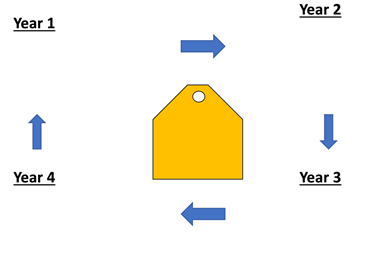
Year 1
Synergized Pyrethroid + Macrocyclic Lactone Combo
- TRI-ZAP®
Year 2
Organophosphate
- Dominator®
- Max40TM
- Optimize®
- PatriotTM
Year 3
Synergized Pyrethroid
- CyLence Ultra®
- Python®II
- SABER ExtraTM
Year 4
Macrocyclic Lactone
- XP820®
IGRs are a great method for managing larval horn flies, and larvae of other biting and nuisance flies that develop in decomposing organic matter such as manure. Feed-through IGRs are consumed by the cattle, and pass through their digestive tract and are excreted in the manure, which serves as a food source for larval flies. When the larvae consume this IGR in the manure, they will not successfully complete their development to the adult stage. Start feeding minerals or supplemental feeds containing IGRs during the month of March and continue through October. We want to make sure all of the manure in pastures contains the IGR, so we can start to have an impact on developing fly larvae (particularly horn flies) as soon as the adults become active and start laying eggs in the manure, and throughout the remainder of the fly season. Products that are registered as feed troughs for cattle contain either the active ingredient Methoprene (examples: Altosid® IGR, Dipteracide®, Pertinent IGR) or Diflubenzuron (examples: ClariFly®, JustiFly®, HerdGuardTM). If you have been feeding your cattle hay over the winter, it is likely that the hay, manure, and urine mixture surrounding your round bale feeding sites is a breeding site for stable flies. During the spring, as it starts to rain more frequently, this wasted hay can remain wet, and continues to be a source of development for stable flies. Premise granular IGR products such as Novaluron (ExhaltTM WDG) and Cyromazine (flynexx® granules) can be spread around on top of this wasted hay surrounding the round bales. These products will dissolve and come into contact with or be consumed by larval stable flies and prevent their development to the adult stage.
Taking the two-pronged approach outlined here can help minimize the impacts of horn flies and other nuisance and biting flies on your herds.