

Cow-Calf Corner | June 23, 2025
Keeping the Tank Full…For Now
Derrell S. Peel, Oklahoma State University Extension Livestock Marketing Specialist
The latest USDA Cattle on Feed report highlights the important distinction between stocks and flows in data. Cattle on Feed is a stock (or inventory) value at a point in time, while placements and marketings are flows of cattle through feedlots. Feedlot placements of cattle in May were down 7.8 percent year over year, a slightly bigger decrease than expected. Placements have been down seven of the past ten months with total placements the last six months down 4.4 percent compared to the same period one year earlier. In fact, annual (12-month) average monthly placements peaked cyclically in February 2018 and are down 8.0 percent as of May 2025 (Figure 1). The largest U.S. calf crop in this cattle cycle was in 2018 and has been getting smaller since then.
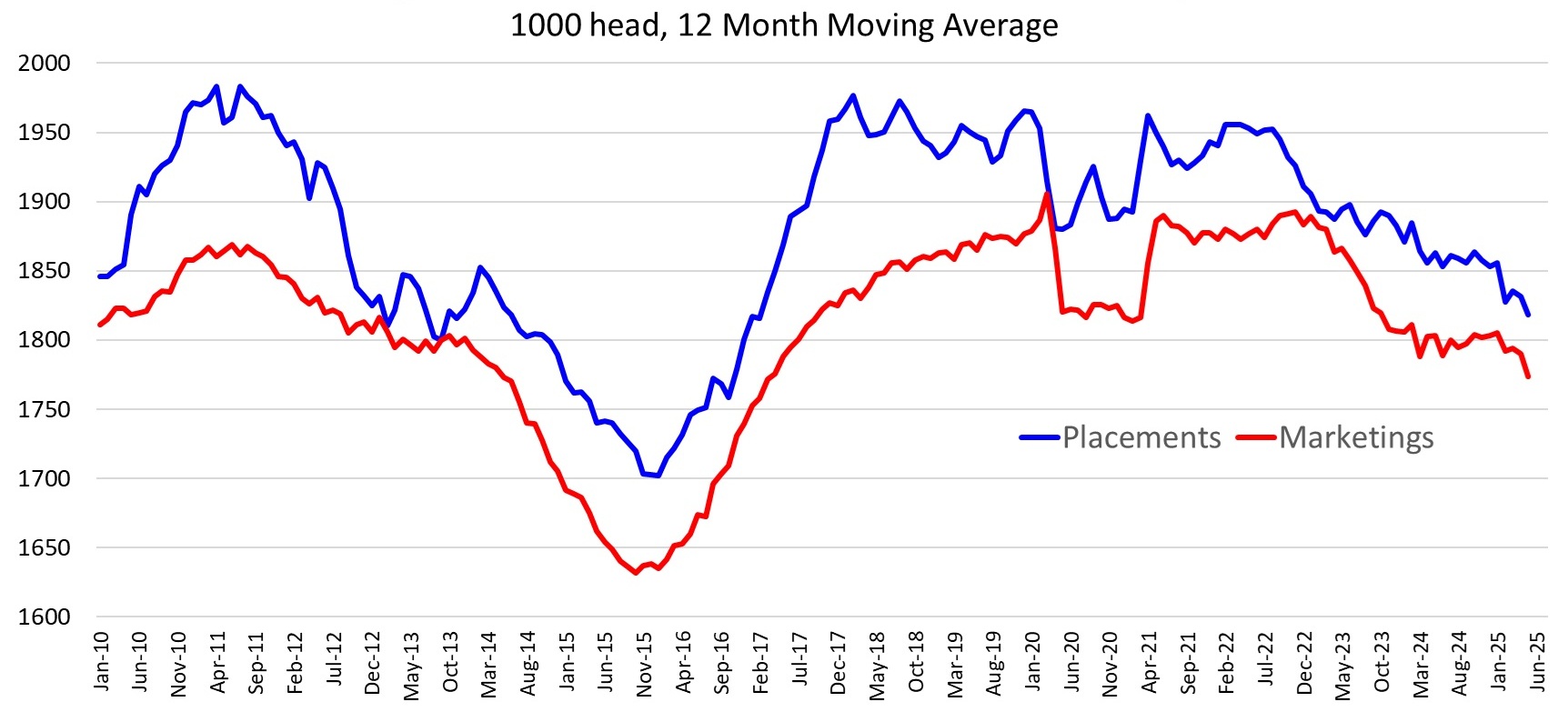
Figure 1. Feedlot Placements and Marketings
Despite lower placements, the July 1 feedlot inventory was 11.442 million head, down just 1.2 percent year over year. Feedlot inventories have been lower year over year for the past seven months but have averaged just a 1.2 percent decrease each of those months. Moreover, the June 12-month moving average of feedlot inventories is down just 2.8 percent from the cyclical peak in average feedlot inventories in September 2022 (Figure 2).
The discrepancy between feedlot placements and inventories is explained by feedlot marketings relative to placements. May placements were down 10.2 percent year over year, about as expected, but have decreased a total of only 3.1 percent year over year in the past six months, including the May figure. Annual average marketings peaked cyclically in March 2020 and are down 7.0 percent since then (Figure 1).
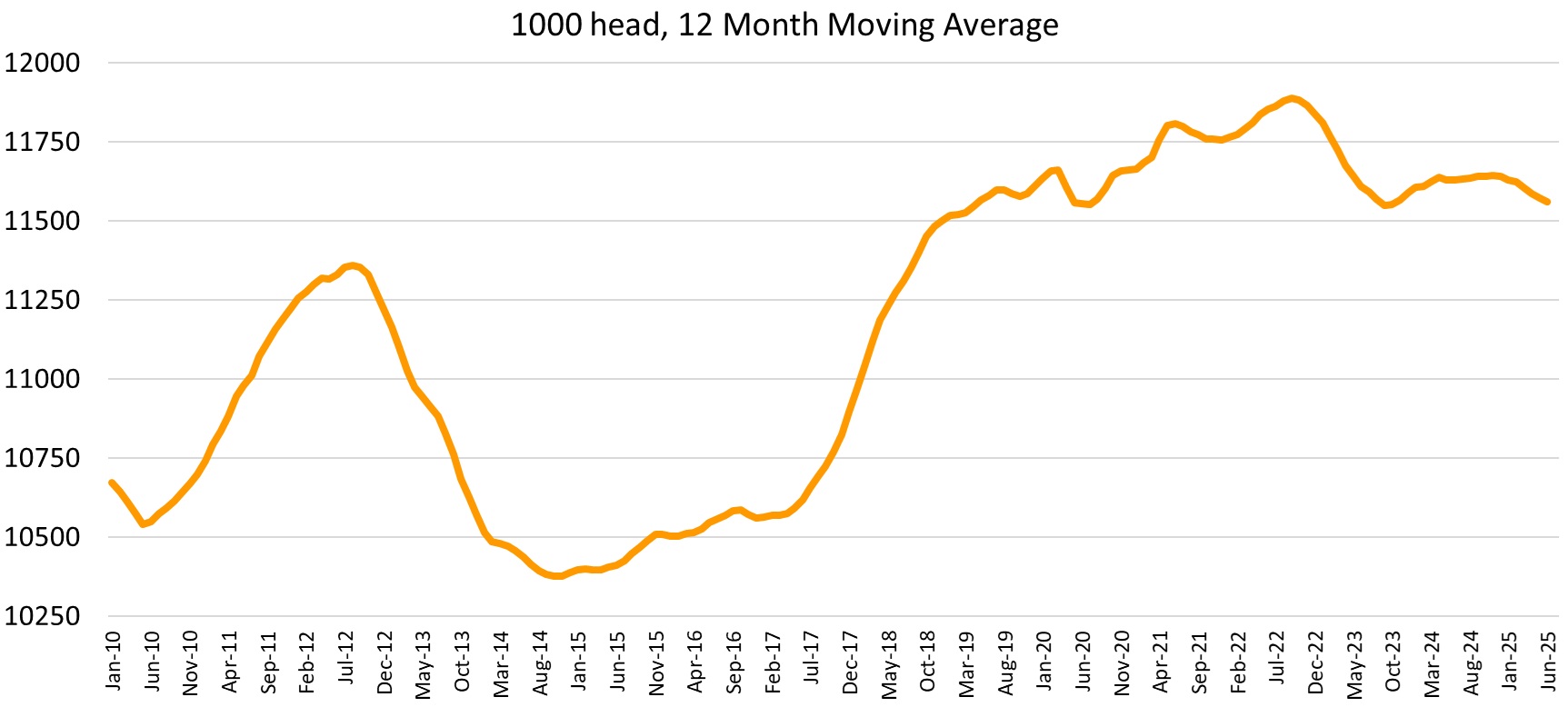
Figure 2 . Cattle On Feed
The feedlot is like a water tank with placements as the inflow and marketings as the outflow. Slower inflow is more than offset by slower outflow and helps keep the inventory (stock level) of the feedlots temporarily higher than the flows would indicate. However, feedlot inventories will keep slowly eroding with more time. The fact is that feedlot production and beef production are falling and will continue to fall, probably faster, in the coming months.
Factors Increasing Calf Value
Mark Z. Johnson, Oklahoma State University Extension Beef Cattle Breeding Specialist
In a robust cattle market it can be easy to overlook management practices that will increase the value of calves sold at weaning. Several phenotypic traits that increase value, such as hide color, polledness and the genetic potential for growth or muscularity were determined a year ago when we selected the bulls to sire our 2025 calf crop. That being the case, there are several best management practices to perform now that will pay off when marketing weaned calves.
Dehorning and castration are fundamental to adding value (or not taking discounts). Growth implants offer an excellent return on investment. Calf weaning weights can be increased through controlling internal and external parasites. Calves weaned at least 45 days prior to marketing have added value to the next owner. As well, assurance of specific cattle handling and health product use like those verified through Beef Quality Assurance (BQA) can be documented to add value. A proper vaccination program, documented and carried out before calves leave the ranch of origin, can reduce the incidence of Bovine Respiratory Disease and is a key management practice in maintaining the health of a calf all the way through the production system. Cattle health is the foundation of specific marketing programs buyers seek to reduce risk. While a variety of programs exist, most start with a first round of vaccinations when calves are two to four months old while still nursing cows. The first round of vaccinations for all would include the first dose of:
- A clostridial 7-way, 8-way or 9-way
- A viral respiratory 5-way (IBR, PI3, BRSVand BVD Type I & II)
- A bacterial respiratory Mannheimia haemolytica and/or Pasteurella multocida
With current prices, these management practices have more value than ever. More details on the Oklahoma Quality Beef Network (OQBN) can be found at the link shown below.
References:
Calf Management and Marketing: What’s Your Next Move?
Kellie Curry Raper, Oklahoma State University Cooperative Extension Livestock Marketing Specialist, Department of Agricultural Economics
Every cow-calf producer strives to produce the best cattle that their unique resource base allows. Right now, you are likely making – or have already made - decisions for your current calf crop based on (1) the resource constraints that you face and (2) the market opportunities available to you. A quality calf crop starts with a quality herd as its foundation and includes good management to achieve the goal of producing calves that you are proud of and that maximize the returns to your efforts. The process also involves a lot of planning. But the plan isn’t complete without both a calf health management program and a marketing plan for those calves.
When you market your calves, buyers can visually observe some indicators of quality and management for themselves – characteristics like frame, muscling, hide color, fill, fleshiness, castration, horn management and lot uniformity. Some of these characteristics are determined by herd genetics and while they are changeable, that change is a longer-term decision with no impact on the calf crop already on the ground. The rest of those characteristics are the result of current management decisions, as are unobservable calf characteristics such as vaccination status, weaning status, weaning period length, and certification. All are important components in the overall price of feeder cattle.
Perhaps the most famous quote of Peter Drucker, the father of modern management in the business world, is “What gets measured gets managed” – sometimes restated as “You can’t manage what you don’t measure.” Are you measuring the impact of your current calf management decisions? And assessing the potential added value of implementing management practices that you currently don’t employ? Measure both the expected cost and expected benefit and consider whether you can implement a “new to you” management practice. And if you do make the change, measure the realized cost and benefit and use that as input into next year’s decision.
With this year’s calf crop, consider the decisions that you can make now that can make a difference in the value of those calves in a few months at marketing time. For example, if you are not weaning calves at least 30 days prior to marketing, what constrains you from doing so? Is it facilities? Data from the Oklahoma Beef Management and Marketing (OBMM) survey indicate that access to preconditioning pens is highly correlated with implementation of 45-day weaning minimums, respiratory vaccinations, and feed bunk training. If you have no place to hold calves separate from cows, consider whether you can build pens - even for part of your calf crop – and consider whether you could expand it next year. Can you remedy that before weaning time? If not, gather cost and benefit information and consider it for next year’s calf crop. How many weaned or preconditioned calves would it take to pay for the initial cost of those pens?
If you are already weaning calves for 30 days, you presumably already have a place to separate them from their dams. Can you hold them for two more weeks to hit a 45-day weaning period? Sixty-three percent of producers who responded to the Oklahoma Beef Management and Marketing survey are weaning calves at least 45 days prior to marketing, but our research indicates that markets are also rewarding significantly longer weaning periods with higher premiums – up to 100 days. Assess what constraint keeps you from holding calves for longer weaning periods before marketing. Is it a need to use that space for something else? Is it forage/feed availability? Is it time? Is it tradition? Does the expected benefit outweigh the expected cost?
And then walk through this process for other potentially value adding management practices.
Every producer’s resource base is different. Presumably, your management and marketing strategies reflect the availability of those resources and their value to your operation. An annual or even semi-annual assessment of your strategy is a healthy exercise. At every level, record keeping about inputs, management practices, marketing successes and failures provides crucial input for future decision-making.
Ask yourself some important questions. Who am I marketing my cattle to? Do my management practices fit the buyer audience that I want to target? Is there a recommended practice that I currently do not utilize, and could it be beneficial to do so? What is the best way to access the buyers who are looking for cattle managed like mine? For this year’s calf crop, find the market where buyers are willing to compensate you for the management that you have put into your calves. And in preparing to breed for next year’s calf crop, be sure to get a strategy in place for their management and marketing too.
When you keep doing what you’ve been doing, you’re going to keep getting what you’ve been getting… Henry Ford.
What’s YOUR next move?
Reference: Hallie M. Barnes, Kellie Curry Raper, and Rodney Jones. “Break-Even Analysis of Equipment Purchases for Calf Health Management.” Journal of the American Society of Farm Managers and Rural Appraisers 2023:83-95. 2023.