

Cow-Calf Corner | June 2, 2025
Declining Beef Production Pushes Prices Higher
Derrell S. Peel, Oklahoma State University Extension Livestock Marketing Specialist
Strong seasonal demand and recent decreases in beef production have pushed beef prices sharply higher recently. The last week May, Choice boxed beef price was $364.92/cwt., up 16.5 percent year over year and has increased 7.7 percent in just the last seven weeks (Figure 1). Cutout values typically increase to a seasonal peak in May but the increase this year has been more pronounced than usual owing to generally strong beef demand and recently declining beef production. The increase in boxed beef cutout values from March to May has been roughly twice the normal seasonal increase over this period.
Choice 600-900 Lbs., Carcass, Negotiated, Weekly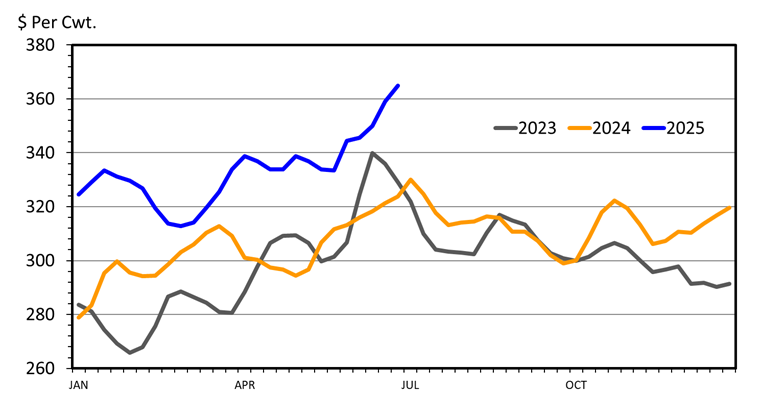
Figure 1. Boxed Beef Cutout Value
Table 1 summarizes changes in cattle slaughter and beef production for the year-to-date and recent weeks. Slaughter and beef production have begun to decrease with total beef production down for the last seven consecutive weeks for a total decrease of 4.4 percent year over year. The big change is fed beef production, which was higher in 2024 and is still 1.2 percent higher year over year for the year to date but is down six of the past seven weeks for a total decrease of 3.3 percent compared to the same period one year ago. In the last seven weeks, total fed (steer plus heifer) slaughter is down 5.6 percent with steer slaughter down 5.5 percent and heifer slaughter down 5.8 percent year over year. This contrasts with 2024 when steer slaughter was up 0.4 percent and heifer slaughter was down a scant 0.3 percent year over year leading to total fed slaughter up 0.3 percent for the year.
Nonfed beef production continues the decline of the past two years. In the first 19 weeks of 2025, nonfed beef production is down 9.7 percent year over year, following a decrease of 12.7 percent last year. Thus far in the year, total cow slaughter is down 12.8 percent with dairy cow slaughter down 8.4 percent and beef cow slaughter down 17.0 percent.
| Fed. Insp. | 2024 | Year-To-Date 2025 (19 weeks) % Change from 2024 |
Last 7 Weeks % Change from 2024 |
|---|---|---|---|
| Steers | 0.7 | -1.4 | -5.5 |
| Heifers | -0.3 | -2.6 | -5.8 |
| Fed | 0.3 | -1.9 | -5.6 |
| Dairy Cows | -11.4 | -8.4 | -11 |
| Beef Cows | -18.8 | -17 | -14.9 |
| Cows | -15.4 | -12.8 | -13 |
| Bulls | -7.7 | -12 | -18 |
| Total | -3 | -4.1 | -7.1 |
| Fed. Insp. | 2024 | Year-To-Date 2025 (19 weeks) % Change from 2024 |
Last 7 Weeks % Change from 2024 |
|---|---|---|---|
| Nonfed | -12.7 | -9.7 | -10.7 |
| Fed | 2.8 | 1.2 | -3.3 |
| Total | 0.1 | 0.5 | -4.4 |
The decrease in nonfed beef production is reflected in the trimmings market. The current price of 90 percent lean trimmings is $383.41/cwt., up 8.3 percent over last year. The recent decrease in fed slaughter has also pushed prices for 50 percent lean trimmings sharply higher, with the latest weekly price at $126.91/cwt., up 67.1 percent year over year. A 5:1 ratio of 90s to 50s – which produces an 83.3 percent blend – is currently valued at $340.66/cwt., up 10.7 percent year over year.
Smarter Gain with Ionophores
Dana Zook, Oklahoma State University Cooperative Extension NW Area Livestock Specialist
When I was growing up, my dad often told me to “work smarter, not harder”. There was always a lot to get done on the farm and I had the tendency to power through the work rather than think about an easier way. Consequently, in my current job I like to discuss products or strategies to help a producer be more efficient. In livestock nutrition, a product that can help a producer be more efficient and “work smarter” is an ionophore.
What is an ionophore? Ionophores are feed additives that were developed to improve efficiency and prevent coccidiosis. The two most common ionophores utilized are monensin (Rumensin® and Monovet®) and lasalocid (Bovatec®). In addition to the improvement of efficiency (more gain/less feed), ionophores have a derived benefit of preventing and controlling digestive disorders such as acidosis and bloat.
How do ionophores work? Ionophores improve feed efficiency simply by increasing the amount of energy available to the animal through selection of more efficient microorganisms in the gut. Ionophores are labeled for both grazing and feedlot cattle. Oklahoma State Animal Science has historically led the charge in research around the use of ionophores for grazing cattle and there are benefits in a variety of grazing situations. For instance, cattle gain is improved 0.15 to 0.2 pounds by including an ionophore in a free-choice mineral. An additional feeding strategy supported by a great deal of research recommends offering ionophores in small package supplements to grazing cattle to complement forage nutrients and ensure proper consumption. Performance varies depending on the forage base however the supplement plus ionophore lends an additional 0.2-0.4 pounds of daily gain. Note that cattle must have proper overall nutrition, adequate forage, and have a healthy status to achieve optimum gains.
It should be emphasized that pure forms of ionophores are very potent and require extreme precision when added to blended feeds and supplements. When feeding ionophores in a pure form or within a supplement, label instructions should be strictly followed. Monensin is toxic specifically to equine species and some monogastric animals. Ionophores can be toxic to any animal when overconsumed.
Increased gain across the board, less bloat, and improved health for growing cattle of all stages; now that is what I call “working smarter”! If you are interested in what an ionophore can do for your cattle operation, reach out to any OSU County Extension Educator or Area Livestock Specialist. We would be happy to work with you.
References:
Oklahoma GOLD Q&A Late-Season Supplementation Program for Stocker Cattle AFS-3032
Oklahoma SUPERGOLD Q&A: Late Season Supplementation Program for Stocker Cattle AFS-3033
Beck, P., T. Hess, D. Hubbell, G. D. Hufstedler, B. Fieser, J. Caldwell. 2014. Additive effects of growth promoting technologies on performance of grazing steers and economics of the wheat pasture enterprise. JAS, Volume 92, Issue 3, March 2014, Pages 1219-1227. https://doi.org/10.2527/jas.2013-7203
Fieser, B.G., G.W. Horn, J.T. Edwards, and J.R. Kountz. Effect of Mineral Supplementation with or without Monensin and Energy Supplementation on Growth Performance of Wheat Pasture Stocker Cattle. Effect of Increasing Levels of Monensin in an Energy Supplement for Cattle Grazing Winter Wheat Pasture
Relationship of Bermudagrass Yield to Nitrogen Fertilization
Mark Z. Johnson, Oklahoma State University Extension Beef Cattle Breeding Specialist
Bermudagrass, an introduced forage, is very important to Oklahoma cow-calf operations. Bermudagrass has some highly beneficial characteristics. Yield, persistence, nutritional value, timing of growth and production, tolerance to heavy grazing, responsiveness to fertilization and resistance to herbicides. A key benefit of Bermudagrass is the potential to support higher stocking rates than native range. When properly managed (for weed control and fertilization) and in response to adequate rain, Bermudagrass has the potential to be highly productive. On the downside, Bermudagrass requires these inputs on an annual basis in order to achieve maximum productivity. The chart below shows the linear response of bermudagrass production relative to Nitrogen applied.
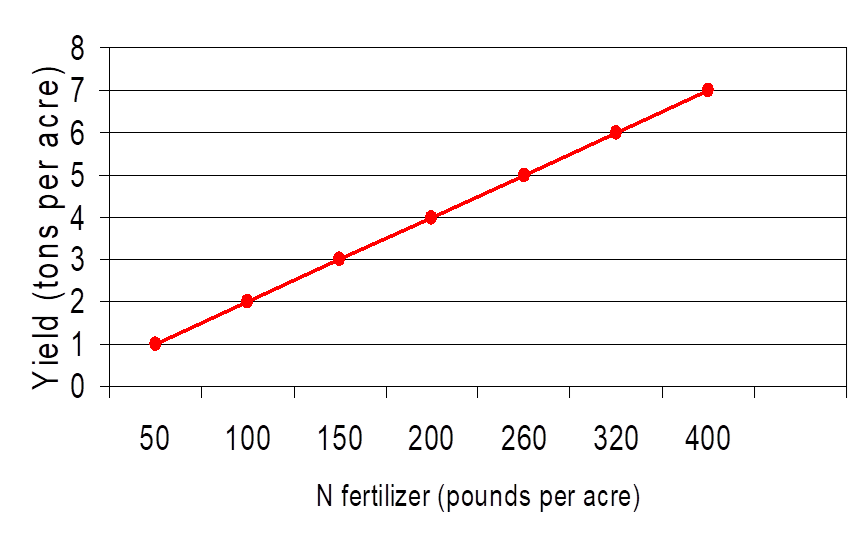
Relationship of Bermudagrass Yield to Nitrogen Fertilization
This chart can be used for forage budgeting to manage fertilizer inputs to meet target goals for production. With recent ample rainfall across much of Oklahoma, timely application of fertilizer is critical to capitalize on the production potential of Bermudagrass pastures to achieve the production levels needed.
Reference:
Chapter 11, OSU Beef Cattle Manual. Seventh Edition. E-913. Oklahoma Cooperative Extension Service.