

Cow-Calf Corner | July 7, 2025
Slow Mexican Border Reopening Planned
Derrell S. Peel, Oklahoma State University Extension Livestock Marketing Specialist
USDA-APHIS has announced a slow phased reopening of the Mexican border for imports of cattle, bison and horses in the coming weeks. Progress has been made in containing the spread of New World Screwworm (NWS) in Mexico with expanded control measures and increased cooperation with Mexican officials. The plan calls for opening ports farthest away from southern Mexico (i.e. Arizona) with the least risk of transporting NWS to and across borders and sequentially reopening ports in New Mexico and Texas between July and September. Each phase of reopening will be contingent on continuing assessment and progress in NWS containment and control in Mexico. The Arizona and New Mexico ports are all at roughly the same latitude with Douglas, AZ the farthest west, roughly 200 miles west of Santa Teresa, NM. The following discussion will use Mexico City as a reference point for relative port locations. NWS affected areas in Mexico are all south of Mexico City.
The first port scheduled to open, on July 7, is Douglas Arizona. Douglas, AZ is located roughly 1230 highway miles from Mexico City and by latitude and longitude is some 828 miles north and roughly 690 miles west. In 2023, the most recent complete year of border cattle trade with Mexico, the Douglas port was the second largest port in volume of cattle crossed and accounted for just under 15 percent of total annual feeder cattle imports. Nogales, AZ, the second largest cattle port in 2023 is not currently scheduled for reopening. In total, Arizona ports accounted for 27.5 percent of total imports of Mexican cattle in 2023.
The Columbus, New Mexico port is scheduled to reopen on July 14. Columbus is about 1209 miles from Mexico City and is roughly 828 miles north and 550 miles west of Mexico City. Columbus was the fourth largest volume port in 2023, with just under 11 percent of total annual imports.
Santa Teresa, New Mexico, located just west of El Paso, Texas, is the largest port for cattle imports and accounted for about 43 percent of total Mexican cattle imports in 2023. The port is scheduled to reopen on July 21. Santa Teresa is roughly 1160 miles from Mexico City and is approximately 828 miles north and 483 miles west of the Mexican capital. The New Mexico ports represented 53.4 percent of Mexican cattle imports in 2023.
The Texas port of Del Rio is scheduled to reopen on August 18. Del Rio is roughly 823 miles from Mexico City and is located roughly 690 miles north and less than 100 miles west of Mexico City. The Del Rio port accounted for less than two percent of total cattle imports from Mexico in 2023.
The port at Laredo, Texas is slated to open on September 15. The port accounted for just over one percent of cattle imports in 2023. This port is closest to southern Mexico, some 700 highway miles from Mexico City and according to latitude and longitude is about 550 miles due north of Mexico City. The Texas ports accounted for just over 19 percent of cattle imports in 2023, including Presidio, Texas, which represented nearly eight percent of total imports and is not currently on the list of ports scheduled to reopen.
In the weeks from early February to May 11, a total of 224,834 Mexican cattle crossed the border. The current list of ports scheduled to reopen accounted for roughly 71 percent of total imports in 2023. Given the remaining weeks of the year and the likelihood that ports will not jump to historic capacity immediately, total possible imports for the year are likely to be significantly reduced for the year. Fewer Mexican cattle were expected this year in any event, compared to the last two years, and with the disruptions thus far, total cattle imports in 2025 may be in the range of 400 to 700 thousand head, depending on how smoothly the reopening process proceeds.
Guidance on Delicious Beef Grilling
Mark Z. Johnson, Oklahoma State University Extension Beef Cattle Breeding Specialist
Beef is the ideal dietary protein for grilling. With regard to flavor, beef is generally more interlaced with marbling, the taste fat that translates to a more flavorful and satisfying eating experience. Intact beef cuts can be aged to further intensify flavor which is not an option for other proteins. Beef offers more variety of cuts, all of which result in the same satisfying eating experience. Beef steaks can be served in a variety of “degree of doneness” options relative to your preference. Likewise, beef offers more options in the amount of time spent in preparation to better fit your schedule. Since beef is the preferred protein among most consumers, it will typically cost more per pound in comparison; nevertheless, the variety of options from a beef carcass leads to choices to fit any budget.
Consider The Cut
Middle meats from the beef carcass like ribeye, strip loin, filet and sirloin steaks are very tender and can be cooked quickly at high temperatures on the grill. Typically steaks or middle meats will be the more expensive cuts to purchase. Burgers, made from ground beef will be less expensive than middle meats and can result in the same savory beef flavor.
Practice Safety
Oklahoma State University Cooperative Extension fact sheets offer guidance on safe and delicious grilling. Key recommendations include:
- Use a food thermometer to ensure a safe internal temperature of burgers of 160 degrees F.
- Prevent cross-contamination and practice safe food handling. Use a clean platter to remove burgers from the grill and discard any leftover marinades.
- Keep children and pets away from the grilling area and never leave a lit grill unattended. Keep the grill at least 10 feet from structures.
- Keep burgers (and other perishable food like dairy products) chilled and covered prior to cooking.
More information about safe grilling can be found in the fact sheet referenced below.
Reference: Keep food safe
Stable Fly Activity Continues
Jonathan A. Cammack, Oklahoma State University Cooperative Extension Service State Livestock Entomology & Parasitology Specialist
It’s hard to believe that in the first week of July that stable flies are still an issue.
While near record rainfall across much of the state has been welcome for forage, hay, and other crop production, it has certainly contributed to pest issues in nearly every aspect of agricultural production, and livestock are no exception. We typically experience two peaks in stable fly activity during the year: one in the late spring/early summer, and the other in the fall, when daily temperatures stay below ~85°F. A cooler than average June across the entire state (Fig. 1A), coupled with higher than average rainfall (Fig. 1B), has helped stable fly populations proliferate, and remain longer than normal.
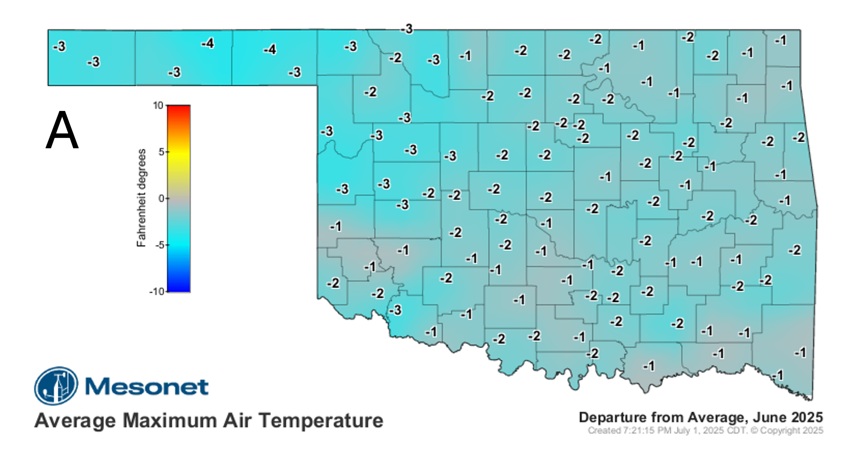
Figure 1a. Comparison of June, 2025 to the 30 year average for: (A) average maximum air temperature and (B) total rainfall for the month.
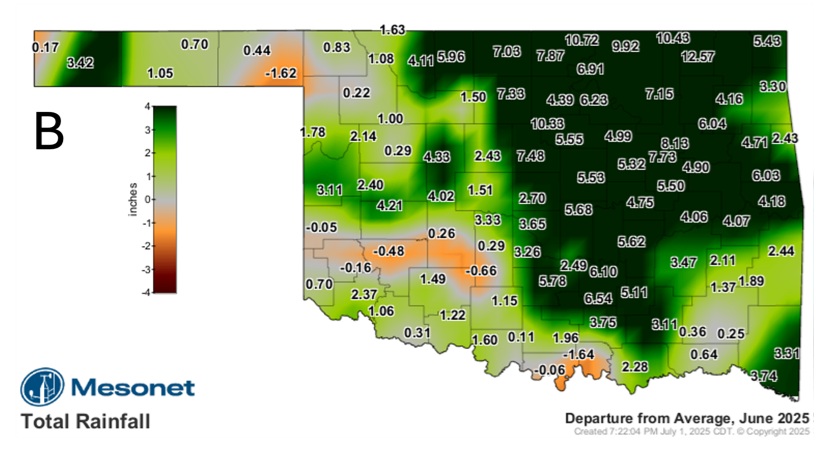
Figure 1b. Comparison of June, 2025 to the 30 year average for: (A) average maximum air temperature and (B) total rainfall for the month.
Stable flies typically develop in the hay, manure, and urine mixture that occurs around round bale feeding sites. While you might have done a great job over the winter moving the placement of your hay bales to prevent the accumulation of that wasted hay and allow it the chance to dry out (Fig. 2), the immense amount of rainfall we have experienced so far this year has kept that material wet, and stable fly numbers up.
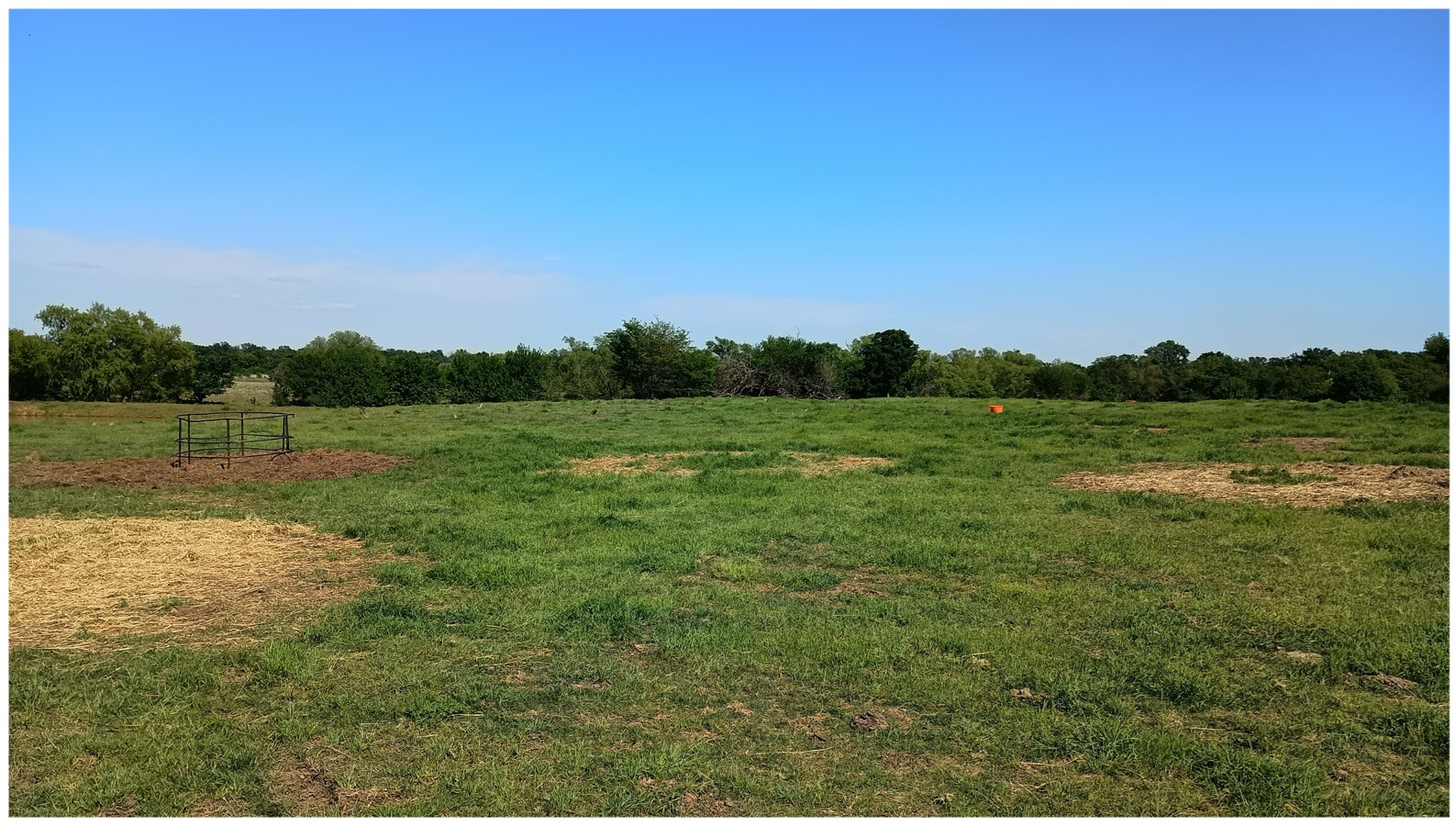
Figure 2. An example of round bale feeding sites that remain after winter feeding of cattle.
In the absence of the hot, dry stretch that characterizes a normal summer, there are things we can do to help reduce stable fly numbers. Larvicide insect growth regulator (IGR) products such as Novaluron (ExhaltTM WDG) and Cyromazine (flynexx® granules) can be applied as granulars or sprays (dissolved in water) on top of these remaining patches of hay where the cattle fed on round bales. These insecticide products will dissolve and infiltrate into the stable fly breeding site (the decomposing hay, manure, and urine) and come into contact with or be consumed by larval stable flies, thus preventing their development to the adult stage. Alternatively (or better yet: additionally), you can periodically turn, till, or disc these areas of wasted hay to help this material dry out, and make the environment less suitable for stable fly development.
Due to the preferential feeding on the lower legs of animals, insecticidal ear tags are not typically effective for stable fly management.