

Cow-Calf Corner | January 27, 2025
Fewer Feedlot Placements; Less Heifers on Feed
Derrell S. Peel, Oklahoma State University Extension Livestock Marketing Specialist
The January USDA-NASS Cattle on Feed report shows a feedlot inventory of 11.823 million head, down 0.9 percent year over year. January feedlot inventories were down from December levels meaning that December is the likely seasonal peak in feedlot numbers this season. Feedlot inventories typically peak in the winter, usually from December to February but as early as November and as late as April.
December marketings were about as expected, up 1.0 percent compared to one year earlier. However, December 2024 had one extra business day compared to 2023, so daily average marketings were down 3.8 percent year over year. For all twelve months of 2024, feedlot marketings were down 0.2 percent from the previous year.
December placements were down 3.3 percent year over year. Placements in December were lower than expected and outside the range of pre-report estimates. For all twelve months of the year, total placements were down 1.6 percent from the previous year.
Although marketings were down slightly, the slower pace of marketing decreases compared to placement decreases explains how feedlots were able to maintain inventories on average fractionally higher year over year each month in 2024. Even with fewer placements, the reduced turnover rate resulting from increased days on feed allowed feedlots to hold average monthly inventories about equal to the previous year. With the slower turnover rate in place, feedlots will likely see inventories fall in 2025 with declining placements. Days on feed in feedlots will likely remain large but are unlikely to continue increasing enough to hold feedlot inventories as tight feeder supplies become more apparent.
The January Cattle on Feed report also included the quarterly breakdown of steers and heifers in feedlots. Steers on feed were up 0.7 percent from one year ago while heifers on feed were down 3.4 percent year over year. Heifers accounted for 38.7 percent of feedlot inventories, down from 39.7 percent in October (Figure 1).
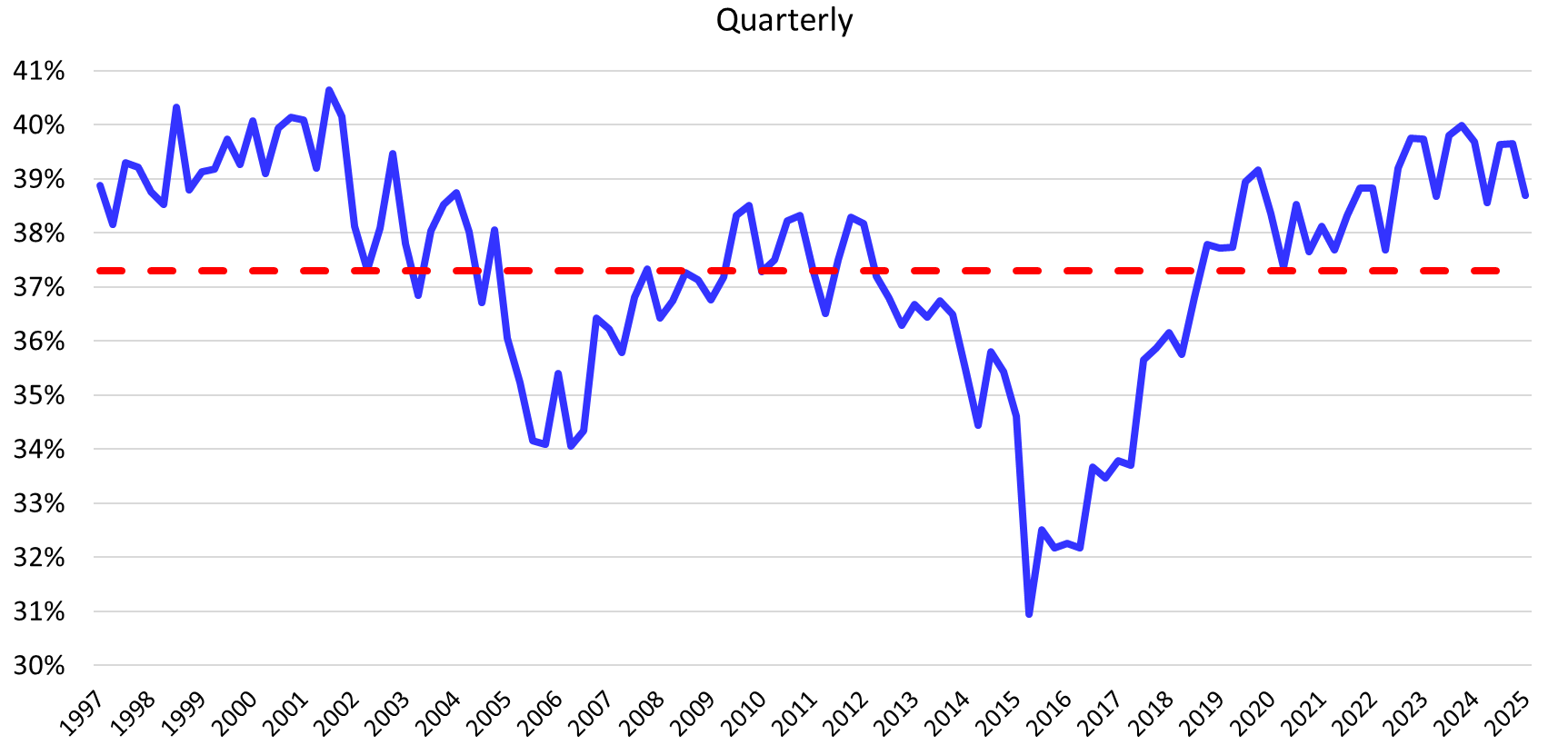
Figure 1. Heifers as Percent of Total Cattle on Feed
While the decrease in heifers on feed is welcome from the perspective of potential herd rebuilding, Figure 1 shows that the decrease is not yet enough to suggest a sustained downtrend in heifer feeding. Similarly, the nearly one percent decrease in feedlot inventories may indicate further decreases in the feedlot total but this modest decrease for just one month is not enough to confirm a declining trend in feedlot inventories. By the time we get to the March quarterly numbers, both heifer feeding and overall feedlot inventory trends may be clearer.
What is a Good Bull Worth in 2025?
Mark Z. Johnson, Oklahoma State University Extension Beef Cattle Breeding Specialist
The spring bull buying season is here it’s time to revisit the age old question. The question has been asked forever, or at least as long as we have been breeding cattle with a notion of trying to make the next generation better. It is a classic and timeless question. It is an important question. At this time of year, when many bulls are being marketed and we are planning ahead for spring breeding season, it is a question that is asked a lot!
The Answer
I remember first hearing the answer nearly 40 years ago as a student at OSU. “A good bull is worth the value of five calves he sires.” I’ve heard that answer again many times over the years. It is a good answer and a good rule of thumb to follow, the problem is it doesn’t exactly narrow down the range. If we do a little “cowboy math,” this answer may in fact lead to more questions. Such as…
What is considered a “Good Bull”?
For this discussion, qualifications to meet “Good Bull” status are:
- A bull that sells with a registration paper which includes pedigree information and a complete set of genetic values (including EPDs and Bio-economic indices) to be considered in the selection process.
- A bull that has passed a Breeding Soundness Exam (BSE) and selling with a breeding soundness warranty (terms will vary).
When are we marketing our Calves? What is their Value?
According to the most recent (January 21, 2025) Oklahoma Market Report:
524 lb. weaned steer calves (Large, 1) are worth about $3.50/lb. for a value of approximately $1,834 per head. Therefore, if my future marketing plan is to sell weaned steers, $1,834 x 5 = $9,170 is the answer.
912 lb. yearling steers (Large, 1) are worth about $2.53/lb. for a value of over $2,300 per head. Therefore, if my future marketing plan is to sell yearling steers, $2,300 x 5 = $11,500 is the answer.
1,500 lb. finished beef steers are worth $2.00/lb. live for a value of $3,000 each. Therefore, if my future marketing plan is to retain ownership through finishing and sell fed cattle on a live weight basis, $3,000 x 5 = $15,000 is the answer.
So, in the current market, a good bull is worth somewhere between $9,000 - $15,000 to a commercial cow-calf operation. Where exactly in that range depends on your marketing plan and the market conditions at that time. Not an exact number because there are many variables in play. One key point illustrated here is that the longer you own the offspring before marketing, the greater the value of the bull to your operation. Retained ownership gives you more time and opportunity to capture the value of your investment in genetics. It is noteworthy that we haven’t considered the value added to replacement females a bull will sire. Bulls used to sire the next generation of cows have an even greater long-term economic impact on the profit potential of your operation and should be valued accordingly.
I encourage cow-calf operations to consider their production system and marketing plan. Doing so should dictate where to apply selection pressure. Genetic values pay when you purchase bulls capable of improving genetic potential for the specific traits that will translate to added value at your intended marketing endpoint.
Keep the following chart in mind as another way to evaluate ownership cost of bulls on a per calf sired basis.
Bull Purchase Price: 
Cost per calf sired - assuming 150 calves sired over duration of time as a herd bull.
Mark Johnson, OSU Extension beef cattle breeding specialist, discusses the value of a good bull on SunUp TV from January 27, 2024.
Round Bale Feeders are Worth the Investment
Brian Pugh, OSU Cooperative Extension Service Northeast Area Agronomist
Hay feeding losses occur primarily from trampling, refusal, and leaf shatter. Some feeding loss is inevitable but can vary from as little as 2% to more than 50%. A study conducted by Arkansas Cooperative Extension Service found that feeding round bales in open bottom hay rings reduced the amount of hay fed by 29% when compared to feeding round bales unprotected (13% loss vs. 42% loss). If a 1200-pound round bale cost $35, a 29% reduction in hay loss is equivalent to a $10.15 savings per bale. The hay savings from using a ring on 20 bales would pay for a round bale feeder that cost $200.
Feeding losses from 20 round bales fed without a hay ring would pay for a commercially available round bale feeder.
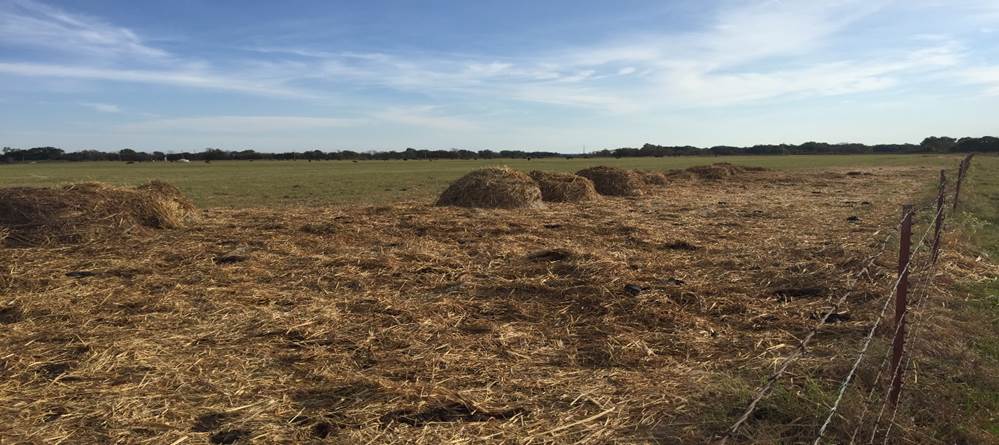
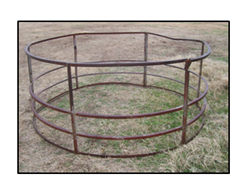
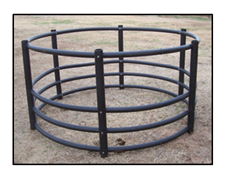
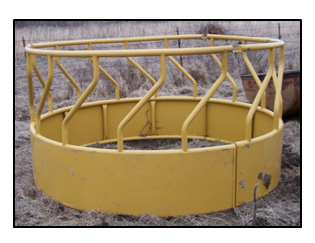
A more recent study by OSU assessed the efficacy of four types of hay ring feeders. Reported dry matter losses for the different rings were: poly rings (21%), open-bottom steel rings (20.5%), sheeted rings (12.6%) and modified cone feeders (5.3%). This data indicates that switching from an open bottom ring to a modified cone feeder would result in a 15.2% reduction in dry matter loss. With the same $35 per bale hay, that equates to a savings of $5.32 per bale. Cone feeders range in style and costs, but a popular model retails for $565. This indicates that after feeding 107 bales through the cone feeder it would pay for itself in hay savings.
If we compare the OSU modified cone data to the University of Arkansas data from using no ring feeder, we could potentially realize a 36.7% reduction in dry matter loss by utilizing a feeder. This is a savings of $12.85 per bale at $35/bale hay value! This decision to purchase a proven and efficient hay feeder design would only require 44 bales of fed hay to pay for the purchase. Round bale feeders are a wise investment when free-choice hay feeding is necessary.
| Hay Feeder | Sheeted-bottom Ring | Open-bottom Steel Ring | Polyethylene Pipe Open-bottom Ring | Sheeted-bottom Steel Ring |
|---|---|---|---|---|
| Types of round bale feeders | 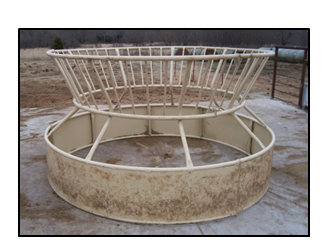 |
 |
 |
 |
Grass Tetany and Milk Fever in Spring Calving Cowherds May be a Concern
Paul Beck, Oklahoma State University Extension Beef Cattle Nutrition Specialist
Many years we are calving during the early spring with cows grazing lush pastures. When cows that have just calved are grazing cool-season annual pastures we often find mature cows that are in otherwise good condition and health with unusual behaviors, unsteady gait, or inability to rise. These are early signs of both grass tetany and milk fever. Both of these metabolic diseases are common in adult cows that have recently calved.
Grass tetany is a condition associated with inadequate magnesium in the diet and inefficient uptake of magnesium from the bone in older cows. We often see grass tetany with older cows grazing on small grain pastures because magnesium is often marginal to low and potassium is high in these forages. The high potassium interferes with magnesium absorption in the small intestine. Mature lactating cows are most susceptible because not only is dietary magnesium limited but these cattle are also losing magnesium through the milk they produce.
The most common method of preventing grass tetany is to supplement the herd with magnesium beginning at least 1 month prior to spring grazing. Mineral supplements should have 10 to 12% magnesium to offset the magnesium deficiency and prevent grass tetany from occurring.
Milk fever, also called parturient paresis (parturition paralysis), is a common metabolic disease in dairy cows, but can be an issue in older mature beef cows. The disease is often associated with the start of lactation and usually occurs within 72-hours of calving. Calcium is not only important for bone formation but also has important roles in nerve and muscle function.
When cows are fed high dietary calcium pre-calving the mechanisms for calcium absorption in the GI tract become inefficient to minimize calcium absorption and focus on mineral storage in the bone. When cows calve their calcium requirements increase due to milk production, but they are unable to rapidly increase calcium absorption and mobilization of calcium from the bone to maintain blood calcium levels for muscle contraction and nervous system function. There are indications that milk fever can be associated with vitamin D deficiency because of its role in calcium metabolism. Vitamin D is naturally produced in the skin when exposed to sunlight UV waves. Providing supplemental vitamin D during the winter months is an important consideration because sunlight intensity is not high enough for adequate vitamin D formation and deficiencies may develop. Feeding high calcium levels during late pregnancy should be avoided, but dietary calcium should be increased at calving to prevent milk fever.
A veterinarian should be consulted for diagnosis and treatment. If deaths have occurred, your veterinarian should be consulted to properly establish cause of death. These metabolic diseases are hard to differentiate, and are difficult to treat in a timely manner, but for both prevention is the best option.
Paul Beck, OSU Extension beef cattle specialist, discusses ways to adapt mineral supplementation as spring calving approaches on SunUp TV from January 25, 2025.