

Cow-Calf Corner | January 20, 2025
Cattle and Beef Markets Charge into 2025
Derrell S. Peel, Oklahoma State University Extension Livestock Marketing Specialist
Cattle and beef markets rocketed out of the gate coming into 2025. With no post-holiday wavering, all cattle and beef markets moved higher in the first half of January – setting new record price levels to start the new year. This continues the trend of the last three years. Cattle prices began to move higher after 2021 and increased more sharply in 2023-2024.
In Oklahoma auctions in the week ending January 17, 2025, the price of 500-pound steers (M/L, #1) was $361.88/cwt., up 18.1 percent year over year and up 111.1 percent from the same week four years ago in 2021. For 800-pound steers, the price was $269.07/cwt., up 21.0 percent year over year and up 105.1 percent in the last four years. The U.S. calf crop peaked cyclically in 2018 at 36.3 million head and decreased for the last six years to a projected 33.1 million head in 2024. Figure 1 shows the average volume of stocker and feeder receipts including the general downtrend since the recent peak in early 2019 and indicates a continued tightening of cattle numbers.
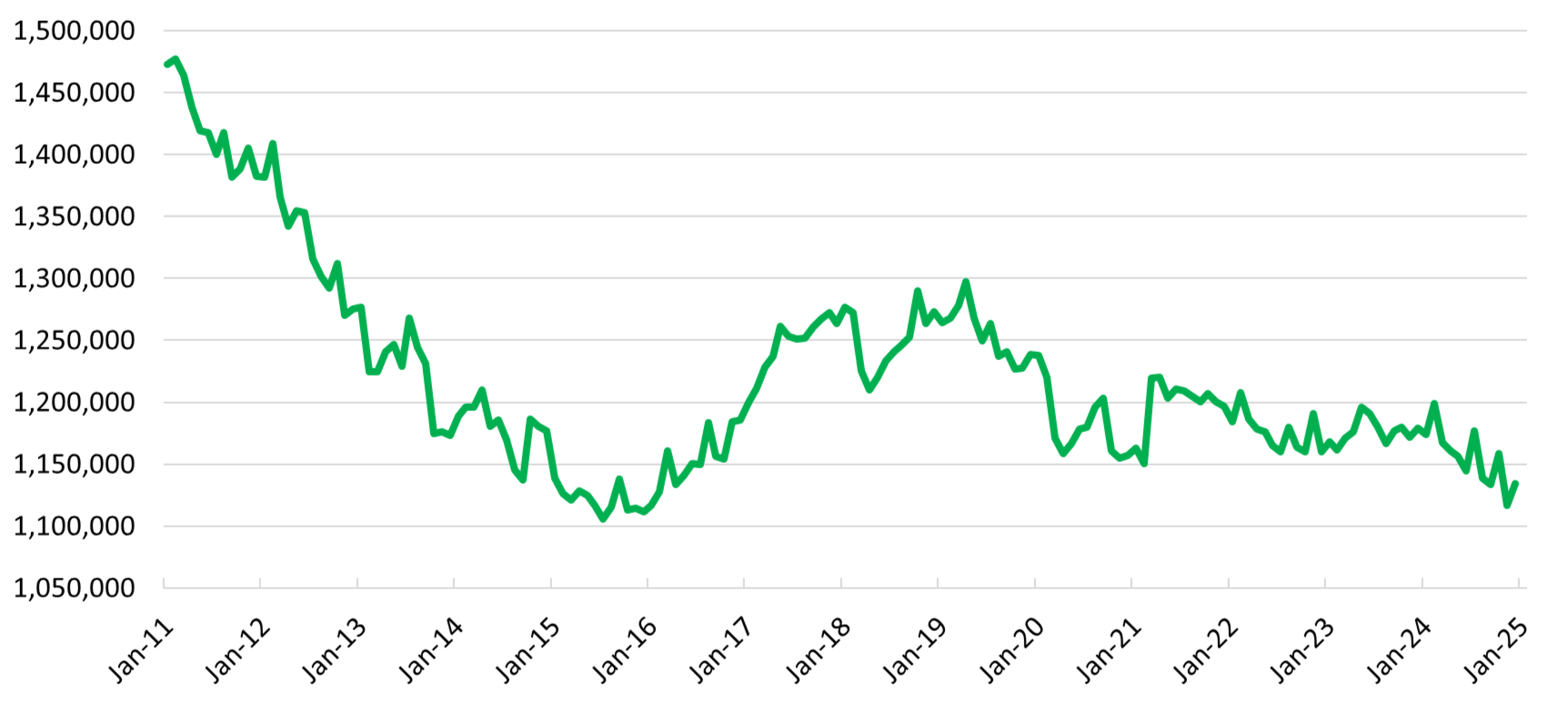
Figure 1. National Stock and Feeder Cattle Receipts, Auction, Direct and Video/Internet, 12 month MA
The 5-market fed steer live price was $203.56/cwt. for the week ending January 17, up 17.3 percent from one year ago and up 85.9 percent from January 2021. Daily 5-market fed steer prices hit $200/cwt. for the first time ever on January 7 and reached as high as $205.37/cwt. on January 15. Higher fed prices are expected ahead.
The Oklahoma price of average dressing Boning cull cows was $124.31/cwt. last week, up 21.1 percent from one year ago and up 149.5 percent from the same week in 2021. Cull cow prices last week ranged from $136.82/cwt. for high dressing Breaker cows to $110.09/cwt. for low dressing Lean cows.
The weekly Choice boxed beef price for mid-January was $333.51/cwt., up 17.7 percent year over year and up 58.2 percent over 2021 levels. The rib primal price last week was $508.06/cwt., up 2.4 percent year over year and up 50.2 percent from the same week in 2021. The latest loin primal price was $393.99/cwt., up 4.9 percent over last year and up 49.7 percent from 2021. The end meats are stronger relative to the middle meats, with the chuck primal price last week at $303.91/cwt., up 33.2 percent year over year and up 60.5 percent since 2021. The round primal price currently is $302.66/cwt., up 36.1 percent from one year ago and up 65.9 percent from 2021.
The strong cattle and beef price trend coming into 2025 is expected to continue as cattle inventories and beef supplies tighten further in the coming months. However, while cattle and beef markets are very strong internally, external shocks from political uncertainty along with U.S. and global macroeconomic jitters may cause short-term shocks and short-lived market setbacks. Volatility is likely to accompany a bullish market expectation.
Derrell Peel, OSU Extension livestock marketing specialist, discusses how the markets have reacted to highly pathogenic avian influenza and questions when herd rebuilding will begin on SunUpTV from January 11, 2025.
Calving and Cow Nutrition in Extreme Cold
Mark Z. Johnson, Oklahoma State University Extension Beef Cattle Breeding Specialist
Calving during the winter months can present some unique challenges. Cold and/or wet weather, higher birth weights, fewer hours of daylight and in most herds this is the time of year when we, as producers, are the primary source of nutrition provided in the form of harvested forage and supplemental feeds. What can we do to make calving in the late winter months as problem-free as possible? GET PREPARED!
Calving Kit and Facilities
Prior to Calving Season it is important to take inventory of our facilities. Our working pens, chutes and alley ways need to be in good working order. If we have a calving barn or indoor facility remember to check cameras, batteries and light bulbs. We want all facilities ready BEFORE we find ourselves assisting that first heifer in the calving process.
To be fully prepared, have the following list of supplies in a cooler, bucket or tool box:
- Colostrum, teat cannula and feeding bottle
- Flashlight and batteries
- OB Sleeves
- Non-detergent lubricant
- Antiseptic
- OB chains and calf puller
- Paper towels
- Rope halter
- Large cloth towel
Also, understand the three stages of bovine parturition (covered in Cow-Calf Corner last week). It’s important to know what to expect when a cow or heifer goes into labor in order to know when and how to provide assistance.
In regard to colostrum, sooner is better. If you come upon a newborn calf and are not certain it has adequately nursed. Administer colostrum via tube feeder as soon as possible. Insuring an adequate amount of colostrum is ingested by newborns is cost effective.
Cold Weather Impacts Nutritional Requirements
Cold, wet weather drives up cow nutritional requirements and cows should be fed accordingly. The Mesonet Cattle Comfort Advisor is an excellent tool for monitoring weather conditions and the impact they have on cattle. According to the Mesonet Cattle Comfort Advisor, cow energy requirements increase 1% for each degree the cattle comfort index is below 32 degrees F. This energy need will double to 2% if the animal is wet to the skin. In regard to new born calves, consider that in the birth process they are leaving the cozy environment of their mother's womb at a temperature of 101-102 degrees F and hitting the ground at temperatures as much as 100 degrees colder. Add in rain, snow, muddy ground or high winds and the situation can be catastrophic for newborns. While nature equips calves with a limited amount of brown adipose tissue which is burned internally to create heat for survival. Extreme cold can overwhelm the ability to create enough internal heat and hypothermia can occur. Calves suffering from hypothermia are more susceptible to naval infections, pneumonia and scours.
Best management practices for cold weather calving include:
- Provide adequate wind breaks, shelter and bedding so cows can separate and calve in a warmer, dryer, protected environment.
- Plan ahead to provide the additional protein and energy needs of cows during the final trimester of pregnancy and the beginning of lactation.
- Sort first calf heifer from cows and manage accordingly. Heifers are inexperienced and more likely to need a higher level of attention during calving and the initial stages of claiming and raising a calf.
Mark Johnson, OSU Extension beef cattle breeding specialist, discusses calving in extreme temperatures on SunUpTV from January 13, 2024.
Feeding Ionophores to Beef Cows
Paul Beck, Oklahoma State University Cooperative Extension Beef Cattle Nutrition Specialist
Forage and supplemental feed costs have the most influence on profitability of cow-calf operations. Feed and pasture have been estimated to be 68% of variable costs and 47% of total costs of maintaining a cowherd. An economic analysis by Kansas State University showed that the top 1/3 producers in profitability had 39% lower feed and pasture cost than low profit producers.
Ionophores are a class of antibiotics that shift rumen microbial populations to increase energetic efficiency and reduce production of waste molecules such as methane. These feed additives are used extensively in the stocker and finishing production segments of the beef industry but their use of ionophores in the cow-calf industry has lagged. The ionophore monensin (marketed as Rumensin) was approved for use in replacement beef and dairy heifers in 1983 and for beef cows in 1988. In finishing cattle ionophores decrease feed intake by 5% while increasing gains by 1.5% and feed efficiency by 7%.
For developing replacement heifers, similar to growing and finishing cattle, monensin increased average daily gain, decreased feed intake, and improved feed efficiency. The reproductive effects were impressive, showing decreased age at first puberty and the percentage of heifers cycling before the breeding season without affecting weight at puberty. Even though early puberty and cyclic activity of heifers is often positively correlated with earlier conception, this analysis did not find differences in first service or AI pregnancy rates or total pregnancy rates for heifers.
For mature cows, bodyweight and body condition score changes were not affected by feeding monensin. Monensin significantly decreased forage intake and increased milk production in a limited number of experiments. Monensin also decreased the days to estrus post-calving and increased the number of cows showing estrus before breeding. As with replacement heifers, there was no difference in pregnancy in this analysis.
| Item | Replacement Heifers | Mature Cows |
|---|---|---|
| Bodyweight change | +5% | No difference |
| Body condition change | - | No difference |
| Feed Intake | -4.3% | -7.8% |
| Feed efficiency | +14% | - |
| Age at Puberty | -8.9 days | - |
| Weight at Puberty | No difference | - |
| Cycling before breeding | +16% | +19% |
| Days Anestrus before breeding | - | -18 days |
| Pregnancy percentage | No difference | No difference |
| Calf Birth Weight | - | +5 pounds |
| Milk production | - | +5.4% |
This data supports using monensin to help push anestrous cattle to start cycling before breeding that would otherwise be late breeders or open. Calculation of energetics from feed intake and performance data show feeding monensin increased dietary energy by 4.7%. The combination of reduced feed intake, increased milk production, and earlier estrus activity has the potential to have long-term positive impacts on cowherd efficiency.
This research was published in the journal Translational Animal Science in 2022.