

Cow-Calf Corner | February 3, 2025
U.S. Cattle Inventories Still Looking for a Low
Derrell S. Peel, Oklahoma State University Extension Livestock Marketing Specialist
The annual Cattle report from USDA-NASS at the end of January showed that the U.S cattle industry continued to get smaller in 2024. The inventory of all cattle and calves was 86.66 million head, down 0.6 percent year over year. This total inventory was 1.8 percent lower than the recent cyclical low in 2014 and the lowest since 1951. The all cattle and calves inventory has decreased 8.0 million head (8.5 percent) from the cyclical peak in 2019.
The beef cow herd on January 1 was 27.86 million head, down 0.5 percent year over year and 3.8 percent below the previous low in 2014; the lowest since 1961. The beef cow herd has declined 3.78 million head from the recent peak in 2019, a decrease of 11.9 percent in six years. The January 1 inventory of beef replacement heifers was 4.67 million head, 1.0 percent less than one year ago and the smallest inventory since 1949. The 2025 beef replacement heifer inventory is down 9.0 percent from the previous low in 2011.
The dairy cow inventory in this report was 9.35 million head, unchanged from last year. The inventory of dairy replacement heifers was 3.9 million head, down 0.9 percent year over year. The inventory of bulls was 2.01 million head, down 0.6 percent from one year ago.
Other inventory categories are used to calculate the estimated feeder supply outside of feedlots. This includes the sum of other heifers (down 1.0 percent); steers 500+ lbs., (down 0.6 percent); and calves <500 lbs. (down 0.2 percent) adjusted for January 1 feedlot inventory (down 0.9 percent) resulting in a feeder supply estimate down 0.5 percent from last year.
The cattle industry is characterized by so-called “10-year” cattle cycles. In fact, the last eight cattle cycles have varied from 9 to 14 years with only one (2004-2014) exactly ten years from low-to-low inventory (Figure 1). The 2025 inventory represents the eleventh year since the previous cyclical low. Is 2025 the cycle low? Maybe, but not necessarily. We won’t know for sure for another year.
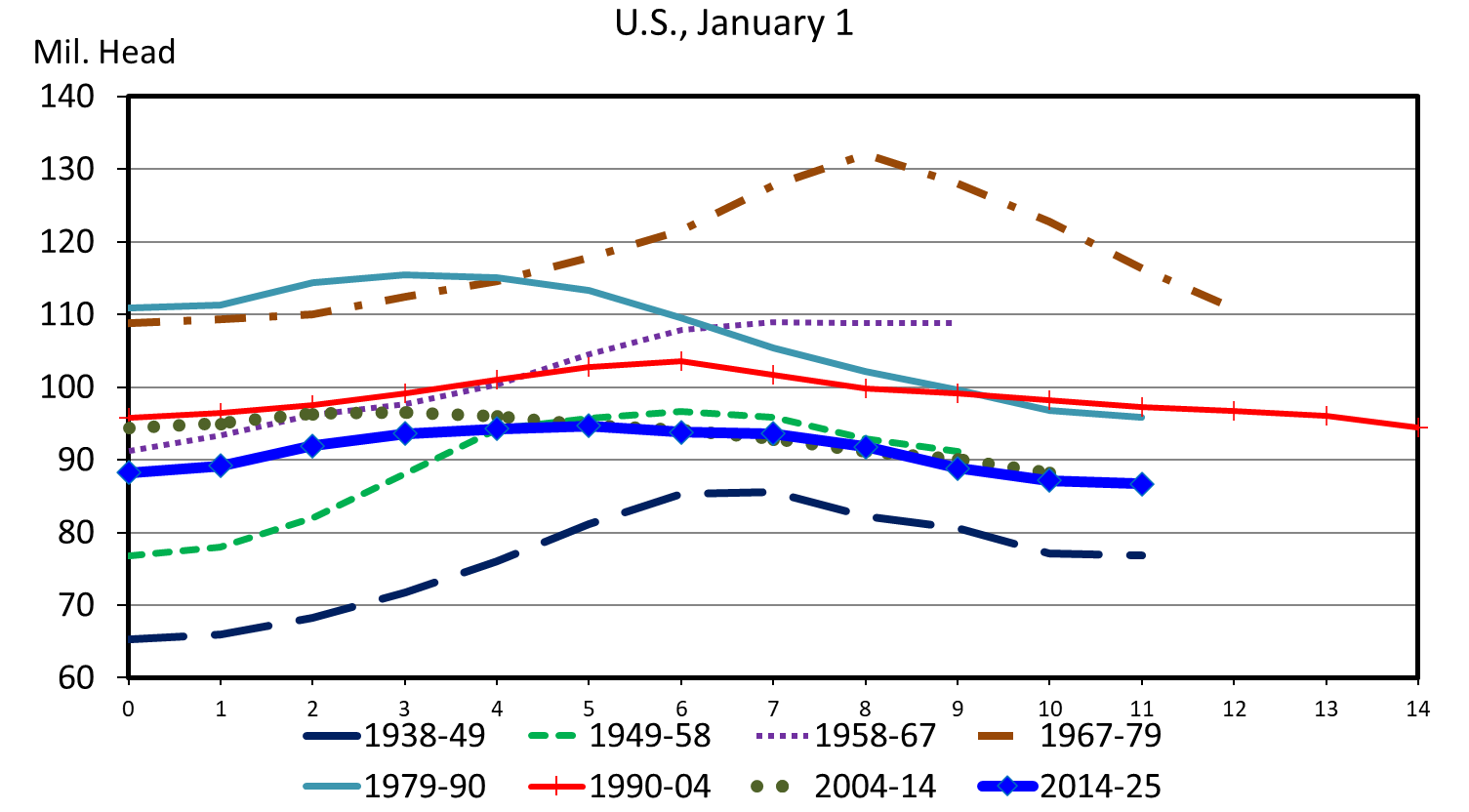
Figure 1. Total Cattle Inventory By Cycle
For 2025, the die is mostly cast relative to herd dynamics. The small inventory of beef heifers calving in 2025 (a part of the total beef replacement heifer inventory) suggests that little, if any, growth in the beef cow herd is likely. With bred heifers determined for the year, it will depend on cow culling. The cow culling rate in 2024 dropped to 10.2 percent (from higher levels in 2021-2023), about equal to the previous twenty-year average. Another year of sharp decrease in beef cow culling could lead to minimal herd growth but, lacking that, the cow herd could shrink a bit more this year. In the last three herd expansions, the cow culling rate has averaged below nine percent. In 2025, beef cow slaughter will have to drop more than 12 percent year over year to result in a cow culling rate below 9.0 percent.
The question of heifer retention in 2025 will determine herd dynamics in 2026 and beyond. Heifers saved for breeding (part of the 2025 beef replacement heifer inventory) and additional unplanned (or impulse) heifer breeding in 2025 may result in a modest increase in heifers calving in 2026. The supply of heifers available to do this is limited but could allow for limited herd growth in 2026. Additional retention of heifer calves in 2025 (for breeding in 2026) might set the stage for more rapid herd growth in 2027 and beyond. We shall see.
Herd Bulls and the Value of Genetic Potential
Mark Z. Johnson, Oklahoma State University Extension Beef Cattle Breeding Specialist
The spring 2025 bull sale season is underway. One economically important objective of the breeding season is to get cows bred to bulls with the highest possible genetic values. With more information available ever before, cow-calf producers need to evaluate this volume of information from their own unique perspective. How is this accomplished? Answer the following questions:
- How and when do you intend to market your calf crop? (at weaning, as yearlings, as fed cattle, as bred heifers or open replacement females).
- To what type females will you be mating the bull? (heifers or cows? will help determine the degree of selection pressure to apply to calving ease)
- Will you be selecting herd replacements from the resulting heifers?
Most sale books will include individual performance of the bulls, Expected Progeny Differences (EPDs) for as many as 20 traits, and bio-economic indices. These include multiple genetic predictors of calving ease, several traits that would be considered as maternal performance, growth at different ages, feed intake and feed efficiency. In addition, several traits indicating carcass merit such as marbling, ribeye size, external fat thickness and carcass weight. A Bio-economic index is a genetic value derived from assigning an economic weighting to several EPDs based on their anticipated value at a specific marketing endpoint.
Bulls are a significant cost to an operation. With proper selection goals and investing wisely, bulls have the potential for high economic returns. While the most expensive bull may not be the best fit for your operation, there is a correlation between bull sale price and the genetic potential transmitted to calves. Over the past three years, CattleFax survey participants indicate that for every additional $2,500 spent on a bull, the average calf price increased by $82 per head. Assuming a bull sires 100 calves over his lifetime of service, that is a return of $8,200. Furthermore, there is data from multiple sources that supports the belief that superior genetics adds value to an operations bottom line.
We are part of an industry in which buyers of cattle (at any age or type) are increasingly willing to pay for documented genetic potential. Determine the traits that stand out as more economically relevant to your marketing plan when deciding how to invest your bull buying dollar. Purchasing bulls offering strong genetic values can and will pay off for your operation.
KOMA Cattle Conference: A Four State Beef Conference Planned for February in Parsons, Kansas and Fort Smith Arkansas
Jaymelynn Farney, Kansas State University Southeast Area Research and Extension Center Beef Systems Specialist
Paul Beck, Oklahoma State University Cooperative Extension Beef Cattle Nutrition Specialist
This annual event brings together updated research from Oklahoma, Kansas, Missouri, and Arkansas.
Extension staff from four states - Oklahoma State University, Kansas State University, University of Missouri, and University of Arkansas have again joined forces to offer a unique conference that will provide information on beef cattle production, marketing, economics, nutrition and forage utilization. Held last year in Missouri and Oklahoma, this year’s KOMA conference will be held in Parsons, Kansas and Fort Smith, Arkansas.
The KOMA Beef Cattle Conference highlights work being done at Kansas State, Oklahoma State, Missouri and Arkansas and features research presented by new faculty and graduate students studying beef cattle production and management.
The conference will be held in two locations:
- Feb. 18, Parsons, Kansas. 8:30 a.m. to 3:30 p.m. at the Southeast Research Extension and Education Center (25092 Ness Road). More information: (620) 820-6125, or jkj@ksu.edu.
- Feb. 19, Fort Smith, Arkansas. 8:30 a.m. to 3:30 p.m. at the U.S. Marshalls Museum (789 Riverfront Drive). More information: Maggie Justice, (501) 355-6128, mjustice@uada.edu.
The agenda is identical at both locations, so interested producers should plan to attend one or the other. Registration costs $20 and is available online through Feb. 12 at www.komacattleconference.com.
Registration includes lunch and copies of presentations and research reports.
Jaymelynn Farney, Beef Systems Specialist with K-State Research and Extension said “This year’s conference will update the public on recent research from the four universities in cattle feeding, supplementation, reproduction and grazing management. The data is relevant to the four-states area and focuses on cow-calf, stocker, feedlot and pasture production systems on a variety of forage bases.”
Darrell Peel, an agricultural economist at Oklahoma State University, will give a presentation on retaining heifers in today’s economic climate. University graduate students and professors will give other presentations.
Several agriculture-related businesses are helping sponsor this conference and will be on hand to discuss how their products can help producers improve their beef cattle operation.