

Cow-Calf Corner | February 17, 2025
Beef Demand Continues Strong in 2025
Derrell S. Peel, Oklahoma State University Extension Livestock Marketing Specialist
The all-fresh retail beef price for January was $8.15/lb., up 4.3 percent year over year. All-fresh beef retail prices have averaged 5.2 percent higher month over month for the last year leading to retail all-fresh beef prices for the past twelve months at a record average level of $8.27/lb. Per capita beef consumption in 2024 was unexpectedly higher at 59.7 pounds as a result of constant domestic beef production and larger net imports of beef. The combination of increased beef consumption and higher prices indicates stronger beef demand.
All-fresh retail beef prices continue to increase relative to pork and broiler prices as shown in Figure 1. For the past twelve months, the average ratio of all-fresh beef to broiler retail prices has been 3.31 and for beef to pork prices has been 1.65. Retail broiler prices were unchanged year over year in January while retail pork prices were up 3.3 percent from one year ago.
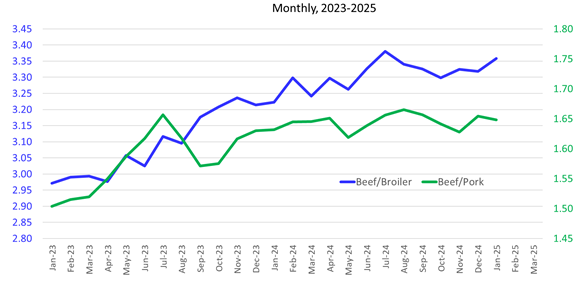
Figure 1. Retail Meat Price Ratio
Wholesale Choice beef cutout prices have averaged 11.8 percent higher year over year
for the first six weeks of 2025. Prices are higher for all primals with stronger prices
for end meats relative to middle meats. Prices for rib primals are up 9.2 percent
year over year with loins prices up 4.6 percent compared to the first six weeks on
year ago. Chuck prices are 14.8 percent higher and round primal prices are up 22.3
percent year over year.
Prices for most wholesale beef cuts are higher thus far in 2025 compared to one year
ago (Table 1). Most steak prices are higher, including Strip Loins and Ribeye. The
most notable exception is weaker prices for Tenderloin in recent weeks. Strong prices
numerous lean carcass cuts, primarily from the round, are supported by increased grinding
demand for ground beef production.
| Primal | Product | IMPS | Price | % Change from one year ago |
|---|---|---|---|---|
| Chuck | Top Blade | 114D | $503.65 | 14.0 |
| Arm Rost | 114E | $519.43 | 31.5 | |
| Petite Tender | 114F | $556.54 | -23.4 | |
| Mock Tender | 116B | $400.14 | 26.8 | |
| Chuck Flap | 116G | $792.23 | -4.0 | |
| Brisket | Brisket | 120A | $644.40 | 2.5 |
| Round | Knuckle | 167A | $413.40 | 25.1 |
| Top Inside Round | 168 | $381.33 | 27.6 | |
| Bottom Round | 170 | $380.81 | 19.3 | |
| Outside Round | 171B | $389.65 | 13.7 | |
| Eye of Round | 171C | $393.33 | 16.4 | |
| Loin | Strip Loin | 180 | $890.80 | 14.1 |
| Top Butt Sirloin | 184 | $425.05 | 7.1 | |
| Tri-Tip | 185D | $656.92 | 16.2 | |
| Tenderloin | 189D | $1262.33 | -9.1 | |
| Flank | Flank | 189A | $581.55 | 8.9 |
| Rib | Ribeye | 112A | $1020.09 | 3.2 |
| Trim | 90 % Lean Trim | $358.09 | 25.3 | |
| 50 % Lean Trim | $110.50 |
26.7 |
Derrell Peel, OSU Extension livestock marketing specialist, looks at how cattle markets are performing one month into the new year on SunUpTV.
Takeaways from 2025 Cattle Industry Convention & NCBA Trade Show
Mark Z. Johnson, Oklahoma State University Extension Beef Cattle Breeding Specialist
I recently attended the 2025 Cattle Industry Convention and National Cattlemen’s Beef Association Trade Show in San Antonio, TX. Outstanding event with interesting topics covered by an excellent group of speakers from which I pull some information together for this article. What were the most interesting take-away points for me?
- The USDA Beef Yield Grade equation needs an update. Beef yield grades (which indicate cutability and red meat yield from a beef carcass) are based on the U.S. cattle population from 60 years ago. While the Yield Grade system has served the industry well, an updated system, based on our current population of cattle is needed.
- Consumers of beef (the product) are willing to pay for quality! The market signal is clear: Consumers want and will pay more for higher quality (tasty and consistent) beef!
- The demand for beef is high. This demand is driving the current market. From 1998 until 2025, increased consumer demand for beef has added an additional $800/head in value.
- Over the past 20 years, the beef industry has shifted from producing beef as a commodity to a much higher quality beef product. Over this time, the industry has seen a dramatic increase in the amount of upper 2/3rds Choice and Prime Quality Grade beef carcasses.
- The market outlook for continued “robust” prices for cattle of all ages is favorable.
References
Cattlemen’s College. The Science of Yield: Research-Driven Innovations. Cattle Industry Convention and NCBA Trade Show. February 4, 2025.
CattleFax 2025 U.S. & Global Protein & Grain Outlook Seminar. Cattle Industry Convention and NCBA Trade Show. February 6, 2025.
Avoiding The Calfcicle
Rosslyn Biggs, DVM; OSU College of Veterinary Medicine Beef Cattle Extension Specialist
Calving season is just around the corner or has already arrived for many. Preparing in advance, particularly for those facing inclement weather, will position producers to successfully address the needs of calves and avoid “calfcicles” in frigid temperatures.
Even before delivery, evaluating calving locations and facilities is a good place to start. Areas should be clean and dry. Consider providing shelters for animals to escape the weather. However, remember that as animals congregate, there can be an increase in disease contamination and transmission. Excellent onsite facilities or the ability to transport to a veterinary clinic is essential when addressing calving problems.
Remember to discuss your calving plan with your veterinarian. Build a relationship with your veterinarian well before a 2 am emergency calving call. Due to high demand, many veterinary practices will only accept emergencies from existing clients. Your veterinarian can work with you and your team to develop protocols for handling calving issues, especially during the cold.
At calving, heifers that labor in Stage 2 of parturition for longer than an hour, and cows that labor longer than 30 minutes, should be examined immediately. Be certain that calving equipment is clean, functional, and readily accessible. Your veterinarian can also help you develop essentials for a calving kit with critical items and medications.
Following delivery, the goal is to see the calf up and nursing as soon as possible. Delays in a calf receiving colostrum have both short and long-term impact on the immune system and in many cases set calves up for failure. Ideally, a calf should receive colostrum within the first two hours of life. Administering colostrum to calves without a suckle reflex using an esophageal feeder should be done with extreme caution due to the increased risk of aspiration pneumonia. Milking the dam or maintaining a supply of frozen colostrum are the best options for colostrum replacement.
Although recent arrivals are potentially most susceptible, even older, sick calves fail to tolerate extreme temperatures. Calves should be evaluated at least daily for signs of illness. The best way to monitor a calf’s temperature is with a rectal thermometer. Inexpensive digital thermometers work well and make it easy to evaluate progress when warming the calf is needed. If a calf’s temperature falls below 100 degrees F, gradually raise that temperature. Bring the calf indoors and out of the elements if needed. When used appropriately, warm water baths, blankets, and warming boxes are all options to rewarm a calf.
Be careful not to damage the skin of the animal by either rubbing too vigorously or placing the animal close to heaters. Additionally, if the calf is brand new, do not wash off the odor of amniotic fluid. This helps prevent rejection by the dam. Treatment of “calfcicles” often goes well beyond just warming.
Evaluating and correcting the underlying cause of a calf’s low temperature is key, especially if there is an infectious agent, such as those that can cause diarrhea, contributing to the condition. Oral or intravenous fluids, as advised by a veterinarian, can assist in warming and addressing internal fluid deficits. The metabolic state, including glucose levels and acid-base balances, should be considered. Medications to treat symptoms and nutrition for calves should not be overlooked. Intensive care of some calves and veterinary hospitalization may be needed depending on the value of the animal.
Early detection and interventions of frozen “calfcicles,” along with working with your veterinarian to develop protocols before calving season, can reduce stress and lead to more successful outcomes during calving season.