

Cow-Calf Corner | August 25, 2025
Less cattle in U.S. feedlots; more cattle in Canada and Australia
Derrell S. Peel, Oklahoma State University Extension Livestock Marketing Specialist
The latest USDA-NASS Cattle on Feed report shows August 1 feedlot inventories at 10.922 million head, down 1.6 percent year over year. This is the eighth consecutive smaller monthly inventory and is the smallest monthly feedlot total since October 2017 (Figure 1). The 12-month moving average of feedlot inventories, which removes seasonality and shows general trends, dropped in August to the lowest level since March 2019.
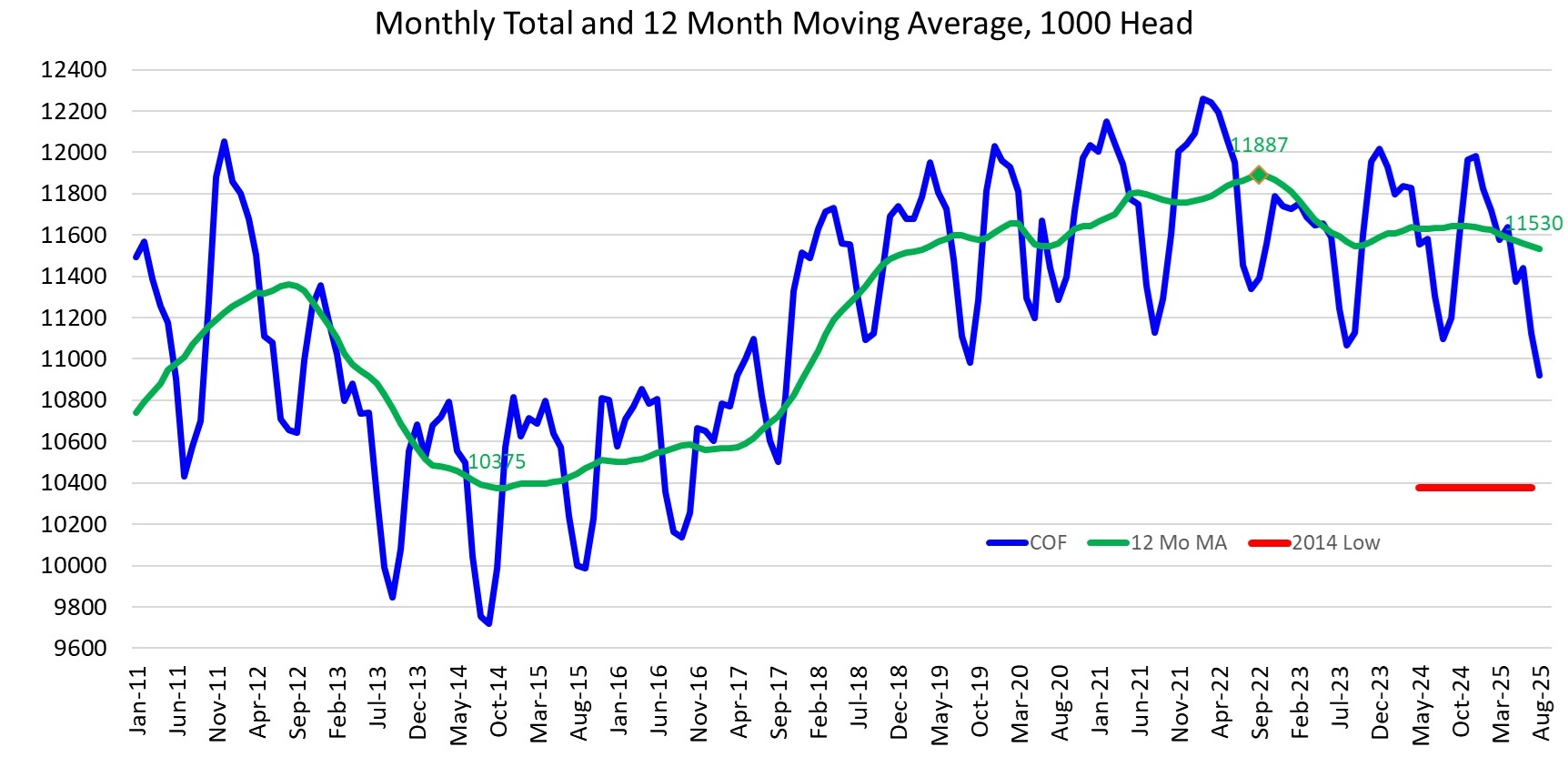
Figure1. Cattle On Feed
July feedlot placements were slightly larger than expected, likely reflecting early sales of “fall-run” calves in response to ever-higher feeder cattle prices. Feeder cattle volumes in Oklahoma auctions are up 27.2 percent year over year in the past six weeks. Higher than expected placements occurred despite the lack of Mexican cattle imports. Texas placements were down 25 percent year over year; a 95,000 head reduction compared to one year ago. Total feedlot placements in July were down 104,000 head, meaning that the decrease in Texas accounts for over 91 percent of the total decline in monthly placements. July feedlot marketings were about as expected at 94 percent of last year.
The latest release of monthly livestock slaughter from USDA-NASS shows that beef production in July was down 4.5 percent year over year, contributing to a year-to-date decrease of 2.7 percent for the first seven months of 2025. Total cattle slaughter thus far in 2025 is down 5.8 percent, including a 4.2 percent decrease in fed (steer + heifer) slaughter and a 12.5 percent decrease in cow slaughter for the first seven months of the year.
Canada Update
The Canadian statistical agency, Statistics Canada, released July livestock inventories last week. The total cattle inventory is 11.9 million head, up 0.8 percent and the first increase since 2021. After declining for several years, the beef cow herd in Canada increased by 0.4 percent and beef replacement heifers were up 2.0 percent year over year. It appears that some herd rebuilding is beginning in Canada. Cattle on-feed in Alberta and Saskatchewan for August 1 are down 0.4 percent year over year at 777 thousand head.
Australia Too!
Cattle inventories in Australia have been increasing since 2021 to current levels just over 27 million head. The latest quarterly reports show cattle on feed in Australia at a new record level of 1.6 million head. Cattle feeding in Australia has increased four-fold in the past 30 years and continues to grow. Grain-fed beef currently accounts for 29 percent of total beef exports from Australia.
Information Asymmetry in Cattle Marketing
Mark Z. Johnson, Oklahoma State University Extension Beef Cattle Breeding Specialist
Information asymmetry refers to a situation where one party in a transaction has more or better information than the other. When one party has more relevant, up-to-date, or detailed information it can lead to potential exploitation and unfair pricing. The less informed party may make poor decisions leading to negative outcomes. In the case of marketing cattle, the less informed party may not be willing to bid or pay fair value as a result of lack of information.
The commercial cow-calf operation serves as the initial source of product in the segmented chain of beef production. In conventional beef production weaned calves will become stockers, then go through a feedlot operation and fed to a compositional endpoint, at which time they be harvested and turned into the product of beef. Your weaned calves will likely have multiple owners and be 18 – 24 months of age by the time they are beef, the product.
When marketing your weaned calves, have you ever felt at a disadvantage? Are you able to document your investment in genetics and management practices that give your calves additional value to the next owner? Can you show evidence that calves have been vaccinated, have a functional immune system, are likely to remain healthy, grow and gain efficiently through the next phases of production, and ultimately yield a carcass of value that meets consumer demand?
Documentation of health status resulting from a sound pre-weaning vaccination program has become the industry standard in marketing calves. Even in the short supplied, robust market we currently enjoy, the backgrounded, long-weaned calves sell for more than bawling, fresh weaned calves. Considering what has value to the next owner, this is logical.
With regard to the genetic potential of calves for post-weaning performance through the stocker and finishing phases of production it also makes sense that the next owners would be willing to pay more for calves with documented superior genetic potential for more gain, better cost of gain, more carcass weight, more red meat yield and especially; more carcass quality. So how is this documentation achieved?
Historically, Genomic companies and breed associations offer genetic tests for commercial cattle that many commercial producers have used to understand the genetic makeup of their herds. This information can be valuable when selecting replacement heifers (maternal traits) and for marketing steers (growth and carcass traits). The sampling process is similar for seedstock or commercial operations. Typically a blood sample (or tail hair with root bulbs) is submitted for testing. After DNA from the sample has been analyzed a scorecard for calves will be received with a rating of genetic potential.
More recently, the Genetic Merit Scorecard (GMS) from the American Angus Association has been made available. The GMS has the advantage of projecting the performance potential from weaning to carcass based on the genetic values of the registered Angus sires. Accordingly, the GMS does not require any tissue sample to be submitted from calves. Starting in August 2024, producers earned premiums on the U.S. Premium Beef, LLC (USPB) Kansas grid based on the genetic merit of their cattle. The marketplace has responded to having an objective, reliable way to describe the genetic merit in a pen of feeder cattle by paying out significant premiums. To qualify for the GMS, calves' sires must be predominantly Angus and 75% of the bull battery must be registered Angus sires. More information on the GMS and enrolling calves is available at the third link referenced at the end of this article.
Longer term solutions include retaining (at least partial) ownership of calves through the stocker and finishing phase. Planning and coordinating retained ownership so that performance data on health, growth and carcass merit is made available and flows back to the cow-calf operation is a critically important step in building a reputation for your operation and the calves you produce.
References:
- Genetics in the Genomics Era. Chapter 28. Oklahoma Cooperative Extension Service Beef Cattle Manual. Eighth Edition.
- NC State Extension: Genomic Testing and Its Uses in Beef Cattle
- Genetic Merit Scorecard An objective, reliable way to describe genetic potential.
Limit-Grazing Wheat Pasture: A Practical Strategy for Beef Cows and Calves
David Lalman, Oklahoma State University Cooperative Extension Beef Cattle Nutrition Specialist
We have excellent prospects for wheat pasture this fall, but the market conditions and low cattle numbers will make purchasing stocker calves more difficult than normal. How can we best use this valuable forage resource? Small-grain winter pasture is an excellent protein and energy source for beef cows. Fall-calving, lactating cows perform extremely well when grazing abundant wheat pasture throughout lactation. We tracked performance of lactating Angus cows and their calves grazing wheat from January through grazeout in May (Table 1).
| Item | January 9 | May 18 | ADG, lb |
|---|---|---|---|
| Cow Weight, lbs | 1157 | 1429 | 2.1 |
| Body Condition Score | 4.8 | 6.7 | |
| Milk, lbs/day | 27 | 25 | |
| Calf Weight, lbs | 262 | 714 | 3.5 |
Notice cows averaged 26 pounds of milk yield during late-lactation and still managed to gain over 2 pounds per day along with tremendous increase in body condition. The combination of forage quality and high forage intake can result in cows becoming over-conditioned. This would certainly be a concern in spring-calving cows as their nutrient requirements are substantially lower during gestation.
Limiting wheat pasture forage intake can serve to control cow condition and stretch the expensive, high-quality forage over more grazing days. One approach is to limit-graze the wheat as a protein and energy source to complement low-quality standing forage or hay. We discovered that about 9 to 12 hours per week of access to wheat pasture (3 to 4 hours per day, 3 days per week) met supplemental protein and energy needs for lactating beef cows. Using this method, we were able to stock cows at about a cow/calf pair to 0.7 acres of wheat pasture from mid-November through mid-May. Hours on wheat can be adjusted to maintain a minimum level of cow body condition. We simply fed low-quality native grass hay in dry lot pens when the cows were not grazing wheat. Stockpiled forage in a pasture adjacent to the wheat pasture would be an ideal situation to minimize wintering costs. In our situation, automatic waterers were available in the dry lot pens. After about 3 to 4 hours of grazing, the cows were ready to get a drink and lay down, so they would walk into the dry lot pens and we would shut the wire gate behind them. Next to the gate, we simply raised the electric fence so the calves could pass under it to graze.
In our experiment, another set of cows were wintered grazing tallgrass prairie stockpiled forage and fed about 5 pounds per day of dried distillers' grain with solubles. Calf weight averaged 467 pounds in mid-April in this "traditional" system whereas calves in the limit-grazed wheat pasture system averaged 565 pounds in mid-April.
Using Patch Burning to Adjust Grazing Distribution
Dana Zook, Oklahoma State University Cooperative Extension Service NW Area Livestock Specialist
Grazing distribution has long been a challenge for cattle producers. Even with a correct stocking rate, cattle can “over-use” or “over-graze” some areas of pasture or rangeland. To combat unbalanced grazing, producers have historically employed different management methods to encourage cattle to graze more evenly (think fencing and water infrastructure or mineral and salt).
Researchers at the Oklahoma State Natural Resource Ecology and Management Department are looking at Patch Burning as a tool in the toolbox to adjust grazing distribution. Patch burning is a technique that burns a portion of a grazing area and allows cattle and other livestock to select what forage they prefer from the burned or unburned areas. In a study conducted by Kathrine Haile, Dr. Laura Goodman and others at the Klemme Research Station south of Clinton, patch burning was used to target under grazed areas of a pasture and adjust grazing distribution.
In this study, GPS collars were put on cattle and grazing distribution was analyzed in three pastures (100-200 acres each) for the first year without fire. This GPS data was then utilized to identify portions of the pasture that cattle were avoiding. Four 4 areas were then selected from these under-grazed areas for patch burning in March (2) and June (2). Forage samples were collected and analyzed every two months comparing quality of burned and unburned areas. The results of this study didn't find a difference in the season of burn (March vs. June), but overall forage consistently remained high quality (8-15% Crude Protein) for about 5 months. By using fire, grazing distribution was totally changed in these pastures and the burned patches enhanced forage quality during times of the year when quality is typically low. Using GPS tracking, they identified that the previously avoided areas were now targeted by the cattle, allowing previously over-grazed areas to recover.
Due to many natural disasters over the years, fire isn't always thought about in the best light. However, good research shows the benefits of a well-planned prescribed burn for plant quality, species diversification, wildlife, and livestock production. If you would like more information about patch burn grazing, check out resources at OSU Natural Resources Extension or find them on Facebook @OklahomaLands.
About OQBN: Oklahoma Quality Beef Network
| LOCATION | SALE DATE | 45-DAY WEAN DATE | 60-DAY WEAN DATE |
|---|---|---|---|
| OKC West Livestock (El Reno) | November 11, 2025 | September 27, 2025 | September 12, 2025 |
| November 18, 2025 | October 4, 2025 | September 19, 2025 | |
| December 16, 2025 | November 1, 2025 | October 17, 2025 | |
| January 20, 2026 | December 6, 2025 | November 21, 2025 | |
| McAlester Stockyards | September 23, 2025 | August 9, 2025 | July 25, 2025 |
| November 11, 2025 | September 27, 2025 | September 12, 2025 | |
| April 7, 2026 | February 25, 2026 | February 10, 2026 | |
| Payne County Stockyards | November 15, 2025 | October 1, 2025 | September 16, 2025 |
| Southern Plains Livestock (Blackwell) | November 24, 2025 | October 10, 2025 | September 25, 2025 |
| LeFlore County Livestock (Wister) | December 13, 2025 | October 29, 2025 | October 14, 2025 |
For more information or to sign up
Paul Vining 405-744-4268
Survey of Oklahoma Cattle Producers Regarding Ticks and Tick-Borne Diseases
Jonathon Cammock, OSU Cooperative Extension Livestock Entomologist
The Oklahoma State University Extension Livestock Entomology Program is seeking participants for a study on the impact of ticks on beef and dairy cattle production in Oklahoma. We are looking for producers who are willing to complete a brief survey, to help us assess tick and tick-borne disease knowledge and prevalence, and identify preventative measures taken to protect producers, employees, and livestock from tick bites and tick-borne diseases. Information collected will be used to develop Extension programming targeted at your needs as cattle producers. We would appreciate if you could take the time to participate!
To access the survey if you are interested in participating Questionnaire: Assessment of Oklahoma Cattle Producer's Knowledge and Awareness of Ticks and Tick-Borne Diseases
Missed an article or want to re-read a past article? Previous editions of the Cow-Calf Corner Newsletter are available at Cow-Calf Corner - The Newsletter
If you were forwarded this email and want to get it delivered straight to your email inbox, email Paul Beck (paul.beck@okstate.edu) or Derrell Peel (derrell.peel@okstate.edu) to be added to our email list.