

Cow-Calf Corner | April 14, 2025
It’s a Critical Time of Year
Derrell S. Peel, Oklahoma State University Extension Livestock Marketing Specialist
Pastures are greening up quickly in Oklahoma. April and May are critical months that set the stage for forage conditions for the bulk of the grazing season. At the current time there are no major drought concerns in the state. However, the northwest one-third of the state has received less than 50 percent of normal rainfall in the last 60 days (Figure 1). According to the Drought Monitor, there are no areas of D3 and D4, but 40 percent of the state is in D1 and D2. This about matches the U.S., which has just under 40 percent D1 and worse but less than nine percent D3 and D4. However, it is the time of year when marginally dry conditions can deteriorate rapidly with warming temperatures and spring winds. On the other hand, good moisture through May can ensure enough pasture and hay production to make a drought later in the year more manageable.
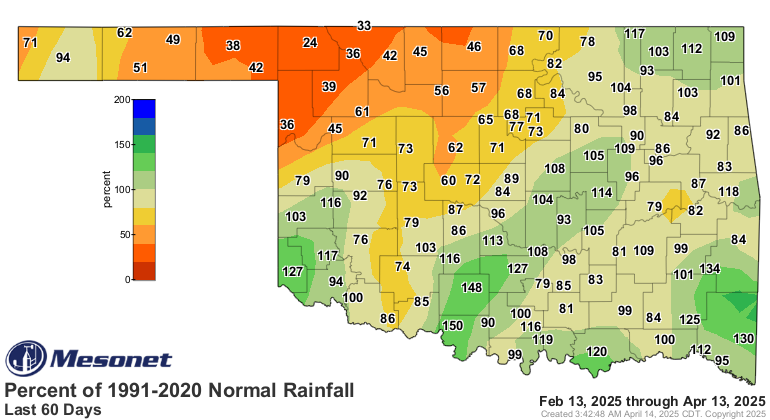
Figure 1. Percent of Normal Rainfall, Oklahoma, Mid-February-Mid-April.
Conditions in much of the beef cattle region in the middle of the country are expected to remain threatening. La Niña conditions have faded to ENSO-neutral conditions that are expected to persist through the summer at least. However, La Niña tendencies will linger on through the middle of the year. The latest seasonal drought outlook suggests that drought conditions will persist and expand in the Plains, from north to south. However, the near-term outlook calls for above average chances of precipitation in Oklahoma.
Precipitation this time of year often arrives in the form of severe storms that typically include wind damage, hail and tornados. My recent travels in central Oklahoma confirm that many ponds are low and the localized heavy rain events that accompany severe weather are the best chance to recharge pond water levels. Water quantity and quality may be the first limiting factor if dry conditions persist.
Depending on their location in the state, many cattle producers are continuing to act with caution, stocking conservatively and tempering production plans given the potential forage limitations ahead. Certainly, the continuing drought threat is one factor that is preventing more aggressive restocking, heifer retention and herd rebuilding. Oklahoma did show some increase in beef cow numbers in 2024, but additional growth is likely to be limited as long as forage conditions are uncertain.
Challenging Traditional Paradigms
Mark Z. Johnson, Oklahoma State University Extension Beef Cattle Breeding Specialist
During the past half century, the cattle business has seen times when maximizing pounds produced at weaning, or as yearlings, or through finishing equated to profitability. As input cost increased, profit margins in all sectors of our business have become more closely related to efficiency or the cost of each pound gained. Interestingly enough, with current record high prices, input cost still have significant potential to pull down or wipe out our profit margin.
Curiosity about the beef industry is essential to stay “ahead of the curve” with regard to breeding, managing and marketing cattle. All pounds are not created equal – not from the cost of production side, nor in the market place. Did you know?
- Beef consumer preferences have changed. Buyers today want (and are willing to pay for) high quality, consistently great tasting beef as well as transparency into how we care for the cattle and the land.
- As a result of improved genetic potential and management, we now see approximately the same percentage of beef carcasses reaching USDA Quality Grade Prime as USDA Select.
- Historically the Choice/Select spread was the primary factor impacting beef carcass value. Today, with more beef carcasses reaching the Prime grade, the Prime/Choice price spread has greater impact on the value of a beef carcass.
- In the market place, documentation of genetic potential of weaned calves, yearlings and potential replacement heifers is resulting in premiums paid by the next owner.
The best managers have the curiosity to be life-long learners and stay ahead of the curve. Challenging traditional paradigms, considering a better way is essential to permit our beef operation to profit, sustain and survive.
Forage Finishing Nutrition and Management’s Impact on Beef Quality
Paul Beck, Oklahoma State University Cooperative Extension Service Beef Cattle Nutrition Specialist
Forage-based finishing systems are gaining attention among cattle producers and consumers. Forage-finishing plays to the natural grazing behaviors of cattle and appeals to many consumers. There are many excellent reasons to consider finish calves on forage, however, this system presents two major challenges: land requirement and variable calf performance. A summary of research trials between 1978 and 2013 revealed that cattle finished on forage gain less per day, are typically slaughtered at a lighter weight, have lower dressing percentage, and have less subcutaneous fat and marbling. The leaner carcass results in beef that is generally rated as less tender, juicy, and flavorful by sensory panels. Despite this, health-conscious consumers may prefer forage-finished beef for its leanness and potential for heart-healthy fat content. Others may still prefer grain-finished beef, especially when sourced locally.
Calf growth rates in forage-finishing systems vary widely. Gains can range from over 2.0 lbs/day in spring and summer to under 0.5 lbs/day during less favorable conditions. It can take over a year for a weaned calf to be market ready especially if daily gains are low. Low quality pastures like toxic tall fescue or bermudagrass limit performance resulting in long finishing times and leaner carcasses unless supplemental nutrients from higher quality forages or concentrate feeds are provided. Research shows that forages like alfalfa and chicory supported higher average daily gains and better carcass fat deposition compared to grass pastures like bermudagrass or summer annuals such as pearl millet.
Hybrid systems have been studied as an alternative to high-concentrate total mixed rations fed in confinement. These systems utilize the roughage supplied by pasture along with additional energy from supplemental concentrates. They may not meet the requirements to meet ‘grass-fed beef’ claims by the USDA but do provide free-choice access to pasture.
Comparisons were conducted where calves from the same ranch were finished at either a commercial feedlot in the High Plains or in the Southeast on bermudagrass pastures. In the first trial, calves from spring or fall calving herds were either sent to a Texas Panhandle feedyard for finishing as yearlings following a stocker program at the home operation and supplemented with 1% of bodyweight per head per day with a grain/grain byproduct supplement consisting of corn and soybean hulls until slaughter. Steers finished conventionally in confinement gained 4.4 lbs/day while steers fed concentrate supplement on pasture gained 2.5 lbs/day. Although the finishing period on pasture was 30 days longer on, steers finished in the conventional feedlot were 128 pounds heavier at slaughter and dressing percentage was higher 62.5% vs 60.6% for Conventional vs pasture finishing. Conventionally finished cattle were 86% Choice while pasture finished calves were 22% Choice quality grade. In the next trial, 60 calves were either finished in conventional Texas Panhandle feedyard or were kept on pasture with a grain/grain byproduct concentrate supplement fed at 1.5% of bodyweight daily. Steers finished on pasture with supplement gained 3.6 lbs per day (vs 4 lbs/day for conventional) and were fed 40 days longer than conventional steers but were still 40 pounds lighter at slaughter. Hot carcass weights, backfat thickness, and dressing percent were slightly lower for pasture finished calves. Cattle finished on pasture were 100% Choice while the Conventional steers were 93% Choice.
Ultimately, while forage-finishing systems can align with niche markets and consumer values, they require careful forage management, extended timeframes, and realistic expectations around carcass quality and palatability.
References
Beck, P.A., Beck, M.R., and Apple, J.K., 2024. Production systems and nutrition. In: Encyclopedia of Meat Sciences III, vol. 1. https://dx.doi.org/10.1016/B978-0-323-85125-1.00029-6. ISBN: 9780323851251
Beck, P., and Lalman, D.. 2021. Finishing Beef Cattle on Farm. Oklahoma State University Cooperative Extension Service. Stillwater OK. AFS-3303