

Cow-Calf Corner | September 9, 2024
The Evolution of U.S.-Mexican Cattle and Beef Trade
Derrell S. Peel, Oklahoma State University Extension Livestock Marketing Specialist
The U.S. and Mexican cattle industries have a long and somewhat colorful trade history that continues to evolve today. Cattle frequently served as the currency of trade between Mexico and the U.S. from the U.S. Civil War through the Mexican Revolution and World War I. U.S. imports of Mexican cattle were important all through the 20th century and continues today (Figure 1). In the last 25 years, an average of 1.15 million head of cattle have been imported from Mexico each year. These imports represent an average of 3.3 percent of the U.S. calf crop. Mexico has a comparative advantage in the production and export of feeder cattle with vast regions of forage production in arid and semi-arid regions as well as in the non-arable regions of dry and wet tropics in which cattle production is the main economic activity.
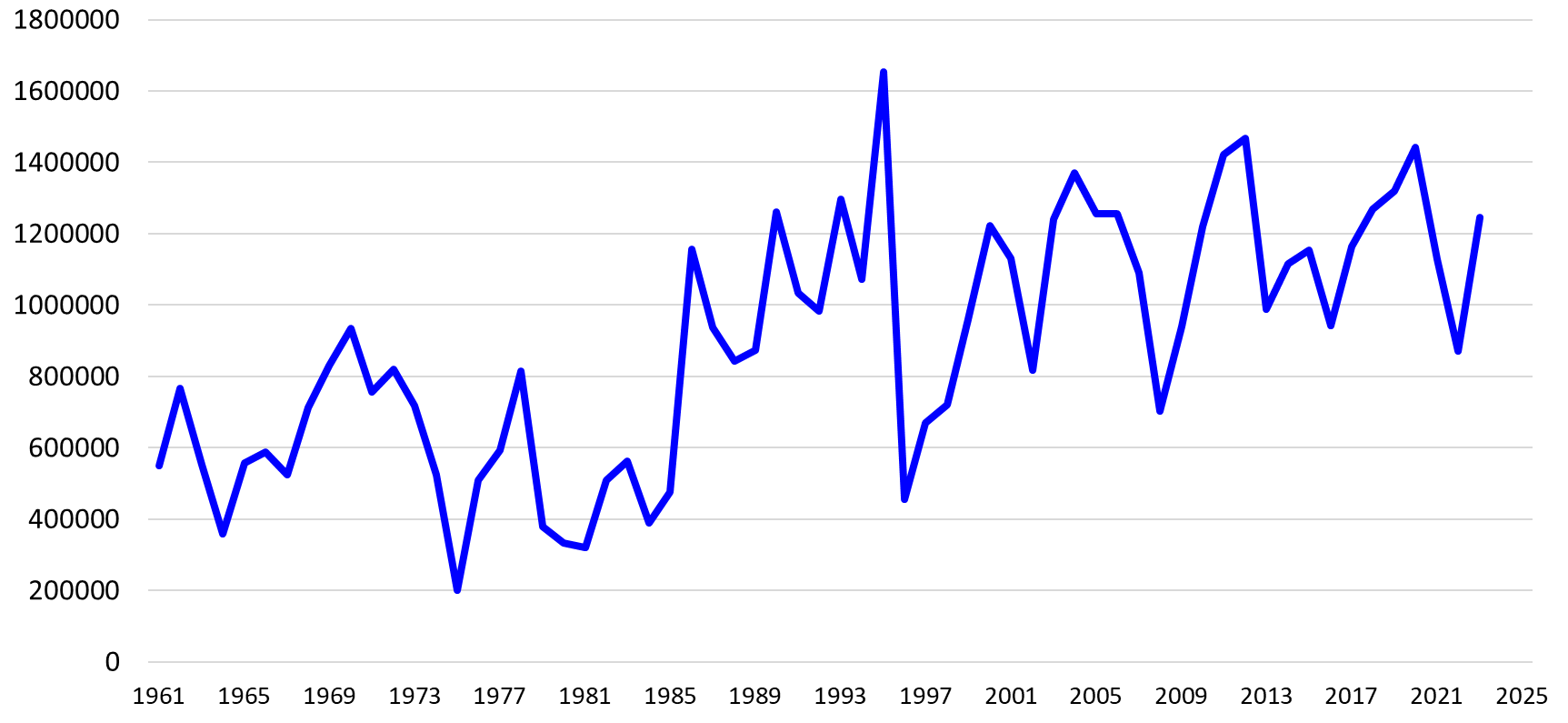
Figure 1. Annual U.S. cattle imports from Mexico.
The next phase of beef industry trade between the U.S. and Mexico was the growth of beef exports to Mexico which began in the 1990s and accelerated sharply in the late part of the decade. By the late 1980s, Mexico was the third largest beef export market because there simply weren't many export markets (Japan accounted for 70 percent of total exports.) Mexico was roughly six percent of total U.S. beef exports at that time. Growing rapidly after 1996, Mexico rose quickly to become the number two export destination and accounted for an average of 23.3 percent of exports from 2000-2003.
After the BSE case in late 2003, Mexico was the only beef export market that did not close or greatly reduce. Mexico accounted for 72.4 percent of total beef exports in 2004 and averaged 59.4 percent of exports from 2004-2007. Mexico was the number one beef export market from 2004-2010 before other markets recovered. Mexico was the number two or three export market each year from 2011-2020 and averaged 15.0 percent of beef exports over the period. Recently Mexico dropped to the number 4 market with an average share of 9.2 percent of total exports from 2021-2023. The economics that drove the increase in beef exports to Mexico in the 1990s and 2000s was largely a matter of supplementing deficit beef supplies in the country as consumption outpaced domestic beef production in the country. In other words, it was mostly a matter increasing the quantity of beef in Mexico.
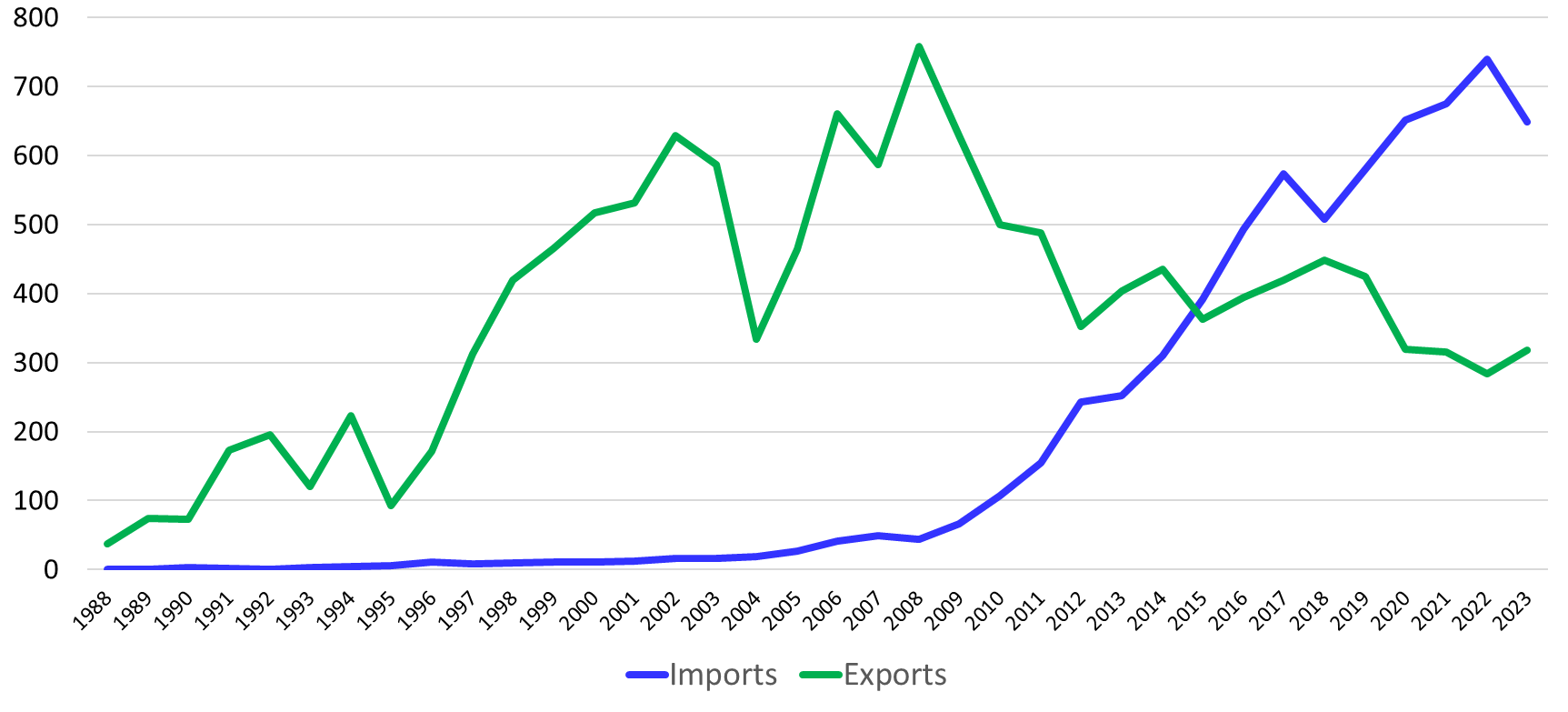
Figure 2. Annual carcass pounds imported and exported in U.S. beef trade with Mexico.
The final phase that has been added to increasingly integrated U.S. and Mexican beef markets is Mexico's emergence as a major global beef exporter. U.S. imports of beef from Mexico accelerated rapidly after 2009, with the country jumping to the number four place as a beef import source in 2010 (Figure 2). Mexican beef imports continued to grow with the country moving into the number three spot as a beef import source by 2017 and number two in 2021.
The growth of beef exports from Mexico is largely the result of the Mexican beef industry switching from carcass-based beef markets to boxed beef technology in the 2000s. Adoption of boxed beef was a huge change in beef markets in Mexico that opened up much more value as specific products could be targeted to specific markets, including export markets. Mexico has also seen significant growth in cattle feeding and packing infrastructure in the past two decades. Mexico is now a major beef export market and beef import source for the U.S. meaning that trade has evolved from one-way flow of beef to bilateral trade of diverse products, which adds value in both markets.
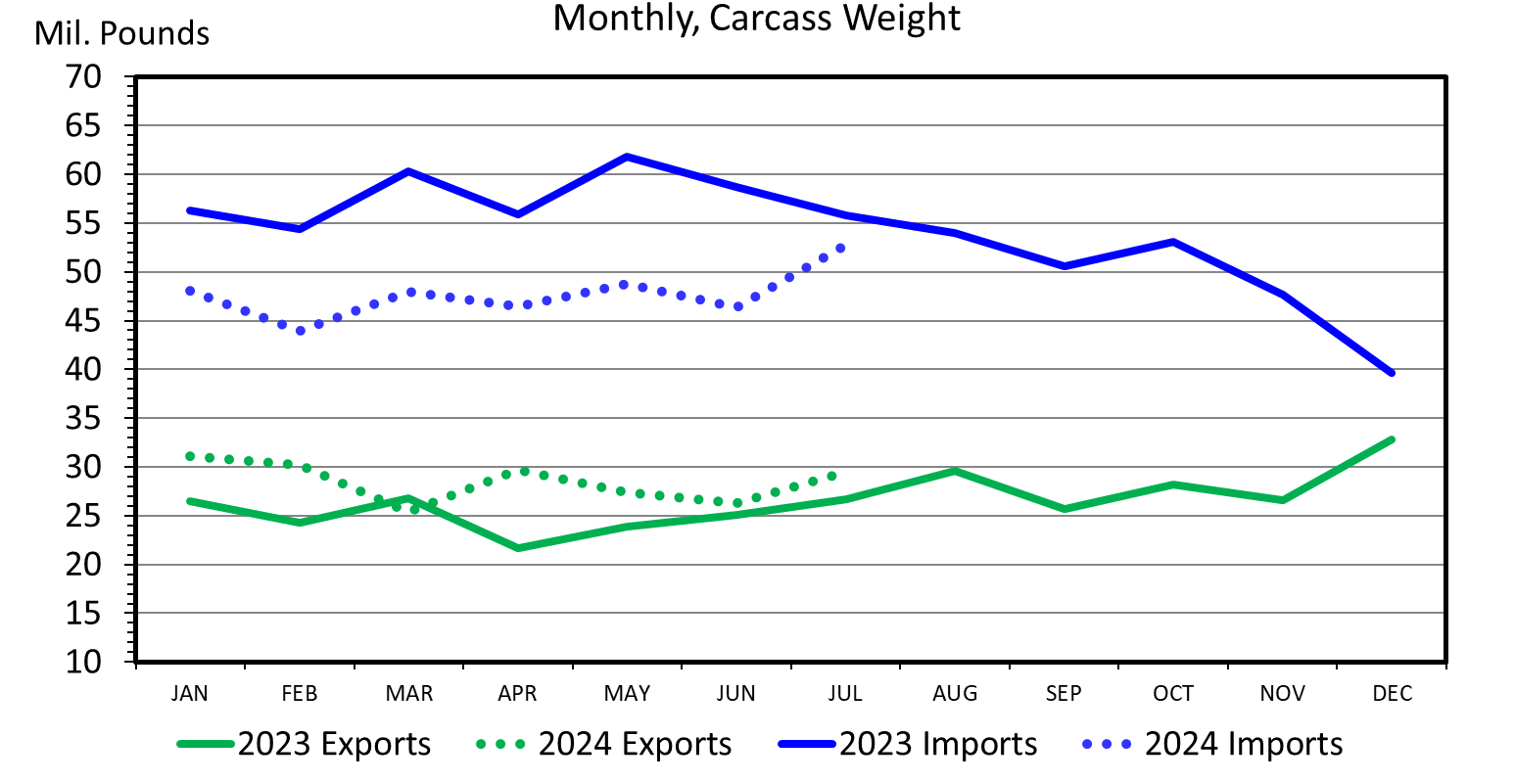
Figure 3. Monthly carcass weight imports and exports in 2023 and 2024.
Figure 3 shows beef trade with Mexico in recent months. Mexico has been anomaly among U.S. beef trade markets in 2024 with exports increasing, despite decreasing exports to most other markets, and decreasing imports from Mexico, despite increasing imports from other major import sources. Numerous factors are no doubt contributing to current beef trade with Mexico, including Mexican macroeconomic conditions and domestic beef market conditions, along with a Mexican Peso that strengthened against the dollar from 2022 through 2023 before weakening recently.
Seven Percent
Mark Z. Johnson, Oklahoma State University Extension Beef Cattle Breeding Specialist
The body condition scoring system (BCS) is used to assess body energy reserves in beef cows. The BCS system used for beef cattle ranges from 1 to 9. A score of 1 indicates cows that are thin and emaciated, cows of BCS 9 are fat and obese. Pictures and definitions of the BCS system can be found in Chapter 20 of the 8th edition of the OSU Beef Cattle Manual.
When condition scoring cows, producers should look beyond age, frame size, depth, length pregnancy status and hair coat. The condition scoring system is intended to provide a consistent system to quantify relative fatness regardless of these other factors that create difference in cows'appearance. There is a strong relationship between weight and BCS. For each unit change in BCS, cows should gain or lose approximately 7% of their BCS 5 weight. For example, a cow that weighs 1,200 lbs. at a BCS 5 should reach a BCS of 6 at 1,284 lbs. or drop to a BCS 4 at 1,116 lbs.
Best time to Evaluate BCS?
Typically, late summer/early fall when cows are slicked off and in 2nd trimester of pregnancy is the most accurate and easiest time of the management cycle to evaluate BCS on cows. Weaning time or at time of fall pregnancy checks is realistically the most convenient time of the annual management cycle to capture a weight on cows. If cows need to be fed and managed to have adequate BCS by the start of calving season, managing for a target weight gain can be effective.
Why is BCS Important?
One of the major constraints in the improvement of reproductive efficiency in cows is the length of post-partum anestrous. If cows are to maintain a calving interval of one year, they must bred back within 80 - 85 days after calving. In both old and young cows, it is well established that BCS at calving time determines the rebreeding performance of beef cows in the subsequent breeding season. Cows maintaining body weight, therefore having ample energy reserves before parturition, exhibit estrus sooner than cows losing weight. Body weight change during pregnancy is confounded with fetus and placenta growth. Therefore, the estimation of body fat by use of BCS is more useful in quantifying the energy reserves of beef cows. The process of fetal development, delivering a calf, milk production and repair of the reproductive tract are all physiological stresses. These stresses require the availability and utilization of large quantities of energy to enable cows to rebreed in the required 85 days. Cold and/or wet weather often faced by spring calving cows adds additional environmental stress resulting in energy intake that is below body maintenance needs. The cow compensates by mobilizing stored energy or adipose tissue which is why adequate BCS at calving is so critical to reproductive performance.
The Goal
Producers should manage their calving season, genetics, grazing system, supplementation program and herd health to achieve an average BCS of 5 to 6 (target 5.5) in the mature cow herd at calving time. The goal for first calf heifers is a BCS of 6. Typically the greatest reproductive challenge in beef cattle is the breed back of two-year old females raising their first calf, lactating for the first time and still growing themselves, accordingly the higher BCS of 6 is recommended.
References
Beef Cattle Manual. Eight Edition. E-913. Oklahoma Cooperative Extension. Chapter 20.
Cattle Euthanasia
Barry Whitworth, DVM, Oklahoma State University Department of Animal & Food Sciences Senior Extension Specialist
Most cattle producers at some time will be required to end the life of an animal. Euthanasia is defined as a good death ("eu" which means well + "thanatos" which means death). The death of the animal should be painless and stress free. It is the responsibility of all livestock producers to either have the skills and equipment to accomplish this or to know someone who does. The decision to euthanize an animal should be based on the welfare of the animal. Euthanasia should be used to relieve suffering and pain. Also, it should be used when there is no hope for improvement in the animal's condition or when additional treatments will not change the outcome. Some common reasons for euthanasia are severe fractures, uncontrollable pain, animals too weak for transport, paralysis, and terminal illness.
Livestock producers have three euthanasia options: injectable euthanasia solutions, gunshot, and captive bolt (CB). Injectable euthanasia solutions provide a rapid loss of consciousness and death. With the regulatory rules associated with narcotics, livestock producers wishing to use this method would need the services of a veterinarian. In addition, this method will require proper disposal of the carcass since scavenging animals may become sick and/or die from ingesting the carcass.
Gunshot is one of the more common methods of euthanasia used on ranches and farms. When used properly, gunshot provides a quick and humane death. Producers using this method need to be aware of the dangers of firearm use.
Captive bolt is another option. With proper placement, CB causes immediate loss of consciousness. However, death is not certain. In order to assure death, another step will be necessary such as exsanguination (bleeding out), use of a pithing rod, or use of saturated solutions to stop the heart such as magnesium sulfate or potassium chloride. Administering these solutions requires the ability to give intravenous injections. Livestock producers, who use gunshot, or CB methods for euthanasia, must have a thorough understanding of the anatomical sites for proper placement of the gunshot or CB.
When a producer uses either the gunshot or CB method, the animal should collapse immediately. The producer may observe some slight muscle twitching. If the animal does not lose consciousness, the producer needs to repeat the procedure. Following unconsciousness, the producer will need to confirm death. Confirmation of death includes lack of corneal reflex (apply pressure to the eye with no blink), dilated and fixed pupil, lack of pulse, lack of breathing, lack of response to a firm toe pinch, graying of the mucous membranes, and/or failure to detect respiratory sounds or heartbeat with a stethoscope.
Euthanasia is sometimes the only choice for a livestock producer. If the producer decides to euthanize the animal herself/himself, she/he should be thoroughly trained in the euthanasia method. Euthanasia needs to be painless and stress free. For more information on euthanasia of cattle, cattle producers should contact their veterinarian or speak to their Oklahoma State University County Agriculture Educators.
References available on request.
Five-State Beef Conference Dates and Locations Set for 2024
Paul Beck, State Extension Beef Nutrition Specialist
The Annual 5-State Beef Conferences is holding sessions on Monday, September 30 in Boise City, OK and Tuesday, October 1 in Coldwater, KS.
The session in Boise City will be held at the Cimarron County Fair Building. Registration will start at 1:30 PM and the program will begin at 2:00 PM on Monday September 30.
The session in Coldwater will be held at the Coldwater Veteran's/City Building at 239 East Main. Registration will start at 3:00 PM and the program will begin at 3:30 PM on Tuesday October 1.
Boise City, OK (Cimarron County Fair Building)
Monday, September 30, 2024: 2:00 PM - 7:00 PM
Coldwater, KS (Coldwater Veteran's/City Building, 239 East Main)
Tuesday, October 1, 2024: 2:00 PM - 7:00 PM
For both locations registration at 1 :30 PM
Program
- Market Update
Glynn Tensor, Kansas State University - Dairy x Beef: Understanding Feedlot Performance and Carcass Characteristics
Casey Maxwell, Cactus Feeders - Optimizing Forage Efficiency: Enhancing Reproductive Performance & Development in Cattle
Emma Briggs, Kansas State University - Building Your Beef Herd: How Trace Minerals can improve profitability
Ddee Haynes, Technical Sale Representative, Axiota® Animal Health - Research Updates
- Justin Waggoner, Kansas State University
- Paul Beck, Oklahoma State University
- Glenn Duff, Clayton Livestock Research Center, New Mexico State University (only at Basie City)
- Corey Moffet, USDA/ARS Southern Plains Range Research Station; Woodward, OK (only at Coldwater)
Beef dinner and proceedings will be provided.
Registration Deadline: Monday, September 23
Registration fee: $20/individual.
For more information about registration, call Kierra Ortega (Cimarron County OK
AG Educator) at 580-544-3399, Levi Miller (Comanche County, KS) at 620-582-
2411 or Britt Hicks (OSU Area Livestock Specialist) at 580-338-7300.