

Land Buyers' Septic System Guide for Oklahoma
If you are buying land in a residential or commercial area that cannot be connected to a municipal or city sewer system, you will need an on-site septic system to treat wastewater. Decisions that pertain to on-site septic systems in Oklahoma are based on soil properties in the area of interest.
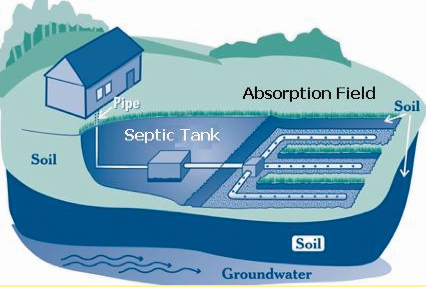
You have to investigate before you invest!
Important Note: This material is meant to be a septic systems guide for initial screening of potential properties to buy. Before you decide to purchase a property, contact your local Oklahoma DEQ office at:
http://www.deq.state.ok.us/eclsnew/localOffices.htm
How to go about your investigation?
1. Open up an internet browser
and access the Web Soil Survey (WSS) by going to: http://websoilsurvey.nrcs.usda.gov.
Click “Start WSS” to begin
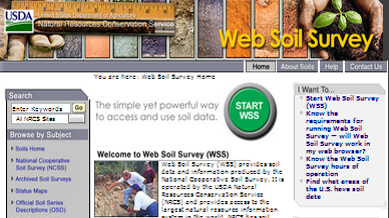
2. Locate your Area of Interest (AOI)
at the left side of the webpage, click “Address” under Quick Navigation.
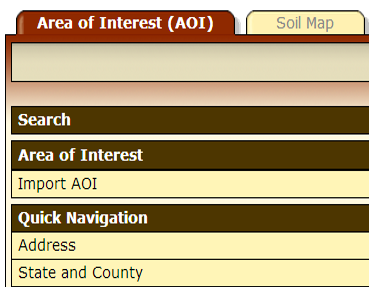
- Type-in the address of your interest and click "view" button to open a pageshowing a map that include your AOI.
- Click the "zoom" button and zoom-in to the location of your AOI.
- Click either of the "AOI" buttons to establish the boundaries of your AOI on the map.
- After setting boundaries, click “Soil Map” to view boundaries of soil mapping units.
- A page, like the one below, will show the names and percent area covered as well as the location of each soil mapping unit in the AOI.
3. Extract the information about the soil mapping units in the AOI
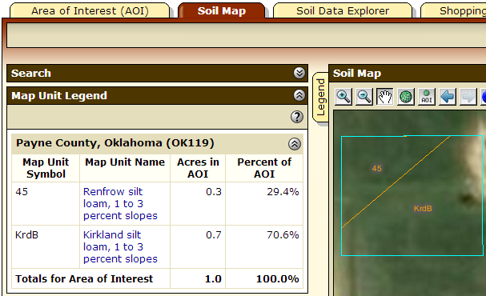
- Click the Map Unit Name to view the Map Unit Description of each soil mapping unit.
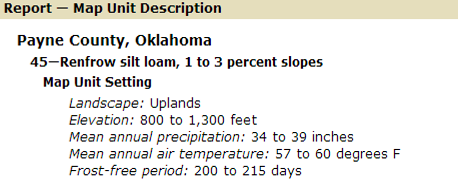
- Scroll down to particularly focus on the following site and soil properties:
- Slope: if less than 10 percent, the system may require more advanced wastewater distribution system.
- Depth from surface to restrictive feature and to water table: preferably less than 48 inches.
- Frequency of flooding and ponding: this should be “none.” If there is potential for flooding and ponding, the area should NOT be used for onsite septic systems.
- Drainage class: Preferably “Well-drained.”
- Devote particular attention to description of Typical Profile.
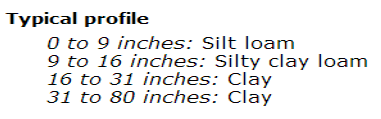
- Determine the soil texture classifications in the upper 48 inches.
- Important Note: Soils can be highly variable. Texture classes listed in the WSS should be viewed as best estimate.
4. Identify the finest soil texture class (or the soil with greatest fraction of fine separates) in the upper 48 inches.
How do I know which textural class is the finest? Use the Textural Triangle.
Trends in the Textural Triangle
- Soil textural classes at the top of the triangle are finer than those at the bottom.
- Soils at the right are finer than those at the left.
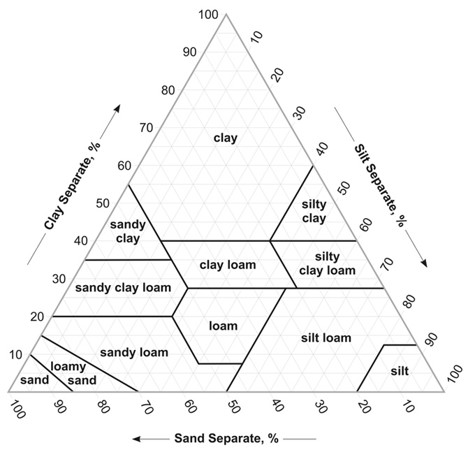
5. Determine under what Oklahoma DEQ Soil Group does the finest soil identified in step 4 belong
Soil Group | Corresponding Soil Textural Class |
|---|---|
1 |
|
2 |
|
2a |
|
3 |
|
3a |
|
4 |
|
5 |
|
6. Determine what Septic System Option that may be permitted in the area of interest.
| Septic System Options | |||||
| Conventional System | Low Pressure Dosing Field | With Aerobic Treatment Units | |||
| Soil Group | Drip Irrigation Field | Spray Irrigation Field | |||
| 1 | not allowed | allowed -depending upon the depth to the restricting layer or the water table | allowed -depending upon the depth to the restricting layer or the water table | allowed | |
| 2 | allowed -depending upon the depth to the restricting layer or the water table | allowed -depending upon the depth to the restricting layer or the water table | allowed | allowed | |
| 2a | allowed | allowed | allowed | allowed | |
| 3 | allowed | allowed | allowed | allowed | |
| 3a | allowed | allowed | allowed | allowed | |
| 4 | allowed | allowed | allowed -depending upon the depth to the restricting layer or the water table | allowed | |
| 5 | not allowed | not allowed | allowed | allowed | |
Other Septic System Options
- Evapotranspiration/Absorption (ET/A)System - allowed in all soils but requires an area of at least 1 acre.
- Lagoons - allowed in all soils but requires an area of at least 2 ½ acres.
Estimated Cost of Septic Systems
For a three-bedroom family home, the following are the estimated cost (as of 2013):
Conventional System | $3,000 - $4,000 | |
Low Pressure Systems | $4,500 - $5,000 | |
Aerobic Treatment Units Spray Irrigation Drip Irrigation | $5,500 - $6,000 $7,500 - $8,000 | |
ET/A Systems | $4,000 - $12,000 |
Online Resources
Oklahoma rules on septic systems: http://www.deq.state.ok.us/eclsnew/index.htm Oklahoma Certified Installers Association: http://www.ocia.s5.com
For more information about onsite septic systems, contact:
Dr. Sergio Abit
Dept. of Plant and Soil Sciences, OSU
Stillwater, OK
Phone: (405)744-9586
E-mail: sergio.abit@okstate.edu
http://nonagriculturalsoils.okstate.edu/
Prepared with some information gathered by Paige Klein.