

Kirton Adaption-Innovation (KAI) Training for Better Problem-Solving and Collaboration
Introduction
There are many training options to choose from when trying to identify what makes team members tick or how collaboration can be improved. These training courses might look at the environment the person is in, the people they are surrounded by or their family of origin. Some trainings focus on strengths, while others associate different characteristics with colors, numbers or different letter combinations.
Kirton’s Adaption-Innovation (KAI) training and assessment is unique to development and leadership training because it takes an in-depth look at a person’s problem-solving style. This training examines the person’s preferred method of solving problems and creating change, from daily organization to completing complex tasks. Some individuals prefer to create change with organization and order, while others prefer flexibility and spontaneity. This article provides an awareness about the KAI assessment and training, related implications for anyone wishing to learn more about their own approaches to change or that of others and how it can improve collaboration, regardless of discipline.
What is Kirton’s Adaption-Innovation (KAI) Theory?
KAI training is based on adaption-innovation theory developed by Dr. Michael Kirton and focuses on cognitive style (how we think), rather than ability or personality, which sets it apart from other trainings and assessments. This training, which involves taking a KAI assessment to determine your problem-solving style, has been in use for more than 45 years and is supported by academic research from around the world.
KAI allows people to see how they prefer to solve problems on a continuum from more adaptive to more innovative style. Rather than focusing on performance level, KAI emphasizes individuals’ problem-solving styles and the way people approach obstacles, activities, challenges and everyday life. On one end of the continuum are more adaptive problem solvers, who are known to improve and refine as they create change. On the other end of the continuum are more innovative problem solvers, who typically challenge and restructure as they create change. A person’s problem-solving style falls somewhere along the continuum, with scores on the continuum ranging from 32 to 160, with an average midpoint of 95 (Figure 1). More adaptive problem-solvers have a score between 32 and 95, while more innovative problem-solvers have a score between 95 and 160.
Characteristics of more adaptive problem-solvers include preference for more structure to solve problems. This can look like building a detailed plan and completing the steps to the plan in order to solve the problem. It might also look like individuals being assigned specific tasks to work toward a solution. More innovative problem solvers might find it easier to brainstorm in group settings and search for solutions in complex situations. More innovative problem solvers don’t need to have an agreed upon plan to solve the problem and don’t rely on rigid structure to find answers.
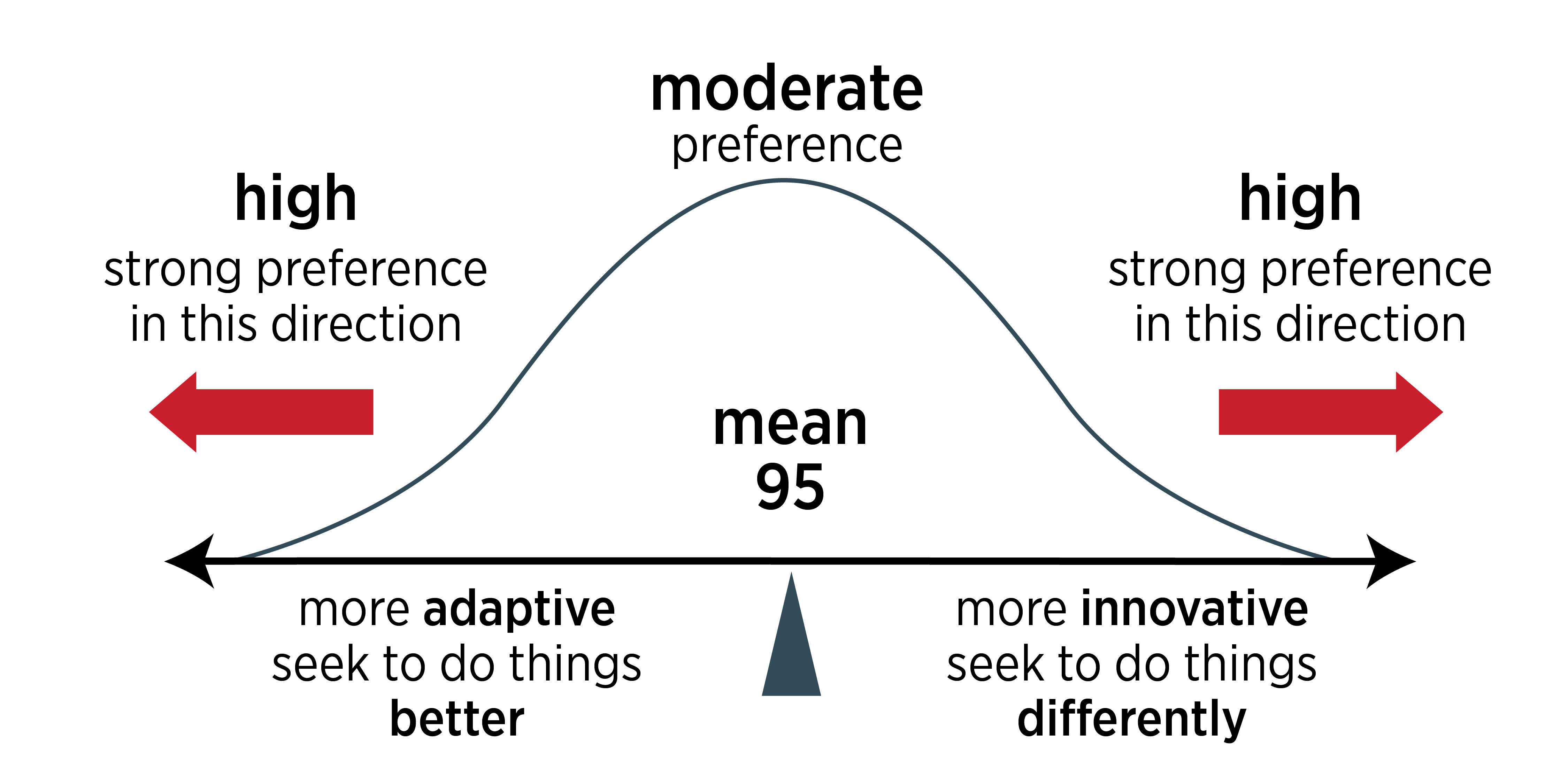 Figure 1. A digital representation of the KAI scale based on adaption-innovation theory as described by the KAI Foundation.
Having an understanding of why you prefer certain things or act the way you do can help you collaborate with those on your team more effectively, utilize your strengths to a higher degree, build better leaders and more. KAI promotes a sense of self-awareness about how you prefer to approach change, which can help individuals embrace their roles in teams and reduce stress. Understanding how you interact in stressful situations can also help reduce negative behavior and improve weaknesses. KAI can be utilized in most settings and life stages. Many occupations and lifestyles can be enhanced or improved by understanding the ways we function on a daily basis.
Recognizing the differences in people’s preferences toward adaptive and innovative change can help team collaboration through the recognition of cognitive diversity (essentially, how our brains work). Someone on an agricultural finance team at a bank might prefer to gather all the facts and data before contributing to a team meeting regarding the outlook of community engagement with the company. Others might want to externally process and allow the ideas to be fully explored by the team before making decisions. Understanding these different preferences and needs to arrive at a decision can give people a greater awareness of what individuals require in decision-making situations.
Here’s another example: On an Extension farm visit there might be an opportunity for Extension professionals to plan conversations and information in advance to maximize time at the operation. While this works for some, others might want to have a more flexible approach and figure out the needs of the operation to base suggestions on as they go. There are opportunities in both situations to understand where the others are coming from and approach a middle ground that respects both parties’ wishes and preferred way of going about change.
KAI training not only recognizes different approaches to solving problems but also helps support conflict resolution and collaboration strategies. Giving people the opportunity to understand the preferences of those around them can help in conflict or high stress situations by allowing people to know what they need going into the situation. For example, if a manager understands one of their employees utilizes checklists while another employee on the same team prefers to do a brain dump and get everything on paper, there is an opportunity to reduce the fall out if conflict arises because the manager understands there are two different approaches to the same problem. One of the individuals in this scenario has a high value on structure and efficiency. The other individual has a focus on challenges and change. These styles are powerful tools when they are utilized to their full potential and enhanced rather than regulated.
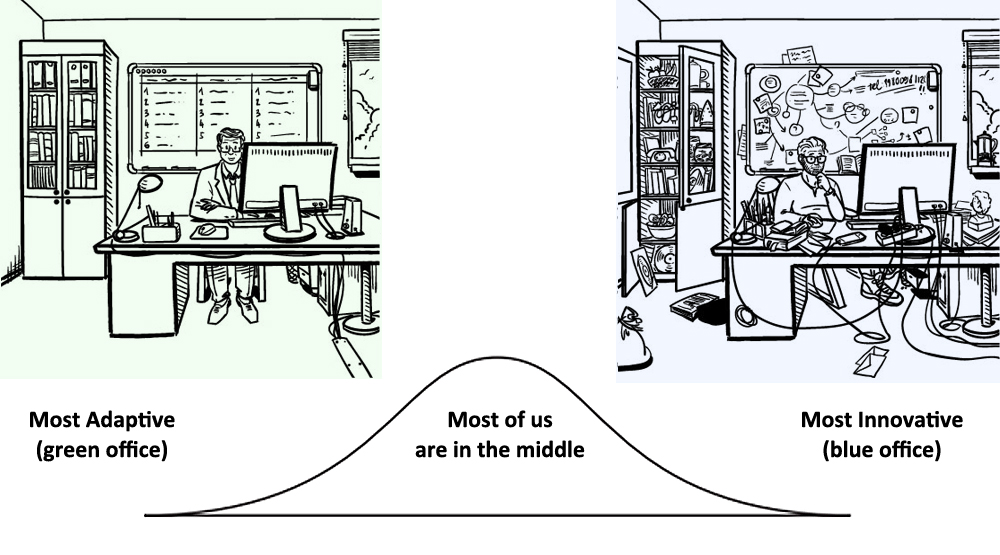 Figure 2. A digital drawing of two different office spaces, one more “adaptive” and one more “innovative” on a sliding scale from the KAI Foundation.
Who Should Attend a KAI Training?
Individuals who work with others, have an interest in improving their people skills, or want to be more self-aware are excellent candidates for KAI training. These groups include Extension educators or agents, education professionals, managers and leaders and individuals that work with people. Improving self-awareness will enhance group cohesion and effectiveness according to the KAI website. Specific industries that have been researched in KAI training include the airline industry, military, rural veterinary clinics, as well as cross-functional and diverse teams.
This training is most beneficial when taken with a group of people you work with or function with regularly because the scores are relative to the individuals around you. Think of it this way: if you share a problem-solving style with a stranger you met in the dentist’s office, it likely wouldn’t matter because you do not interact with them on a regular basis; on the contrary, sharing a similar or different problem-solving style with your colleague who you work with every day would likely have a much greater impact. Unless people are at the very end of the scale at 32 or 160, individuals will typically be more innovative or more adaptive than those around them. Tasks required of you through a job, volunteer opportunity, or personal commitment may also be more adaptive or more innovative in nature, which may also align or conflict with your own personal problem-solving style. All scores are considered ideal, meaning there is no “perfect” score. Each score will be relative to those around it. KAI training with team members can improve team collaboration by learning more about the preferences of those you work and interact with.
Key Components of the Training
The KAI assessment takes approximately 15–20 minutes to complete and contains 32 questions. The assessment measures the ways people show creativity and make decisions to bring about change. When training is facilitated by a KAI accredited practitioner, they will interpret individual and team’s results. KAI training can include an exploration of adaptive vs. innovative characteristics, strategies for managing and leveraging cognitive style differences, and practical group exercises for better collaboration. The training session can look like a half-day, full-day or multi-day workshop depending on the size of team, depth of training and practitioner preferences. The training is fully customizable for your team and organizational needs.
References
KAI Foundation. (n.d.). A digital drawing of two different office spaces, one more “adaptive” and one more “innovative” on a sliding scale. KAI Foundation. Retrieved July 7, 2025, from https://kai.foundation/about-kai/
Singh, A. (2024, October 21). A digital representation of the KAI scale based on adaption- innovation theory as described by the KAI Foundation. Medium. Retrieved March 24, 2026, from https://aayushsingh365.medium.com/kirtons-adaptation-inno-vation-theory- unlocking-better-project-management-3f5a3962f239