

The Economics of Data Centers: Considerations for Communities
The primary reason communities consider recruiting or approving data centers is their anticipated economic impact. It is often expected that these facilities will generate jobs and increase revenue to support public services. However, the actual economic impact that data centers will have on the local community remains uncertain. Large data centers — often 10,000 square feet or more — are still new, and their local effects are largely speculative, often depending on the specifics negotiated for each project.
This fact sheet begins with a brief overview of data centers and a discussion on why Oklahoma is being considered as a potential location for these facilities. This is followed by an overview of some of the most frequently discussed economic considerations, including revenue, employment and infrastructure. The purpose of this fact sheet is to offer a high-level introduction for communities navigating data center proposals. Additional fact sheets will explore specific topics (such as water or electricity use) in greater detail. This fact sheet is informational only and does not indicate support for or against data centers.
What Is a Data Center?
Data centers are specialized facilities that house servers, storage systems and networking equipment used to support cloud services and digital applications. They enable the storage, processing and transfer of vast amounts of data, making modern digital services possible. Everyday activities like sending a text, checking an email, streaming a movie, using GPS navigation or posting on social media depend on data centers to process information quickly and deliver results in real time. The deployment of Artificial Intelligence (AI) platforms like ChatGPT, Claude or Gemini requires significant computational power and data storage to support the complex models that power them. As a result, data centers have become essential infrastructure in today’s technology-driven society.
Why Oklahoma?
Oklahoma has attracted growing interest as a location for data center development. As of 2026, several facilities are already operating in the state, with additional projects in various stages of planning and construction. While Oklahoma currently has fewer data centers than states like Virginia or Texas (Figure 1), demand for new sites is growing in Oklahoma, as it is across the nation.
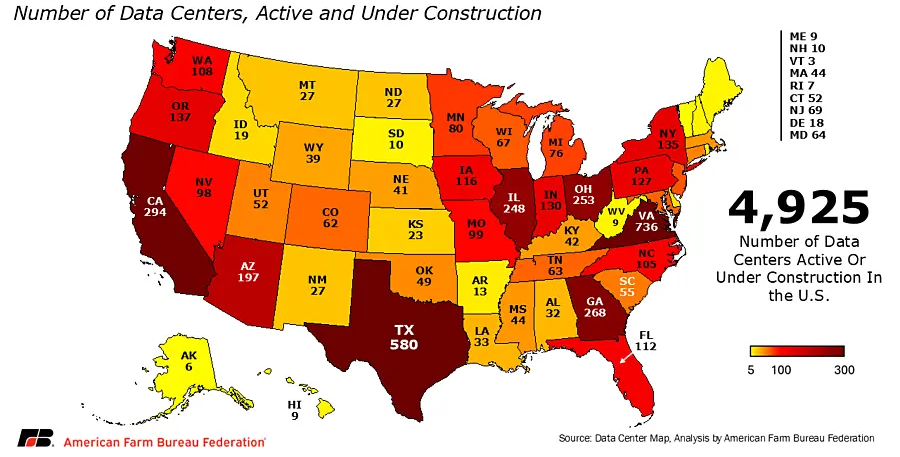 Figure 1. Data Centers Across the U.S., Data centers by state. Source: Higgins and Nelson (2026)
Several factors help explain why Oklahoma is appealing to data center builders. Research on siting decisions highlights the importance of energy access, infrastructure, low exposure to natural hazards and land availability (Arzumanyan et al., 2025). Oklahoma aligns well with many of these criteria, offering relatively low land costs and proximity to stable energy sources. In addition, state and local incentives and “behind the meter” legislation, which allows data centers to generate their own power if public utilities raise rates, are other factors that could encourage the building of new data centers in Oklahoma (Behind-the-Meter Generation Act, 17 Okla. Stat. § 151, 2025).
Potential Economic Effects
As communities across Oklahoma continue to receive data center proposals, a wide array of economic considerations is frequently discussed. While the topics listed below are not exhaustive, they reflect the most common themes we hear.
Revenue
The anticipated revenue generated by a data center is often central to local economic development discussions. Data centers can contribute to the local economy through several mechanisms, including property taxes, payment in lieu of taxes (PILOT) agreements, utility franchise fees, sales taxes and other negotiated payments such as Google’s “Community Betterment Payments” to the City of Stillwater (City of Stillwater, Oklahoma, 2024).
In Oklahoma, both real property (land and buildings) and personal property (home furnishings and appliances, business equipment and business inventory) are subject to taxation (Lansford, 2014). For data centers, a substantial portion of the total assessed value will be tied to personal property, specifically their servers and computing equipment, rather than the physical infrastructure itself. For example, the data center building may be valued at $100 million while the servers housed within it could be worth $400 million. As a result, the combined value of real and personal property has the potential to generate significant tax revenue for the community.
However, the actual revenue received depends on local incentives. Data center developers may seek tax abatements or exemptions, particularly on high-value personal property. In cases where only real property (land and buildings) is taxed, and personal property (servers) is given an exemption, the potential tax base and revenue can be substantially reduced. Similar considerations apply to PILOT agreements, which may provide predictable payments to local governments but often at levels below what standard property taxes (real + personal property) would generate.
Additional revenue may arise during the construction phase from sales taxes on building materials and increased economic activity in local hotels, restaurants and service industries that support construction workers. In some cases, local governments earmark a portion of these tax revenues for specific community priorities; for example, increased sales tax collections associated with Meta’s data center development in Richland Parish, Louisiana, helped fund teacher bonuses of up to $50,000 (Bobrowsky, 2026). However, these benefits depend on local sales tax rates, the length and magnitude of the construction phase (i.e., how many workers are needed) and the local economy’s capacity to capture and retain such spending (Whitacre and McPeak, 2025).
Communities can also receive payments to directly support local services, beyond what is provided through other revenue streams. In Stillwater, they will receive “Community Betterment Payments” to support parks and other quality-of-life amenities. This is something communities negotiate and will thus be specific to the project.
Data center developers may also make voluntary contributions to local communities, such as donations to schools, workforce programs or other local needs. These investments can provide meaningful short-term benefits and are often highlighted in development discussions, but are not guaranteed and typically fall outside contractual frameworks. Thus, they should be viewed as supplemental and a signal of whether the developer may be a good community partner.
Overall, several important nuances shape the potential revenue from data center development. The actual revenue generated will depend heavily on local tax structures, negotiated agreements and the specific project’s characteristics.
Employment
Employment effects and/or job growth also frequently come up in discussions about data center development. Emerging academic research finds that data centers generate only a small, temporary uptick in construction employment and generate little long-term labor demand (Hicks et al., 2026).
Data center construction often requires a large workforce over a short period, which can seemingly create a temporary influx of jobs. However, many of these positions are filled by specialized contractors who often come from outside the local community. As a result, the employment effects within the community are limited.
In the operations phase, permanent employment levels are typically low relative to the facility’s size and capital investment. As a recent example, a new hyperscale data center in Abilene, Texas (population 130,000), employed over 1,500 people during construction but was expected to have only 100 employees upon opening (Dotan, 2025). While this may be viewed as a drawback from a job-creation perspective, some communities may lack the local workforce to support large-scale job creation but may benefit from creating a smaller number of potentially above-average-wage jobs. The lower employment levels can also reduce demands on local infrastructure, such as traffic and housing, compared to more labor-intensive developments (Miet, 2024).
In addition to direct employment by the data center, there is potential for indirect employment through services such as maintenance, security and landscaping, as well as from industries that support the data center’s operations and workforce. Obtaining these services or goods from outside the community may limit the indirect employment benefits that accrue within the community.
Beyond direct and indirect employment, there could also be potential for “clustering” effects. In theory, the presence of data centers could attract related technology firms or complementary businesses to a region. For example, improved digital infrastructure and proximity to large-scale computing capacity may make an area more attractive to firms that rely on cloud services or data-intensive operations. However, the extent to which these clustering effects materialize is uncertain, with recent evidence from Texas finding no impact on sub-sectors like Information or Computer Systems Design (Hicks et al., 2026). Data centers are relatively self-contained and may not generate strong linkages with other local industries compared to more labor-intensive sectors. Thus, while there is potential for additional economic activity, these outcomes should be viewed as possible rather than guaranteed.
Infrastructure
Data center development can have important implications for local infrastructure, creating both potential benefits and drawbacks for the local community. These facilities require substantial investments in electricity, water, transportation and broadband.
In some cases, data center projects can lead to upgrades that benefit the broader community. Investments in electrical transmission and distribution systems may improve grid reliability and capacity, while expansions in fiber networks might enhance broadband access. Road improvements and water system upgrades may also support long-term growth and provide spillover benefits to residents and businesses.
However, these outcomes are not guaranteed. Data center developers may or may not cover the full upfront costs of the infrastructure needed to support their projects. Some investments are designed solely for the facility’s operational needs and may offer limited public benefit. In addition, the significant energy and water demands of data centers can place pressure on local systems, potentially increasing costs for other users or requiring additional public investment.
As a result, the extent to which communities benefit depends heavily on how projects are structured and negotiated. Local governments should ensure that data center developers bear the full cost of any necessary infrastructure upgrades upfront to reduce the likelihood that existing residents and businesses are burdened with higher utility rates or taxes. They should also consider how the data center infrastructure investments may help meet infrastructure expansion and upgrades already needed in their community. Including these upgrades or modernization efforts as part of a community benefit agreement could be a better option than standalone adjacent systems solely for the data center (Muro and Methkupally, 2026).
Opportunity Cost
While data centers can bring significant investment to a community, they also have an opportunity cost. The opportunity cost is the value of the next best alternative to a data center that was not chosen. Land, water, infrastructure capacity and public incentives are limited resources and committing them to a data center may mean forgoing alternative developments that could generate more jobs, higher tax revenues or greater economic diversification. Additionally, other industries might avoid a community with a data center presence because the facilities may deplete available water and electrical capacity needed for operation.
These considerations raise important questions about whether data centers generate the highest return compared to other development options. Because they are highly capital-intensive but employ relatively few workers and are likely to receive public incentives, the long-term benefits in terms of jobs and tax revenue may be more limited. As a result, communities should evaluate not only the direct benefits of data centers but also what alternative opportunities may be displaced. Careful assessment can help ensure that development decisions align with long-term economic goals and maximize overall community benefits.
Conclusion
Data centers can generate economic benefits for a community, but the scale and distribution of those benefits could vary widely. Local economic outcomes will depend on several factors, including the size of the project, the structure of tax incentives, the availability and cost of infrastructure and the specific terms negotiated between the developer and the community.
In many cases, data centers offer a mix of benefits, including potential tax revenue and infrastructure investment. But these benefits come alongside drawbacks, including relatively low employment levels and potential strain on local resources. As a result, the economic impact of a data center is not uniform and should be evaluated on a project-by-project basis.
Careful planning and transparent decision-making are essential. Communities that clearly assess how the benefits and the costs of data center development align with their long-term goals will be better positioned to capture value while mitigating potential downsides.
References
Arzumanyan, M., Calzado, E. R., Lin, N., Bahadur, V., Das, J., Ko, T. L., & Koesterke, L. (2025). Geospatial suitability analysis for data center placement: A case study in Texas, USA. Sustainable Cities and Society, 106687.
Behind-the-Meter Generation Act, 17 Okla. Stat. § 151 (2025)
Bobrowsky, M. (2026, June 12). The teachers getting $50,000 bonuses thanks to a massive Meta data center. The Wall Street Journal. https://www.wsj.com/us-news/education/the-teachers-getting-50-000-bonuses-thanks-to-a-massive-meta-data-center-b4631d05
City of Stillwater, Oklahoma. (2024, September 4). Stillwater data center economic development project plan (draft for review and discussion purposes only). https://stillwaterok.portal.civicclerk.com/event/2035/files/attachment/2274
Dotan, T. (2025). The AI Data-Center Boom is a Job-Creation Bust. The Wall Street Journal. https://www.wsj.com/tech/ai-data-center-job-creation-48038b67
Gargano, Antonio, and Marco Giacoletti. “Data Centers and the Local Economy.” Working paper, University of Houston and University of Southern California, 2022.
Hicks, M., Boyce, M., Whitacre, B., & Faulk, D. (2026). Data centers and local labor markets: Evidence from the Texas experience (Working paper). [Ball State University].
Higgins, A. L., & Nelson, B. (2026, April 23). Balancing data center growth with American agriculture. American Farm Bureau Federation. https://www.fb.org/market-intel/balancing-data-center-growth-with-american-agriculture
Lansford, N. (2014). Ad valorem taxes (Fact Sheet AGEC-795). Oklahoma State University Extension. https://extension.okstate.edu/fact-sheets/ad-valorem-taxes
Muro, M. and Methkupally, S. (2026). Turning the Data Center Boom into Long-term, Local Prosperity. Brookings. https://www.brookings.edu/articles/turning-the-data-center-boom-into-long-term-local-prosperity/
Whitacre, B. and McPeak, M. (2025). Pull Factors: A Measure of Retail Sales Success - Estimates for 77 Oklahoma Cities (2024 Edition) (Fact Sheet AGEC-1079). Oklahoma State University Extension. https://extension.okstate.edu/fact-sheets/pull-factors-a-measure-of-retail-sales-success-estimates-for-77-oklahoma-cities