

Estimating Wheat Grain Yield Potential
Wheat grain yield is the product of heads per square foot, seeds per head and seed weight. Using estimates of these parameters, farmers can derive an estimated grain yield potential. These estimates are generally more accurate as the season progresses. An estimate of the number of heads per square foot in the late spring, for example, will be much more accurate than one made in the fall. It is also important to note that any estimate is an estimate, and nothing more, until the crop is harvested.
Heads per Square Foot
Heads per square foot is dictated by seeding rate, tillering and tiller survival. Most wheat seed in Oklahoma has between 13,000 and 16,000 seeds per pound. At a 60 pounds per acre seeding rate, this will deliver 18 seeds to 22 seeds per square foot. Wheat needs 60 heads to 70 heads per square foot at harvest for full yield potential. October-sown wheat will generally produce two to three good tillers per plant and will reach the 60 heads per square foot target when sown at 60 pounds per acre. November-sown wheat may have only one to two good tillers per plant and will, therefore, fall short of the 60 heads per square foot target when sown at 60 pounds per acre.
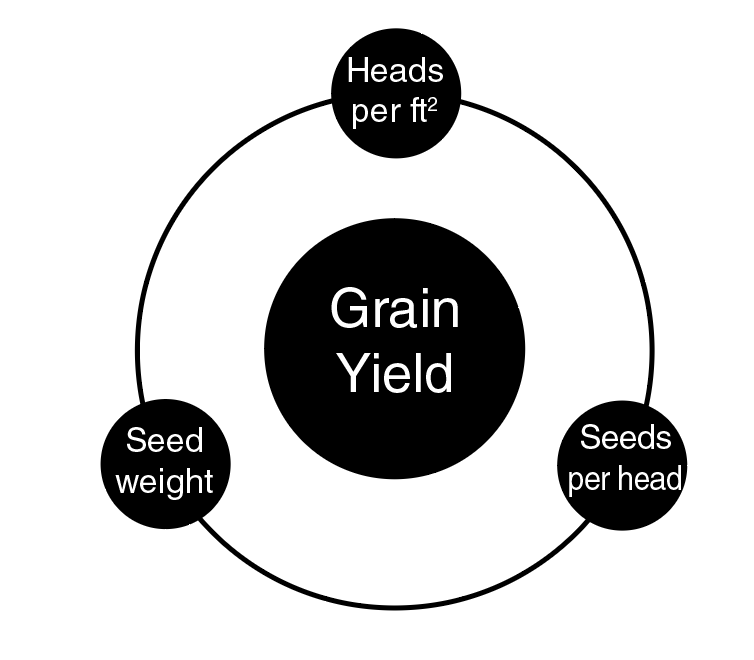
Figure 1.
Potential heads per square foot can be estimated in field by counting tillers in one linear foot of row and using Equation 1 to calculate the number of tillers per square foot. These calculations have been performed for various row spacings and tiller counts in Table 1. It is important to count only tillers with at least three unfolded leaves. It is also important to keep in mind that these are tillers that can produce grain heads; environmental conditions could still cause the plant to abort some of these tillers. The closer to harvest that these counts are made, the more accurate the estimate will be.
Equation 1
tillers per sq. ft. =
tillers per ft. of row X 12
row spacing in inches
Table 1. Tillers per square foot based on tiller counts per linear foot of row at various row spacings.
| Tillers per foot of row | Row Spacing in Inches | ||
|---|---|---|---|
| 6 | 7.5 | 9 | |
| ---tillers/ft2--- | |||
| 10 | 20 | 16 | 13 |
| 12 | 24 | 19 | 16 |
| 14 | 28 | 22 | 19 |
| 16 | 32 | 26 | 21 |
| 18 | 36 | 29 | 24 |
| 20 | 40 | 32 | 27 |
| 22 | 44 | 35 | 29 |
| 24 | 48 | 38 | 32 |
| 26 | 52 | 42 | 35 |
| 28 | 56 | 45 | 37 |
| 30 | 60 | 48 | 40 |
| 32 | 64 | 51 | 43 |
| 34 | 68 | 54 | 45 |
| 36 | 72 | 58 | 48 |
| 38 | 76 | 61 | 51 |
| 40 | 80 | 64 | 53 |
| 42 | 84 | 67 | 56 |
| 44 | 88 | 70 | 59 |
| 46 | 92 | 74 | 61 |
| 48 | 96 | 77 | 64 |
| 50 | 100 | 80 | 67 |
Seeds per Head
Seeds per head is simply the product of the number of seeds per spikelet and the total number of spikelets per head. Oklahoma wheat averages between 2 grains and 2.5 grains per spikelet and from 8 spikelets to 12 spikelets per head for a total of 20 grains to 30 grains per head. This is the “typical” range and actual grains per head can deviate greatly from this range. Factors such as variety, emergence time, grazing, tiller population density, fertility, foliar disease, insect infestations, weed control and moisture availability will affect the final number of seeds per head.
If a yield estimate is being calculated during or after grain fill, seeds per head can be estimated very precisely by counting seeds in random head samples from across the field. Estimates of seeds per head earlier in the year will be less reliable, as they rely upon several assumptions that may or may not prove to be correct as the crop year progresses. It is also important not to count seeds that are shriveled or light, as these will likely not make it to the combine tank and will not contribute much to yield if they do.
Seed Weight
The list of factors that can influence seeds per head also influence seed weight. Within a given environment, however, variety probably has the largest effect on seed size. Even though seed size influences final grain yield, it is important to note that small-seeded varieties frequently compensate by producing more heads and more seeds per head than larger-seeded varieties. Given these caveats, most hard red winter wheat produced in Oklahoma will have between 13,000 and 16,000 seeds per pound. It is also important to note that seeds per pound will generally be larger in noncleaned wheat because small seeds are removed during the cleaning process.
Calculating the estimate
Once estimates of the number of heads per square foot, seeds per head and seed weight have been established, they can be combined using Equation 2 to produce an estimated yield potential. The ‘726’ value in Equation 2 is a constant that results from simplifying the equation. The results of Equation 2 using several possible combinations have been calculated in Table 2.
Equation 2
estimated grain yield (bu/A) =
heads per sq. ft. x grains per head x 726
seeds per pound
Table 2. Estimated yield potential for seeds per pound, seeds per head, and heads per square foot combinations likely to be found in Oklahoma wheat fields.
| 14,000 seeds per pound | |||||
|---|---|---|---|---|---|
| Seeds per head | |||||
| Heads per square foot | 20 | 22 | 24 | 26 | 28 |
| grain yield estimate (bu/A) | |||||
| 20 | 21 | 23 | 25 | 27 | 29 |
| 22 | 23 | 25 | 27 | 30 | 32 |
| 24 | 25 | 27 | 30 | 32 | 35 |
| 26 | 27 | 30 | 32 | 35 | 38 |
| 28 | 29 | 32 | 35 | 38 | 41 |
| 30 | 31 | 34 | 37 | 40 | 44 |
| 32 | 33 | 37 | 40 | 43 | 46 |
| 34 | 35 | 39 | 42 | 46 | 49 |
| 36 | 37 | 41 | 45 | 49 | 52 |
| 38 | 39 | 43 | 47 | 51 | 55 |
| 40 | 41 | 46 | 50 | 54 | 58 |
| 42 | 44 | 48 | 52 | 57 | 61 |
| 44 | 46 | 50 | 55 | 59 | 64 |
| 46 | 48 | 52 | 57 | 62 | 67 |
| 48 | 50 | 55 | 60 | 65 | 70 |
| 50 | 52 | 57 | 62 | 67 | 73 |
| 52 | 54 | 59 | 65 | 70 | 76 |
| 54 | 56 | 62 | 67 | 73 | 78 |
| 56 | 58 | 64 | 70 | 76 | 81 |
| 58 | 60 | 66 | 72 | 78 | 84 |
| 60 | 62 | 68 | 75 | 81 | 87 |
| 62 | 64 | 71 | 77 | 84 | 90 |
| 64 | 66 | 73 | 80 | 86 | 93 |
| 66 | 68 | 75 | 82 | 89 | 96 |
| 68 | 71 | 78 | 85 | 92 | 99 |
| 70 | 73 | 80 | 87 | 94 | 102 |
| 15,000 seeds per pound | |||||
|---|---|---|---|---|---|
| Seeds per head | |||||
| Heads per square foot | 20 | 22 | 24 | 26 | 28 |
| grain yield estimate (bu/A) | |||||
| 20 | 19 | 21 | 23 | 25 | 27 |
| 22 | 21 | 23 | 26 | 28 | 30 |
| 24 | 23 | 26 | 28 | 30 | 33 |
| 26 | 25 | 28 | 30 | 33 | 35 |
| 28 | 27 | 30 | 33 | 35 | 38 |
| 30 | 29 | 32 | 35 | 38 | 41 |
| 32 | 31 | 34 | 37 | 40 | 43 |
| 34 | 33 | 36 | 39 | 43 | 46 |
| 36 | 35 | 38 | 42 | 45 | 49 |
| 38 | 37 | 40 | 44 | 48 | 51 |
| 40 | 39 | 43 | 46 | 50 | 54 |
| 42 | 41 | 45 | 49 | 53 | 57 |
| 44 | 43 | 47 | 51 | 55 | 60 |
| 46 | 45 | 49 | 53 | 58 | 62 |
| 48 | 46 | 51 | 56 | 60 | 65 |
| 50 | 48 | 53 | 58 | 63 | 68 |
| 52 | 50 | 55 | 60 | 65 | 70 |
| 54 | 52 | 57 | 63 | 68 | 73 |
| 56 | 54 | 60 | 65 | 70 | 76 |
| 58 | 56 | 62 | 67 | 73 | 79 |
| 60 | 58 | 64 | 70 | 76 | 81 |
| 62 | 60 | 66 | 72 | 78 | 84 |
| 64 | 62 | 68 | 74 | 81 | 87 |
| 66 | 64 | 70 | 77 | 83 | 89 |
| 68 | 66 | 72 | 79 | 86 | 92 |
| 70 | 68 | 75 | 81 | 88 | 95 |
| 16,000 seeds per pound | |||||
|---|---|---|---|---|---|
| Seeds per head | |||||
| Heads per square foot | 20 | 22 | 24 | 26 | 28 |
| grain yield estimate (bu/A) | |||||
| 20 | 18 | 20 | 22 | 24 | 25 |
| 22 | 20 | 22 | 24 | 26 | 28 |
| 24 | 22 | 24 | 26 | 28 | 30 |
| 26 | 24 | 26 | 28 | 31 | 33 |
| 28 | 25 | 28 | 30 | 33 | 36 |
| 30 | 27 | 30 | 33 | 35 | 38 |
| 32 | 29 | 32 | 35 | 38 | 41 |
| 34 | 31 | 34 | 37 | 40 | 43 |
| 36 | 33 | 36 | 39 | 42 | 46 |
| 38 | 34 | 38 | 41 | 45 | 48 |
| 40 | 36 | 40 | 44 | 47 | 51 |
| 42 | 38 | 42 | 46 | 50 | 53 |
| 44 | 40 | 44 | 48 | 52 | 56 |
| 46 | 42 | 46 | 50 | 54 | 58 |
| 48 | 44 | 48 | 52 | 57 | 61 |
| 50 | 45 | 50 | 54 | 59 | 64 |
| 52 | 47 | 52 | 57 | 61 | 66 |
| 54 | 49 | 54 | 59 | 64 | 69 |
| 56 | 51 | 56 | 61 | 66 | 71 |
| 58 | 53 | 58 | 63 | 68 | 74 |
| 60 | 54 | 60 | 65 | 71 | 76 |
| 62 | 56 | 62 | 68 | 73 | 79 |
| 64 | 58 | 64 | 70 | 76 | 81 |
| 66 | 60 | 66 | 72 | 78 | 84 |
| 68 | 62 | 68 | 74 | 80 | 86 |
| 70 | 64 | 70 | 76 | 83 | 89 |