

Conserving Beneficial Arthropods in Residential Landscapes
The typical Oklahoma backyard contains hundreds of arthropod species occurring from below the soil surface to the tree canopy. However, only a small fraction are observed on a frequent basis because many are microscopic and/or are hidden belowground or within plant tissue. Very few species are classified as pests, whether they feed on plants or plant products, invade our homes, inflict painful bites or stings, or transmit diseases. In fact, most insects and other arthropods are beneficial and serve a variety of important functions in the garden. Beneficial insects include decomposers of plant and animal matter, plant pollinators, and natural enemies (predators and parasitoids) of pest insects.
The abundance of beneficial insects, especially natural enemies, is often limited in urban landscapes because these environments typically are characterized by disturbance. Disturbance factors include use of pesticides and other chemicals, air pollution, and wind-borne dust, all of which may increase mortality of beneficial arthropods. Residential landscapes often lack adequate amounts of essential resources such as food, nesting sites, and shelter that enhance reproduction and survival of natural enemies. Here we introduce some common natural enemies found in Oklahoma and current strategies to conserve them in residential landscapes. These strategies may help reduce insecticide use and improve plant health by enhancing natural (biological) control of arthropod pests.
Background
Integrated pest management (IPM) strategies are designed to maintain pest populations below damaging levels by combining a variety of control tactics (cultural, physical/mechanical, biological, and chemical). Biological control is just one aspect of IPM that can be implemented in urban and agricultural landscapes. There are three basic strategies of biological control:
- classical (introduction)
- augmentation, and
- conservation.
Because many arthropod pests are exotic, the aim of classical biological control is to reduce pest numbers by reuniting old enemies through importation of predators, parasitoids, or insect-killing pathogens from the area of the pest’s origin. Classical biological control is highly regulated and only can be implemented by university and government scientists. Augmentation biological control involves making periodic releases of commercially available predators and parasitoids (e.g., lady beetles, parasitic wasps) when pest numbers increase, similar to how pest density thresholds signal the need to apply insecticides. Conservation biological control involves encouraging the survival and reproduction of naturally occurring enemies to increase their abundance in the landscape. Of the three strategies, conservation biological control is often the most practical and amenable to residential landscapes.
Lady beetles, green lacewings, and spiders are familiar examples of predatory arthropods inhabiting residential landscapes and gardens. In general, predators are larger than their prey, consume many prey items during their lifetime, and feed on a broad range of species. Immatures and/or adults may be predatory and often do not leave behind any evidence of attack. In contrast, parasitoids are smaller than their hosts, consume only one prey item during their lifetime, and typically feed on a narrow range of species. The majority of parasitoid species are wasps or flies. Adult female parasitoids deposit eggs in or on a host and the developing larvae feed on the host’s internal organs and tissues. Hosts remain alive while the larvae develop and eventually exhibit signs that they are parasitized such as changes in color, size, and activity (e.g., reduced feeding, sluggish movement). Natural enemies often keep aphids, spider mites, caterpillars, and other pests under control without much intervention. However, many residential landscapes are disturbed or otherwise out of balance with natural forces that keep pests under control. Under these circumstances, we must seek to restore balance and promote biological control by modifying the habitat in ways that attract and retain natural enemies.
The first step in conserving natural enemies is to identify common predators and parasitoids frequently occurring in residential landscapes. Following are brief descriptions of the development, habitat, and feeding preferences for common predators and parasitoids in Oklahoma.
Natural Enemies
Predators
Beetles
Lady Beetles
Key Characteristics:
Egg: Soft, yellow, and typically clustered
Immature: Small and alligator-like larva with yellow or orange markings
Pupa: Attached to plant matter and looks similar to bird droppings
Adult: Elliptical or round, usually with various spot patterns
Prey: Aphids, scales, and other small, soft-bodied insects, mites, and insect eggs
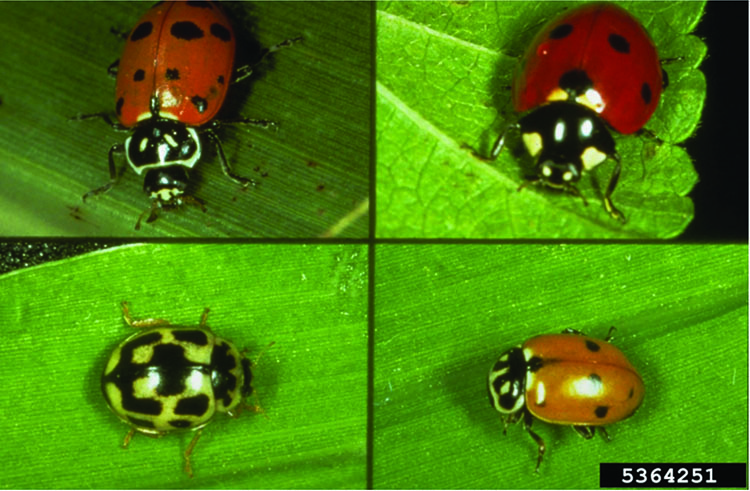
Figure 1. Adults of four species of lady beetle. Clockwise from upper left: convergent lady beetle, seven spotted lady beetle, variegated lady beetle, and fourteen spotted lady beetle.
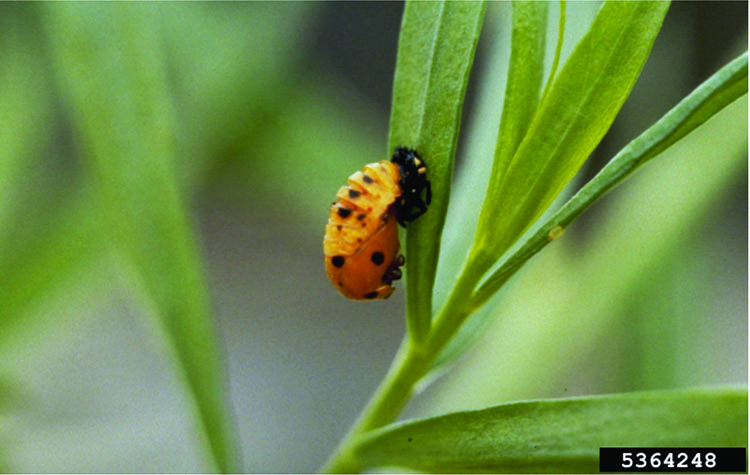
Figure 2. Pupa of multi-colored Asian lady beetle.
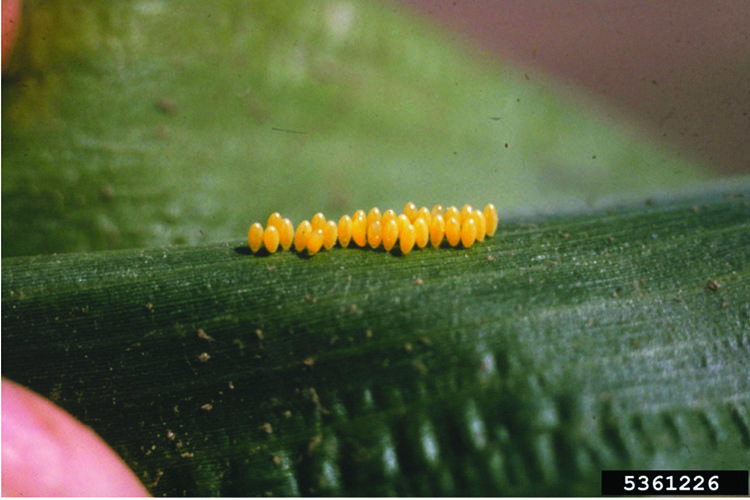
Figure 3. Lady beetle egg mass on corn leaf.
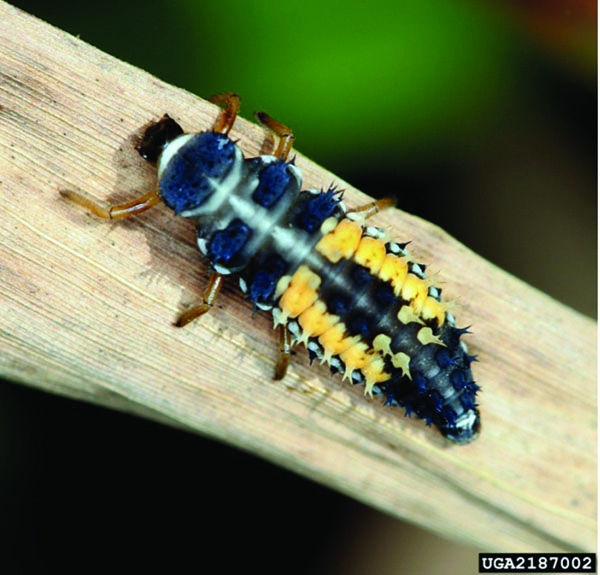
Figure 4. Larva of multi-colored Asian lady beetle.
Predatory Stages: Immatures and adults
General Description: Lady beetles preferentially feed on aphids or scale insects, but when populations of these prey are low they often supplement their diet with other insects and their eggs. Both immatures and adults are predators and several different species can be found in Oklahoma. The most common species encountered are Coleomegilla maculata (Pink Spotted Lady Beetle), Cycloneda munda (Polished Lady Beetle), Hippodamia convergens (Convergent Lady Beetle), Coccinella septempunctata (Seven Spotted Lady Beetle), andHarmonia axyridis (Multi-colored Asian Lady Beetle). Lady beetles develop through complete metamorphosis. After eggs hatch, larvae feed and develop through four immature stages before pupating and emerging as adults. Adults range in size from 1/8-inch to 3/16- inch long and are most often identified by the spot pattern on their hard forewings.
Habitat and Feeding Preferences: Lady beetles are mobile in both their immature and adult life stages and tend to dissipate after prey populations diminish; however, the adults use pollen and nectar so flowering plants will encourage lady beetles to visit your landscape.
Ground Beetles
Key Characteristics:
Egg: Not typically seen, deposited in the soil
Immature: Long and segmented larva with large jaws
Pupa: Not typically seen, pupates in the soil
Adult: Typically brown or black, sometimes metallic blue or green with a clearly distinct head, thorax, and abdomen; with prominent eyes
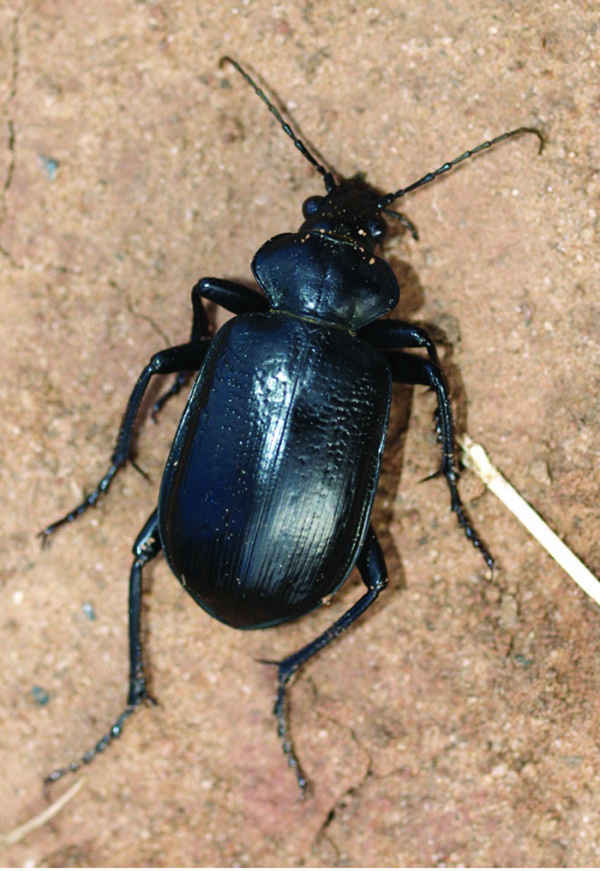
Figure 5. One of many species of ground beetles. Both adults and larvae are predators, but larvae are rarely encountered.
Prey: A wide range of soil-dwelling and plant-feeding insects, including moth and butterfly caterpillars and pupae.
Predatory Stages: Immatures and adults
General Description: Ground beetles feed on insects in or on the soil, although some species venture up onto plants and trees to feed on caterpillars and pupae. Both larvae and adults are nocturnal and secretive, hunting for prey at night and hiding under rocks, leaves, and debris during the day. Some common Oklahoma species are Calosoma scrutator (Fiery Searcher/Caterpillar Hunter) and Harpalus caliginosus (Murky Ground Beetle). Ground beetles develop through complete metamorphosis. Eggs are laid in the soil and larvae hatch out and feed for one to two years before pupating in the soil. Adults range in size from 1/8-inch to 1½ inches and the head is narrower than the thorax.
Habitat and Feeding Preferences: Ground beetles are nocturnal hunters seeking concealed refuge during the day. Organic mulches and perennial plants provide places for these beetles to hide and reproduce, helping conserve populations in your garden or landscape.
True Bugs
Minute Pirate Bugs
Key Characteristics:
Egg: Typically not seen, deposited in plant tissue
Immature: Pear-shaped, orange nymph with reddish-brown eyes and undeveloped wings
Adult: Small, tan and black with triangular markings
Prey: Insect eggs, aphids, thrips, and spider mites
Predatory Stages: Immatures and adults
General Description: Minute pirate bugs have piercing-sucking mouthparts and attack a variety of small plant pests including aphids, spider mites, thrips, and the eggs of several types of insects. Besides preying on pests, they cause additional mortality by piercing prey without feeding on them. Minute pirate bugs undergo gradual metamorphosis. Once eggs hatch, nymphs develop through five stages before becoming adults. Adults measure 1/8-inch long or less and the lower half of the outer pair of wings are membranous.
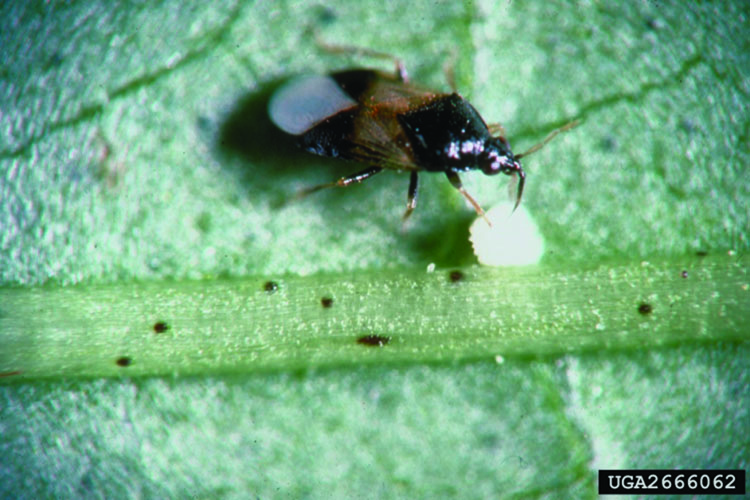
Figure 6. Adult minute pirate bug feeding on unidentified insect egg.
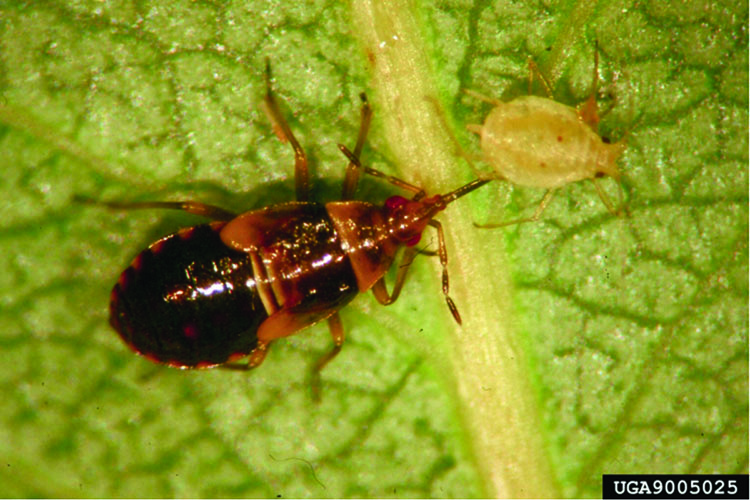
Figure 7. Nymph of minute pirate bug feeding on aphid.
Habitat and Feeding Preferences: Although minute pirate bugs are predators, in the absence of prey they can survive on plant sap and pollen (but cause no damage to plants). Keeping a variety of blooming plants from spring through fall will provide habitat and food to keep these tiny but important predators in your landscape.
Damsel Bugs
Key Characteristics:
Egg: White and oval, deposited in plant tissue
Immature: Nymphs resemble adults but lack fully developed wings
Adult: Grayish-brown with large, grasping front legs and a long “beak” (piercing-sucking mouthparts)
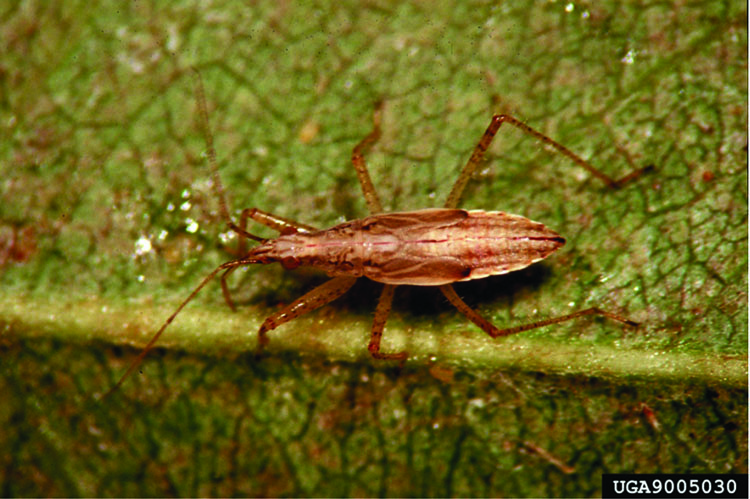
Figure 8. Nymph of a damsel bug. Adults look similar, but have fully formed wings.
Prey: Small, soft-bodied insects such as aphids, thrips, leafhoppers, and spider mites
Predatory Stages: Immatures and adults
General Description: Damsel bug adults and immatures feed on many small, soft-bodied insects such as aphids, thrips, leafhoppers, small caterpillars, sawflies, and spider mites. They use their piercing-sucking mouthparts to pierce the body of their prey and suck out the contents. Damsel bugs undergo gradual metamorphosis and nymphs resemble adults but lack fully developed wings. Adult damsel bugs are 3/8-inch to 1/2-inch long with very slender bodies and a dark triangle at the base of their wings.
Habitat and Feeding Preferences: Damsel bug nymphs are found on the soil surface, in leaf litter, or near the base of plants. Adults are typically found on vegetation and ground cover. Perennial plants serve as habitat during warm months as well as overwintering sites for adults.
Assassin Bugs
Key Characteristics:
Egg: Brown, laid in masses on plants or in the soil
Immature: Nymphs resemble adults but lack fully developed wings
Adult: Large grasping front legs, narrow head and a stout, three-segmented “beak”
Prey: A wide range including aphids, leafhoppers, lygus bugs, insect eggs, and immatures
Predatory Stages: Immatures and adults
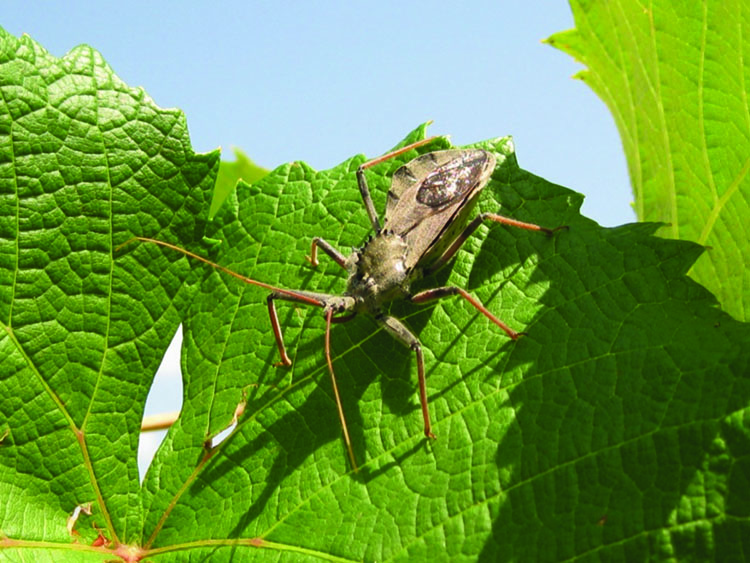
Figure 9. Adult wheel bug, Arilus cristatus.
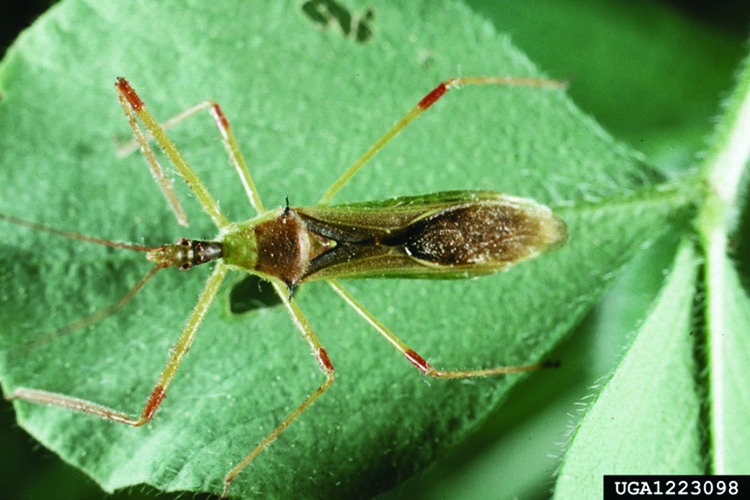
Figure 10. Adult of an assassin bug, Zelus exsanguis.
General Description: Assassin bugs vary greatly in their choice of prey. Some specialize on one particular type such as ants, while others are generalists, feeding on anything from small items such as aphids and insect eggs to larger prey such as lygus bugs, leafhoppers, and even lady beetles. Several species of assassin bugs are found in Oklahoma. Common species include Arilus cristatus (Wheel Bug), Zelus species, and Sinea diadema (Spined Assassin Bug). Assassin bugs undergo gradual metamorphosis. Nymphs resemble adults but lack fully developed wings. Different species vary widely in size and color. Assassin bugs can be as long as 1½ inches and range from brown or gray to bright orange with stripes. Key features are the large grasping front legs, narrow head, and the stout, three-segmented “beak” (most true bugs have a four-segmented “beak”). Eggs are brown and laid in masses on plants or in the soil.
Habitat and Feeding Preferences
Assassin bugs are quite mobile and able to move around, but will most often be found in vegetation searching for prey.
Big-Eyed Bugs
Key Characteristics:
Egg: White with a red spot, laid singly
Immature: Nymphs resemble adults but lack fully developed wings
Adult: Oval with a head much broader than long and characteristic bulging eyes
Prey: Whiteflies, aphids, spider mites, and the eggs and immatures of plant bugs
Predatory Stages: Immatures and adults
General Description
Big-eyed bugs feed on a variety of prey smaller than themselves, including whiteflies, aphids, spider mites, and eggs and immatures of plant bugs. Like other predatory true bugs, they feed by piercing their prey with their piercing-sucking mouthparts and sucking out the contents. Big-eyed bugs undergo gradual metamorphosis. Adults are about 1/5-inch long and grayish-silver.
Habitat and Feeding Preferences
Big-eyed bug adults and immatures find shelter in mixed plantings and can feed on pollen, nectar, and even seeds when prey populations are low. Sunflowers are an excellent choice to help conserve these natural enemies.
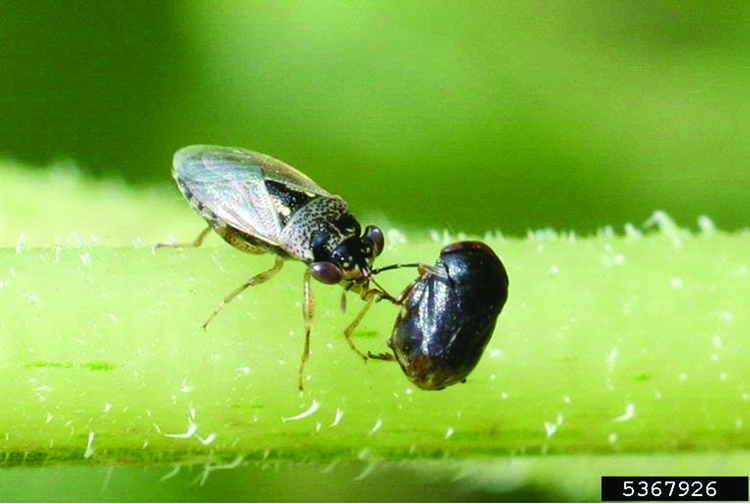
Figure 11. Adult big-eyed bug feeding on a spittlebug. Note the large, bulging eyes on sides of the head.
Lacewings
Green Lacewings
Key Characteristics:
Egg: Oval eggs attached to a silk “stalk”
Immature: Alligator-like larva with large, sickle-shaped mandibles and cream and brown markings
Pupa: Pea-sized silk cocoons found on various parts of the plant
Adult: Green with slender bodies and large, transparent wings with many veins
Prey: Whiteflies, aphids, and insect eggs
Predatory Stages: Immatures
General Description: Lacewings are also known as “aphid lions,” referring to the larva’s voracious appetite for aphids. Larvae also consume other small prey items such as insect eggs. However, adults feed solely on nectar and “honeydew,” a sugary waste product of aphids. Green lacewings undergo complete metamorphosis. Adults measure about 1/2-inch to 3/4-inch long with large wings.
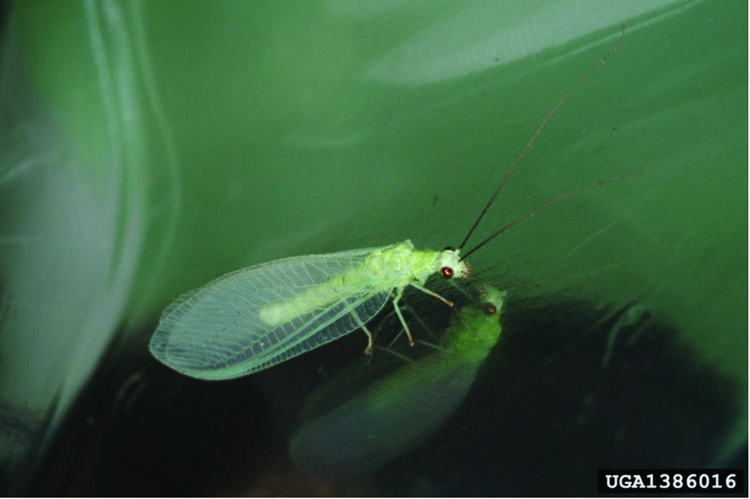
Figure 12. Adult green lacewing. Note the large wings with many veins.
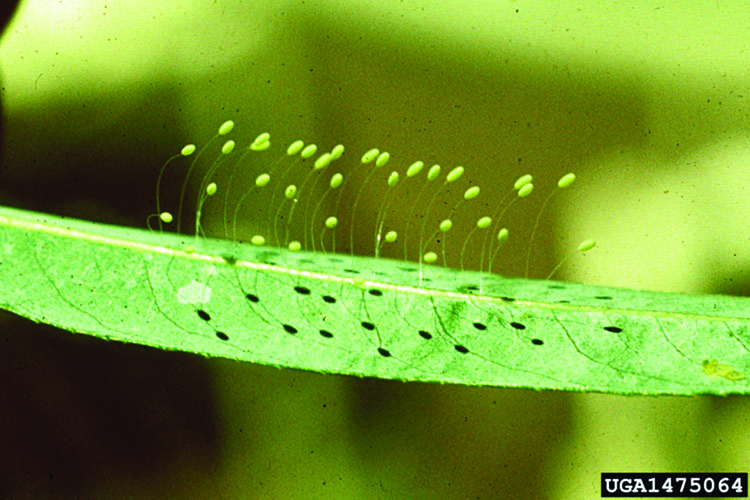
Figure 13. Green lacewing eggs on a willow leaf. Note that eggs are laid on silken stalks.
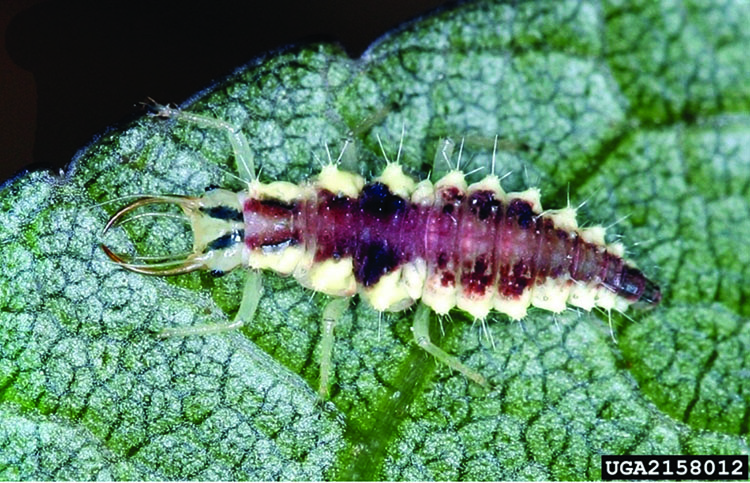
Figure 14. Larva of green lacewing.
Habitat and Feeding Preferences: Larvae of green lacewings are mobile, but generally will stay in the vicinity of their hatching site if prey are available. Adults require nectar or aphid “honeydew” to lay eggs, so planting a garden that blooms throughout the season will help attract green lacewings to your landscape.
Brown Lacewings
Key Characteristics:
Egg: Purple, laid in clusters
Immature: Alligator-like larva with large, sickle-shaped mandibles and cream and reddish-brown markings
Pupa: Loose brown silk cocoons found under bark or other hidden areas
Adult: Brown with slender bodies and large, transparent wings with many veins
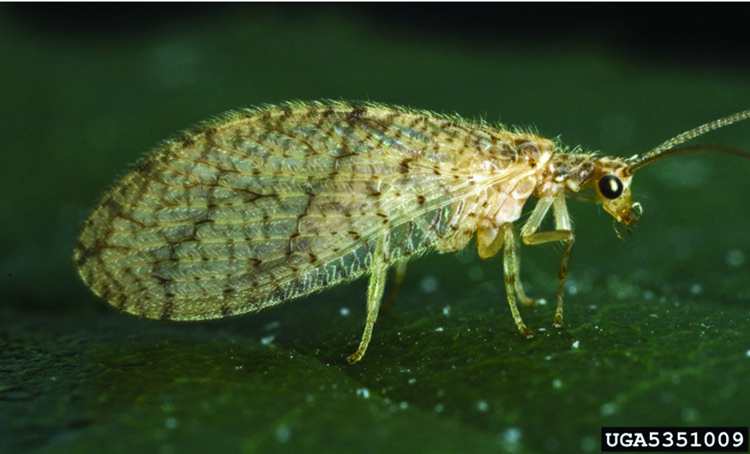
Figure 15. Adult brown lacewing. Note the large wings with many veins.
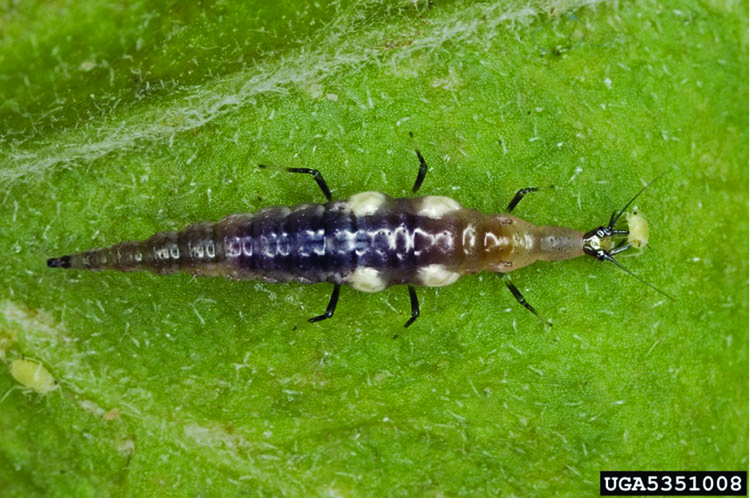
Figure 16. Larva of brown lacewing feeding on an aphid.
Prey: Whiteflies, aphids, and insect eggs
Predatory Stages: Immatures and adults
General Description: Brown lacewings are similar in habit to green lacewings by also attacking aphids and other small prey such as whiteflies. They differ from green lacewings in that both the immature and adult stages are predatory. Brown lacewings undergo complete metamorphosis. Their eggs are not on “stalks” like those of green lacewings but are laid in clusters on vegetation and turn purple. Also, adults are typically only 1/4-inch to 2/5-inch long.
Habitat and Feeding Preferences: Brown lacewings prefer arboreal habitats so incorporating trees into your landscape will provide shelter for these natural enemies.
Predatory Flies
Hover Flies
Key Characteristics:
Egg: Resembles a grain of rice
Immature: Worm-like larva, typically green or brown and tapered toward the mouth
Pupa: Pear shaped and brown
Adult: Bee mimics; typically black and yellow and sometimes hairy
Prey: Aphids
Predatory Stages: Immatures
General Description: Immature hover flies are voracious aphid predators, eating up to 400 aphids during development, depending on the species. Adults are not predatory and feed only on pollen and nectar. Adult hover flies are efficient pollinators. There are many species of hover flies in Oklahoma. One common species is Allograpta obliqua (Oblique Syrphid). Hover flies undergo complete metamorphosis with three larval stages. Hover flies can be distinguished from bees and wasps by their lack of hind wings, which are reduced into small clubs called halteres. Hover fly adults are very adept fliers and often hover over flowers, hence their name.
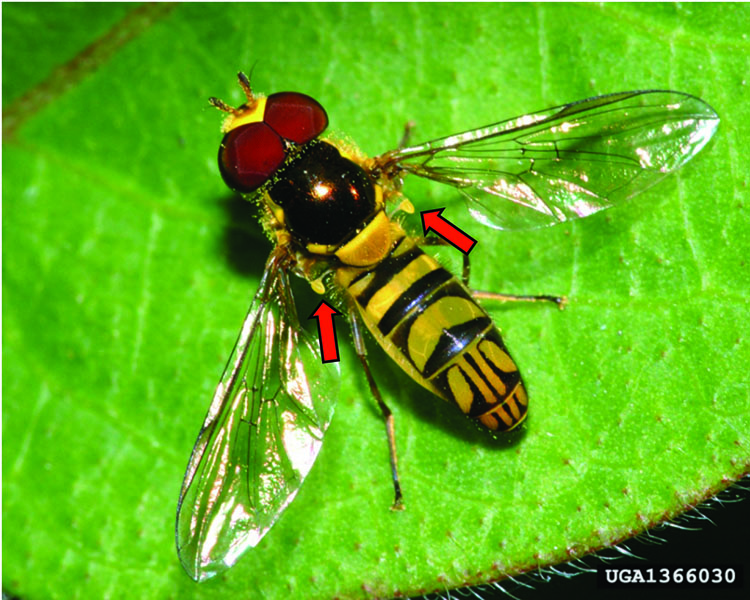
Figure 17. Adult hover flies resemble bees but have one pair of membranous wings with a second pair reduced into specialized structures called halteres (see arrows).
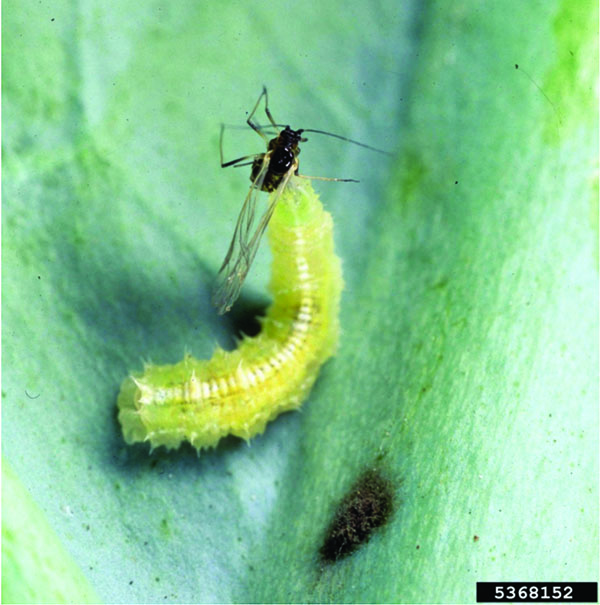
Figure 18. Larva of hover fly feeding on an aphid.
Habitat and Feeding Preferences: Adult hover flies require nectar and pollen to survive and prefer herbs and other flat-flowered plants. Gardens that bloom throughout the season will help attract hover flies to your landscape.
Aphid Midges
Key Characteristics:
Egg: Orange, laid in clusters near aphid infestations
Immature: Orange or red maggots
Pupa: Not typically seen, found in the soil
Adult: Resemble mosquitoes with long legs and antennae
Prey: Aphids
Predatory Stages: Immatures
General Description: Female aphid midges lay eggs near aphid infestations, leaving the predatory larvae to hatch near an abundant food source. Larvae can consume up to 80 aphids in their lifetime and kill even more. Aphids are paralyzed and their contents sucked out, leaving the rest of the aphid attached to the plant. The most common species of aphid midge is Aphidoletes aphidimyza. Aphid midges undergo complete metamorphosis.
Habitat and Feeding Preferences: Aphid midges need shelter from high temperatures and strong winds. Plants that create a canopy clustered together could create habitat that would attract aphid midges.
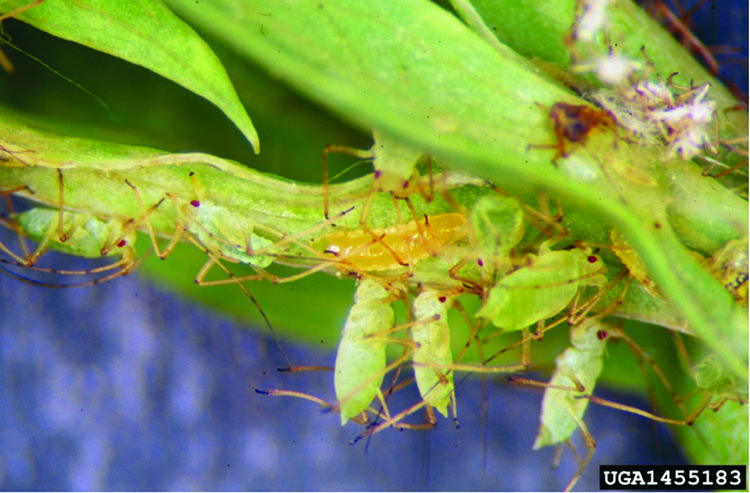
Figure 19. Predatory midge (orange) feeding on pea aphids.
Other Predators
Spiders
Key Characteristics:
Egg: Small and round, often clustered in sacs of silk; some species carry eggs attached to their abdomens
Immature: Resembles adults but smaller and color can vary
Adult: Two body segments, eight legs, and a leg-like appendage called a pedipalp on each side of the mouth
Prey: A wide variety of insects and other arthropods that are typically smaller than themselves
Predatory Stages: Adults and immatures
General Description: Spiders are not insects, but are related arthropods belonging to the class Arachnida. They are generalist predators and will attack insects and other arthropods smaller than themselves. Many types are web builders such as the orbweavers, but others such as wolf spiders and jumping spiders do not build webs and actively hunt their prey instead. Many species of both web builders and active hunters are common in Oklahoma urban landscapes. Another common spider found in gardens is the crab spider, so named because of its characteristic crab-like body form. Crab spiders are usually found in flower heads. These ambush predators are camouflaged, blending in with flowers where they lie in wait and prey upon flower-visiting insects. Spiders undergo gradual metamorphosis and the immature stages, called spiderlings resemble to, but are smaller than adults.
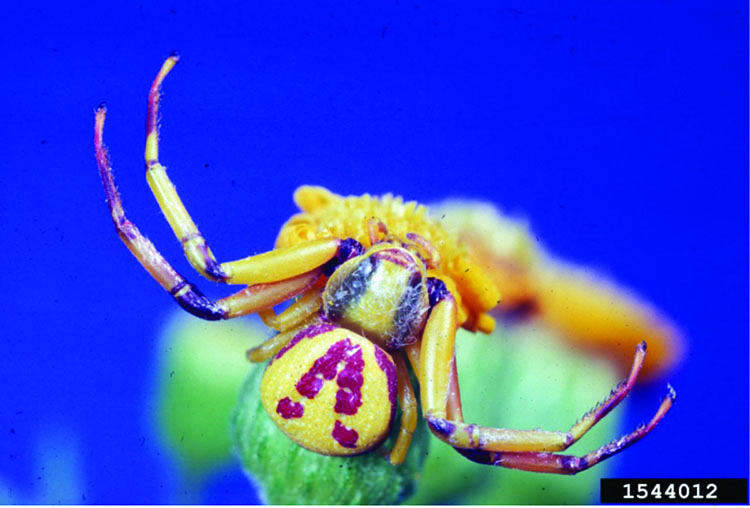
Figure 20. Crab spider on flower bud
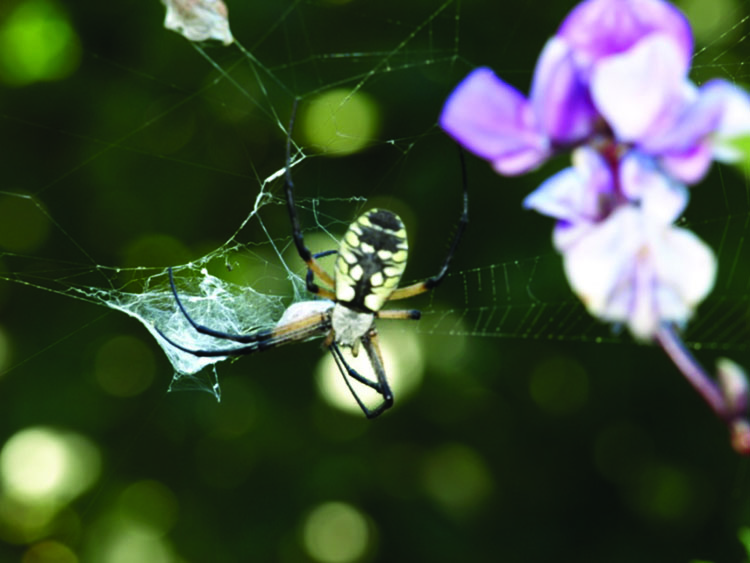
Figure 21. Garden spider in web.
Habitat and Feeding Preferences: Spiders are very adaptable animals and are able to thrive in most places, including houses. Although many consider them frightening or a nuisance, most are harmless and highly beneficial predators.
Parasitoids
Parasitic Wasps
Key Characteristics:
Egg: Not typically seen, deposited in or on the host
Immature: Not typically seen, most often found inside the host
Pupa: Silken cocoons found on or around the body of the host
Adult: Small with long, thin abdomens, long ovipositors (egg-laying organ), and antennae
Hosts: Aphids, moths, butterflies, sawflies, beetles, flies, and others
Parasitic Stage: Immatures
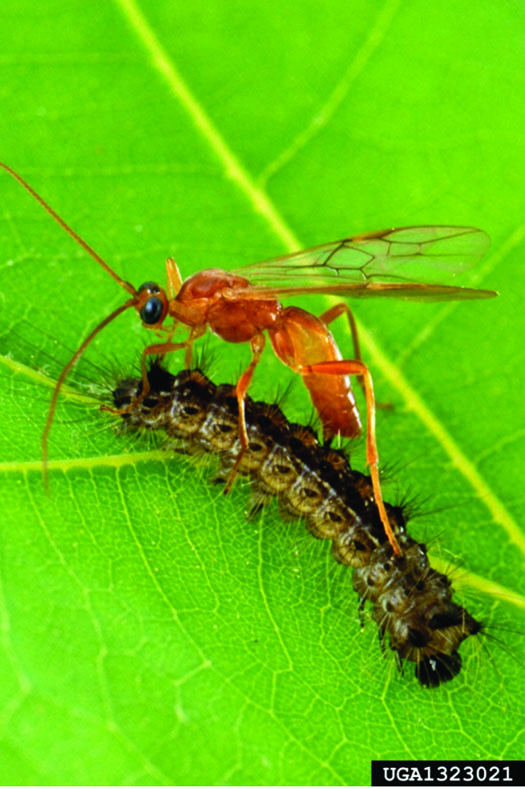
Figure 22. Adult female parasitoid wasp attacking gypsy moth caterpillar.
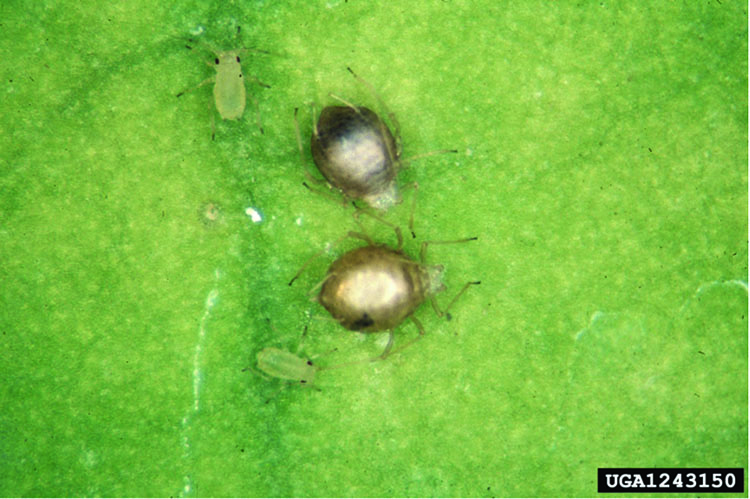
Figure 23. Aphid “mummies” are telltale signs of parasitism by parasitoid wasps. The swollen, dark-colored mummies are shown in comparison to unparasitized aphids.
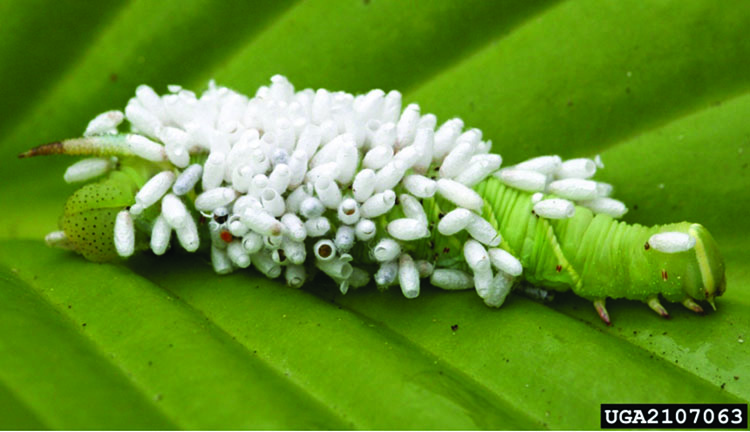
Figure 24. Silken cocoons of parasitoid wasps on a hornworm larva. Note that some cocoons have holes at the top where adult wasps emerged.
General Description: Several families of parasitoid wasps are native to Oklahoma and have a wide variety of hosts. Each species has a specific host(s) and life stage(s) that it will attack. Life stages attacked include eggs, larvae/nymphs, pupae, or adults. Parasitoid wasps undergo complete metamorphosis. Adult females lay one or more eggs in or on the host. Upon hatching, larvae feed and develop within the host, eventually killing it. Larvae typically emerge from the host to pupate, creating silk cocoons on or around the body. However, it is far more common to see the effects of parasitism on a host than the actual wasp itself. Some common indicators of parasitoid activity are silk cocoons on the body of an insect or, in the case of aphids, dark-colored, immobile adults called “mummies.” Although parasitoids do not kill their hosts immediately, parasitized hosts exhibit reduced feeding and activity and so are less harmful to plants. In addition, adult parasitoids can kill hosts by “host feeding– stinging a host without laying an egg and feeding on the fluids that flow from the wound. Parasitoid wasps pose no threat to people as they are solitary, rarely attack people, and their sting is medically harmless.
Habitat and Feeding Preferences: Adult parasitoid wasps often feed on nectar or pollen. Plants with small, flat flowers can provide them with the food they need for optimal egg production. They also benefit from a source of water and windbreaks created by borders.
Tachinid Flies
Key Characteristics:
Egg: White and oval, found on the body of the host or on its food source to be consumed
Immature: Typically not seen, often found inside the host
Pupa: Red to brown, small, leathery, and oblong
Adult: Closely resemble “fuzzy” house flies with cream, gray, or red markings on the abdomen
Hosts: Beetles, true bugs, moths, and butterflies
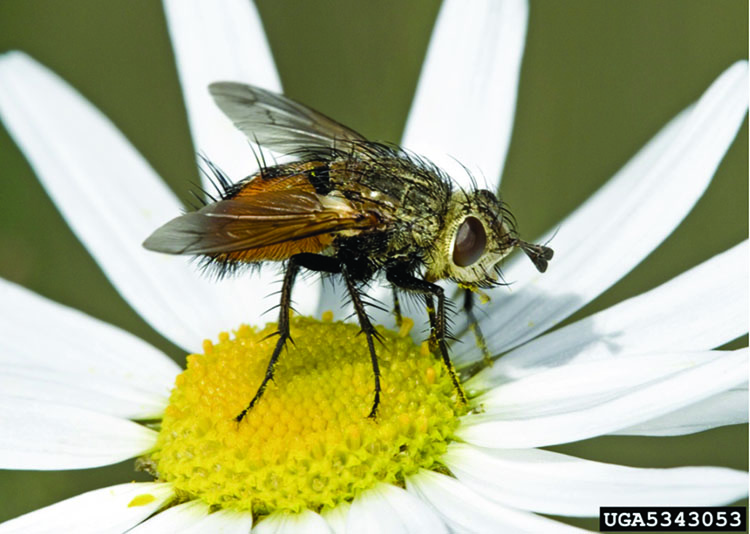
Figure 25. Adult of tachinid fly visiting daisy.
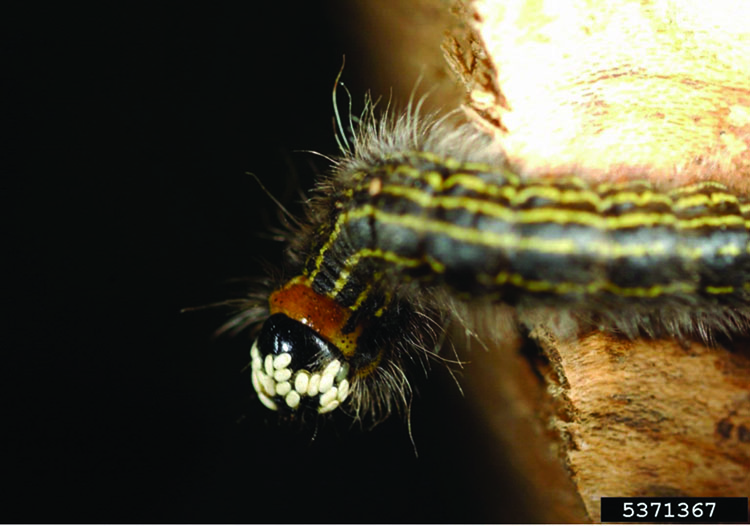
Figure 26. Eggs of tachinid fly laid on compound eyes of a yellownecked caterpillar.
General Description: Several different species of tachinid flies are found in Oklahoma and attack a variety of pest insects at various life stages. Some are host specific, while others are able to parasitize several types of insects. All tachinid flies go through complete metamorphosis with egg, larva, pupa, and adult stages. Eggs are often laid on the host but sometimes are laid on the food source for the host to consume. Larvae almost always are internal parasites and feed inside the host until pupation when they bore out, killing the host, and pupate in the soil. Although adults are easily seen, the most common indicators of parasitoid activity are insects with several white, oval eggs present on their body or discovery of the leathery pupa.
Habitat and Feeding Preferences: Adult tachinid flies feed on nectar and are attracted to flowering plants. Keep blooming plants in your landscape all season to help support populations of these natural enemies.
Conservation Strategies
The three R's of conservation biological control are (1) Reduced insecticide use, (2) Refuge, and (3) Resource allocation. These strategies should be combined to maximize success in managing arthropod pests.
Reduced insecticide use
Conserving natural enemies is often as simple as reducing the amount of insecticides applied and/or the frequency of application. From an IPM perspective, chemical control should be a last resort when alternative control strategies fail. When insecticide use is warranted, we can minimize exposure to natural enemies by using products that are not applied where and when natural enemies are active. For example, systemic insecticides may be mixed with water and applied as a soil drench around the base of plants. Systemic materials are translocated throughout the plant's vascular system, providing long-term protection from insect pests and minimizing contact with natural enemies. Another option is timing applications when natural enemies are not present in the landscape. Correct timing can be achieved by applying insecticides when key predators and parasitoids have yet to emerge from dormancy or during daily periods of inactivity (e.g., early morning or late evening). This strategy requires a general knowledge of the biology and life cycle of the natural enemies we are trying to conserve.
Another strategy is to enhance the compatibility of chemical and biological control by choosing selective, target-specific insecticides over broad-spectrum products. Selective chemistries include microbial insecticides, insect growth regulators, botanicals, and novel insecticides that exhibit a narrow spectrum of activity against pests. Microbial products contain bacteria, viruses, fungi, nematodes, and other pathogenic organisms that either kill directly or produce substances toxic to insects. A well-known example of the latter is the bacterium, Bacillus thuringiensis var. kurstaki, which produces a toxin that only affects caterpillars. Insect growth regulators contain hormone mimics that interfere with the development of juvenile insects, enhancing safety for adult natural enemies and other non-target organisms. Botanical products are plant-derived compounds that have insecticidal properties and tend to be safer for natural enemies, particularly when application coincides with their inactivity. Finally, several insecticides are inherently safer for natural enemies because of the way they kill insects, referred to as the mode of action. These products include insecticidal soaps and horticultural oils that desiccate and smother softer or less mobile pests, respectively. The key to using these "reduced-risk insecticides" is correctly matching the active ingredient in the product with the target pest.
Refuge
We can protect natural enemies from environmental extremes by providing them a suitable microclimate, essentially a small space where temperature, humidity, light intensity, etc., are at optimal levels for survival. Thus, plants with a dense canopy will provide shade, cooler temperatures, and higher humidity for natural enemies during hot, dry periods. Candidate plants include small trees, shrubs, bushy perennials, and tall ornamental grasses. These plants also can be ideal for ambush predators such as predatory bugs and some spiders. Refuge plants may also harbor alternative prey species for both immature and adult natural enemies. Alternative prey are especially important for sustaining natural enemies when primary prey species are scarce. Similarly, organic mulches and ground cover plants can support greater numbers of ground-dwelling predators than bare soil. Mulches and ground covers provide a favorable microclimate for predators such as ground beetles and hunting spiders and also support a variety of prey. Finally, refuge plants and plant materials often enhance reproduction of natural enemies by providing nesting sites. For example, a dense plant canopy is an ideal habitat for spiders to lay eggs.
Resource allocation
We can promote natural enemy abundance by providing adult predators and parasitoids with food resources necessary for their survival and reproduction. Planting flowering plants rich in pollen and nectar (floral resource plants) will attract adult natural enemies that feed on these important energy sources (Table 1). Many studies in a variety of crops have shown that nectar and/or pollen increase the lifespan, reproductive output, and survival rate of natural enemies. In fact, many parasitoid wasps are dependent on floral resources for egg development.
An added benefit of incorporating floral resource plants into the landscape is an increased abundance of insect pollinators. Thus, floral resource plants can enhance yield of other plants such as fruit trees and insect-pollinated vegetable plants. When designing or modifying the landscape, select a variety of flowering plants that bloom at different times during the year. This staggered approach ensures a continuous supply of nectar and pollen to natural enemies and pollinators throughout the growing season. Indeed, garden design should take into account blooming period for not only aesthetics but for provisioning natural enemies with required food resources.
In summary, conservation biological control can be achieved in residential landscapes through reduced insecticide inputs and enhanced plant diversity. While certain conservation strategies (e.g., resource allocation) may also favor pest insects, the benefits of implementing these strategies into residential landscapes far outweigh the costs. Keep in mind the effectiveness of some conservation strategies may vary with geographic location, primary pest species, occurrence of specific natural enemies, gardening practices, etc. However, the general tactics presented and their combinations can be tailored to any situation to enhance pest management in residential landscapes.
Table 1. Native Oklahoma garden plants that attract and sustain natural enemies throughout the growing season.
| Scientific Name | Common Name | Type | Bloom Period |
|---|---|---|---|
| Aquilegia canadensis | Wild Red Columbine | Perennial Forb | February-July |
| Oenothera speciosa | Showy Evening Primrose | Perennial Forb | February-July |
| Verbena canadensis | Rose Vervain | Perennial Forb | February-September |
| Bignonia capreolata | Crossvine | Perennial Vine | March-May |
| Phlox divoricata | Wild Blue Phlox | Perennial Forb | March-May |
| Thalictrum thalictroides | Rue Anemone | Perennial Forb | March-June |
| Penstemon buckleyi | Buckley's Beardtongue | Perennial Forb | April-May |
| Penstemon cobaea | Wild Foxglove | Perennial Forb | April-May |
| Coreopsis lanceolata | Lanceleaf Coreopsis | Perennial Forb | April-June |
| Fragaria virginiana | Wild Strawberry | Perennial Forb | April-June |
| Potentilla simplex | Common Cinqefoil | Perennial Shrub | April-June |
| Oenothera macrocarpa | Missouri Evening Primrose | Perennial Forb | April-August |
| Monarda punctata | Spotted Beebalm | Annual Forb | April-August |
| Zizia aurea | Golden Alexanders | Perennial Forb | April-August |
| Echinacea purpurea | Purple Coneflower | Perennial Forb | April-September |
| Penstemon grandiflorus | Large Beardtongue | Perennial Forb | May-June |
| Echinacea angustifolia | Yellow Coneflower | Perennial Forb | May-July |
| Monarda citriodora | Lemon Beebalm | Annual Forb | May-July |
| Apocynum cannabinum | Indian Hemp | Perennial Forb | May-August |
| Gaillardia pulchella | Indian Blanket | Annual Forb | May-August |
| Asclepias tuberosa | Butterfly Weed | Perennial Forb | May-September |
| Monarda fistulosa | Wild Bergamot | Perennial Forb | May-September |
| Oenothera rhombipetala | Fourpoint Evening Primrose | Annual Forb | May-September |
| Ratibida columnifera | Mexican Hat | Perennial Forb | May-September |
| Lobelia cardinalis | Cardinal Flower | Perennial Forb | May-October |
| Phlox carolina | Carolina Phlox | Perennial Forb | May-October |
| Salvia greggii | Autumn Sage | Perennial Forb | May-November |
| Amopha canescens | Leadplant | Perennial Forb | June-July |
| Eupatorium perfoliatum | Common Boneset | Perennial Forb | June-October |
| Agastache foeniculum | Blue Giant Hyssop | Perennial Forb | July-August |
| Agastache nepetoides | Yellow Giant Hyssop | Perennial Forb | July-September |
| Eupoatorium pupureum | Joe-pye Weed | Perennial Forb | July-September |
| Helianthus strumosus | Pale Leaf Sunflower | Perennial Forb | July-September |
| Silphium laciniatum | Compass Plant | Perennial Forb | July-September |
| Silphium perfoliatum | Cup Plant | Perennial Forb | July-September |
| Lobelia siphilitica | Giant Blue Lobelia | Perennial Forb | July-October |
| Veronia bladwinii | Baldwin's Ironweed | Perennial Forb | July-November |
| Veronia missurica | Missouri Ironweed | Perennial Forb | August |
| Solidago speciosa | SHowy Goldenrod | Perennial Forb | August-September |
| Symphyotrichum laeve | Smooth Blue Aster | Perennial Forb | August-October |
| Symphyotrichum novae-angeliae | New England Aster | Perennial Forb | August-October |
| Helianthus maximiliani | Maxamilian Sunflower | Perennial Forb | August-November |
| Physostegia virginiana | Obedient Plant | Perennial Forb | August-November |
| Liatris pycnostachya | Prairie Blazing Star | Perennial Forb | August-December |
| Scientific Name | Common Name | Site Requirements | Notes |
|---|---|---|---|
| Aquilegia canadensis | Wild Red Columbine | Part Shade/Shade, Moist/Dry Soil | Heat Tolerant |
| Oenothera speciosa | Showy Evening Primrose | Sun, Moist/Dry Soil | |
| Verbena canadensis | Rose Vervain | Part Shade, Moist Soil | |
| Bignonia capreolata | Crossvine | Sun/Part Shade, Moist/Dry Soil | Non-native but Oklahoma Proven selection |
| Phlox divoricata | Wild Blue Phlox | Part Shade/Shade, Moist Soil | |
| Thalictrum thalictroides | Rue Anemone | Part Shade, Moist Soil | Toxic if ingested |
| Penstemon buckleyi | Buckley's Beardtongue | Sun, Sandy Soil | |
| Penstemon cobaea | Wild Foxglove | Sun/Part Shade, Dry Soil | |
| Coreopsis lanceolata | Lanceleaf Coreopsis | Sun/Part Shade/Shade, Dry Soil | Drought tolerant |
| Fragaria virginiana | Wild Strawberry | Sun/Part Shade, Dry Soil | |
| Potentilla simplex | Common Cinqefoil | Part Shade/Shade, Dry Soil | |
| Oenothera macrocarpa | Missouri Evening Primrose | Sun, Dry Soil | |
| Monarda punctata | Spotted Beebalm | Sun, Dry Soil | Drought tolerant and edible |
| Zizia aurea | Golden Alexanders | Sun/Part Shade, Moist Soil | |
| Echinacea purpurea | Purple Coneflower | Sun/Part Shade, Dry Soil | Can become aggressive |
| Penstemon grandiflorus | Large Beardtongue | Sun, Sandy Soil | |
| Echinacea angustifolia | Yellow Coneflower | Sun/Part Shade, Dry Soil | |
| Monarda citriodora | Lemon Beebalm | Sun/Part Shade, Dry Soil | |
| Apocynum cannabinum | Indian Hemp | Part Shade, Moist Soil | Aggressive/can become weedy |
| Gaillardia pulchella | Indian Blanket | Sun/Part Shade, Dry Soil | |
| Asclepias tuberosa | Butterfly Weed | Sun/Part Shade, Moist/Dry Soil | Toxic if ingested in large quantities |
| Monarda fistulosa | Wild Bergamot | Sun/Part Shade, Moist/Dry Soil | Heat tolerant and edible |
| Oenothera rhombipetala | Fourpoint Evening Primrose | Sun/Part Shade, Dry Soil | |
| Ratibida columnifera | Mexican Hat | Sun/Part Shade, Dry Soil | |
| Lobelia cardinalis | Cardinal Flower | Sun/Shade, Wet/Moist Soil | Toxic if eaten in large quantities |
| Phlox carolina | Carolina Phlox | Sun/Part Shade, Wet/Moist Soil | Heat tolerant |
| Salvia greggii | Autumn Sage | Sun, Dry Soil | Non-native but Oklahoma Proven selection |
| Amopha canescens | Leadplant | Sun/Part Shade, Dry Soil | |
| Eupatorium perfoliatum | Common Boneset | Sun/Shade, Wet/Moist Soil | |
| Agastache foeniculum | Blue Giant Hyssop | Sun/Shade, Moist Soil | Non-native but Oklahoma Proven selection |
| Agastache nepetoides | Yellow Giant Hyssop | Not well defined | |
| Eupoatorium pupureum | Joe-pye Weed | Sun/Shade, Moist Soil | |
| Helianthus strumosus | Pale Leaf Sunflower | Sun/Shade, Dry Soil | |
| Silphium laciniatum | Compass Plant | Sun, Dry Soil | Drought tolerant |
| Silphium perfoliatum | Cup Plant | Sun, Wet/Dry Soil | Drought tolerant and can be difficult to control |
| Lobelia siphilitica | Giant Blue Lobelia | Sun/Shade, Wet/Moist Soil | Toxic if eaten in large quantities |
| Veronia bladwinii | Baldwin's Ironweed | Sun, Moist Soil | Aggressive/can be difficult to control |
| Veronia missurica | Missouri Ironweed | Not well defined | |
| Solidago speciosa | SHowy Goldenrod | Part Shade, Moist Soil | |
| Symphyotrichum laeve | Smooth Blue Aster | Not well defined | |
| Symphyotrichum novae-angeliae | New England Aster | Part Shade, Moist Soil | Can be aggressive |
| Helianthus maximiliani | Maxamilian Sunflower | Sun, Moist/Dry Soil | |
| Physostegia virginiana | Obedient Plant | Sun/Shade, Moist Soil | |
| Liatris pycnostachya | Prairie Blazing Star | Sun, Moist/Dry Soil | Heat and drought tolerant |
Eric Rebek
Associate Professor