

Heads Up! Essential Scouting and Management for Sorghum Headworms
This week the OSU Cropping Systems Entomology crew detected treatable numbers of sorghum headworms at several North Central Oklahoma sorghum fields at milk to soft dough stages (Figure 1). Sorghum headworms are a complex of different caterpillar pests that can inflict severe economic damage on grain sorghum during its reproductive stages. The two primary species comprising the headworm complex in our region are the fall armyworm, Spodoptera frugiperda, and the corn earworm, Helicoverpa zea. A third species in this complex is the sorghum webworm, Nola sorghiella. Because these pests feed hidden in the developing sorghum head, timely scouting is important for protecting yields.
Pest Identification
Fall armyworm, corn earworm, and sorghum webworm are all moths as adults. The immature forms, caterpillars which are also referred to as “worms”, are the economically damaging stages. These caterpillars will progress through multiple instars, increasing in size and appetite as they grow. Oklahoma has multiple, overlapping generations of these pests. See Table 1 for identifying characteristics of sorghum headworms.
| Pest | Image | Body Characteristics |
|---|---|---|
| Fall Armyworm | 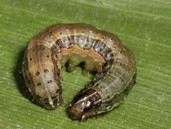
| Dark head capsule with a distinct, broad, white inverted "Y" shape. Dorsal lines running lengthwise down the body. Range in color from light green, brown, or tan. |
| Corn Earworm | 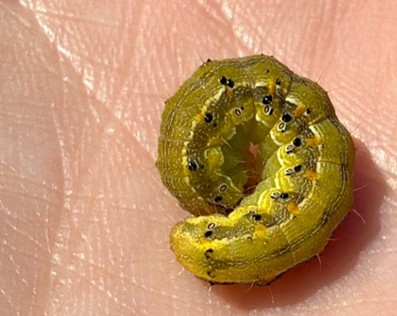
| Light-colored head capsule. Alternating light and dark stripes along the body. Body covered with small bristles visible with a hand lens. Vary in color from green and yellow to brown or pink. |
| Sorghum Webworm | 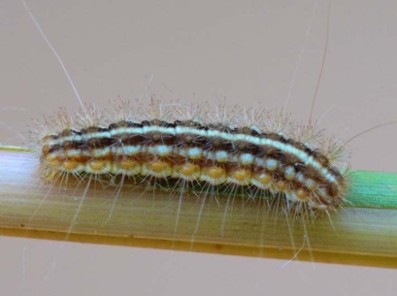
| Four distinct reddish-brown stripes down the back Many spines and clear white hairs on their body, grouped in clusters. |
Sorghum Vulnerability and Damage
Sorghum is most vulnerable to headworm infestations from panicle emergence (bloom) through the hard dough stage. Fall armyworms and corn earworm can also be considered whorl worms, caterpillars that feed during the vegetative sorghum stages. Whorl-stage feeding causes "windowpaning" (Figure 1) and "shot holes" (Figure 2) on the leaves, but this damage rarely reduces yields enough to justify chemical control. Open-headed sorghum varieties are more susceptible to headworm infestations than tight-headed varieties. Tight-headed varieties make chemical control penetration much more challenging but using high gallon per acre (GPA) when spraying can help.
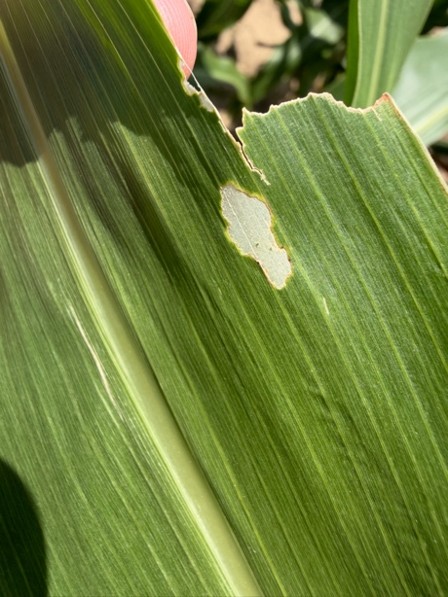 Figure 1. “Windowpaning” caused by early instar whorl worms feeding on a sorghum leaf. Image credit: Ashleigh M. Faris, OSU Extension.
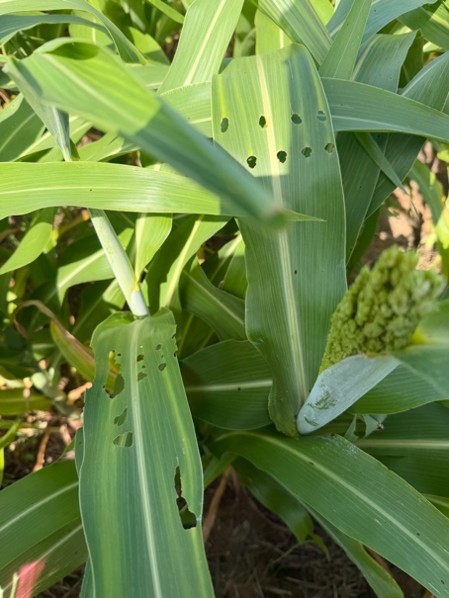 Figure 2. “Shot holes” caused by later instar whorl worms on a sorghum leaf. Image credit: Ashleigh M. Faris, OSU Extension.
Headworms directly feed on flowering parts and the developing starches within the grain (Figures 3 and 4). They feed in an irregular pattern on the sorghum head, leaving the starchy portion of the kernel exposed (Figure 5). A single larva can consume approximately 0.01 pounds of grain (up to 12 kernels per day) during its lifespan. Infestations of 1 to 2 larvae per head can result in a 5% to 10% overall yield loss.
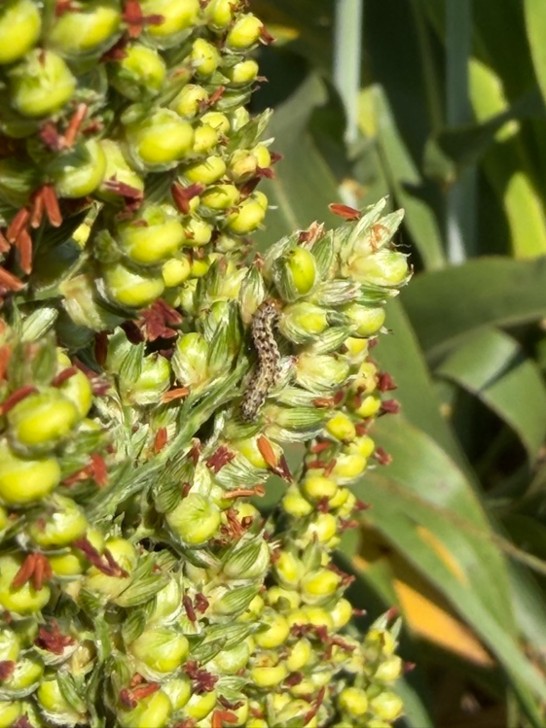 Figure 3. Early instar corn earworm feeding on developing sorghum kernels. Image credit: Ashleigh M. Faris, OSU Extension.
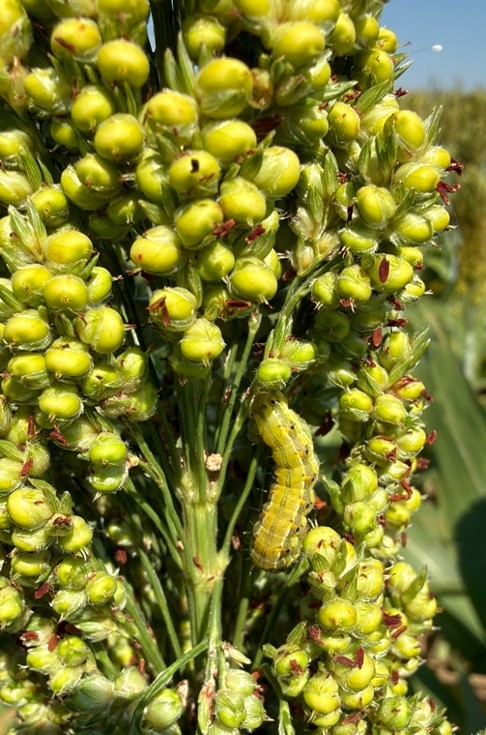 Figure 4. Late instar corn earworm feeding on developing sorghum kernels. Image credit: Ashleigh M. Faris, OSU Extension.
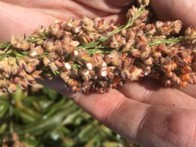 Figure 5. Sorghum webworm feeding damage. Note the empty glumes and irregular feeding pattern. Image credit: Ron Schnell, Texas A&M University.
Scouting Procedures
Active monitoring gives producers the best chance at making timely insecticide applications. Scouting should begin at full panicle emergence and continue every 3 to 5 days until the hard dough stage. OSU Extension Specialists have developed a sequential sampling Sorghum Headworm Quick Count Sampling Plan to aid growers in management decision making. This support tool can be found at the OSU EPP-7087 Fact Sheet Sampling for Sorghum Headworms in Oklahoma Using the Headworm Decision Support System.
Alternatively, one can also scout for headworms using the following steps:
- Walk at least 15 to 20 feet into the sorghum field before taking your first sample.
- Grasp the stalk just below the emerged head and bend it into a white 2.5 - 5-gallon bucket.
- Vigorously beat the head against the side of the bucket to dislodge the larvae.
- Ignore any caterpillars smaller than 1/4 inch, as they feed very little and experience extremely high natural mortality.
- Count and categorize the remaining worms as either medium (1/4 - 1/2 inch) or large (greater than 1/2 inch).
- Walk 30 paces down the row, sample another head, and repeat this process across multiple rows to ensure field-wide representation.
Economic Threshold for Sorghum Headworms
Management decisions should be driven by the size of the larvae and the growth stage of the crop. When sorghum is in the reproductive/panicle stage, use a treatment threshold of 1 to 2 larvae per head for corn earworms or fall armyworms, or 0.5 headworms per head using sequential sampling. The threshold for smaller, less damaging pests like the sorghum webworm is higher, at 3 to 4 larvae per head.
Insecticide Management Options
If economic thresholds are met, selecting the appropriate chemistry is vital for control and the preservation of natural enemies. Spraying broad-spectrum insecticides like pyrethroids or carbamates can kill beneficial insects that are predators of sorghum aphids and other pests (Table 2). Removing these natural enemies can cause sorghum aphid populations to flare and reach/exceed economic thresholds. Always read the label to ensure the product is registered for use on sorghum and the target pest, and to be aware of restricted entry intervals (REI) and pre-harvest intervals (PHI).
| Insecticide Active Ingredient | Trade Name | Notes |
|---|---|---|
| Spinosad | Blackhawk | Soft on natural enemies. |
| Chlorantraniliprole | Coragen eVo (formerly Vantacor and Prevathon) | Excellent option for larger worms and populations resistant to pyrethroids; provides effective control with lower toxicity to natural enemies. |
| Zeta-cypermethrin, lambda-cyhalothrin | Mustang MAXX EC, Warrior II with Zeon | Broad-spectrum activity may impact beneficial/natural enemy insect populations, potentially flaring sorghum aphids. |