

Soybean Disease Update – Seedling Diseases
According to the USDA-NASS Crop Progress and Condition Report released on May 27, 2025, 40% of soybeans in the state had been planted, with 14% already emerged. However, recent heavy rainfall has caused water accumulation in some fields, delaying emergence, growth, and development of the crop compared to better-drained areas. These saturated conditions create a favorable environment for seedling diseases, as soybean plants in waterlogged soils are more vulnerable to infection by fungi and fungal-like pathogens. The development of seedling diseases can reduce the stand of the crop, which may require replanting of affected areas, and lead to significant yield and economic losses. Scouting the fields and obtaining an accurate disease identification will help you to determine the most appropriate disease management practices.
Accurately identifying the causal agent of soybean seedling diseases is challenging, as multiple pathogens can simultaneously infect the plant and produce similar symptoms. Additionally, the rapid decomposition of infected tissue can make pathogen identification of the correct causal agent extremely difficult, requiring further investigation under laboratory conditions. The most common soybean seedling diseases observed are Fusarium root rot (Fusarium spp.), Rhizoctonia seedling blight (Rhizoctonia solani), Phytophthora root rot (Phytophthora spp.), and Pythium seedling blight (Pythium spp.).
Fusarium Root Rot
This disease can be caused by several species of the fungus Fusarium. This disease can result in both pre- and post-emergence damping off, also leading to delayed emergence and stunting of infected plants. The root system of the infected seedlings is smaller with fewer secondary roots, along with light to dark brown discoloration on the roots, sometimes extending through the vascular tissue to the hypocotyl (Figures 1 and 5). Infection can occur in a wide range of soils and environmental conditions, and it’s often associated with stressful growing conditions. Biotic and biotic factors such as herbicide injury, high soil pH, iron chlorosis, nematode feeding, and nutritional disorders can all predispose plants to infection. In severe cases, seedlings may die before emergence. The causal agent of this disease survives in the soil or in the previous crop residue. Certain weeds can also host some of the Fusarium spp. It's important to emphasize that soybean plants can be infected by Fusarium spp. at any point during the growing season, but stressed plants are more prone to infection.
Rhizoctonia Seedling Blight
This disease is caused by the fungus Rhizoctonia solani, that can cause both pre- post-emergence damping-off. The common symptoms associated with this disease include the red-brown, dry sunken lesions on the seedling hypocotyl (Figures 2 and 5). Symptoms of this disease often appear in patches in the field or affect entire sections of row within a field. Infection occurs over a wide range of soil conditions and typically does not occur after the seedling stage (V4). The pathogen prefers soils with light and sandy texture, with disease prevalence increasing under warm and moist environmental conditions. However, saturated soil does not favor disease development. The pathogen, Rhizoctonia solani, also has a broad host range and survives in plant residue as mycelium and in soil.
Phytophthora Root Rot
This disease is primarily caused by Phytophthora sojae, a water-loving, fungal-like organism belonging to the oomycete group. Symptoms of this disease include mushy and water-soaked stems, and stunted or wilted seedlings (Figures 3 and 5). Infection is favored by wet conditions after planting, but is more common in warmer and saturated soils, typically after heavy rainfall events where there is water standing. Symptoms are most often observed in patches, particularly in low-lying areas of the field. Infection occurs via the roots, and from there the pathogen colonizes the roots and stems. Phytophthora sojae can infect soybeans at any point in the growing season, from seed to maturity. The pathogen can survive on crop residue or in the soil as structures known as oospores.
Pythium Seedling Blight
This disease is caused by several Pythium species, another group of oomycetes. Because of that, symptoms of Pythium seedling blight have similarities to Phytophthora root rot. Symptoms of this disease include rotten, mushy seeds with poorly developed roots. Above ground symptoms may appear as water-soaked lesions on the hypocotyl or cotyledons and are most observed in patches in low-lying areas of the field (Figures 4 and 5). This disease is more severe in poorly drained soils. Pythium spp. can also infect across a wide range of soil temperatures typically preferring cool and wet conditions; however, some species are more prevalent in warm and wet conditions.
Management of Soybean Seedling Diseases
The organisms that cause soybean seedling diseases can survive in soil for many years, and in the majority, are able to infect other crops as well, such as alfalfa, corn, sugar beet, and wheat, as some species of weeds. Therefore, crop rotation may not always be effective in managing these diseases due to the wide host range of Fusarium and Rhizoctonia species and the longevity of Phytophthora and Pythium species. Planting soybeans in optimal environmental conditions that favor quick stand establishment of the seedling will reduce plant stress and mitigate disease risk. Improving soil drainage may also reduce stress and risk of pathogen infection. Optimal seeding rates and planting depths may also increase the rate of stand establishment to reduce the susceptibility of seedlings to various diseases.
Regarding chemical control, not all seed treatments are effective for every seedling disease. For example, Pythium spp. and Fusarium spp. require the use of seed treatment products with different modes of action for disease prevention. Seed treatment options to manage soybean seedling diseases can be found in the following link to publications found on the Crop Protection Network website.
Conditions With Similar Symptoms
It is important to consider that recent excessive rainfall across Oklahoma has resulted in prolonged saturated soil conditions. These wet soils can delay crop emergence, increase the risk of soil compaction—thereby restricting root development—and contribute to reduced plant-to-plant uniformity in early growth stages. As a result, it is essential to scout fields to determine whether poor stand establishment and slow crop development are associated with soilborne pathogens or are primarily due to abiotic stress factors. Other disorders that can cause similar symptoms as soybean seedling blights are “Fluopyram effect” and herbicide injury. For more information on those disorder visit An Overview of Soybean Seedling Diseases publication.
If you're noticing poor crop stands or symptoms that resemble soybean diseases in your fields, please reach out to Dr. Maira Duffeck at (347) 205-2180, or send samples directly to the Plant Disease and Insect Diagnostic Laboratory.
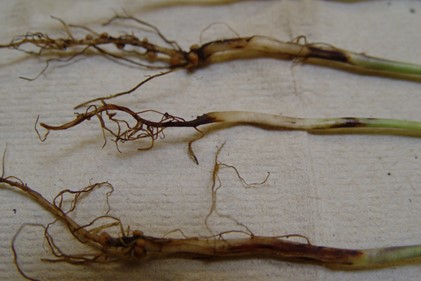
Figure 1. Fusarium-infected soybean seedlings (Image credit: Loren Giesler).
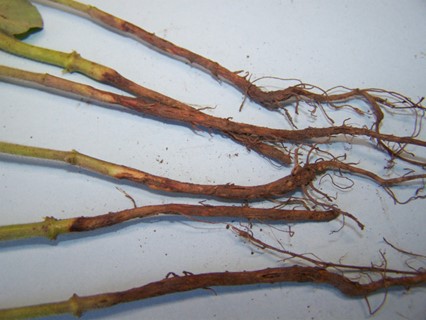
Figure 2. Sunken, dry lesions near the soil line characteristic of Rhizoctonia seedling blight and root rot (Image credit: D. Mueller, A. Robertson, C. Bradley, T. Mueller, and M. Chilvers).
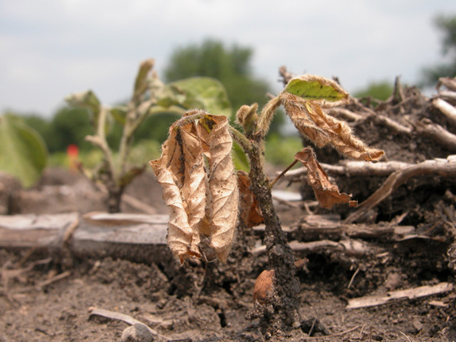
Figure 3. Early season symptoms of Phytophthora sojae infection include damping off (Image credit: C. Grau, C. Bradley, K. Black, and D. Mueller).
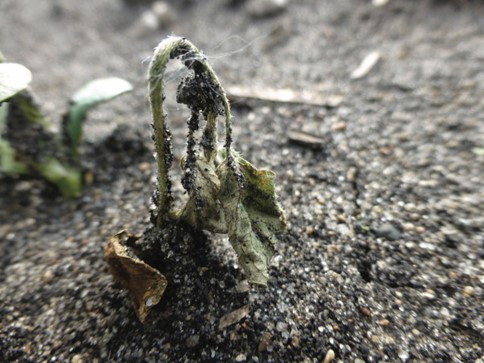
Figure 4. Pythium seedling blight may kill seedlings prematurely (Image credit: Crop Protection Network)
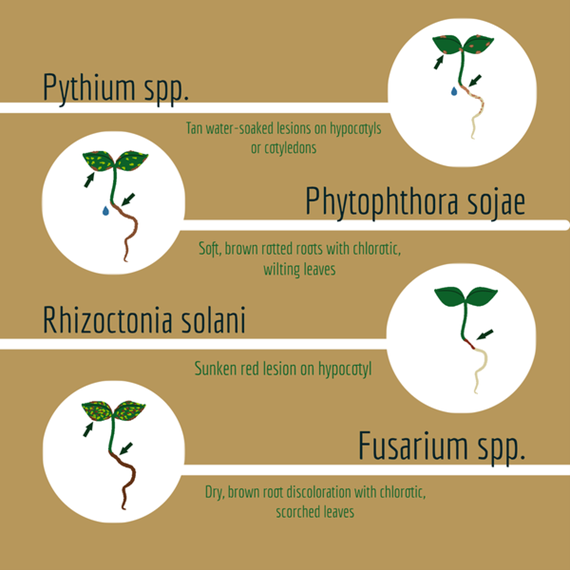
Figure 5. General symptoms of soybean seedling disease caused by different fungal pathogens. Symptoms may not always be typical, and diagnosis should be confirmed to select appropriate control (Image credit: Ashley Joyce).