

Scouting & Management Tips for Sorghum Headworms
Sorghum headworm, also known as corn earworms, Helicoverpa zea, are one of many larvae that make up the sorghum headworm complex. The primary species that make up this complex are the corn earworm, fall armyworm, and sorghum webworm. We’re starting to see sorghum headworms moving into grain sorghum.
Producers are advised to be on the lookout for these worms as the sorghum enters panicle development, bloom, and grain fill. Active monitoring will give producers the best chance at timely insecticide applications if thresholds are met. Foliar damage from the worms feeding and their frass in whorls will be noticed before the worms are (Figure 1 A & B). Below are the worms that have currently been observed in grain sorghum production based on OSU scouting reports. There are numerous worms that will feed on grain sorghum throughout its development. Below is information on their damage, as well as how to scout for and manage these pests You can receive in the field, live updates on insect pests by following @osu_crop_insects on Instagram. For details on the worms not included here please refer to the OSU Fact Sheet EPP-7157: Field Key to Larvae in Sorghums.
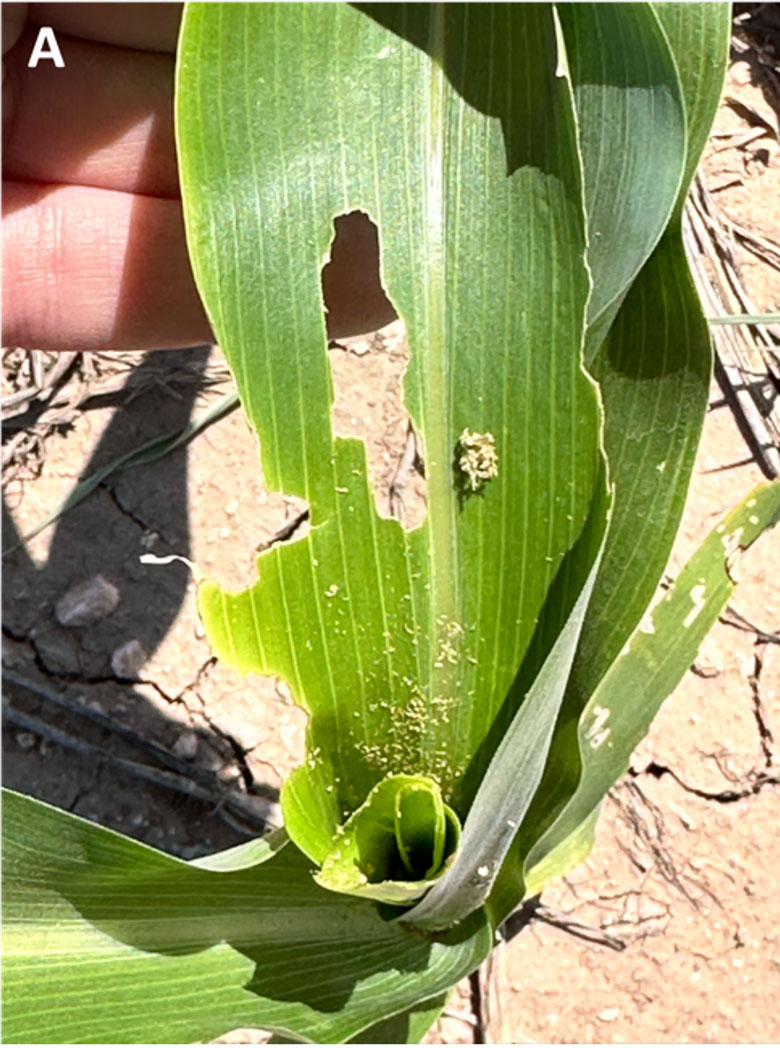
Figure 1. A) Shot hole damage from larval feeding and larval frass on sorghum leaves.
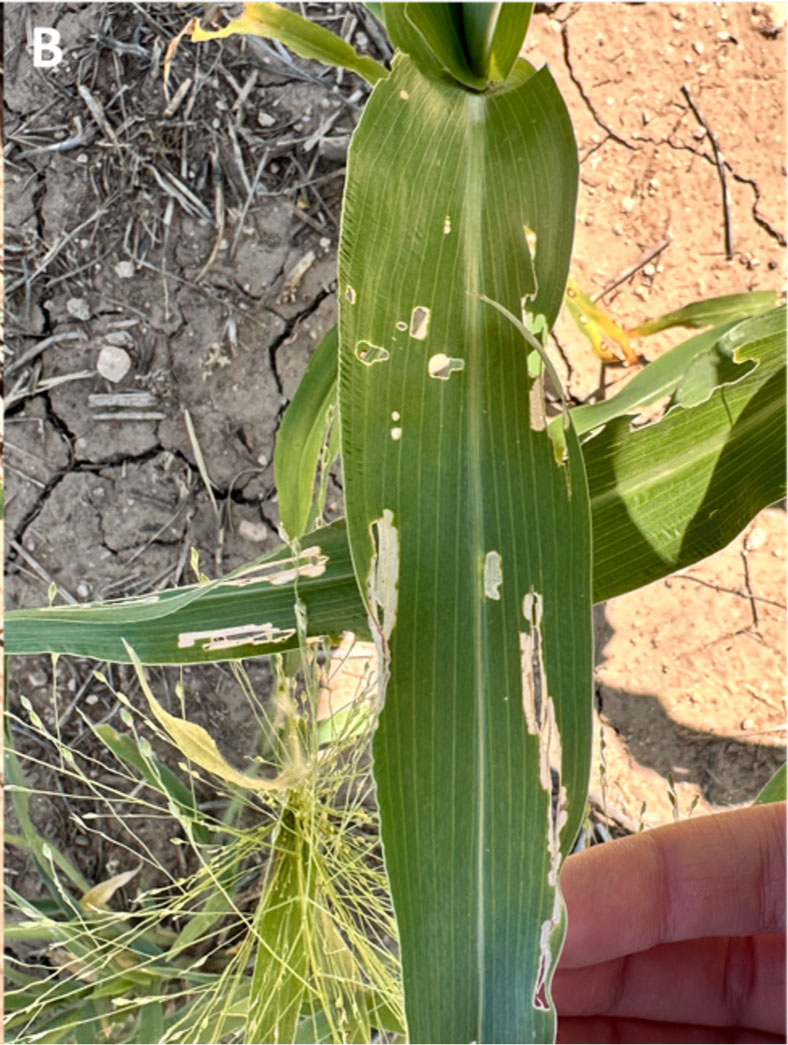
Figure 1. B) Windowpane feeding damage from larvae feeding on sorghum leaves. (Photos: Ashleigh M. Faris, Oklahoma State University)
Corn Earworm/Sorghum Headworm, Helicoverpa zea
Description: Corn earworm larvae can vary from shades of pink to yellow, green, black, and brown (Figure 2). These larvae have darker or lighter stripes that run down the sides of the body. They are set apart from other caterpillars by their short microspines between body segments (Figure 3). These worms will infest grain sorghum at flowering and early seed fill stages.
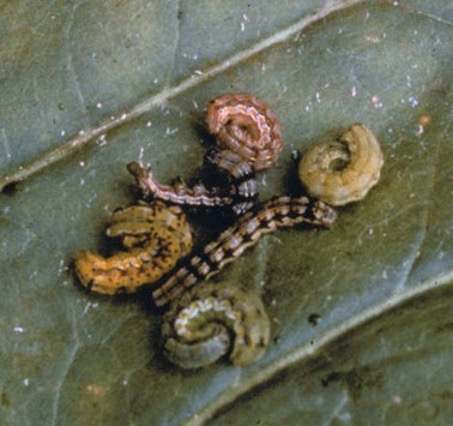
Figure 2. Color variations of budworm larvae. Photo Credit: OSU Extension.
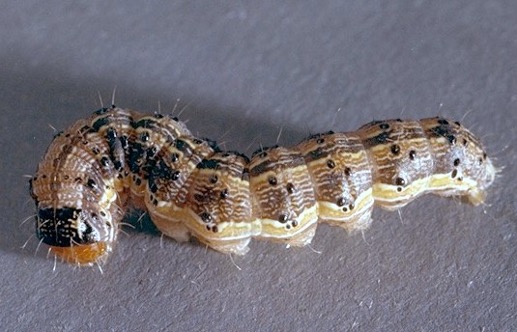
Figure 3. Corn earworm. Photo Credit: OSU Extension.
Life Cycle
Adult moths typically lay their eggs in other crops such as corn. Infestation normally occurs in mid to late summer months, after generations have built in other cropping systems. Corn earworm larvae will overwinter as a pupa in the soil and emerge as moths in late spring, early summer.
Damage
Sorghum is vulnerable to infestation from bloom through milk stages. 1-2 larvae per head can result in 5-10% yield loss.
Fall Armyworm, Spodoptera frugiperda
Description: These larvae usually have a distinct, broad, white inverted “Y” present on the front of the head. Body varies in color from light tan to green to dark brown or nearly black in color with three widely separated narrow yellowish-white stripes down the back (Figure 4). On each side are three more broad longitudinal lines side by side; the top, brown; the middle, reddish; and the bottom, yellow with reddish mottled marks. These larvae measure up to 1 1/3" long when fully grown. Fall armyworms are primarily foliage feeders but will feed on heads.
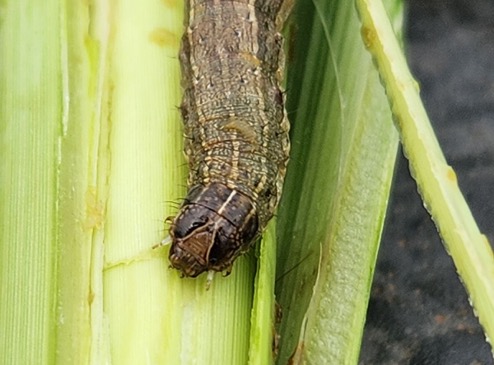
Figure 4. Fall armyworm on grain sorghum. (Photo: OSU Extension)
Life Cycle
Female moths will lay their eggs on the underside of leaves near the base of the plant. As the caterpillars feed, they will progress through several instars and feed on the plant leaves and developing.
Damage
The most noticeable early damage signs are “windowpane” leaves due to the early instar larvae scraping the top of leaf tissue (Figure 1B). As larvae grow, the amount of leaf tissue that is consumed increases. Fall armyworms will feed in the whorl and on ripening seed in the head. While yield loss from whorl feeding is negligible, damage to seed in head can occur until grain reaches the soft dough stage. Open-headed varieties are more susceptible than tight-headed varieties. However, tight-headed varieties make chemical control more challenging.
Sorghum Webworm, Nola cereella
Description: Sorghum webworms are small, yellowish-green and hairy and striped worms (Figure 5). When disturbed, these larvae will spin a thin, silk thread so they can suspend themselves and descend to a safer location. These worms are more common in areas with high humidity.
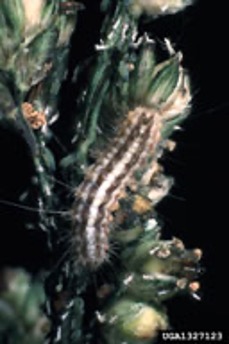
Figure 5. Sorghum webworm on sorghum head. (Photo: Alton N. Sparks, Jr., University of Georgia)
Life Cycle
Adult moths lay their eggs on kernels so that larvae will have a resource to feed on as they hatch. They progress through several instars, growing in size over time. This species can complete its lifecycle in one month.
Damage
Young larvae feed on developing flowers. The last two larval instars are the most damaging as they feed on starches in the kernels. In just 24 hours a single larvae can consume 12 kernels. When sorghum heads begin to flower, it is recommended to scout for sorghum webworms every 5 days until hard dough stage.
Sorghum Headworm Management
For early infestations at the vegetative stages where worms may be in the whorl, do not initiate controls unless 40% or more of the plants in a field are infested. Because the worms are only defoliating at this point in the plant's development, economic damage isn't a concern and there would likely be no return for the time and money invested in spraying before panicle development. For growers in this situation, active monitoring to catch the next generation of worms as the plant progresses to the panicle development, reproductive, and grain fill stages will be critical. Worms are in the environment and spraying when the worms are in the early instar (small) stages and the panicle is developing will be critical for proper management.
OSU Extension Specialists have developed a Sorghum Headworm Quick Count Sampling Plan to aid growers in management decision making. This support tool can be found at the OSU EPP-7087 Fact Sheet Sampling for Sorghum Headworms in Oklahoma Using the Headworm Decision Support System. Scouting should begin from full panicle emergence until hard dough stage. Utilize a bucket to vigorously shake sorghum heads into and count the worms that land in the bucket. The fact sheet linked above provides step by step instructions for how to sample and sampling sheets that can be printed for use in the field to keep track of headworm counts.
One may be concerned when they see multiple kinds of worms/caterpillars in their sorghum, fortunately a single insecticide approach should take care of the different kinds of caterpillars that feed in sorghum heads. When worms are small, and we mean small, a pyrethroid such as zeta-cypermethrin or lambda-cyhalothrin may be a good option for headworm control. However, when larger worms are present then Prevathon may be a better option for caterpillar control. For more information on suggested insecticides consult CR-7170 Management of Insect and Mite Pests in Sorghum.
For foliar insecticide applications, always read the label to ensure that the insecticide is first labeled for the crop you will be applying it to. If the label does not state that it is for use in sorghum, then do not use it on sorghum. For example, Bifenthrin is not labeled for sorghum, therefore it should not be used in sorghum. Also ensure that you are following the label for the rate at which the insecticide should be applied based on the insect pest. Check the label for and follow the re-entry and pre-harvest intervals.