

Keep an Eye Out for Late Season Pecan Pests
As we enter the home stretch of pecan season, harvest is just around the corner. In most cases this time of year growers are breathing a sigh of relief from a long growing season battling insect and disease, environmental conditions, and thinking about enjoying the fruits of their labor. However, harvest can be a frustrating time for a pecan producer if they discover significant stink bug and leaffooted bug damage.
Stink bugs and leaffooted bugs are found throughout the pecan producing regions of the United States, including Oklahoma.
Description
The green stink bug, Acrosternum hilare, the brown stink bug, Euschistus servus, and the leaffooted bug, Leptoglossus sp. are the three species of kernel feeding Hemiptera that are commonly associated with pecans. The adult green stink bug (Fig. 1) is shield-shaped in appearance, is approximately one-half to three-fourths of an inch in length and is light green. The adult brown stink bug (Fig. 2) is similar in size and shape to the southern green stink bug but is brownish gray. The body is outlined with alternating light-dark markings. The adult leaffooted bug (Fig. 3) is about one-half inch in length and is narrower than either of the two stink bugs.
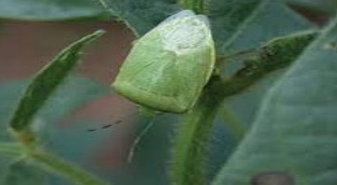
Figure 1. Green Stink bug. LSU Extension.
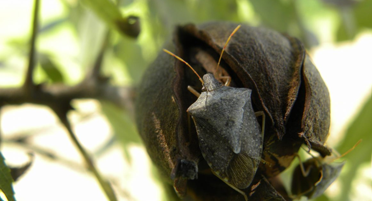
Figure 2. Brown Stink bug. Pecan South.
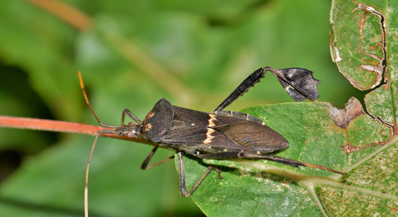
Figure 3. Leaffooted bug. BugGuide.
Stink bugs and leaffooted bugs overwinter as adults in weedy areas along fence rows and ditch banks. They also have been observed to overwinter in leaf litter and under the bark of trees. They become active in the spring as temperatures start to rise. It takes approximately five weeks for stink bugs to develop from egg to adult. There is one generation per year of the southern green stink bug and possibly two generations per year of the brown stink bug in Oklahoma. However, egg laying by females can occur anytime adults are present (May – August).
Many plants have been reported as hosts of these insects. They include various species of weeds, such as thistle and jimson weed, and cultivated crops, such as cowpeas, okra, tomatoes, cotton, corn, soybeans, millet and grain sorghum. When the weeds and cultivated crops become unsuitable as host plants stink bugs and leaffooted bugs move onto pecans. Although stink bugs and leaffooted bugs do not reproduce or develop on pecan trees, the feeding on pecans by the adults can cause significant crop loss.
Feeding on nuts causes two types of damage — black pit and kernel spot. Black pit (Fig. 4) occurs when stink bugs and leaffooted bugs feed prior to shell hardening. The internal tissue of the nut breaks down and becomes discolored. Nuts with black pit drop prematurely from the tree. Determining the amount of nut drop from black pit is difficult because other factors can also cause premature nut drop.
Kernel spot (Fig. 5) occurs after shell hardening. Kernel spot is characterized by dark brown to black circular spots on the surface of the kernel. The area underneath the spots is whitish and is pithy and porous in appearance. The area where the spots occur are bitter tasting; however, the unaffected areas of the kernel taste normal. Kernel spot cannot be detected until after the nut has been cracked and shelled. This can result in significant price reductions by buyers.
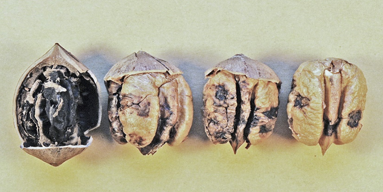
Figure 4. Black pit damage far left. Northern Pecans.
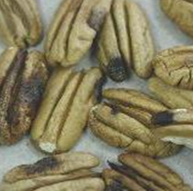
Figure 5. Kernel spot damage. OSU Extension
Control
An important step in reducing the severity of stink bug and leaffooted bug infestations is the elimination of weed hosts from within and around the orchard. In some orchards cover crops are used to enhance the presence of beneficial arthropods and to improve soil fertility. Some of these cover crops are hosts to stink bugs and leaffooted bugs, and if used, they should be carefully monitored to ensure that they do not cause a buildup in the numbers of these insects within the orchard. Cultivated crops grown adjacent to, or near the orchard, such as corn, soybeans, and cotton also should be carefully monitored for stink bugs and leaffooted bugs, and if possible, they should be controlled within these crops.
Damage can occur past shell hardening, so continued monitoring is imperative until the crop is harvested. Any late season insecticide applications must be made with harvest in mind. Choose insecticides carefully. Depending on the product, pre-harvest interval (PHI) can range from 7-21 days. Always follow label recommendations.
More information on stink bug control options in pecan can be found in CR – 6209, Commercial Pecan Insect and Disease Control.