

December 2025/January 2026 Hort Tips
Monday, December 1, 2025
How to Cook a Sweet Potato!
William McGlynn, Horticultural Processing Specialist
Back in 1903, in Bulletin No. 129, the U. S. Department of Agriculture had this to say about cooking a sweet potato:
"The delicate flavor of a sweet potato is lost if it is not cooked properly. Steaming develops and preserves the flavor better than boiling, and baking better than steaming. A sweet potato cooked quickly is not well cooked. Time is an essential element. Twenty minutes may serve to bake a sweet potato so that a hungry man can eat it, but if the flavor is an object, it should be kept in the oven for an hour."
Intuitively, we know that, with sweet potatoes as with many other foods, long slow cooking results in a tastier dish. But why? The answer has to do with the chemistry of cooking. Many of the changes in food we associate with cooking are a result of chemical reactions that occur. This includes the breakdown of pectin chains that results in softening of fruits and vegetables as well as the synthesis and release of aromatic compounds that we perceive as smells and flavors. In sweet potatoes, there are also enzymatic reactions that help convert starches to sugars. All these reactions have temperatures at which they most readily occur, and all take time to develop. A slow-roasted sweet potato has ample time to develop more sugars, a finer-grained texture, and a more complex flavor profile. That is why, poetry aside, a slow-cooked sweet potato is a well-cooked sweet potato.
Why Do My Pecans Look Like This?
Becky Carroll, Senior Extension Specialist
This pecan growing season has been a roller coaster. Cloudy and wet early in the spring during pollination time had some worried about good fruit set. Self-pollination can reduce nut size, quality, yield, and or cause pecans to drop early before fully ripening. Most cultivars will not self-pollinate due to dichogamus flowering – male and female flowers mature at different times. On a few cultivars, the maturity may overlap slightly. Kernels or the embryo can abort at different times causing nut drop or quality issues.
Here are a few of the issues that growers have reported this season.
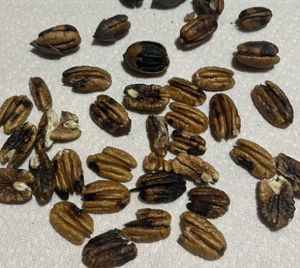
Black Spots – usually small black spots are created by stink bug feeding. They inject digestive materials into the kernel while feeding and it causes the kernel to be bitter, and a black spot or larger black area can also form.
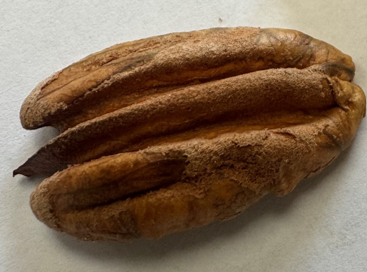
Fuzzy Kernels (Fig. 2) – this is associated with tree stress. Fuzziness or adherence is caused by overcropping, not enough water, or too much water. Some cultivars are more prone to adherence like Stuart.
Embryo Rot – this is a black area at the point where the two kernels attach. Embryo rot is caused by stress as well but can be a result of ‘vivipary’ or germinating in the shuck. Pre-germination is due to high humidity in between the shuck and shell, and high temperatures during ripening. The radicle dies back and leaves the black area where the kernels attach. This usually causes them to be inedible and unsellable. Without timely shuck opening, vivipary can be an issue. Some cultivars are more prone to vivipary. Late infections of phytophthora shuck and kernel rot can also cause dark kernels, embryo rot, and bitter flavor.
Lightweight/wafers – light pecans that are not well filled can be due to overcropping or dry conditions. Kernel percentage can be drastically lower on trees that have not been crop thinned during late July or August. Lightweight pecans will crack easier during harvest since they are not completely filled.
Stick tights – Shucks that don’t open can result from a few different issues. Poor quality or no kernel in the shell won’t produce ethylene. This ethylene signals the shuck to open on time. Not enough water at shuck split is another reason for stick tights. Irrigation should continue even after nuts have filled to allow those shucks to split. Low potassium levels can be a problem with shuck opening. Potassium is pulled from the leaves to shucks to help the opening process. Pecan scab can cause the shucks to open, and hickory shuckworm can be an issue as well.
Dark color – kernels that are dark may be graded lower. This darker coloring is usually caused by tree stresses like overcropping or poor water management. Some minor diseases late in the season can cause darker kernels.
Christmas Tree
David Hillock, Senior Extension Specialist
Today there are several options when it comes to choosing a Christmas tree including cut trees, potted or balled trees, and artificial trees. Cut, live trees are still a popular type of Christmas tree. Three options are available to a person wanting a cut Christmas tree ---a pre-cut tree purchased from a dealer, a choose-and-cut tree purchased from a local grower, or a wild-grown native Christmas tree.
Cut Trees
Great care needs to be taken in selecting a pre-cut tree. Most pre-cut Christmas trees sold in Oklahoma are grown in the Lake States and the Pacific Northwest and may have been cut as early as August. However, some trees are locally grown and thus will be fresher and less prone to drying out too quickly. As soon as a Christmas tree is cut it begins to dry. A tree that has dried will not recover when placed in water and is a fire hazard. Dry trees also tend to lose needles.
Follow these steps to be sure that the tree you are buying is fresh and of high quality.
- Gently pull on the needles. They should be tightly attached to the twig.
- Shake the tree vigorously or bounce the butt on the ground. If green needles fall, look further. Dead, brown needles falling from the inner part of the tree are older needles and are less of a problem.
- Check to see that the tree is a fresh, green color. Some trees are sprayed with blue-green dye. This dye is harmless but be sure it's not hiding a dry tree. Some trees like Scotch pine tend to be light green in color during colder weather but will darken up once moved indoors.
- Buy early before all the desirable trees have been sold.
- Fir and pine trees hold needles better than spruce trees.
- Break a few needles. They should be flexible and will feel moist or possibly sticky. They should also be fragrant when crushed.
- Be sure limbs are strong enough to support lights and ornaments. Limbs should also be well placed to give the tree a pleasing shape. Minor defects can often be turned toward a wall, however, and can lower the purchase price.
- Ask the dealer if the tree was locally grown. Local trees are much more likely to be fresh because they are cut nearer Christmas and aren't shipped long distances.
Choose-and-cut trees are available from Christmas tree growers throughout Oklahoma. For the locations of local growers, visit the Oklahoma Christmas Tree Association website. Trees available from Oklahoma growers include Virginia pine, Scotch pine, Austrian pine, loblolly pine, ponderosa pine, white pine, Leyland cypress, and Arizona cypress.
Buy a choose-and-cut tree the way you would a precut tree. Freshness and health are still the most important characteristics. The grower will usually have many trees marked for sale in various sizes. Some growers will cut the tree for you and others will expect you to cut your own.
Native trees can also be used as Christmas trees. If you cut your own native Christmas tree, be sure you get the landowner's permission. Trespassing is illegal, even cutting what may be an unwanted tree.
It may also be wise to check for insects on choose-and-cut and native trees. Aphids can be found on evergreens this time of year. Several years ago, my family cut our own tree from a tree farm. A few days after we got the tree home and set up, little dark spots began to appear all over the presents and the floor. It turns out that the tree was loaded with aphids that became active when brought into the warmer temperatures. We had to occasionally vacuum them up until we got them all.
Cut Tree Care
To ensure a safe and happy holiday, you need to know a few things about caring for Christmas trees.
Once you have chosen a fresh Christmas tree, do your best to keep it fresh. A tree can stay fresh and healthy for several weeks if it is well cared for.
- When you get the tree home, cut about an inch off of the butt end to aid in water absorption. Get the cut end into a container of plain water quickly. There is no need to add aspirin, sugar, or flame retardant to the water.
- If the tree is not set up right away, store it in a protected, shady, unheated area. Cut the end and place the tree in a bucket of water.
- When the tree is brought into the house, saw a slice of the butt again to insure water absorption.
- Use a sturdy stand with a large water reservoir so it won't dry out. A fresh tree can use 1 quart or more of water a day, so water daily. A tree is beginning to dry out if its water use slows or stops.
- Keep the tree away from heat sources such as fireplaces, TV's, radiators, and air ducts. Never have open flames on or near a Christmas tree.
Potted or Balled Trees
Some people buy a potted or balled Christmas tree with roots intact in the hope of having a new landscape tree come spring. This is very difficult to do successfully, but your chances of success increase if the tree is treated right.
- Buy a healthy tree from a reputable nursery or grower. Expect to pay a higher price than for a typical Christmas tree.
- Keep the tree in a shaded area or a nonheated garage until it is brought inside.
- Keep the soil in the ball or pot moist until well after it is transplanted after Christmas. A frozen ball need not be watered if the crown is shaded and protected.
- Lift and carry the tree by the ball or pot, not the top.
- Keep the tree in the house no longer than about one week, five days or less is even better.
- Have the tree's planting hole dug before the soil freezes and keep the fill dirt thawed. The planting hole and backfill can be protected from freezing by covering with plastic and then a thick layer of straw.
Artificial Trees
Artificial trees are a very popular option but must be used carefully. Electric lights should not be used on metal trees because of the danger of electric shock. Light these trees with off-the-tree spotlights. Plastic trees may be fire resistant but the fumes they give off when burned are toxic.
Decorating the Tree
Use only electric lights on your tree, never candles. Lights and cords should have the Underwriters Laboratories safety seal. Discard old, damaged Christmas lights. New lights are relatively inexpensive, use less electricity, and stay cooler than old lights. Follow directions to determine how many strings to put on one circuit. Be sure to turn off the tree lights when no one is in the room for any length of time.
Tree Disposal
Christmas trees can be useful even after they are taken down. Trees can be placed in the yard to add greenery and act as a bird haven until spring. Christmas trees can be used for firewood or chopped up and used as mulch. Many communities have programs to gather trees after Christmas to be chipped for mulch or other uses. Trees can also be used to create a fish attractor by weighting the base of the tree and sinking it in a pond.
Poisonous Holiday Plants for Pets
Courtney DeKalb-Myers, Assist. Extension Specialist
As the weather cools and days shorten, some gardeners may turn to decorating their homes for festive holiday fun. Boughs of evergreen material, striking poinsettias, and delightful mistletoe can brighten up rooms during the dark months of the year. Homes with pets should take care when bringing seasonal plants indoors. There are some popular holiday plants that can cause issues for pets.
Amaryllis bulbs are easy to grow and can add a splash of bright color to the home. Paperwhites can bring a flush of green foliage and white, fragrant blooms, while also providing a nice reminder that spring is around the corner. All parts of these plants are poisonous, though, especially the bulbs. Amaryllis and paperwhites contain the toxic compound lycorine as a defense mechanism against hungry critters. Unfortunately, plants can’t distinguish between wild animals and overly curious indoor pets. Ingesting amaryllis or paperwhites can cause severe stomach issues in pets, including vomiting and diarrhea.
The white berries of mistletoe can also cause stomach problems if ingested. Similarly, the red berries of holly can be toxic to pets. If interested in decorating with these plants, it may be best to go with artificial counterparts.
Recent research shows that poinsettias’ toxicity has historically been exaggerated. However, poinsettias are in the Euphorbiaceae family and produce a milky white sap. Ingesting the sap can cause upset stomach and vomiting, but these symptoms should resolve with time.
Fortunately, several non-toxic plants are available for pet owners. Christmas cactus, as well as closely related Easter and Thanksgiving cactus, can offer a pop of white, pink, red, or orange. Their fleshy, segmented leaves do not pose a threat to pets. Prayer plants or calatheas can offer a lush display of multicolored leaves. Another non-toxic option is African violets, which are low maintenance and bloom in several different colors.
There are many different species of plants that can be brought into the home during the winter. If unsure, always research the potential toxicity so all household members can stay healthy during the holidays.
Don’t Forget to Water this Winter
David Hillock, Senior Extension Specialist
Lack of adequate soil moisture is often a major cause of winter damage. Dry soil coupled with strong winter winds can cause havoc on a plant. All plants, but especially narrowleaf and broadleaf evergreens, use water during winter. When little or no soil moisture is present, plants can become desiccated, and it is more likely root damage will also occur.
When dry cold fronts are predicted, water the landscape at least 24 hours in advance of the front. Apply about ½ inch of water at the time of watering. A sunny day on moist soil helps warm the soil and root area thus reducing the amount of time the roots will be exposed to cold temperatures.
Moisture must be available below the frost line or frozen soil. When the soil freezes, if moisture is not present in soil pore spaces, moisture is pulled from plant roots to form the ice crystals resulting in desiccated roots, thus what some would refer to as “winter kill.”
Of course, some common sense needs to be practiced at this time of year; do not allow the sprinklers to come on during a hard freeze. Ice forming on some plants could result in some serious damage and you could create a hazardous situation for you, pedestrians, or even passing vehicles.
Too much water can also result in problems during the winter. Cold wet soil can lead to rotting roots. Soils with more than ample moisture may also encourage winter weeds to germinate and flourish. Water only every three to four weeks and apply only enough water to moisten the top 6 or so inches of soil.
Do not forget plants growing in aboveground planters protected from rain. They need watering even in a wet season. Also, remember to water plants that are located under the eaves of a building or home since they often receive little natural precipitation.
Deicing Effects on Landscape Plants
David Hillock, Senior Extension Specialist
Cold temperatures usually bring ice and snow making it difficult to travel for both motorists and pedestrians. Public safety during this time is a high priority and usually addressed using deicing compounds. While these deicing compounds make it safer for us, they often damage concrete surfaces, automobiles, and landscape plants.
There are several deicing compounds, each with pros and cons.
Sodium chloride (NaCl) is the most common and known as table or rock salt. It is the least expensive, most widely used and is most effective when temperatures are above 15°F. Unfortunately, sodium chloride is very corrosive and damaging to landscape plants and excessive sodium in the soil can destroy its structure.
Calcium chloride (CaCl2) dissolves readily, acts quickly and is effective in very cold temperatures - down to -20°F. It is, however, highly corrosive to concrete and metals, but slightly less damaging to plants than sodium chloride.
Potassium chloride (KCl) is a natural material used for fertilizer but is highly corrosive as a deicer. It is less damaging than sodium chloride to plants.
Calcium magnesium acetate (CMA) is an environmentally friendly compound derived from dolomitic limestone and acetic acid. CMA is considered safer for plant material, non-corrosive to concrete surfaces and biodegradable. It is also effective at melting ice to around 15°F. The downside, it is 30 to 40 times more expensive.
Deicing materials are salts that melt ice, creating a brine solution (salty water) which freeze at lower temperatures. The problem in the landscape occurs when this brine solution is splashed onto plant foliage or runs off pavement into the soil. An accumulation in the soil near plant roots results in damage to the plants. Plants suffer a salt-induced water shortage, even though there may be moisture in the soil, because roots are unable to absorb sufficient water.
To minimize damage by deicing materials in the landscape consider the following approaches:
- Mechanical removal – the less ice and snow present, the less deicing material needed.
- Use abrasive materials in conjunction with mechanical and/or deicing materials – abrasives such as sand have few impacts on the environment. They do not melt ice but do improve traction on slippery surfaces.
- Plan ahead – plant salt tolerant plants in areas receiving large amounts of deicing material; locate salt sensitive plants away from areas deicing materials are used; use hardscapes (gutters, barriers) to channel runoff away from planting areas; do not pile snow containing deicing materials onto planting areas; and irrigate once heavily in the spring to leach salts away from root zone.
Downed Tree Leaves a Benefit or a Curse for the Lawn?
Dennis Martin, Professor and Turfgrass Extension and Research Specialist
Fallen tree leaves can be beneficial or detrimental to the lawn, depending on the type of grass that is present. In southern Oklahoma where St. Augustinegrass is present, fallen tree leaves can serve as added insulation to buffer the lawn from extremely cold temperatures. The St. Augustinegrass is dormant for most of late fall and winter, so light exclusion by falling leaves is of no consequence, and the presence of fallen tree leaves is often the difference between survival and death from winterkill for St. Augustinegrasses which are all very winter tender in Oklahoma.
Tall fescue is a cool-season grass that remains green nearly year around in Oklahoma. Fallen tree leaves should always be removed from tall fescue, as the fallen leaves block out valuable light during the time of year when tall fescue is developing a deep root system and many additional green shoots. This re-establishment or recovering and repairing from damage caused during the summer months occurs principally in the fall, and less so in the spring. The fall/early winter growing period is one of the most important times of year to optimize growing conditions for tall fescue. The more mature tall fescue becomes in the fall of the year, the greater its chance of survival during the hot and dry summer months taking up valuable landfill space. See OSU leaflet L-252 - Recycling Yard Waste: “Don't Bag It” Leaf Composting.