

Vitamin A in Cow-Calf Production: Impacts of Maternal Supplementation and Status on Offspring
Saturday, November 1, 2025
Research has shown that the young calf is the most at risk for vitamin A deficiency in cow-calf systems. Vitamin A plays several important roles in the body, one of which is immune function. Marginal deficiencies can impact calf health and potentially cow productivity. Calves are born with very low vitamin A stores, and their primary source of vitamin A is colostrum. Vitamin A concentrations in colostrum have been reported to be six to fourteen times greater than that of milk, so colostrum is critical for establishing vitamin A stores in the young calf. Thus, calves not getting enough vitamin A from colostrum are at increased risk for diarrhea and respiratory disease in their first one to two weeks of life.
Fresh green forage contains high amounts of beta carotene, a vitamin A precursor. It is used by the cow to synthesize the vitamin A needed to support a variety of biological functions. Excess vitamin A can be stored in the liver and used during times when dietary vitamin A intake is low. In contrast, stored forages contain significantly less beta carotene compared with fresh forages. Thus, cows fed diets consisting primarily of stored forages and concentrates may be at risk for vitamin A deficiency. Low amounts of vitamin A in the cow's diet during late gestation may lead to a deficiency in the calf impacting its health. There is minimal placental transfer of vitamin A, so calves at birth rely on colostrum to supply vitamin A. University of Nebraska researchers conducted two studies to identify the relationship between cow and calf vitamin A status using plasma and liver samples, and to understand the effect of amount of supplemental vitamin A provided from mid-gestation to early lactation on liver vitamin A concentrations in the cow and her calf.1
In Experiment 1, 120 beef cows that had previously been grazing on pasture in mid-gestation were assigned to receive 9,638 IU/day vitamin A (30 cows) or 24,973 IU/day vitamin A (90 cows). These amounts were approximately one-third and two-thirds of the current recommendation of ~1,273 IU/lb of dry feed2 (33,000 IU/day in this study) for gestating beef cows weighing 1,300 lb consuming 2.0% of body weight in dry matter (DM) per day. The cows were individually supplemented in Calan gates from 111 days pre-calving to 32 days post-calving. For assessing vitamin A status, liver biopsies and blood samples were collected at day 0 (111 days pre-calving) and day 144 (32 days postcalving), and calves were sampled at 32 ± 7 days of age.
In Experiment 2, 54 beef cows that had been fed in the drylot for a year or more were stratified by body condition score and time in the drylot and assigned to a pen. Pens were then randomly assigned to receive 1 of 3 amounts of supplemental vitamin A: the current recommendation for gestating beef cows (31,000 IU/day; 1X), 3 times (93,000 IU/day; 3X), or 5 times the current recommendation (155,000 IU/day; 5X). The 1X treatment was set in this study assuming a cow weight of 1,200 lb that consumed 2.0% of body weight in DM per day. Prior to treatment initiation, all cows were receiving 31,000 IU/day (1X). Treatments were initiated in mid-gestation and concluded 32 days post-calving.
In Experiment 1, since the cows had recently spent time on green grass, initial liver
retinol
concentrations (830 μg/g DM) of cows were well above adequate. By 32 days post-calving,
mean cow liver retinol concentration (482 μg/g DM) had decreased but was still considered
adequate based on the current reference range of 300 - 700 μg/g DM. Data in Figure
1 shows that there was a positive correlation (P< 0.01) between cow and calf liver
retinol 32 days post-calving, suggesting that as cow retinol liver concentrations
increased, calf liver retinol concentrations increased. However, it appears that despite
cows having adequate liver retinol concentrations, when supplemental vitamin A was
fed below current recommendations, it did not result in calf liver retinol stores
considered adequate given current reference ranges. These researchers noted this is
likely because cow liver retinol stores are not the only contributor to vitamin A
in colostrum. Research in beef cattle indicates cow stores only contribute about 40%
of the vitamin A found in colostrum, while the other 60% comes from the cow's diet.
Therefore, dietary vitamin A the cow receives during late gestation, as well as her
liver vitamin A stores, affect the amount of vitamin A her calf receives via colostrum
to build its own liver vitamin A stores.
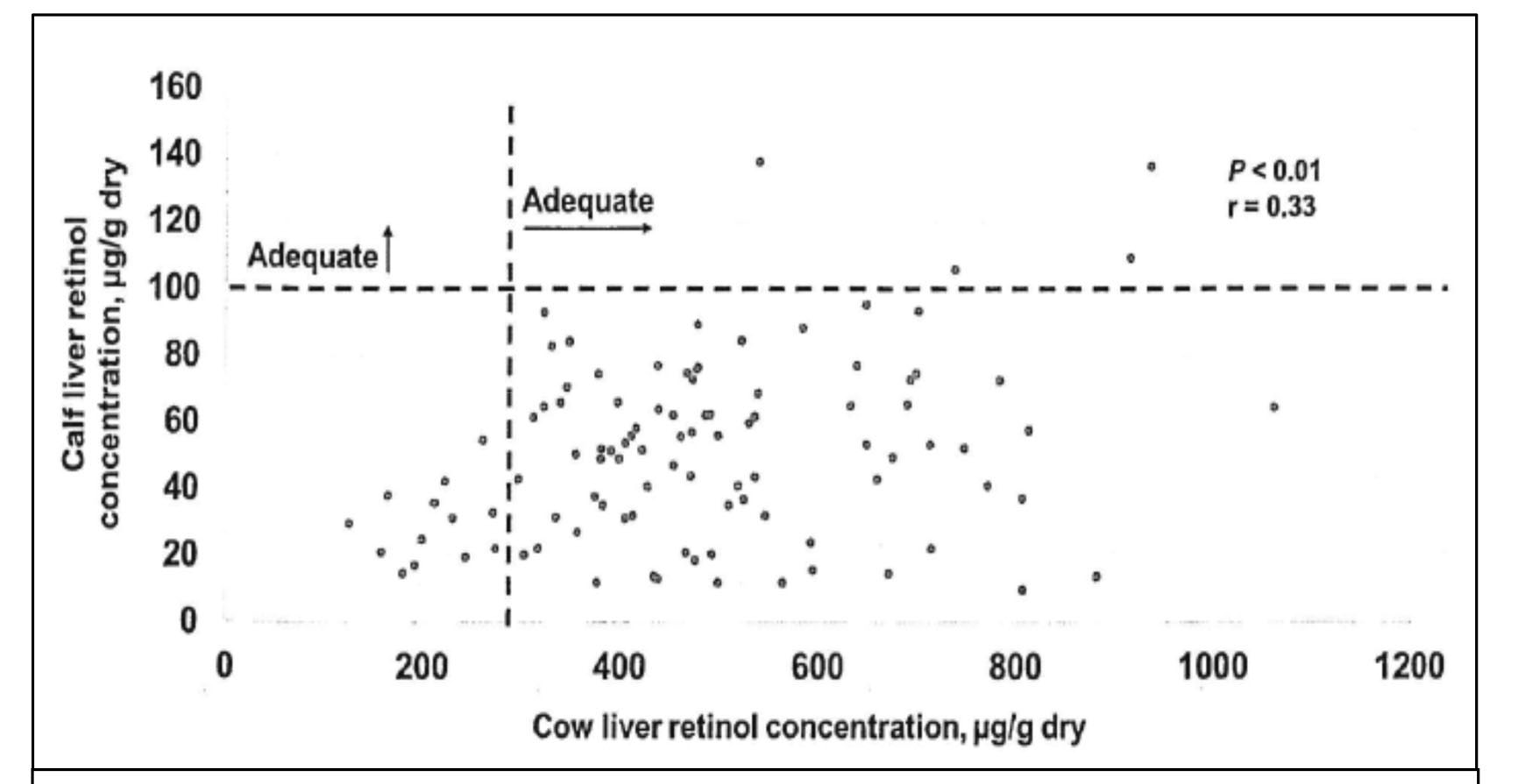
Figure 1. Relationship between cow and calf liver retinol concentrations measured 32
days post-calving from Experiment 1. Dashed lines indicate the liver retinol concentration
considered adequate for cows (300 μg/g DM) and calves at 32 days of age (100 μg/g
DM).
In Experiment 2, no differences (P= 0.86) in initial cow liver retinol concentration (186 μg/g DM; Figure 2) were observed between treatments. Cows were receiving the 1X amount of supplemental vitamin A before the study, suggesting the current supplemental vitamin A recommendation of 31,000 IU/d was not enough to get cows to adequate liver retinol concentrations (300 - 700 μg/g DM). A significant treatment x day interaction (P < 0.01) was observed for cow liver retinol. On day 40, cows in 1X had liver retinol concentrations (178 μg/g DM) that were not different (P = 0.12) from 3X (213 μg/g DM) but less (P = 0.02) than 5X (241 μg/g DM), while 3X and 5X did not differ (P = 0.21). Liver retinol concentrations of 1X cows remained below adequate reference ranges (300 - 700 μg/g of DM) throughout the study, whereas 3X and 5X were elevated into the adequate range by day 81 of supplementation.
Calf liver retinol concentration also differed among treatments (P = 0.01; Figure 3), as calves of cows in 1X had lower (P < 0.05) liver concentrations than 3X and 5X calves which did not differ (P = 0.12). Liver retinol concentrations considered adequate for calves at 32 days of age (100 - 350 μg/g of DM) were not observed in 1X calves (51 μg/g DM) but were observed in calves from 3X and 5X cows (119 and 165 μg/g DM, respectively).
In general, these data show that calves did not have adequate liver vitamin A concentrations despite cows having adequate liver vitamin A stores following calving suggesting that for cows fed stored feeds long term (1 year or longer), the current recommendation for supplemental vitamin A will not result in their calf's liver vitamin A concentrations being within the adequate reference range. These data also suggest that cows with initially low liver retinol stores needed to be fed 93,000 IU/d (3 times the current recommendation) of vitamin A for 81 days to achieve adequate liver retinol concentrations. However, continuing to feed this amount did appear to result in continuously increasing liver stores. These authors concluded that more research is needed to understand the quantity of supplemental vitamin A required to maintain cow liver retinol concentrations in the adequate range and ensure adequate concentrations in the colostrum for the calf.
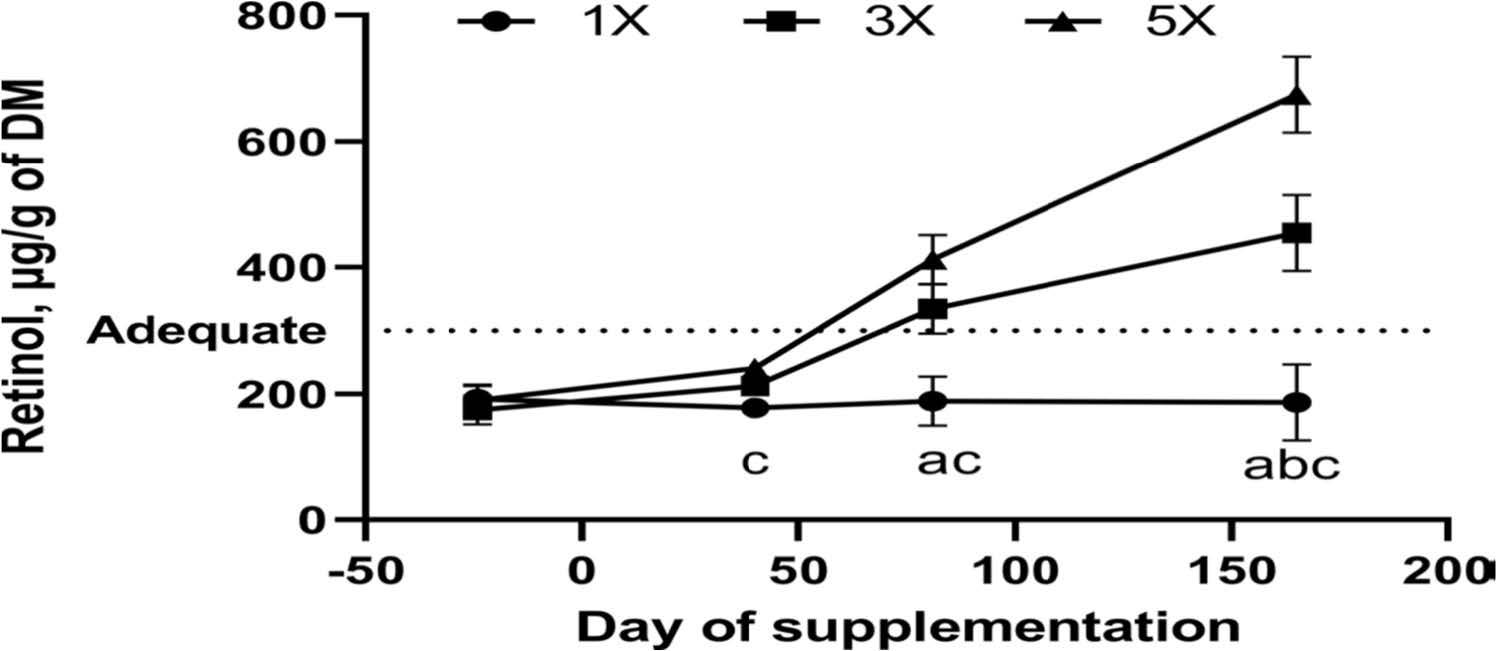
Figure 2. Effect of amount of supplemental vitamin A [IX= 31,000 IU/day (current recommendation), 3X = 93,000 IU/day, and 5X = 155,000 IU/day] on cow liver retinal concentrations. Dashed line indicates the liver retinal concentration considered adequate for cows (300 μg/g DM). Different letters (a - c) indicate significant differences (P ≤ 0.05) among treatments within time point: a = 1X versus 3X, b = 3X versus 5X, c = 1X versus 5X. Adapted from Speer et al., 2024.
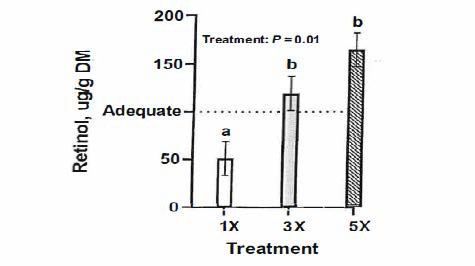
Figure 3. Effect of cow supplemental vitamin A amount [1X = 31,000 IU/day (current recommendation); 3X = 93,000 IU/day; 5X = 155,000 IU/day] on calf liver retinol concentration at 32 days of age in Experiment 2. Dashed line indicates the liver retinol concentration considered adequate for calves at 32 days of age (100 μg/g DM).
1 Speer, H.F., H. C. Freetly, K. H. Wilke, and M.E. Drewnoski. 2024. Vitamin A in Cow-Calf
Production: Impacts of Maternal. Nebraska Beef Cattle Report. pp. 25-27. Available
at:
https://digitalcommons.unl.edu/cgi/viewcontent.cgiarticle=2174&context=animalscinbcr.
2 NASEM (National Academies of Sciences, Engineering, and Medicine). 2016. Nutrient Requirements of Beef Cattle. 8th rev. ed. Natl. Acad. Sci., Washington, DC.